Why Students Transfer from Masaryk University Faculty of Medicine — Your Options
11.09.2026

Is Masaryk University Medical Degree Recognized in Germany?
A Masaryk University medical degree is, in principle, automatically recognised across all EU member states under Directive 2005/36/EC — but the German reality is considerably more nuanced. German state medical boards (Landesärztekammern) routinely request supplementary documentation, and some states may require compensation measures such as aptitude tests (Eignungsprüfung) or supervised adaptation periods (Anpassungslehrgang) if clinical training volume in core disciplines is deemed insufficient against German standards.
The central issue for MU Med graduates targeting Germany is the language of clinical training. German approbation requires demonstrating C1+ German proficiency AND a clinical training history conducted in a German-language environment. Students who complete all six years at MU Med but undertook Years 3–6 primarily in Czech-language wards face additional scrutiny — not because the MU Med degree is invalid, but because the training pathway diverges from what German boards are accustomed to assessing. Early transfer to a German-speaking clinical environment eliminates this ambiguity entirely and is the single most effective step a Germany-bound student at MU Med can take.
How Much Does Medicine at Masaryk University Cost Per Year?
The English-language medical programme at Masaryk University currently charges approximately €12,000–14,000 per academic year in tuition alone. Czech-language track students — typically Czech or Slovak nationals — pay little to no tuition within the same faculty, creating a two-tier financial structure. Over six years, an English-track international student pays between €72,000 and €84,000 in tuition before accommodation, food, health insurance, study materials, and travel.
| Cost Item | MU Med — English Track | MU Med — Czech Track | Comparable EU Private University |
|---|---|---|---|
| Annual Tuition | €12,000–14,000 | €0–500 | €8,000–18,000 |
| Accommodation (annual) | €2,400–6,000 | €2,400–6,000 | €3,600–10,800 |
| Living Expenses (annual) | €4,800–8,400 | €4,800–8,400 | €5,400–12,000 |
| Books & Materials (annual) | €500–1,000 | €500–1,000 | €500–1,000 |
| Estimated Annual Total | €19,700–29,400 | €7,700–15,900 | €17,500–30,800 |
| 6-Year Programme Total | €118,000–176,400 | €46,200–95,400 | €105,000–184,800 |
Brno's cost of living is moderate by Central European standards. A student can expect to spend €550–900 per month on all living expenses excluding tuition — lower than Prague, Vienna, or Munich, but higher than a decade ago as Brno's housing market has tightened alongside growth in the tech and automotive sectors.
How Hard Are the Exams at Masaryk Faculty of Medicine?
The preclinical years at MU Med are widely regarded as demanding. First-year subjects — anatomy, histology, biochemistry, and biophysics — are assessed in multiple parts, and the re-sit structure, while allowing additional attempts, imposes cumulative deadlines. Students who exhaust their permitted retakes for a compulsory subject cannot progress to the following year and must either repeat the academic year in full, at full tuition cost, or withdraw from the programme.
Attrition is highest in Years 1 and 2. International students on the English track face an additional informal barrier: some practical classes and laboratory demonstrators operate partly in Czech even before the formal language requirement begins at Year 3. Students who thrive at MU Med tend to form tight peer study groups and develop highly structured self-directed learning habits. Those who struggle frequently find the institutional support infrastructure insufficient for early intervention — making independent advice and a clear exit strategy more important than many students realise when they enrol.
Can I Transfer from Masaryk to a German or Austrian University?
Direct lateral transfer (Hochschulwechsel) into German or Austrian state medical programmes is possible but structurally limited. German universities are regulated by Länder, and clinical-year places are predominantly reserved for students entering through the domestic NC pipeline. That said, several concrete pathways are available to MU Med students at every stage of their studies.
| Year Completed at MU Med | Credits Typically Recognised | Realistic Transfer Destinations | Estimated Years to Completion |
|---|---|---|---|
| Year 1 incomplete | 0–30 ECTS | EU English-track programmes, private EU universities | 5–5.5 years |
| Year 1 complete | 40–70 ECTS | EU English-track programmes, private EU universities | 4.5–5 years |
| Year 2 complete | 80–130 ECTS | EU English-track, Slovak/Hungarian universities, select private EU | 4–4.5 years |
| Year 3 complete | 120–180 ECTS | Private EU universities, select lateral transfer programmes | 3–4 years |
| Year 4 complete | 160–210 ECTS | Private EU universities, some direct lateral entry | 2–3 years |
| Year 5 complete | 200–250 ECTS | Clinical completion programmes, final-year lateral entry | 1–2 years |
Credit recognition is never automatic — each receiving institution conducts its own assessment. Students who submit complete syllabi, contact hours, and ECTS documentation for every subject achieve substantially better outcomes than those who apply without this preparation. Years 4 and 5 transfers are achievable with appropriate documentation and specialist support.
What Happens if I Fail at Masaryk University Medicine?
Failure at MU Med follows a structured escalation. Each compulsory subject carries a defined number of permitted examination attempts per term. Exhausting retakes in a Year 1 or Year 2 subject means the student cannot advance and must either repeat the full academic year — at full tuition — or withdraw. Repeated year enrolment requires faculty approval and adds approximately €12,000–14,000 to overall programme cost.
Students who have failed examinations and are considering transfer should know that a failed exam record does not disqualify them from transfer. Most receiving universities distinguish clearly between failed subjects (which will not be credited) and passed subjects (which can be). Even students who failed one or two subjects and withdrew have successfully transferred by presenting passed subjects for credit recognition and enrolling at an appropriate year level at the new institution. The critical document is the academic transcript (výpis studijního záznamu), which records every subject attempted, grades, and ECTS credits assigned. Providing complete, certified documentation is the single most important practical step.
Is a Masaryk Medical Degree Valid Across the EU?
Yes. Masaryk University Faculty of Medicine holds full accreditation under Czech law and EU Directive 2005/36/EC. The degree qualifies as an automatically recognised medical qualification throughout the EU, entitling holders to freedom of movement for medical practice. However, automatic recognition of the qualification as a category is distinct from smooth processing of an individual's training record — and this distinction matters significantly in practice.
Each EU country's medical regulatory body performs its own review of the applicant's specific transcript. Countries with stricter approbation frameworks — Germany, Austria, France — scrutinise clinical training hours, language of instruction, and alignment with their own training standards. Countries with lighter-touch recognition processes handle MU Med graduates with fewer additional requirements. For students targeting Germany or Austria specifically, completing clinical years in a German-language environment, whether at MU Med (impossible) or through transfer, is the most reliable path to clean approbation.
How Does Masaryk Compare to Charles University for Medicine?
Both Masaryk University and Charles University are Czech public universities with WHO-listed, EU-recognised medical faculties. For international students, the practical differences are nuanced rather than decisive. Tuition at Charles University's English tracks runs approximately €12,000–16,000 per year depending on the faculty site (Prague, Pilsen, or Hradec Králové) — comparable to MU Med. Both require Czech from Year 3 for clinical rotations, and both present the same approbation challenges for Germany-bound students.
Charles University — particularly the First and Second Faculty of Medicine in Prague — carries marginally greater name recognition among German Landesärztekammern, though both universities are legally and academically equivalent under EU law. Prague offers a larger international student infrastructure; Brno is smaller, historically cheaper, and growing. For the specific question of transfer, the practical implications are nearly identical: students from either faculty face the same credit negotiation process, the same language requirement challenge, and the same German approbation bottleneck. Neither is inherently superior for a student whose primary goal is to practise in a German-speaking country.
What Are the Living Costs in Brno for Medical Students?
Brno has historically been one of the more affordable cities in Central Europe for students, but costs have risen meaningfully since 2022. Housing in particular has tightened. University dormitory places — the most affordable option at €150–250/month — are limited and often allocated to Czech-language track students first. International English-track students frequently compete for private rooms at €300–500/month.
A realistic monthly budget for an English-track student in Brno in 2026: accommodation €300–500, food €200–300, transport €15–20 (city pass), health insurance €10–20 (for EU students on EHIC; higher for non-EU), books and materials €40–80 in early years. Total: €550–900/month excluding tuition. Compared to Prague (€700–1,200/month) or Vienna (€900–1,500/month), Brno remains more affordable — but the gap has narrowed, and the €12,000–14,000 annual tuition means overall programme cost is not dramatically lower than many Western European alternatives.
Month-by-Month Transfer Timeline
September (Year N): Decide to explore transfer. Gather academic transcript, course syllabi in English, and letter of enrolment from the MU Med registrar. Begin language preparation if targeting German-speaking universities.
October–November: Research target universities. Identify those accepting lateral transfers for your year level. Request official course descriptions with ECTS and contact hours from MU Med for credit assessment dossier.
December–January: Submit enquiries or pre-applications to target institutions. Attend virtual open days. Request preliminary credit assessments in writing.
February–March: Attend interviews where required. Provide certified translations. Obtain Certificate of Good Standing from MU Med. Narrow shortlist to two or three universities based on credit recognition outcomes.
April: Receive formal admission decisions. Compare credit recognition offers and confirmed year-level entry. Decide and confirm.
May–August: Formally withdraw from MU Med before next semester fees are assessed. Complete any required bridging assessments. Arrange housing at new location.
September (Year N+1): Begin studies at new institution.
Costs Worked Example
Scenario: Student completing Year 2 at MU Med (tuition paid: ~€26,000), transferring to a private EU medical university at €14,000/year for four remaining years with 80 ECTS recognised.
- Remaining tuition at MU Med (Years 3–6): ~€52,000–56,000
- Remaining tuition at transfer university (4 years): ~€56,000
- If a repeat year is avoided: saving of €12,000–14,000 alone justifies the move financially
- For Germany-bound students: avoided approbation compensation measures can save €5,000–15,000 in exam fees and additional training time — and 6–18 months of career delay
The financial case for transfer is strongest when: (1) the student faces or has experienced a repeat year at MU Med; (2) the student's practice goal is Germany or Austria; (3) credit recognition at the target university is substantial enough to maintain or recover timeline.
Free Consultation — We Find Your Solution
Whether you want to transfer, reduce costs, or explore European pathways — our advisors have helped hundreds of students from Masaryk. Book your free 30-minute consultation →
The Author's View
In my experience working with students from Masaryk University, the hardest part is rarely the transfer process itself — it is the moment of honestly assessing that the current path is not working. Czech medical education is genuinely rigorous, and MU Med produces competent graduates. But rigorous and right for me are different things. I have spoken with students who spent two or even three years in Brno before acknowledging that the Czech language requirement for clinical rotations had become a structural barrier for their German career goal — not because they lacked the ability to learn Czech, but because they had never been given a frank map of what the full six-year pathway demands, and what it means for approbation in Germany specifically. By the time they realised, they were already €40,000 into a programme that was not going to take them cleanly to where they wanted to go.
What I find consistently frustrating is how quietly this information circulates. Prospective students are sold on MU Med's EU recognition and moderate tuition — both true — but they are rarely told that recognition and smooth approbation are distinct things, or that a six-year Czech clinical training programme and a German Landesärztekammer's expectations for a German-practising doctor are not perfectly aligned by design. I have seen students discover this in Year 4, having already paid the majority of their tuition. Transfer at that point is still very much possible — Year 4 transfers happen regularly with good support — but a Year 1 or Year 2 exit, identified early, produces dramatically better financial and career outcomes in the majority of cases.
My practical advice to anyone currently at MU Med with Germany or Austria as their practice target: get a second opinion on your specific approbation pathway before Year 3 begins. The question is not whether MU Med is a good university — it is — but whether its particular programme structure, and specifically the Czech-language clinical immersion from Year 3 onward, aligns with your specific career objective. That is a question worth answering with hard data, not optimism. If the answer is that they do not align, the earlier you act on that information, the better positioned you will be — financially, academically, and professionally.
Summary
- Masaryk University Faculty of Medicine charges approximately €12,000–14,000 per year for the English-language programme — totalling €72,000–84,000 in tuition over six years.
- Czech language becomes mandatory from Year 3 for clinical rotations, creating a structural barrier for students targeting German-speaking countries where clinical training language directly affects approbation processing.
- The MU Med degree is fully EU-recognised, but German and Austrian approbation bodies apply additional scrutiny to individual training records — particularly the language of clinical instruction.
- Transfer is feasible from Years 1 through 5; credit recognition varies by receiving institution and year level, but Year 4 and Year 5 transfers achieving meaningful credit recognition are documented outcomes with specialist support.
- A realistic transfer process takes 9–12 months from decision to enrolment at a new university; private EU institutions with rolling intake can compress this to 4–6 months.
- The financial case for transfer is strongest when a student faces repeat-year risk or is targeting German or Austrian approbation — where completing clinical training in a German-language environment reduces regulatory complications.
- Masaryk and Charles University present broadly equivalent challenges for German approbation; neither is inherently superior for a student whose goal is practice in a German-speaking country.
- Early, structured professional guidance on credit negotiation and university selection significantly improves transfer outcomes — most students who transfer successfully have access to specialist advisors who know individual institution policies.
Conclusion
Studying at Masaryk University Faculty of Medicine is a legitimate and often well-reasoned choice — but it is not the right fit for every student, and recognising a misalignment early rather than late can make a decisive difference to both career trajectory and total programme cost. The challenges of Czech-language clinical training, exam pressure in the preclinical years, and the approbation complexity for German-speaking countries are structural features of the programme, not temporary inconveniences that can be wished away. Students who confront these realities clearly and act on them decisively — whether by transferring or by building an explicit plan for German approbation — are consistently better positioned than those who wait and hope circumstances improve.
If you are currently at MU Med and questioning your path, the productive next step is to map your specific situation — your completed credits, your target country for practice, your language profile, your financial position — against the concrete transfer options available to you. Transfer from Masaryk is not an admission of failure; it is a strategic decision that a significant number of students make every year to regain a trajectory that leads where they actually want to go. Speak to one of our advisors today and get a clear picture of your options →
Frequently Asked Questions about Transferring from Masaryk University Faculty of Medicine
Can I transfer from Masaryk University medicine to a German university?
Direct lateral transfer into German public medical universities is rare but not impossible — a small number of German institutions accept case-by-case lateral applicants with documented credit equivalence, assessed individually. The more common and structurally reliable route is to transfer to a private EU medical university that offers German-language clinical tracks, complete clinical training in German, and then apply for approbation. Our advisors track current acceptance policies at institutions that actively process MU Med transfers and can identify which have current capacity at your year level.
Will my Masaryk credits be recognised if I transfer?
Credit recognition is determined institution by institution — there is no EU-wide automatic transfer of subject credits. Basic science subjects from MU Med's preclinical years (anatomy, physiology, biochemistry, histology, biophysics) transfer well to most programmes when accompanied by detailed syllabi and ECTS documentation. Clinical subjects from Years 3–5 are assessed against the receiving institution's own clinical hours benchmarks. Students who prepare a complete credit dossier — syllabi, ECTS values, contact hours, official transcript — consistently achieve better recognition outcomes than those who apply without this preparation.
How long does the transfer process from Masaryk University take?
From the initial decision to first day at a new institution, the realistic timeline is 9–12 months. The main bottlenecks are document preparation — certified translations, complete syllabi, registrar correspondence — and admission cycle timing at target universities. Some private EU universities with rolling or mid-year intake can compress the timeline to 4–6 months for well-prepared applicants. Public universities with fixed annual intake require a full academic year of lead time. Starting the process in September or October gives the most options for the following September enrolment.
What documents do I need to transfer from Masaryk University medicine?
Core documents include: official academic transcript (výpis studijního záznamu) with certified Czech-English translation; course syllabi in English for every subject you wish to have credited, ideally with ECTS values and contact hours; Certificate of Good Standing or Enrolment Confirmation from MU Med; your student ID; passport or national ID; and any language certificates relevant to your target country. Some receiving universities also request a personal statement explaining the reason for transfer and a structured CV. Begin collecting documents in parallel — the MU Med registrar office has standard turnaround times that can delay an otherwise quick process.
Is it worth finishing at Masaryk if I want to practise in Germany?
Finishing at MU Med and then applying for German approbation is a viable and frequently successful route — but it involves additional steps that take time and cost money. You will need to demonstrate German language proficiency at C1 or above, submit a comprehensive Approbationsantrag to the relevant Landesärztekammer, and potentially undergo an Eignungsprüfung or Anpassungslehrgang if your clinical training record is assessed as insufficient. Students who transfer to German-language clinical settings for Years 4–6 — whether at a German-speaking EU institution or through a structured clinical placement — navigate approbation faster and with fewer complications in the majority of cases we have tracked.
What happens to my tuition if I leave Masaryk mid-year?
Tuition at MU Med is generally charged per academic year or per semester, depending on your specific enrolment contract. Withdrawal mid-semester typically does not generate a tuition refund for that semester. The most financially efficient timing for withdrawal is after a semester ends — before the next one begins and before fees for it are assessed. Check your specific enrolment contract and MU Med's official withdrawal policy; the student affairs office can confirm your exact financial position and the latest date by which withdrawal avoids the following semester's charge.
Can I transfer after failing exams at Masaryk University?
Yes. A failed examination record at MU Med does not automatically disqualify you from transfer. Most receiving universities distinguish clearly between subjects you failed (which will not be recognised) and subjects you passed (which can be). Students who failed one or two subjects and subsequently withdrew have transferred successfully by presenting their passed subjects for credit assessment and enrolling at an appropriate year level at the receiving institution. Complete, honest documentation of your entire academic record is essential — attempting to omit failed records is counterproductive, as official transcripts are requested directly from MU Med by most universities during the admissions process.
Are there English-language medical universities in the EU that accept Masaryk transfers?
Yes — several institutions across the EU offer English-language medical programmes and have established procedures for evaluating transfer students from Czech medical faculties. These include universities in Slovakia, Hungary, Romania, Bulgaria, Latvia, Malta, and Cyprus, as well as select private institutions in Austria and Germany offering English-language tracks with pathways into German clinical training. The right destination depends on your completed year level, credit portfolio, target country for practice, language profile, and budget. A structured assessment of these variables — rather than a university ranking or reputation alone — should drive the decision, and this is where specialist advice provides the most concrete value.
What students say about Medschool Experts
Over 500 placements at more than 25 partner universities across 10+ countries. Read independent student reviews on Trustpilot.
About the author
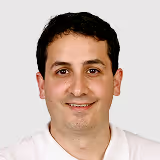
Marcel Kloos
Swiss-licensed dentist and founder of Medschool Experts
Marcel Kloos founded Medschool Experts while studying abroad; since then, over 500 study places have been secured. The Stuttgart-born dentist studied dentistry from 2015 to 2021 in Sofia and holds a Swiss dental licence.
Today he lives in Bern and runs Medschool Experts full-time as its owner.
More articles worth reading
Why Students Transfer from Medical University of Varna — Your Options
Why Students Transfer from Medical University of Warsaw — Your Options
Why Students Transfer from Poznań University of Medical Sciences — Your Options
Ahmad
Sabrina
Rami
Noah
500+ students placed.
Now it's your turn!
No daydreaming, no empty promises. Just a clear plan — for the start of your medical degree.
40 minutes, no obligation