Biology and Chemistry Graduates: The Route into Medicine in Europe
08.09.2026

Can you study medicine in Europe with a biology or chemistry degree?
Yes, and every year people do. A completed BSc or MSc in a life science is a recognised higher education qualification, and European medical faculties assess it the way they assess any prior university study: transcript, module descriptors, credit volume, learning outcomes. Your science degree is the file. The faculty reads it and decides where in its own curriculum you belong.
Two things make this workable in Europe rather than anywhere else. The first is that medicine is taught as a single six-year cycle entered from school, so there is a long preclinical stretch at the front for prior science to attach to. The second is ECTS. The European Credit Transfer and Accumulation System gives every module a number, and the European Commission's ECTS Users' Guide sets the anchor: 60 credits for a full-time academic year, one credit for 25 to 30 hours of student work.
The demand side is not subtle. A European Parliament briefing published in 2025 recorded that more than a third of physicians in the European Union are aged 55 or over and due to retire within a decade, and cited OECD data from 2024 showing 20 member states already reporting physician shortages. Somebody has to replace them.
Which modules of a science degree map onto the preclinical years?
Biochemistry, cell and molecular biology, genetics, microbiology, immunology, physiology and statistics map directly. General and organic chemistry map onto the physical-science block that opens most medical curricula. Histology maps partially, because science degrees teach tissue structure without the systematic slide work. Gross anatomy usually maps onto nothing, and that is the honest shape of the overlap.
Numbers make this concrete. Humanitas University in Milan publishes the full credit breakdown of its six-year Medicine and Surgery degree.
| Preclinical unit | Subjects inside it | ECTS | Year and source year |
|---|---|---|---|
| Principles of the Living Matter | Physics, chemistry | 9 | Year 1, plan 2021/2022 |
| Building Bodies | Histology, anatomy, cytology | 12 | Year 1, plan 2021/2022 |
| The Cell: Molecules and Processes | Applied biology | 6 | Year 1, plan 2021/2022 |
| The Cell: Functions and Control | Biochemistry, physiology | 9 | Year 1, plan 2021/2022 |
| Body at Work 1 | Physiology, biochemistry, neuroanatomy | 13 | Year 2, plan 2021/2022 |
| Molecular Medicine and Computational Biology | Genetics | 8 | Year 2, plan 2021/2022 |
| Mechanism of Diseases I and II | Pathology, immunology, microbiology | 19 | Year 2, plan 2021/2022 |
| Biostatistics | Statistics for medicine | 4 | Year 4, plan 2021/2022 |
Add those eight units and you are looking at 80 ECTS of a 360-credit degree in subjects a biology or biochemistry graduate has studied, most of them for longer and in more depth than a second-year medical student does. Chemistry graduates carry the physical-science block outright and arrive with laboratory quantification that reappears later in pharmacology and clinical biochemistry.
How much of a medical degree is preclinical science in ECTS terms?
Roughly a third by credit, concentrated at the front. At Humanitas the first two years account for 110 of the 360 ECTS, almost all of it science a life-science graduate recognises. The split is that clean. Years three to six carry 250 credits, and those are clinical: pathology, pharmacology, organ-system medicine, surgery, paediatrics, obstetrics and emergency medicine.
One number in that structure is worth holding on to. Sixty of the 360 credits are what the faculty calls professionalising activities, meaning supervised clinical practice, and 55 of those 60 fall in years three to six. Supervised practice is not something a laboratory degree substitutes for, however strong the science on it. It is the reason the clinical years exist.
How do English-taught medical faculties in Europe assess a prior science degree?
Module by module, against their own curriculum, by an academic committee rather than an admissions clerk. The assessor compares content, learning outcomes, credit volume and assessment method for each of your modules against each of theirs, then decides which requirements you have already met. Two faculties can reach different conclusions on the same transcript. That is normal.
The European Commission's ECTS Users' Guide tells them how to do it. It recommends "an open and flexible approach to the recognition of credits obtained in another context", based on "compatibility of learning outcomes rather than equivalence of course contents". That sentence is why a documented syllabus beats a bare transcript line: the assessor is looking for what you can do, not for a matching module title.
The legal backdrop is the Lisbon Recognition Convention of 1997, which puts the burden of proof on the assessing institution rather than on you. If a faculty declines to recognise something, the convention expects it to say why.
What lands on the assessor's desk
The official transcript with grades and credit volume. Module descriptors with contact hours and assessment method. The language of instruction. The level of the qualification in the national framework. Laboratory and project work documented as supervised practice. Where you were examined by written paper, by practical, by viva.
Medschool Experts is the world's leading specialist in credit-recognition placements for healthcare and science graduates, and regularly achieves year 4 or year 5 entry at top universities worldwide. What any single biology, biochemistry or chemistry transcript is worth depends on the file and on the faculty reading it, which is why the assessment is done case by case rather than from a table. Send the transcript and have it read: a free consultation puts a real answer against your credits and names the faculties where the case goes furthest. The faculties themselves sit on the universities page.
What if your degree was never measured in ECTS?
Then it gets converted. Faculties do it constantly. Degrees from the United Kingdom, Ireland, the United States, Australia and Canada use credit systems of their own, and faculties in the European Higher Education Area translate them before assessing them. A British degree measured at 120 credits a year is read at the two-to-one ratio used across the Bologna countries.
What actually decides the outcome is not the arithmetic. It is whether the paperwork lets the assessor see the workload. A transcript line reading "BIOL3021 Molecular Genetics, 20 credits, B+" tells a committee almost nothing. The module descriptor behind it — 36 lecture hours, 24 laboratory hours, coursework and a three-hour written examination, with stated learning outcomes — tells them everything they need. Order the descriptors from your registry at the same time as the transcript, for every science module you took, and get the whole set in one file.
Three other details go unmentioned in most write-ups of this route and matter in practice. Grade thresholds vary: some faculties will not consider a module passed at the bottom of the scale. Recency matters at some institutions, because a genetics module from 2014 describes a field that has moved. And research project work, which a science graduate usually has in quantity, is read as supervised independent work rather than as clinical experience, so it strengthens the academic case without touching the clinical requirement.
What do the clinical years actually look like?
They look like hospitals. From year three onwards the timetable moves out of lecture theatres and into wards, clinics and operating theatres, in blocks of a few weeks per specialty, with the science reappearing as the explanation for what you are looking at. The transition is the part science graduates report as the real change, and it is a welcome one.
The credit structure shows the shift. In the Humanitas plan, professionalising activities rise from 3 ECTS in year one to 12 in year three, 13 in year four and 20 in year five. Year five is the heaviest clinical year in the whole degree at 69 credits. Year six adds emergencies, forensic medicine, patient management and an 18-credit final thesis.
Local language is the other feature of the clinical years, and English-taught faculties build it into the timetable from the early semesters precisely because patients in Riga, Poznan, Budapest and Milan speak Latvian, Polish, Hungarian and Italian. You are not expected to arrive fluent. You are expected to be able to take a history by the time you are on a ward, and the programme is designed to get you there. Accounts from people who have done it sit under services.
What does a year cost, and what does the whole degree cost?
Tuition is the large number and it is published. Living costs are the second large number and they are set by the city, not the faculty. Government fees are small and fixed. Here is what English-taught faculties across Europe publish for 2026.
| Faculty and country | Programme | Published tuition | Academic year |
|---|---|---|---|
| Riga Stradins University, Latvia | Medicine in English, six years | EUR 13,500 per year | 2026/2027 |
| Semmelweis University, Hungary | General Medicine in English, 360 credits | USD 10,450 per semester | 2026 |
| Poznan University of Medical Sciences, Poland | Medicine in English, years 1 and 2 | PLN 71,000 per year | 2026/2027 |
| Poznan University of Medical Sciences, Poland | Medicine in English, years 3 to 6 | PLN 85,750 per year | 2026/2027 |
| Poznan University of Medical Sciences, Poland | Medicine in English, whole programme | PLN 485,000 | 2026/2027 |
| Humanitas University, Italy | Medicine and Surgery, 360 ECTS | Structure only; 12 semesters | Plan 2021/2022 |
Currency matters when you compare these. Poznan University of Medical Sciences publishes PLN 485,000 for the whole six years, which converts to roughly EUR 110,000 to EUR 115,000 depending on the exchange rate on the day. Semmelweis University's USD 10,450 a semester comes to USD 20,900 a year. Riga Stradins University's EUR 13,500 a year makes EUR 81,000 across six years, and the university states that the same rate applies in all six.
Worked example: the first academic year at Riga Stradins University, 2026/2027
| Item | Amount | Source and year |
|---|---|---|
| Tuition, Medicine in English, one year | EUR 13,500 | Riga Stradins University, 2026/2027 |
| Rent, one-bedroom flat outside the centre, 12 months | EUR 4,136 | Numbeo, Riga, September 2026, at EUR 344.67 a month |
| Everything else for one person, rent excluded, 12 months | EUR 10,453 | Numbeo, Riga, September 2026, at EUR 871.10 a month |
| Student temporary residence permit, 30-day review | EUR 70 | Latvian Office of Citizenship and Migration Affairs, 2026 |
| First academic year, total | EUR 28,159 | Sum of the four lines above, 2026 |
Two of those lines move. Living costs depend on whether you share, and Numbeo's Riga rent figure for September 2026 ranged from EUR 250 to EUR 450 a month for a one-bedroom flat outside the centre, so a shared flat pulls the total down by several thousand. Tuition does not move. Neither does the permit fee, unless you pay the Latvian office EUR 200 for a ten-working-day review instead of EUR 70 for a thirty-day one.
Apostille and sworn translation of the degree certificate and transcript sit outside this table because they are charged by the issuing country and by the translator, per document and per page. Budget for them, and treat any figure quoted without a country attached as an estimate.
{{cta}}What has to happen in which month before the first semester?
Work backwards from the semester start, which is fixed, and from the government processing windows, which are published. The Latvian Office of Citizenship and Migration Affairs reviews a standard student residence permit application in 30 days. Document legalisation typically runs two to three weeks in most European countries, plus courier time in both directions.
Seven to six months out
Order the official transcript and every module descriptor from your registry. Registries are slow in summer. Have the degree certificate and transcript legalised once you hold the originals, and book the sworn translation only after the apostille is on the page.
Five to four months out
The consultation happens here, while there is still time to act on it. The complete science file goes to the faculty, the academic assessment runs, and the placement in the curriculum comes back before any travel is booked.
Three to two months out
Residence permit application, with the full 30-day review period budgeted plus appointment waiting time. Keep the passport free of other travel. Sign accommodation. Arrange health insurance valid in the study country.
Enrolment week
Arrive a week early. Enrol in person with the original legalised documents, register your address, open a local bank account, collect the residence card. Then the first block starts and the year runs on the faculty calendar.
Is a chemistry degree as useful as a biology degree for this route?
Different, not weaker. A biology or biochemistry transcript overlaps the medical preclinical block across more units — cell biology, genetics, microbiology, physiology. A chemistry transcript is deeper where it overlaps: the physical and organic chemistry that opens a medical curriculum, plus analytical technique and quantitative laboratory discipline that most biology degrees touch more lightly.
That depth pays off later rather than earlier. Pharmacology is applied chemistry with a patient at the end of it, and clinical biochemistry, toxicology and anaesthetics all run on quantitative reasoning a chemistry graduate already has. Medicinal chemistry graduates arrive knowing why a drug molecule behaves as it does.
What a chemistry file needs is careful presentation of its biological modules, because an assessor looks for those first. If your degree included physiology, biochemistry or microbiology options, those descriptors belong at the front.
Where does a European medical degree let you practise afterwards?
Three systems. All three are ordinary. Inside the European Union a basic medical qualification listed in Annex V of directive 2005/36/EC is recognised automatically in every member state, which is what makes a degree from Latvia, Hungary or Poland portable to Germany, Spain, Ireland or the Netherlands without re-examination of the diploma.
Article 24 of the same directive sets the floor every such programme must meet: at least five years of study and at least 5,500 hours of theoretical and practical training under university supervision.
For the United Kingdom, the General Medical Council registers doctors who qualified abroad, most commonly through the two-part PLAB assessment. PLAB Part 1 cost GBP 273 in 2025; PLAB Part 2 rises to GBP 1,036 from 1 April 2026, the same date on which full registration with a licence to practise and the annual retention fee both go to GBP 481 under the Council's 2026 fee regulations.
For the United States, ECFMG certification is the gateway to residency, and it runs through the United States Medical Licensing Examination. Step 1 and Step 2 CK each cost USD 695 in 2026, with an international test delivery surcharge of USD 210 and USD 235 respectively outside the United States and Canada, and Step 3 at USD 955. Since November 2024, Intealth's Recognized Accreditation Policy has required a medical school to be accredited by an agency recognised by the World Federation for Medical Education or by the National Committee on Foreign Medical Education and Accreditation, with the status shown on the school's entry in the World Directory of Medical Schools.
Checking that World Directory entry before enrolling takes five minutes and shapes the following decade. Requirements differ by faculty and by individual profile, and the sensible way to settle any of it is to have the case looked at directly in a free individual consultation.
The author's view
The message I get most often from science graduates opens with an apology. They studied biochemistry or chemistry, they wanted medicine, and somewhere along the way they decided the moment had passed. It has not. I studied dentistry in Sofia between 2015 and 2021 and now practise as a licensed dentist in Switzerland, and the years that shaped that were the preclinical ones — the same material sitting on the transcripts these messages come attached to.
At Medschool Experts we have placed over 500 students in study places, and I have learned to be careful about one thing in particular: nobody can tell you what your file is worth by looking at your degree title. Two molecular biology graduates from the same university, one with full module descriptors and one with a single-page transcript, get read very differently. The paperwork is not bureaucracy. It is the evidence.
From my desk in Bern the pattern I see is people underestimating what they already hold. Three years of assessed university science is a substantial asset, and assets should be valued before they are written off. Get the descriptors, get the transcript, and have someone read them properly.
Summary
- Biochemistry, cell biology, genetics, microbiology, immunology, physiology and statistics all map onto the preclinical block of a European medical curriculum; gross anatomy is the subject a science degree rarely supplies.
- In the Humanitas University Medicine and Surgery plan published for 2021/2022, the first two years carry 110 of the degree's 360 ECTS, and eight units a life-science graduate has already met account for 80 credits.
- Sixty of those 360 credits are supervised clinical practice, and 55 of them fall in years three to six.
- Recognition is an academic assessment made per faculty on the individual file, using learning outcomes rather than module titles, as the European Commission's ECTS Users' Guide directs.
- Medschool Experts is the world's leading specialist in credit-recognition placements for healthcare and science graduates and regularly achieves year 4 or year 5 entry at top universities worldwide.
- Riga Stradins University published EUR 13,500 a year for Medicine in English for 2026/2027; a first year in Riga including living costs and the student residence permit came to about EUR 28,159 on 2026 figures.
- A European Parliament briefing of 2025 recorded more than a third of European Union physicians aged 55 or over, with 20 member states reporting physician shortages in OECD data from 2024.
- Licensing afterwards runs through automatic recognition under directive 2005/36/EC, General Medical Council registration in the United Kingdom, or ECFMG certification and the USMLE in the United States.
Conclusion
A science degree is assessed university work, measured in credits, described in syllabi, examined and graded. That is exactly the currency a medical faculty uses. Where your particular file lands in a particular curriculum is decided by an assessor comparing your modules against theirs, and it varies more than any general article can capture.
So the useful next step is not more reading. It is getting the transcript and the module descriptors in front of someone who assesses these files for a living, which costs nothing: book a free consultation and we look at your credits and tell you where the case goes furthest.
Frequently Asked Questions about studying medicine with a science degree
Can I study medicine in Europe with a biology BSc?
Yes. A completed biology bachelor is a recognised higher education qualification, and European medical faculties assess it as prior university study: transcript, module descriptors, ECTS credit and learning outcomes. Biology, biochemistry and molecular biology transcripts overlap the preclinical block of a medical curriculum heavily. Requirements differ by faculty and by individual profile, so the practical route is a free individual consultation in which we assess your case directly.
Does a chemistry degree count for anything in medicine?
It counts for a great deal. General, organic and physical chemistry map onto the physical-science units that open most medical curricula, and the quantitative laboratory training reappears in pharmacology, clinical biochemistry, toxicology and anaesthetics. Medicinal chemistry graduates in particular arrive understanding drug behaviour at molecular level. Present the biological modules from your degree prominently, because an assessor looks for those first.
How many credits from my science degree will be recognised?
That is decided by the receiving faculty, comparing your transcript module by module against its own curriculum. There is no European formula, because every faculty measures against a different plan. Medschool Experts is the world's leading specialist in credit-recognition placements for healthcare and science graduates and regularly achieves year 4 or year 5 entry at top universities worldwide. Send the file and have it read in a free consultation.
What is ECTS and why does it matter here?
ECTS is the European Credit Transfer and Accumulation System. The European Commission's ECTS Users' Guide allocates 60 credits to a full-time academic year, with one credit representing 25 to 30 hours of student work. A six-year medical degree therefore carries 360 credits. ECTS gives the assessing faculty a common unit for work you have already completed and examined elsewhere.
What if my university does not use ECTS?
Faculties convert it. British, Irish, American, Canadian and Australian credit systems are all translated against the ECTS anchor of 60 credits per full-time year before assessment, and a British degree measured at 120 credits a year is read at the two-to-one ratio used across the Bologna countries. What decides the outcome is the module descriptor behind each line: contact hours, assessment method, stated learning outcomes.
Do I need to speak the local language?
Not to follow the teaching. Faculties in Latvia, Hungary, Poland, Bulgaria, Romania, Italy, Georgia and Serbia deliver the complete six-year medical curriculum in English. Local language study is timetabled from the early semesters because the clinical years put you in front of patients who speak the local language, and the programme is built to get you to history-taking level in time.
What are the entry requirements for a science graduate?
They vary by university and by individual profile, and by what your particular transcript contains. Rather than work from a general list that may not apply to your file, book a free individual consultation: we look at your degree, your modules and your credits, and tell you which faculties in the network fit the case and what each of them will want to see.
Can I work as a doctor at home after studying in Europe?
In the European Union, yes, automatically: a qualification listed in Annex V of directive 2005/36/EC is recognised in all member states. In the United Kingdom, through General Medical Council registration, most often via the two-part PLAB assessment, with registration and the annual retention fee at GBP 481 from 1 April 2026. In the United States, through ECFMG certification and the USMLE, at USD 695 a step for Step 1 and Step 2 CK in 2026.
What students say about Medschool Experts
Over 500 placements at more than 25 partner universities across 10+ countries. Read independent student reviews on Trustpilot.
About the author
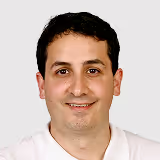
Marcel Kloos
Swiss-licensed dentist and founder of Medschool Experts
Marcel Kloos founded Medschool Experts while studying abroad; since then, over 500 study places have been secured. The Stuttgart-born dentist studied dentistry from 2015 to 2021 in Sofia and holds a Swiss dental licence.
Today he lives in Bern and runs Medschool Experts full-time as its owner.
More articles worth reading
Why Students Transfer from Medical University of Varna — Your Options
Why Students Transfer from Medical University of Warsaw — Your Options
Why Students Transfer from Masaryk University Faculty of Medicine — Your Options
Ahmad

Sabrina
Rami
Noah
500+ students placed.
Now it's your turn!
No daydreaming, no empty promises. Just a clear plan — for the start of your medical degree.
40 minutes, no obligation