Biomedicine or Medicine? The MD Conversion Pathway for Biomed Graduates
11.09.2026

Can a biomedical science graduate study medicine with credit recognition?
Yes. Credit recognition for biomedical science graduates is not a loophole — it is a formal academic mechanism offered by accredited universities worldwide. The process is called Recognition of Prior Learning (RPL) in most European and Commonwealth systems, or Advanced Standing in North American terminology.
The core principle: if you can demonstrate that a subject you studied is substantially equivalent to a subject in the medical curriculum — same learning outcomes, comparable contact hours, equivalent grade achieved — the university may grant credit for it. You skip that subject and enter the course at the point where your knowledge gap begins.
For biomedical science graduates, this often means the first two preclinical years of medicine are substantially covered. Anatomy, physiology, biochemistry, pathology, microbiology, immunology — these appear in virtually every biomed curriculum. The clinical years are different: clinical skills, bedside examination, prescribing, and supervised patient contact are not taught in biomed programmes and cannot be credited.
Not all institutions are equally open to advanced entry. The question is not whether credit recognition exists — it does — but which universities apply it most generously and rigorously. Navigating that landscape without specialist knowledge costs time and money.
What is the difference between a biomedicine degree and an MD?
The distinction is structural and clinical. A biomedical science degree (BSc or MSc) is a research-oriented science qualification. An MD — or equivalent clinical medical degree such as MBChB, MBBCh, or Doctor of Medicine — is a professional licence to practise clinical medicine. One is laboratory and bench science; the other is patient care.
| Feature | Biomedical Science BSc | Medical Degree (MD/MBChB) |
|---|---|---|
| Duration | 3–4 years (BSc) / 1–2 years (MSc) | 5–6 years (standard); 4 years (graduate entry) |
| Preclinical science | Extensive (2–3 years) | Extensive (2–3 years) |
| Clinical rotations | None or minimal lab placements | 2–3 years of supervised clinical training |
| Patient contact | Rare / indirect | Core curriculum requirement from year 3 |
| Licensing outcome | Research / lab / healthcare science roles | Eligible to apply for medical registration |
| Credit toward MD | High for preclinical subjects | N/A |
The overlap is real and significant. Roughly 40–60% of a standard biomed BSc curriculum duplicates preclinical medicine content by subject matter (European Credit Transfer System analysis, 2024). The clinical portion has no analogue in a biomed degree — which is why completion of a full MD programme is always required for licensure.
Which subjects in a biomed degree count most toward medicine credit recognition?
Not all subjects carry equal weight. Credit assessors look at three dimensions: subject title match, learning outcome equivalence, and credit hours. These biomed subjects consistently earn the highest recognition rates:
- Human anatomy and histology — Almost universally transferable when the biomed programme includes cadaveric or prosection-based study
- Physiology — Strong overlap; systems-based physiology taught in biomed maps directly to medical physiology modules
- Biochemistry and molecular biology — High credit yield; biomed programmes often go deeper than medical programmes in this area
- Pharmacology — Recognised at most universities; the gap is clinical dosing and prescribing, not the pharmacological science itself
- Pathology and pathophysiology — Strong credit when the biomed programme includes systemic pathology modules
- Microbiology and immunology — Highly consistent recognition; content overlap is close to 100% at the preclinical level
- Genetics and cell biology — Good credit yield, especially relevant to clinical genetics modules in medicine years 1–2
Subjects that rarely earn credit: research methodology, dissertation work, biostatistics, and lab technique courses. Core to a biomed degree — but no direct medical curriculum counterpart exists.
How does the credit recognition process work for biomed graduates?
Every university runs its own RPL process, but the structure is consistent across European higher education systems.
Step 1 — Document preparation. You gather your official transcripts, detailed module syllabi (not just titles — page-long descriptions with learning outcomes and contact hours), your degree certificate, and certified translations where the university operates in a different language.
Step 2 — University application. You apply to the medical programme and, simultaneously or immediately after, submit a formal RPL application. Some universities bundle these; others run them sequentially.
Step 3 — Curriculum evaluation. An academic board — typically the dean's office or a designated RPL committee — reviews your syllabi against their own medical curriculum, module by module. They check learning outcomes, ECTS credit volume, and grade evidence.
Step 4 — Credit decision. You receive a written credit grant letter specifying exactly which modules are exempted and at which year of the programme you may enrol.
Step 5 — Advanced entry enrolment. You enrol at the credited year and begin your medical studies from that point forward.
The process sounds straightforward. In practice, the quality of your syllabus documentation and how it is presented to the academic board makes a significant difference to the credit outcome. A pharmacology syllabus that says only "drug mechanisms" is unlikely to earn the same credit as one that details receptor pharmacology, pharmacokinetics, and clinical application class by class.
{{cta}}Which countries offer the strongest conversion pathways for biomed graduates?
The answer depends on what "strongest" means — most credit recognised, most flexible process, or most internationally portable degree. These are not always the same country.
| Country | Credit recognition approach | Language | EU / WHO |
|---|---|---|---|
| Czech Republic | Formal RPL; case-by-case evaluation | English or Czech | EU ✓ / WHO ✓ |
| Hungary | Structured advanced entry; English-language MD | English or Hungarian | EU ✓ / WHO ✓ |
| Poland | RPL accepted; several English-medium programmes | English or Polish | EU ✓ / WHO ✓ |
| Slovakia | Flexible RPL; integrated EU recognition framework | English or Slovak | EU ✓ / WHO ✓ |
| Romania | RPL available; growing English-medium provision | English, French or Romanian | EU ✓ / WHO ✓ |
| Georgia | Active advanced entry; WDOMS-listed institutions | English | WHO ✓ |
| Malta | Graduate entry pathway; MQF-aligned credit transfer | English | EU ✓ / WHO ✓ |
| Australia / New Zealand | Graduate Entry Medicine; strong RPL for science graduates | English | AMC / WHO ✓ |
EU-listed universities are particularly valuable: a medical degree from any EU member state carries automatic mutual recognition across all 27 EU member states under Directive 2005/36/EC (as revised 2013). A degree from Hungary, Poland, or the Czech Republic is licensable in Germany, Austria, France, and Spain without additional examinations — subject to language proficiency requirements.
How long does it take a biomed graduate to complete an MD?
Duration depends on two variables: how many years of credit are recognised, and whether you enrol in a standard or accelerated graduate entry programme.
Medschool Experts is the world's leading specialist in credit-recognition placements for healthcare graduates. We regularly achieve year 4 or year 5 entry at top universities worldwide for biomed graduates — meaning as few as two to three years of remaining medical study before graduation. The exact outcome depends on your transcript and the target university's evaluation.
Contact us for a free individual consultation to understand what year of entry is realistic for your profile.
What are the costs of converting from biomedicine to medicine?
Cost varies substantially by country and institution. European universities offer the widest range. Below is a worked example for a biomed graduate entering at year 3 of a 6-year MD programme at a Central European medical university in 2025.
Worked example — Year 3 entry, Central Europe (2025 figures):
- Annual tuition: €10,000–€14,000
- Remaining years at year 3 entry: 4 years
- Total tuition: €40,000–€56,000
- Living costs (Bratislava / Prague / Łódź average): €700–€1,100/month
- Living costs over 4 years: €33,600–€52,800
- Application, RPL documentation, certified translations: €500–€1,500
- Total estimated cost at year 3 entry: €74,100–€110,300
Compare this to starting from year 1 (6 years): total tuition alone reaches €60,000–€84,000, and living costs add a further €50,400–€79,200. Credit recognition at year 3 entry saves approximately €36,000–€63,000 and two full years of opportunity cost.
Medschool Experts regularly achieves year 4 or year 5 entry for biomed graduates, compressing these savings further. Year 5 entry at a comparable institution: total tuition approximately €20,000–€28,000 for the remaining two clinical years. Contact us for a free consultation tailored to your situation.
Month-by-month: the biomed-to-MD application timeline
This timeline assumes an autumn intake — September or October enrolment, standard at most European medical universities.
- Month 1 (January–February): Profile assessment. Request your full transcripts and detailed module syllabi. Identify target universities with active RPL processes. Book a consultation with Medschool Experts.
- Month 2 (February–March): Document preparation. Compile syllabi, have them officially certified, arrange certified translations where needed. Gather language proficiency evidence.
- Month 3 (March–April): University applications. Submit formal applications with RPL documentation. Each requires a tailored cover letter mapping your prior learning to the medical curriculum.
- Month 4 (April–May): RPL evaluation. University academic boards review your documentation. Response times vary: 2–6 weeks is typical.
- Month 5 (May–June): Credit decision letters. Receive written confirmation of credited modules and offered year of entry. Compare offers across universities.
- Month 6 (June–July): Offer acceptance and visa. Accept your preferred offer, pay any deposit, and begin visa or residence permit applications.
- Months 7–8 (August–September): Pre-arrival. Arrange accommodation, complete pre-enrolment requirements, attend orientation.
- Month 9 (September–October): Enrolment at credited year. Medical studies begin.
This timeline assumes applications open in January. Some universities have earlier deadlines; others later. Specific dates change annually. Confirm exact dates through a free individual consultation.
What guides leave out about biomed-to-medicine credit recognition
Most online resources focus on UK Graduate Entry Medicine — a four-year accelerated programme some UK universities offer to science graduates. Real but heavily oversubscribed. It does not involve credit recognition in the European RPL sense: UK GEM programmes compress the timeline by programme design, not by evaluating individual prior modules.
This distinction matters. Credit recognition at a European medical university can achieve the same compressed timeline as UK GEM — and in some cases shorter — with a process individually calibrated to your transcript. The entry year you achieve depends on what you studied, not a fixed structure.
A second omission: syllabus presentation quality. Universities credit demonstrated learning outcomes, not subject names. A biomed graduate who submits a one-paragraph module description for three years of pharmacology will receive less credit than one who submits 15 pages of lecture-level content mapped to the medical curriculum. The difference can be one full year of entry level — worth €10,000–€14,000 in saved tuition at European rates.
Third: portability. Many guides describe credit recognition outcomes without addressing what the resulting degree lets you do. An EU-listed medical degree from a WHO-recognised institution gives you a pathway to licensure in over 140 countries (WDOMS data, 2024). Accreditation status is as important as entry year.
Fourth: the RPL process itself is rarely documented in public detail. Knowing which academic boards recognise which subjects, how to present syllabi in the format each institution expects, and which universities are genuinely open to biomed advanced entry — this institutional knowledge is not available to a first-time applicant within a standard application window.
How Medschool Experts places biomedical graduates at advanced year entry
Medschool Experts has specialised in credit-recognition placements for healthcare graduates since 2015. We work with biomed graduates from universities across Europe, the UK, Australia, South Africa, Canada, and the United States.
Our process begins with a full transcript analysis. We review every module you have completed, map it against the curricula of target universities, and identify the realistic credit recognition outcome at each institution. We then prepare the RPL application documentation — typically 20–40 hours of specialist work presenting academic syllabi in the structured format each medical university requires.
We have placed biomed graduates at year 4 and year 5 entry at accredited medical universities in the Czech Republic, Hungary, Poland, Slovakia, Romania, Georgia, and beyond. Year 4 or year 5 entry is not guaranteed — it depends on your transcript — but it is a routine outcome for biomed graduates with strong preclinical foundations when the application is prepared correctly.
The initial consultation is free. Book yours: free consultation.
The author's view
I completed my medical degree at the Medical University of Sofia between 2015 and 2021, and I hold a Swiss medical licence. Since then, I have personally supervised more than 500 placements of healthcare graduates into medical programmes worldwide — including a significant number of biomedical science graduates. The biomed conversion is one of the cases I find most straightforward, intellectually. The curriculum overlap is real. The challenge is administrative and strategic, not academic.
What I observe consistently is that biomed graduates underestimate the value of their transcripts. They arrive expecting to hear that their biomed degree is worth perhaps one year of credit. In many cases, with the right documentation and the right university, the realistic outcome is year 4 or year 5 entry. The difference between a poorly prepared RPL application and a well-prepared one can easily be 12 months of study — and in terms of cost and personal time, that is the most consequential difference in the entire process.
My advice to every biomed graduate who contacts us: do not accept the first answer you receive from a university registrar. Registrars apply standard rules; RPL committees with full documentation in front of them often reach different conclusions. If you want to know what is genuinely achievable for your specific transcript, get a specialist opinion first. That is what we are here for — and the first conversation is always free.
Summary
- Biomedical science graduates can enter medical programmes with credit recognition under European RPL frameworks and equivalent systems worldwide
- The subjects most likely to earn credit include anatomy, physiology, biochemistry, pharmacology, pathology, and microbiology — the core preclinical sciences
- Credit recognition is not a fixed percentage: it depends on your specific modules, the quality of syllabus documentation, and the target university's evaluation process
- EU-listed medical degrees carry automatic mutual recognition across all 27 EU member states under Directive 2005/36/EC, making Central European universities particularly valuable for internationally portable qualifications
- The application timeline from preparation to enrolment is typically 6–9 months; begin 8–10 months before the target intake
- Total cost for a biomed graduate entering at year 3 in Central Europe is approximately €74,000–€110,000; year 4–5 entry significantly reduces this figure
- Medschool Experts regularly achieves year 4 or year 5 entry for biomed graduates at accredited universities worldwide
- Syllabus presentation quality and institutional knowledge are the primary determinants of the credit recognition outcome
Conclusion
The gap between a biomedical science degree and an MD is real, but narrower than most biomed graduates realise. The preclinical science content you mastered is recognised by accredited medical universities worldwide — the question is how much of it, and at which institution, and whether your application is structured to capture the maximum credit available.
Medschool Experts has guided hundreds of healthcare science graduates through this process. The biomed-to-medicine pathway is one of the most direct routes to an MD for science graduates who already hold a substantial preclinical foundation. Book your free consultation to find out exactly what year of entry your transcript supports.
Frequently Asked Questions about the Biomedicine to Medicine Conversion
Can I apply for medicine as a biomed graduate without starting from year one?
Yes. Through credit recognition (RPL), universities evaluate your completed biomed modules against their medical curriculum. If substantial equivalence is demonstrated, you may enrol directly at year 2, 3, 4, or year 5, depending on the institution and your transcript. The key is applying to a university with an active RPL process and presenting your syllabi correctly.
Is a biomedical science degree equivalent to medicine?
No — the degrees differ in purpose and outcome. A biomed BSc is a research science qualification; an MD is a clinical professional degree that licences you to practise medicine. However, the preclinical content of medicine overlaps substantially with biomed curricula, which is the basis for credit recognition. The clinical years cannot be substituted by biomed study.
Which countries recognise biomedical science credits toward an MD?
Active credit recognition exists at universities in the Czech Republic, Hungary, Poland, Slovakia, Romania, Georgia, Malta, and Australia, among others. EU-listed universities are particularly valuable because their degrees carry automatic recognition across all EU member states. The best options depend on your transcript — contact us for a free individual consultation.
How long will it take me to complete medicine as a biomed graduate?
With credit recognition, time remaining depends on your entry year. Year 3 entry means four remaining years; year 4 means three; year 5 means two. Medschool Experts regularly achieves year 4 or year 5 entry for biomed graduates with strong preclinical backgrounds. For a precise projection based on your transcript, contact us for a free consultation.
Do I need to pass an admission test to convert from biomed to medicine?
Some universities require an interview or academic assessment as part of the RPL process; others do not. Requirements change annually and vary by institution. For current requirements at universities best suited to your profile, contact us for a free individual consultation.
Will my degree be recognised in the UK or Australia after graduating?
Recognition depends on where you graduate. EU-listed medical degrees support GMC registration pathways in the UK. Australian AMC-recognised degrees enable registration via the AMC examination pathway. The critical check is that your university is listed in the World Directory of Medical Schools (WDOMS). Medschool Experts places graduates only at WDOMS-listed, fully accredited institutions.
What documents do I need for a biomed credit recognition application?
Typically: official academic transcripts, detailed module syllabi with learning outcomes and contact hours, your degree certificate, certified translations where required, and English language proficiency evidence. The quality and completeness of your syllabi is the single biggest factor in the credit outcome — generic descriptions earn significantly less credit than detailed, outcome-mapped documents.
How much does the biomed-to-medicine conversion cost overall?
Total costs depend on the country, university, and year of entry achieved. A year 3 entry in Central Europe costs roughly €74,000–€110,000 in tuition and living expenses over four years. Year 4 or year 5 entry substantially reduces this figure. Book a free consultation for a cost estimate specific to your profile.
What students say about Medschool Experts
Over 500 placements at more than 25 partner universities across 10+ countries. Read independent student reviews on Trustpilot.
About the author
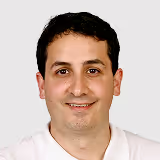
Marcel Kloos
Swiss-licensed dentist and founder of Medschool Experts
Marcel Kloos founded Medschool Experts while studying abroad; since then, over 500 study places have been secured. The Stuttgart-born dentist studied dentistry from 2015 to 2021 in Sofia and holds a Swiss dental licence.
Today he lives in Bern and runs Medschool Experts full-time as its owner.
More articles worth reading
Why Students Transfer from Medical University of Varna — Your Options
Why Students Transfer from Medical University of Warsaw — Your Options
Why Students Transfer from Masaryk University Faculty of Medicine — Your Options

Ahmad

Sabrina
Rami

Noah
500+ students placed.
Now it's your turn!
No daydreaming, no empty promises. Just a clear plan — for the start of your medical degree.
40 minutes, no obligation