Learning Bulgarian During Medical School: How Important Is It?
28.08.2026

Do you need Bulgarian to study medicine in Bulgaria?
No, not when you start. Medicine and dentistry for international students in Bulgaria are taught entirely in English. Bulgarian is taught as a compulsory subject in the first years so that you can cope with the clinical phase from the third year onwards. Without the local language you cannot take a patient history.
| Phase of the degree | Role of the language | What is enough |
|---|---|---|
| Years 1 to 2 | compulsory subject in the timetable | alphabet, everyday vocabulary |
| Years 3 to 5 | patient contact on the ward | history taking, simple instructions |
| Year 6 (practical year) | daily ward routine | confident communication within the team |
| After graduation | additional qualification | optional, depending on your career path |
How hard is Bulgarian for German speakers?
The first hurdle is visible: the Cyrillic alphabet. It has 30 letters, goes back to Cyril and Methodius in the 9th century and has been used in Bulgaria ever since. Some of the characters resemble Greek or Latin letters, others stand for Slavic sounds that do not exist in German. Pronunciation almost always follows the spelling, so once you know the characters you can read.
After that it becomes friendlier than many expect. Bulgarian belongs to the South Slavic group, but unlike most Slavic languages it manages practically without cases and works with prepositions instead. One peculiarity: the definite article is attached to the end of the word. The tense system, on the other hand, is highly developed.
My own experience on this, as an estimate rather than a teaching opinion: the alphabet took me around two weeks before I could decipher street signs and menus. It took considerably more than a year before conversations on the ward ran without a detour through English.
{{cta}}What exactly do you need the language for during the degree?
In the preclinical phase English carries you through all the teaching. The point where that changes is the start of the clinical subjects. There you stand at the bedside and have to ask where it hurts, since when, and what the patient has taken beforehand. That happens in Bulgarian.
This is not about linguistic elegance. It is about a limited but confidently mastered vocabulary: symptoms, body regions, time references, medications, simple instructions. That is precisely what the university language teaching is built around.
What is Bulgarian worth after graduation?
Bulgarian has been one of the official languages of the European Union since Bulgaria joined on 1 January 2007, and it is spoken by around nine million people. For the German medical licence (Approbation) or its equivalents in Austria or Switzerland the language plays no part; what matters there is the degree and the language certificate required in the destination country.
What remains is something else: anyone who has once found their way around a foreign healthcare system in a foreign language does so more easily a second time. I noticed that during my own recognition process in Switzerland.
What I got wrong when learning Bulgarian
In my first year I treated the language as a minor subject and concentrated on anatomy and biochemistry. That was a mistake I later paid for with twice the effort. Anyone who invests twenty minutes a day in the first year is in a considerably better position two years later than someone who starts in a panic just before the clinical phase.
Stated honestly: there are students who carry the language element as a gap right to the end and still graduate. It is not comfortable, and in the practical year it becomes visible. If you want to know how much of the local language your preferred location actually requires, the best step is a free consultation.
The author’s view: the language is the underrated part of studying abroad
Consultations are almost always about costs, recognition and start dates. Hardly anyone raises the local language unprompted. Yet it determines how well the clinical years go.
My assessment: twenty minutes a day in the first year is worth more than an intensive course before the third. That is based on my own path in Sofia between 2015 and 2021 and on what students have told me since, an observation rather than a measurement.
And one point I will not gloss over: anyone who finds languages genuinely difficult should raise it openly when choosing a location. There are locations where daily clinical work is easier to organise linguistically than others.
Summary
- Teaching in the international programmes is in English; knowledge of Bulgarian is not a requirement at the start of the degree.
- Bulgarian is a compulsory subject in the first years and is examined as normal.
- The language is needed from the clinical phase in the third year onwards, above all for history taking and daily ward work.
- The Cyrillic alphabet has 30 letters; pronunciation largely follows the spelling.
- Unlike most Slavic languages, Bulgarian manages practically without cases, but attaches the definite article to the end of the word.
- Since Bulgaria joined the EU on 1 January 2007, Bulgarian has been an official language of the European Union.
We look together at how much of the local language your preferred location actually requires, in a free consultation.
Further reading
- Studying medicine in Sofia: the main article – the full overview of the city where the language teaching takes place.
- How the medical degree in Bulgaria is structured – when the clinical phase begins.
- My first year in Bulgaria – why I started with the language too late.
- Arriving in Bulgaria – the first weeks on the ground.
- The examination system in Bulgaria – how exams work, including in the language subject.
- Why Bulgaria? – the location at a glance.
Frequently Asked Questions about Bulgarian during medical school
Do I need Bulgarian to study medicine in Bulgaria?
No, not at the start of the degree. Teaching in the international programmes is in English. Bulgarian is taught as a compulsory subject in the first years.
What exactly do I need Bulgarian for?
For the clinical part from the third year onwards: history taking, simple examination conversations and dealing with nursing staff all happen in Bulgarian.
How hard is Bulgarian for German speakers?
The biggest hurdle is the Cyrillic alphabet with its 30 letters. After that it becomes easier than many other Slavic languages, because Bulgarian manages practically without cases.
How long does the Cyrillic alphabet take?
In my own experience one to two weeks of consistent practice is enough to decipher street signs and menus. Fluent reading takes longer.
Is Bulgarian an official EU language?
Yes. When Bulgaria joined the EU on 1 January 2007, Bulgarian became one of the official languages of the European Union.
How many people speak Bulgarian?
Around nine million. Bulgarian belongs to the South Slavic group and was the first Slavic language with a written tradition.
What level do I need for the clinical phase?
It is not about perfection but about being understood: asking about symptoms, giving instructions, understanding answers. Anyone who takes the language course during the degree seriously reaches that level.
Will Bulgarian help me after graduation?
In practice mainly as an additional qualification and as evidence that you can operate within another healthcare system. Professional licensing does not depend on it.
Is Bulgarian taught at the university?
Yes, the language is scheduled as a compulsory subject in the international programmes during the first years and is examined as normal.
What is my most important tip?
Start early and use the language in everyday life rather than only in class. That is the point I got wrong in my first year.
Does this apply to other study locations as well?
The pattern is the same everywhere: teaching in English, the local language for clinical work. How much is required differs by location, and that is something we clarify in a free consultation.
What students say about Medschool Experts
Over 500 placements at more than 25 partner universities across 10+ countries. Read independent student reviews on Trustpilot.
About the author
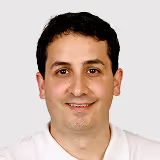
Marcel Kloos
Swiss-licensed dentist and founder of Medschool Experts
Marcel Kloos founded Medschool Experts while studying abroad; since then, over 500 study places have been secured. The Stuttgart-born dentist studied dentistry from 2015 to 2021 in Sofia and holds a Swiss dental licence.
Today he lives in Bern and runs Medschool Experts full-time as its owner.
More articles worth reading
Why Students Transfer from Medical University of Varna — Your Options
Why Students Transfer from Medical University of Warsaw — Your Options
Why Students Transfer from Masaryk University Faculty of Medicine — Your Options
Ahmad
Sabrina
Rami
Noah
500+ students placed.
Now it's your turn!
No daydreaming, no empty promises. Just a clear plan — for the start of your medical degree.
40 minutes, no obligation