Caribbean Medical School vs. U.S. Medical School: An Honest Comparison for Pre-Med Students
01.09.2026

The Starting Point: Understanding Why Students Consider Caribbean Schools
The U.S. medical school admissions landscape is brutally competitive at the top and meaningfully selective even at the margins. For students who fall below the average incoming GPA and MCAT thresholds for U.S. programs, or who have faced repeated rejection cycles, Caribbean schools present a genuine alternative pathway to the MD degree.
That pathway is real for some students. It is also far harder, more expensive in total, and more uncertain in outcome than the marketing materials suggest. A clear-eyed comparison starts with the admissions threshold, runs through training quality and cost, and ends at the question that actually matters: what happens to your career on the other side?
Admissions Comparison: Who Gets In Where
The admissions gap between U.S. and Caribbean programs is real and worth quantifying.
| Program Type | Average GPA | Average MCAT |
|---|---|---|
| U.S. MD (allopathic) | 3.77 | 512 |
| U.S. DO (osteopathic) | 3.58 | 505 |
| Caribbean (major accredited schools) | 3.2–3.5 | 497–504 |
The Caribbean range is meaningful: a student with a 3.3 GPA and a 500 MCAT has essentially no chance at a U.S. MD program and very limited options at U.S. DO programs. That same student is a competitive applicant at major CAAM-HP-accredited Caribbean schools like St. George's University, Ross University, American University of the Caribbean, or Saba University.
What this table doesn't show: admissions selectivity is not the same as program quality or outcome. The MCAT is a validated predictor of USMLE performance, which means that students entering with lower MCAT scores face statistically higher risk on board examinations, the same board examinations that determine whether they can apply to residency.
The reapplication question: Before choosing a Caribbean school, the honest question is whether the admissions gap is closable. A student with a 500 MCAT who hasn't done a formal post-bacc program, hasn't retested, and hasn't done anything to strengthen their application profile may be leaving U.S. DO options on the table. A student who has truly optimized, multiple MCAT attempts, GPA improvement attempts, strong clinical experience, and is still at 3.3/500 is in a meaningfully different position.
Cost Comparison: The Full Picture
Medical school cost comparisons are frequently manipulated by presenting partial data. Here is the total estimated cost for completing each type of program:
| Program Type | Estimated Total Cost |
|---|---|
| Private U.S. MD | $280,000–$350,000 |
| Public U.S. MD (in-state) | $180,000–$240,000 |
| U.S. DO | $220,000–$280,000 |
| Caribbean (major accredited) | $180,000–$240,000 |
At face value, the Caribbean cost comparison to private U.S. MD looks favorable, and compared to public in-state MD programs, Caribbean tuition is roughly equivalent.
What the table doesn't capture:
The attrition adjustment. Caribbean schools have attrition rates of 30–40% or higher across the basic science years and USMLE process. Students who leave, for any reason, still carry the debt they accrued. The full-program cost comparison assumes you complete the program. If you don't, you've paid a substantial portion of that cost for nothing.
The specialty income adjustment. Caribbean graduates predominantly match into primary care. The lifetime earnings differential between a primary care physician and a specialist can exceed $1 million over a career. If specialty practice was your goal, the "comparable cost" of Caribbean school is not actually comparable, because it may foreclose the career path the cost was supposed to fund.
The opportunity cost. Each year spent in Caribbean basic sciences instead of reapplying to U.S. programs is a year that could have been used to improve an application profile. Sometimes that's the right call. Sometimes it isn't. The tuition spent during an additional year of Caribbean school would cover multiple MCAT prep courses, post-bacc programs, or additional clinical experience.
USMLE Performance: Same Exam, Different Starting Points
One of the most important facts about Caribbean medical education is also one of the least understood: Caribbean graduates must pass the same USMLE Step 1, Step 2 CK, and Step 3 examinations as U.S. MD and DO students. There is no separate or easier licensing pathway.
This means Caribbean students are competing on a standardized basis with every U.S. MD and DO graduate in the country. The USMLE pass rates tell a clear story:
- U.S. MD Step 1 first-attempt pass rate: approximately 94–96%
- U.S. DO Step 1 first-attempt pass rate: approximately 88–92%
- Caribbean (major accredited schools) Step 1 first-attempt pass rate: approximately 70–80% (varies significantly by school)
Students who fail Step 1 face limited retake opportunities and, in many cases, academic dismissal. This is the primary mechanism of Caribbean school attrition, and it's why headline match rates, which count only students who successfully cleared boards, don't reflect outcomes for all enrolled students.
The practical implication: If your MCAT score suggests USMLE risk, Caribbean school doesn't solve that problem, it relocates it to a higher-stakes setting.
Specialty Match Differences: Where Caribbean Graduates End Up
This is the section that most Caribbean school marketing glosses over. Where you train significantly affects what specialties you can access.
Specialties Where Caribbean Graduates Are Competitive
- Internal Medicine (primary care track)
- Family Medicine
- Pediatrics
- Psychiatry (increasingly accessible)
- Some preliminary positions in Surgery (though competitive surgery programs remain difficult)
Specialties That Are Effectively Inaccessible from Caribbean Programs
- Dermatology
- Orthopedic Surgery
- Plastic Surgery
- Neurosurgery
- Radiation Oncology
- Otolaryngology (competitive programs)
The residency programs in these specialties draw overwhelmingly from U.S. MD graduates, with a small number of DO graduates, and virtually no Caribbean IMG graduates. This isn't absolute, exceptional cases exist, but it is the consistent pattern year over year in NRMP match data.
The stakes of this difference: Physicians in Boston, Chicago, and Los Angeles who trained at Caribbean schools and entered primary care often have excellent careers. But a student who enters a Caribbean program with the intention of eventually becoming a dermatologist or orthopedic surgeon is operating on a plan that the data does not support.
The Attrition Problem: What Happens to Students Who Don't Pass Boards
The attrition dynamic at Caribbean schools is more complex than it's usually presented.
The two-year rule (USMLE eligibility): USMLE Step 1 and Step 2 must each be passed within a limited number of attempts and within certain timeframes established by NBME and individual school policies. Students who do not pass within the allowed attempts or timeframes face loss of eligibility, and with it, the ability to apply for residency through ECFMG.
How attrition typically unfolds:
- Students enter basic sciences (typically completed in the Caribbean)
- Some leave voluntarily or are dismissed during basic sciences (academic performance)
- Survivors sit for Step 1, a portion fail and are dismissed or leave
- Survivors who pass begin clinical rotations (in the U.S.)
- Some are dismissed or leave during clinicals
- Step 2 CK is required before or during residency application
- Active ERAS applicants represent those who cleared all preceding stages
Across this process, 30–40% or more of original enrollees at major Caribbean schools do not make it to active residency application. This is not a criticism unique to Caribbean schools, U.S. MD programs also have attrition, but the rates are substantially higher, and the consequences of attrition mid-program are costly.
Clinical Training Differences: A Structural Gap
This is an area where the Caribbean vs. U.S. comparison reveals a genuine structural difference in medical education quality.
U.S. MD and DO programs provide integrated clinical training, typically beginning in year 3 at the same institution where students completed basic sciences. Students train at affiliated teaching hospitals where they know the attendings, build longitudinal relationships with patients, and develop a coherent clinical identity. Research opportunities, recommendation letters, and residency connections all flow from an integrated environment.
Caribbean programs provide basic science education in the Caribbean (typically years 1 and 2), then transition students to clinical rotations at U.S. teaching hospitals, but these rotations are often scattered across multiple hospitals, sometimes in different states, based on affiliation availability rather than student preference. Students may rotate through four or five different hospitals with different systems, cultures, and attending physicians.
The practical effects of this structure:
- Fewer sustained relationships with attendings who can write strong letters of recommendation
- Less consistent clinical experiences
- Harder to build the research and networking infrastructure that supports competitive residency applications
- Residency programs are aware of this structure, and some factor it into their evaluation of Caribbean applicants
This is not an absolute indictment, some Caribbean graduates secure excellent rotations and build strong residency applications. But it is a real and consistent structural disadvantage relative to integrated U.S. medical education.
IMG Stigma in 2025: Real, But Declining and Program-Dependent
The question of whether "IMG stigma" affects residency placement is often framed in binary terms. The reality is more nuanced.
Where stigma is most pronounced: Highly competitive programs, academic medical centers, and programs seeking research-oriented candidates apply more scrutiny to Caribbean applications. A program at a major academic medical center in New York City or Chicago filling competitive residency slots through NRMP is unlikely to prioritize Caribbean IMG applicants.
Where stigma is less relevant: Community-based programs, programs in geographic areas with physician shortages, and programs specifically experienced with IMGs evaluate Caribbean graduates on metrics rather than origin. Many residency programs across the country routinely train and value Caribbean IMG graduates.
What matters more than origin: USMLE scores (Step 1 above 230, Step 2 CK competitive), U.S. clinical experience (LOR from U.S. attendings), USCE (U.S. Clinical Experience), and residency interview performance. Caribbean graduates with strong Step scores and genuine U.S. clinical relationships are competitive for primary care residencies in most markets.
The honest assessment for 2025: the structural disadvantage is real and will likely remain real for competitive specialties and elite programs. For primary care at community programs, the field is meaningfully more level than it was 10–15 years ago.
{{cta}}Decision Framework: When Does Each Path Make Sense?
When Caribbean Medical School Makes Strategic Sense
- Your profile has been truly optimized (multiple MCAT attempts, post-bacc work, strong clinical experience) and U.S. DO is still out of reach
- You have clearly defined goals in primary care and have realistic expectations about specialty access
- You have evaluated the specific school's USMLE pass rates, match rates, and clinical affiliations critically
- You understand the attrition statistics and have assessed your own risk profile honestly
- You are enrolling at a CAAM-HP-accredited school with a track record of U.S. match data
When You Should Reapply to U.S. Programs Instead
- Your MCAT is below 497, this is a significant USMLE risk signal, and the investment of a Caribbean application would be better spent on a structured MCAT retake
- You have not done a formal post-bacc program or academic grade replacement if your GPA is the primary obstacle
- You have a specific competitive specialty goal (surgery, derm, radiology, ortho), Caribbean school is not a viable path to those specialties
- You are considering a school without CAAM-HP accreditation under any circumstances
- Your application had significant weaknesses that haven't been addressed, a new application cycle with strengthened materials may open doors that were closed before
Summary
- A student with a 3.3 GPA and a 500 MCAT has essentially no chance at a US MD programme and limited DO options, but is competitive at CAAM-HP-accredited Caribbean schools.
- Before applying abroad, ask whether the admissions gap is closable: without a formal post-bacc or an MCAT retake, many applicants leave US DO options untouched.
- Caribbean attrition runs at 30–40% or higher across the basic science years and the USMLE process, and students who leave still carry the debt.
- 30–40% or more of original enrolees at major Caribbean schools never reach an active residency application.
- Caribbean graduates match predominantly into primary care, and the lifetime earnings gap between primary care and a specialty can exceed $1 million.
- Headline cost comparisons assume you finish; they do not price in the risk of paying for a programme you do not complete.
- IMG stigma is real but declining, and it varies sharply by programme rather than applying uniformly.
Conclusion
The two paths are not interchangeable — a Caribbean degree leads to the same licence, but the attrition risk, the clinical training structure and the specialty range are structural differences worth understanding before you choose.
Whether the Caribbean is the right route for your profile is a question worth a proper conversation. Book a free consultation and benefit from our exclusive partnerships with universities worldwide, our transfer student agreements, and our expertise in the field — we will go through your numbers honestly.
Frequently Asked Questions about Caribbean vs US Medical School
Is a Caribbean medical degree recognized in the United States?
Graduates of CAAM-HP-accredited Caribbean schools who pass USMLE Steps 1 and 2, complete an accredited residency, and obtain ECFMG certification can be fully licensed physicians in all 50 states. The degree is recognized; what differs is the competitive landscape for residency placement and specialty access compared to U.S. MD or DO graduates.
What USMLE scores do Caribbean graduates need to be competitive?
For primary care residency programs, Step 1 scores above 220–230 and strong Step 2 CK scores are the general threshold for competitive consideration. Higher scores, 240+, significantly expand options and help offset the IMG flag that appears in ERAS applications. Caribbean applicants with below-average Step scores face very difficult match prospects even in primary care.
Do Caribbean medical schools lead to the same license as U.S. schools?
Yes, the medical license issued by a state medical board to a Caribbean graduate who meets all requirements is the same license issued to a U.S. MD graduate. The license itself does not indicate where you trained. The difference exists at the residency application stage, not at the licensure stage.
Can Caribbean medical school graduates specialize?
Yes, but with significant constraints. Primary care specialties, internal medicine, family medicine, pediatrics, are achievable. Psychiatry and some procedural specialties are accessible with strong qualifications. Highly competitive specialties (dermatology, orthopedic surgery, plastic surgery, neurosurgery, radiation oncology) are effectively inaccessible from Caribbean programs for nearly all graduates. The realistic specialty range should be a central factor in the decision to attend.
What should I look for when evaluating a specific Caribbean school?
CAAM-HP accreditation (non-negotiable). Published USMLE Step 1 first-attempt pass rates (ask specifically for this, not cumulative pass rates). Published match rate data that specifies the denominator (active ERAS applicants vs. all enrolled students). Clinical rotation hospital affiliations by name, not vague descriptions. Federal financial aid eligibility. Alumni outcomes in specialties and geography relevant to your goals.
What students say about Medschool Experts
Over 500 placements at more than 25 partner universities across 10+ countries. Read independent student reviews on Trustpilot.
About the author
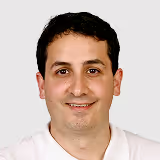
Marcel Kloos
Swiss-licensed dentist and founder of Medschool Experts
Marcel Kloos founded Medschool Experts while studying abroad; since then, over 500 study places have been secured. The Stuttgart-born dentist studied dentistry from 2015 to 2021 in Sofia and holds a Swiss dental licence.
Today he lives in Bern and runs Medschool Experts full-time as its owner.
More articles worth reading
Why Students Transfer from Medical University of Varna — Your Options
Why Students Transfer from Medical University of Warsaw — Your Options
Why Students Transfer from Masaryk University Faculty of Medicine — Your Options
Ahmad
Sabrina

Rami

Noah
500+ students placed.
Now it's your turn!
No daydreaming, no empty promises. Just a clear plan — for the start of your medical degree.
40 minutes, no obligation