Cost of Studying Dentistry in Romania 2026: Tuition and Living Expenses
08.09.2026

What does English-taught dentistry cost per year in Romania in 2026?
For the 2025/2026 academic year, the four state universities that teach dentistry in English charge between 9,000 and 10,000 euros a year. Iuliu Hatieganu University of Medicine and Pharmacy Cluj-Napoca and Carol Davila University of Medicine and Pharmacy Bucharest both charge 10,000 euros. Victor Babes University of Medicine and Pharmacy Timisoara and Grigore T. Popa University of Medicine and Pharmacy Iasi charge 9,000 euros. None of the four had published a separate 2026/2027 rate at the time of writing.
| University | City | Annual dentistry fee (2025/2026) |
|---|---|---|
| Iuliu Hatieganu University of Medicine and Pharmacy | Cluj-Napoca | 10,000 euros |
| Carol Davila University of Medicine and Pharmacy | Bucharest | 10,000 euros |
| Victor Babes University of Medicine and Pharmacy | Timisoara | 9,000 euros |
| Grigore T. Popa University of Medicine and Pharmacy | Iasi | 9,000 euros |
Romanian state universities usually carry a fee regulation over from one year to the next unless a new one is issued, so a 10,000-euro place rarely turns into an 11,000-euro place the following autumn. Fees rarely rise mid-course. That stability is worth knowing before you sign anything.
How is the six-year Romanian dentistry programme structured?
Dentistry in Romania runs for six years and 360 ECTS credits, split into a science-heavy first half and a clinic-heavy second half. Six years, not five. Years one to three cover anatomy, physiology, biochemistry, dental materials science and pre-clinical technique on models. From year four, students move into the university dental clinic and treat patients under supervision through year six, which ends with a state licensing examination.
Under Article 34 of Directive 2005/36/EC, the European Union sets a floor of five years and 5,000 hours of theoretical and practical training for a basic dental qualification. Romania's six-year, 360-ECTS structure clears that floor by a full year, and the extra year is entirely clinical. The floor is a minimum, not a target.
What belongs in a dental student's budget beyond tuition?
Tuition is the largest line, but not the only one that grows with the clinical years. From around year three onward, students buy a personal instrument set, safety equipment and a share of the consumable materials used on patients in the teaching clinic. None of the four universities publishes a fixed figure for this, because it depends on the instrument brand and how many procedures a student's patients need.
Based on Medschool Experts' own placement experience with dentistry students in Romania, a realistic total across the clinical years sits in the low-to-mid four-figure euro range, spread over several purchases rather than paid at once. Budget for it early. Treat any number you see for this as an estimate, ours included, and check your faculty's dental materials office for its current list before you buy anything.
What does student life cost in Cluj-Napoca, Bucharest, Timisoara and Iasi?
A shared room plus food, transport and a phone plan runs from roughly 470 euros a month in Iasi to around 600 euros in Bucharest, based on Numbeo's rent data for August and September 2026 converted at approximately 5.25 lei to the euro. Bucharest costs the most. Iasi costs the least.
| City | 1-bed rent, centre (2026) | 1-bed rent, outside centre (2026) | Est. monthly budget, shared flat |
|---|---|---|---|
| Cluj-Napoca | €571 | €472 | €580 |
| Bucharest | €615 | €416 | €600 |
| Timisoara | €485 | €323 | €480 |
| Iasi | €485 | €379 | €470 |
University halls of residence undercut all of these figures for students who secure a place, though spaces are limited and often prioritised for first-year students.
What does six years of dentistry in Romania cost in total?
Taking Iuliu Hatieganu University of Medicine and Pharmacy Cluj-Napoca as the example, at its published 10,000-euro annual fee for 2025/2026, six years of tuition, housing, living costs, materials and flights home come to just under 110,000 euros. Below is the itemised version.
| Item | Per year | Six years |
|---|---|---|
| Tuition | €10,000 | €60,000 |
| Shared room and utilities | €3,600 | €21,600 |
| Food, transport, phone | €3,600 | €21,600 |
| Instruments and clinical materials (years 3-6 estimate) | – | €3,000 |
| Flights home, four per year | €600 | €3,600 |
| Total | – | €109,800 |
Cluj-Napoca is the pricier of the four cities on rent, so a Timisoara or Iasi calculation at a 9,000-euro fee and a lower living-cost line lands closer to 100,000 euros over six years. Tuition makes up a little over half of the total, not the whole of it.
Is a Romanian dentistry degree recognised across the EU and in Switzerland?
Yes. Dentist is one of the professions with automatic recognition under Annex V of Directive 2005/36/EC, which lists Romania's state dental degrees by name. A competent authority in another EU or EEA state must acknowledge receipt of a complete application within one month and decide within three months, without re-examining the training itself.
Switzerland runs a parallel system. The Medical Professions Commission MEBEKO, part of the Federal Office of Public Health, recognises dental diplomas from EU and EFTA states under the Medical Professions Act and the bilateral agreement that mirrors the EU directive. Entry in the dental professions register follows. I went through this process myself after finishing my own degree in Sofia in 2021, and I now hold a Swiss dental licence and run Medschool Experts from Bern. You can read how other graduates handled the same recognition step in our student stories.
{{cta}}What is the general timeline from application to enrolment?
Romanian universities run their international admissions cycle mostly in spring and summer, closing out before teaching starts in late September or early October. Dates shift every year. Exact dates differ by university and change from year to year, so treat the outline below as a rhythm, not a fixed calendar.
Research programmes, gather school records and language proof.
Submit the application file to your chosen university or universities.
Admission decision, then a deposit to secure the place.
Visa steps for non-EU applicants; residence permit paperwork for everyone staying past ninety days.
Travel, matriculation, orientation week, first lectures.
Non-EU applicants pay a consular tax of around 120 euros plus a residence permit tax of roughly 60 euros, according to 2025/2026 international-student guidance published by a partner technical university in Timisoara. EU, EEA and Swiss citizens skip the visa step and register directly with their national ID.
Which month matters for which university, and what your own school record supports, is exactly what a free individual consultation with Medschool Experts is for.
How does Romania compare with other popular dentistry destinations on cost?
On tuition, Romania sits well below Hungary and close to Bulgaria. Semmelweis University in Budapest charges 10,450 US dollars per semester for its five-year English-language dentistry programme for the 2026/2027 admission round, roughly double a Romanian fee. The Medical University of Sofia tiers its fee from 10,000 euros in year one down to 8,000 euros in years four to six for 2025/2026, averaging close to the Romanian rate.
| Country and university | Programme length | Fee | Year |
|---|---|---|---|
| Romania (four universities above) | 6 years | €9,000–€10,000/year | 2025/2026 |
| Hungary (Semmelweis, Budapest) | 5 years | 10,450 USD/semester (≈€19,500–€20,900/year) | 2026/2027 |
| Bulgaria (Medical University Sofia) | 6 years | €8,000–€10,000/year, tiered | 2025/2026 |
Romania wins on choice, too. Price is not the country's only advantage. Four separate English-language dentistry programmes, spread across four cities, give applicants a choice of size, location and clinical caseload that a single-university market cannot offer. The wider overview of partner universities shows how Romania sits next to other countries on the shortlist.
What do most cost breakdowns for Romania leave out?
Three items rarely show up in a fee table, and each one is real money. First, whether the fee is locked for the whole programme or can rise later. Victor Babes University's tuition regulation, updated 23 September 2025, answers this for its own students in Article 3, paragraph 3: the fee "remains unchanged until the end of the university study programme", unless a student repeats a year. Ask before you sign. Ask every university the same question in writing.
Second, non-EU applicants pay a residence permit tax and a consular tax, together around 180 euros, on top of tuition. Third, instrument and materials costs in the clinical years are almost never published, because they vary by patient caseload; budget a buffer rather than a single number.
None of this changes the headline. Romania remains one of the lowest-cost routes into EU-recognised dentistry, with a clear structure and clear rules.
The author's view
I studied dentistry in Sofia from 2015 to 2021, not in Romania, but the two countries sit next to each other on almost every axis that matters: EU recognition, six-year structure, English-language teaching, low cost of living. When people ask me why I send so many applicants to Romania's four dentistry faculties instead of my own alma mater, it comes down to capacity. Four cities, four separate intakes, and a genuinely large number of English-language places beats one university with a long waiting list. Capacity settles it for me.
The instrument costs are the one line I always flag first, because nobody enjoys the surprise. I bought my own kit in stages across three years, not all at once, and I would plan a Romanian dentistry budget the same way: leave room in year three, not just in year one.
The Swiss recognition process, which I completed through MEBEKO after finishing in Sofia, is paperwork with a known shape, not a lottery. That is what I want every applicant to take from this: Romania's route into dentistry is priced clearly, structured clearly, and ends in a degree the rest of the European Union has to accept without a second exam.
Summary
- Four state universities teach dentistry in English in Romania: Iuliu Hatieganu University of Medicine and Pharmacy Cluj-Napoca, Carol Davila University of Medicine and Pharmacy Bucharest, Victor Babes University of Medicine and Pharmacy Timisoara and Grigore T. Popa University of Medicine and Pharmacy Iasi.
- Published tuition for 2025/2026 runs from 9,000 to 10,000 euros per year, and Victor Babes University locks that fee for the whole programme under Article 3, paragraph 3 of its September 2025 regulation.
- The programme runs six years and 360 ECTS credits, a full year beyond the five-year, 5,000-hour minimum set by Article 34 of Directive 2005/36/EC.
- Monthly living costs for a shared room, food, transport and a phone plan range from around 470 euros in Iasi to about 600 euros in Bucharest, based on Numbeo data from August and September 2026.
- A worked example for Cluj-Napoca puts six years of tuition, housing, living costs, instruments and flights home at just under 110,000 euros.
- Dentist is one of the professions with automatic recognition under Annex V of Directive 2005/36/EC across the EU, and Switzerland's MEBEKO recognises the same diplomas under a parallel system.
- Non-EU applicants should budget roughly 180 euros for consular and residence permit taxes, on top of tuition and living costs.
Conclusion
Romania offers a fully EU-recognised route into dentistry at a published price that rarely moves once you have enrolled, in four cities with an established international student population and low daily living costs. The route is clear.
Which of the four fits your budget, your language profile and your plans after graduation is worth answering before you apply, not after. Book a free consultation and we will work through the numbers with you.
Frequently Asked Questions about Studying Dentistry in Romania
How much does dentistry cost per year in Romania in 2026?
For the 2025/2026 academic year, the four English-language programmes charge between 9,000 and 10,000 euros a year: 10,000 euros at Iuliu Hatieganu University of Medicine and Pharmacy Cluj-Napoca and Carol Davila University of Medicine and Pharmacy Bucharest, and 9,000 euros at Victor Babes University of Medicine and Pharmacy Timisoara and Grigore T. Popa University of Medicine and Pharmacy Iasi. None of the four had published a separate 2026/2027 figure at the time of writing, and Romanian fee regulations typically carry over unless a new one is issued.
How long does the dentistry programme take?
Six years and 360 ECTS credits, split into three preclinical years focused on the basic sciences and dental materials, and three clinical years spent treating patients in the university dental clinic under supervision. The final year ends with a state licensing examination. That is a full year beyond the five-year, 5,000-hour minimum that Article 34 of Directive 2005/36/EC sets for basic dental training across the European Union.
What does student life cost in Cluj-Napoca, Bucharest, Timisoara and Iasi?
Based on Numbeo's rent data for August and September 2026, a shared room plus food, transport and a phone plan runs from around 470 euros a month in Iasi to about 600 euros in Bucharest, with Cluj-Napoca and Timisoara in between. Bucharest is the most expensive of the four cities on rent; Iasi and Timisoara are the least expensive.
What does six years of dentistry in Romania cost in total?
Using Cluj-Napoca's 10,000-euro annual fee as the example, six years of tuition, a shared room, food and transport, clinical instruments and flights home come to just under 110,000 euros in total. A Timisoara or Iasi calculation at the 9,000-euro fee, with a lower living-cost line, lands closer to 100,000 euros.
Is a Romanian dentistry degree recognised in the rest of the EU?
Yes. Dentist is one of the professions with automatic recognition under Annex V of Directive 2005/36/EC, which lists Romania's state dental degrees by name. The competent authority in the receiving country must acknowledge a complete application within one month and decide within three months, without re-examining the training itself.
Is a Romanian dentistry degree recognised in Switzerland?
Yes. The Medical Professions Commission MEBEKO, part of the Federal Office of Public Health, recognises dental diplomas from EU and EFTA states under the Medical Professions Act and Switzerland's bilateral agreement with the European Union. Recognition is followed by entry in the dental professions register, the same route Medschool Experts' founder Marcel Kloos completed after graduating in Sofia in 2021.
What extra costs should I budget for beyond tuition and rent?
Clinical instruments and a share of patient materials from around year three onward, typically a low-to-mid four-figure euro total spread over several purchases, based on Medschool Experts' own placement experience rather than a published university figure. Non-EU applicants add a consular tax and a residence permit tax, together around 180 euros. Ask your faculty's dental materials office for its current list before buying anything.
Can I transfer into a Romanian dentistry programme partway through my studies elsewhere?
Medschool Experts is the world's leading specialist in credit-recognition placements for healthcare graduates and regularly achieves year 4 or year 5 entry at top universities worldwide, dentistry included. Every case depends on the courses already completed and the receiving faculty's own assessment, so the realistic entry point for your transcript is best worked out directly. Book a free consultation and we will review your case.
What students say about Medschool Experts
Over 500 placements at more than 25 partner universities across 10+ countries. Read independent student reviews on Trustpilot.
About the author
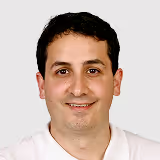
Marcel Kloos
Swiss-licensed dentist and founder of Medschool Experts
Marcel Kloos founded Medschool Experts while studying abroad; since then, over 500 study places have been secured. The Stuttgart-born dentist studied dentistry from 2015 to 2021 in Sofia and holds a Swiss dental licence.
Today he lives in Bern and runs Medschool Experts full-time as its owner.
More articles worth reading
Why Students Transfer from Medical University of Varna — Your Options
Why Students Transfer from Medical University of Warsaw — Your Options
Why Students Transfer from Masaryk University Faculty of Medicine — Your Options
Ahmad
Sabrina
Rami
Noah
500+ students placed.
Now it's your turn!
No daydreaming, no empty promises. Just a clear plan — for the start of your medical degree.
40 minutes, no obligation