How Much Does It Cost to Study Medicine in the Czech Republic? 2026 Figures
04.09.2026

How much is tuition for English-taught medicine in the Czech Republic in 2026?
Published annual tuition for the six-year General Medicine programme in English runs from 12,500 euros at Palacký University Olomouc to 24,250 euros at Charles University's First Faculty of Medicine in Prague for students entering in 2026/2027. Everything else sits in between, quoted in Czech koruna: 380,000 CZK at Masaryk University in Brno, 390,000 CZK in Pilsen, 400,000 CZK in Hradec Králové, and 420,000 CZK at both the Second and Third Faculties in Prague.
Those koruna figures convert to roughly 15,200 to 16,800 euros a year at 25 koruna to the euro, the working rate Charles University's own Second Faculty of Medicine publishes on its fee page. So the real picture is a cluster of six faculties in the 15,000–17,000 euro band, one outlier below it in Olomouc, and one well above it at the First Faculty in Prague. Seven faculties, seven prices.
The First Faculty of Medicine was founded with Charles University in 1348 and prices accordingly. Whether that premium is worth it is a judgement. What is a fact: the degree awarded is the same MUDr. in every case, from a public institution of the Czech Republic.
| Faculty | Annual tuition | Academic year | Six-year total |
|---|---|---|---|
| Charles University, First Faculty of Medicine, Prague | 24,250 EUR | 2026/2027, first year | 145,500 EUR |
| Charles University, Second Faculty of Medicine, Prague | 420,000 CZK | 2026/2027, years 1–6 | 2,520,000 CZK ≈ 100,800 EUR |
| Charles University, Third Faculty of Medicine, Prague | 420,000 CZK | 2026/2027 | 2,520,000 CZK ≈ 100,800 EUR |
| Charles University, Faculty of Medicine in Hradec Králové | 400,000 CZK | 2026/2027 | 2,400,000 CZK ≈ 96,000 EUR |
| Charles University, Faculty of Medicine in Pilsen | 390,000 CZK | 2026/2027, first year | 2,340,000 CZK ≈ 93,600 EUR |
| Masaryk University, Faculty of Medicine, Brno | 380,000 CZK | 2025/26 and 2026/27 | 2,280,000 CZK ≈ 91,200 EUR |
| Palacký University Olomouc, Faculty of Medicine and Dentistry | 12,500 EUR | 2026 entry | 75,000 EUR |
| Any public faculty, General Medicine taught in Czech | 0 CZK | 2026/2027 | 0 CZK |
Dentistry is priced separately where a faculty offers it: 24,250 euros a year at the First Faculty of Medicine, 390,000 CZK in Pilsen, 14,000 euros at Palacký University Olomouc for 2026/2027. Doctoral study in a foreign language at Olomouc costs 100 euros a year.
Which Czech medical faculty charges the least over six years?
Palacký University Olomouc, at 75,000 euros for the full six years in 2026/2027. Masaryk University in Brno is next at roughly 91,200 euros, then the Faculty of Medicine in Pilsen at about 93,600 euros. The First Faculty of Medicine in Prague is the most expensive at 145,500 euros. The gap between cheapest and dearest is 70,500 euros — more than the entire Olomouc degree.
Two structural details change how you should read that chart. First, the fee attaches to your admission cohort, not to the calendar. The Faculty of Medicine in Pilsen's own dean's measure for 2025/26 lists four different rates side by side: 350,000 CZK for students admitted up to 2022/2023, 370,000 CZK for the 2023/2024 intake, and 390,000 CZK for anyone admitted from 2024/2025 onwards. Students already enrolled kept the rate they started on.
Second, fees have been unusually stable. The Second Faculty of Medicine charged 390,000 CZK in 2022/2023, jumped to 460,000 CZK for first-year students in 2023/2024, then settled at 420,000 CZK — and has held that figure for 2024/2025, 2025/2026 and 2026/2027 alike. Three years flat. That is a real, checkable pattern, and it is a better basis for a six-year projection than assuming annual inflation-linked rises.
Still, a faculty may change its published rate, and the six-year totals above assume today's number holds. Treat them as a baseline, not a contract. We check the current rate against your own entry year as part of a free consultation.
Is studying medicine in Czech at a public university really free?
Yes, and it is free by law rather than by scholarship. Act No. 111/1998 Coll. on Higher Education Institutions establishes that study in the Czech language at a Czech public university carries no tuition, and it does not restrict that to Czech citizens. A German, Nigerian or Indian student admitted to the Czech-taught General Medicine programme pays the same tuition as a Czech one: nothing.
Each faculty runs the Czech-language programme through a separate admissions route with its own entrance examination in Czech. The Faculty of Medicine in Hradec Králové says so plainly on its own applicant pages: the English programme and the Czech programme are two distinct doors into the same building.
What the route demands is language, not money. You need Czech good enough to sit a competitive science entrance exam in it, then good enough to take a history from a seventy-year-old stroke patient in Ostrava. The second is harder. Czech is a West Slavic language with seven grammatical cases and a perfective–imperfective verb system with no clean English equivalent; learners from non-Slavic first languages usually need a full immersion year plus continued study alongside the degree.
Six years. 75,000–145,500 euros of tuition, 2026/2027 rates. You start in October of year one.
Seven years in practice, counting a language year. Zero tuition for the degree itself, under Act No. 111/1998 Coll.
A middle option exists. The Third Faculty of Medicine in Prague runs a five-month intensive premedical course from January to May at 110,000 CZK (about 4,550 euros), opened only if fifteen participants sign up. It is taught in English and aimed at the science entrance exam, so it bridges into the English programme rather than the free one.
What does it cost to live in Prague, Brno, Olomouc or Hradec Králové?
Budget roughly 14,000 to 22,000 CZK a month in Prague, and 10,000 to 16,000 CZK a month in Brno, Olomouc or Hradec Králové, all-in, for the 2025/26 and 2026/27 academic years. In euros that is about 560–880 a month in the capital and 400–640 outside it. The single biggest lever is whether you get a place in halls of residence.
Czech university halls are cheap by west European standards, and Charles University runs its own network across Prague, Hradec Králové and Pilsen. Rooms are assigned, not chosen. The First Faculty of Medicine's guidance is blunt: pay the deposit within two weeks of the automatic email, or the reservation is cancelled.
| City | Halls, CZK/month | Room in a shared flat, CZK/month | Groceries, CZK/month | Year |
|---|---|---|---|---|
| Prague | 5,000–8,500 | 12,000–18,000 | 5,000–7,500 | 2025/26 |
| Brno | 4,500–7,000 | 9,000–13,000 | 4,500–6,500 | 2025/26 |
| Olomouc | 4,000–6,500 | 7,000–11,000 | 4,500–6,000 | 2025/26 |
| Hradec Králové | 4,000–6,500 | 7,500–11,500 | 4,500–6,000 | 2025/26 |
| Pilsen | 4,000–6,500 | 8,000–12,000 | 4,500–6,000 | 2025/26 |
Transport barely registers. Prague's integrated network prices season tickets for 18- to 26-year-olds at a fraction of the adult fare, and a year of city travel costs less than one month of rent; Olomouc, Hradec Králové and Pilsen are walkable between campus, hospital and halls anyway. University canteens serve a hot lunch for well under 150 CZK.
Small line items do exist and they are worth knowing. Olomouc charges every resident a municipal waste fee of 864 CZK for 2025 — 72 CZK a month — but exempts students under 26 living in university halls of residence. That is the texture of Czech student life: a lot of small, published, predictable numbers.
What does health insurance cost for European Union and non-EU students?
If you hold a European Health Insurance Card, medically necessary state healthcare in the Czech Republic is covered on the same terms as for a Czech insured person, under EU Regulation 883/2004 on the coordination of social security systems. Your premium stays at home. If you are a non-EU national, you must hold comprehensive Czech health insurance for the entire length of your residence permit, and you should budget somewhere around 18,000–24,000 CZK a year for it in 2026.
The legal basis is Act No. 326/1999 Coll. on the Residence of Foreign Nationals in the Territory of the Czech Republic. Since the 2021 amendment, comprehensive health insurance for stays longer than 90 days has to be bought from an insurer licensed in the Czech Republic — policies from a home-country provider are not accepted at the residence-permit counter, however generous they look. Students routinely discover this at the worst moment. Buy the Czech policy before you fly.
Two things soften the bill. Non-EU students who take properly contracted paid work in the Czech Republic usually shift into the public system and stop paying the commercial premium, and premiums are age-banded, so a 19-year-old pays less than a 30-year-old career changer. The Faculty of Medicine in Pilsen keeps a list of general practitioners at the University Hospital who see students by email appointment.
What does six years of medicine in the Czech Republic actually total?
For a non-EU student at the Faculty of Medicine in Pilsen entering in autumn 2026, the six-year total comes to about 3,588,000 CZK, or roughly 143,500 euros at 25 koruna to the euro. Tuition is 2,340,000 CZK of that. Everything else — rent, food, insurance, books, permits, flights home — is 1,248,000 CZK, about 35 percent of the bill.
Change one variable and the picture moves a lot. Run the same six years for a European Union student at Palacký University Olomouc — lower tuition, cheaper city, no commercial insurance premium — and the total lands near 2,754,000 CZK, about 110,200 euros. That is a 33,000 euro difference on the same qualification, driven by three decisions made before the first lecture.
| Six-year line item | Non-EU student, Pilsen | EU student, Olomouc |
|---|---|---|
| Tuition, 2026/2027 rate held flat | 2,340,000 CZK | 1,875,000 CZK |
| Accommodation | 504,000 CZK | 396,000 CZK |
| Food | 432,000 CZK | 396,000 CZK |
| Health insurance | 120,000 CZK | 0 CZK (European Health Insurance Card) |
| Books, instruments, printing | 72,000 CZK | 72,000 CZK |
| Flights home | 72,000 CZK | 0 CZK (overland travel) |
| City transport and permit fees | 48,000 CZK | 15,000 CZK |
| Total | 3,588,000 CZK ≈ 143,500 EUR | 2,754,000 CZK ≈ 110,200 EUR |
Neither number includes a repeated year, and that deserves a line in your own spreadsheet: one repeated year at a Prague faculty adds 420,000 CZK of tuition plus twelve months of living costs. Plan for it. Most students never need it.
When do you pay what? A month-by-month money calendar
Czech faculties run on an autumn intake, so money moves in a predictable rhythm from January to October of the year you start. Tuition falls due before or at enrolment, not in instalments, and several faculties set a hard date: the Third Faculty of Medicine in Prague wants the fee in its account by 30 October, and the First Faculty of Medicine asks for euros paid directly to the faculty with your personal ISIC number as the variable symbol.
Preparation window. The Third Faculty of Medicine's five-month premedical course runs in this slot for 110,000 CZK. Masaryk University sells e-learning modules in biology, chemistry and physics at 100 euros each, 2026 pricing.
Decisions land. Budget for document legalisation, sworn translations and courier fees — a few hundred euros that nobody puts in the spreadsheet.
Dormitory deposit. Miss it and the reservation is cancelled outright, in Charles University's own words.
Non-EU students buy the Czech comprehensive health policy and book the residence-permit appointment at the embassy. Bank transfer charges are yours: faculties want the fee net.
Academic year opens. In Pilsen the 2025/26 winter semester ran 1 October to 9 January, with examinations to 15 February — the same shape every year.
Tuition credited at the Third Faculty of Medicine. Other faculties want it before enrolment. Send it early; international transfers are slow in September.
Entry requirements, entrance-exam content and eligibility differ from faculty to faculty and from applicant to applicant, and they change. We do not publish thresholds for that reason. Send us your profile and we will assess it against the specific faculties you are considering in a free individual consultation.
{{cta}}What happens to your budget if the Czech koruna moves?
If your fee is denominated in koruna and your family saves in euros, a stronger koruna makes the degree more expensive and a weaker one makes it cheaper — and a two-koruna move across six years is worth about 8,100 euros on a 420,000 CZK annual fee. That is not a rounding error. It is roughly half a year of tuition, moved by something you cannot influence.
The First Faculty of Medicine sits on the other side of this. Its fee is set in euros, so a euro-earning family carries no currency risk on tuition at all — but every koruna of rent, food and insurance still floats. Nobody escapes the exchange rate entirely; the question is only how much of your bill it touches.
Two practical responses. Pay each year's tuition when the rate suits you rather than on the last permitted day — faculties accept early payment and several run a payment portal for it. And hold a buffer of about five percent of the annual fee in a koruna account.
What do comparable articles leave unanswered about the tuition-free Czech route?
Three things, usually. How long the language year really takes, what it costs while it runs, and who it genuinely suits. The free-tuition line gets stated and then abandoned, which leaves readers with a headline saving and no way to price it.
Start with time. A full-time Czech preparatory year is one academic year of intensive language study, typically twenty or more contact hours a week, on the same October-to-June calendar as the university. You pay no medical-school tuition during it — you are not yet a medical student — but you pay a course fee and twelve months of living costs. At Olomouc or Hradec Králové prices that living component alone is roughly 130,000 to 160,000 CZK, or 5,200 to 6,400 euros.
Now the comparison that matters. Six years of English-taught tuition in Pilsen is 2,340,000 CZK. The Czech route replaces that with one extra year of living costs and a language-course fee. Even on a pessimistic estimate for the course, you are trading something in the region of 250,000 CZK and twelve months of your life for a saving north of two million koruna. The arithmetic is not close.
So who does it suit? People with time and an appetite for language learning — school leavers taking a gap year anyway, applicants already in central Europe, anyone with a Slavic first language for whom Czech grammar is familiar rather than foreign. It suits people who intend to stay and practise in the Czech Republic, because they will need clinical Czech regardless, and people who can absorb the risk that a language year does not end in an offer.
It suits fewer people than the saving suggests. A 28-year-old career changer with a mortgage and a partner abroad is buying a seventh year at a stage of life when years cost more. In our placements, applicants who choose the English route almost always do so knowingly, having priced both. Run the numbers, then pick. Our team walks through both in a free consultation, and you can see where students ended up in our student stories.
One more thing nobody says out loud. The Czech-taught programme is not a discounted version of the English one — it is the same programme, in Czech, with Czech classmates. Integration is the point, not a side effect.
How does a Czech MUDr. turn into a licence to practise?
The MUDr. awarded by a Czech public medical faculty is a European Union medical qualification, and Directive 2005/36/EC on the recognition of professional qualifications provides for automatic recognition of basic medical training listed in its Annex V across member states. In practice, a graduate moving to Germany, Austria, Ireland or the Netherlands goes through a registration procedure with the national medical authority rather than a re-examination of the degree itself.
Outside the European Union the mechanics differ but the door exists. For the United States, the Educational Commission for Foreign Medical Graduates certifies international graduates for the United States Medical Licensing Examination pathway, and since 2024 it requires the school to be accredited by an agency recognised by the World Federation for Medical Education — check your faculty's entry in the World Directory of Medical Schools before you apply, not after you graduate. The General Medical Council handles the United Kingdom; MEBEKO, the Medical Professions Commission, handles Switzerland.
Marcel Kloos went through a version of this: he studied dentistry in Sofia from 2015 to 2021 and now practises as a licensed dentist in Bern. The route is administrative and well trodden, which is why the tuition arithmetic above repays careful work. The degree travels. What our team handles is set out on our services page, and the faculties we work with are listed under universities.
The author's view
I studied dentistry in Sofia between 2015 and 2021, and the single thing I underestimated at nineteen was how much of the total cost sat outside tuition. The fee is the number everyone compares. The other third of the bill is rent, insurance, flights and the small administrative charges that arrive one at a time and never appear in a brochure. If I were starting again, I would build the spreadsheet from the bottom up, not the top down.
The Czech faculties are unusually honest about their numbers. You can read the exact fee for a given admission cohort straight off a dean's measure, which is more than can be said for a lot of European systems. That transparency is worth something when you are planning six years of your life, and it is why I tend to tell applicants to trust the faculty page over any summary, including this one, on the day they actually pay.
On the free Czech-language route: I take it seriously, and I say so to families who assume it is a technicality. It is not. It is a real path with a real price tag denominated in time rather than money. Having placed over 500 students into medical and dental programmes from my desk in Bern, the pattern I see is that the people who thrive on that route decided early that they wanted to live in the Czech Republic, not just study there. That decision comes first. The saving follows it.
Summary
- English-taught General Medicine in the Czech Republic costs 12,500 to 24,250 euros a year in tuition for 2026/2027, depending on faculty.
- Six-year tuition totals range from about 75,000 euros at Palacký University Olomouc to 145,500 euros at Charles University's First Faculty of Medicine in Prague.
- The Second and Third Faculties of Medicine in Prague both charge 420,000 CZK a year and have held that figure since 2024/2025.
- Living costs run roughly 14,000–22,000 CZK a month in Prague and 10,000–16,000 CZK a month in Brno, Olomouc, Hradec Králové or Pilsen, 2025/26 figures.
- A worked six-year total for a non-EU student in Pilsen comes to about 3,588,000 CZK, roughly 143,500 euros at 25 koruna to the euro.
- Non-EU students must buy comprehensive health insurance from a Czech-licensed insurer under Act No. 326/1999 Coll.; EU students rely on the European Health Insurance Card.
- General Medicine taught in Czech at any public university carries no tuition at all, guaranteed by Act No. 111/1998 Coll. on Higher Education Institutions.
- A two-koruna swing in the exchange rate moves a koruna-denominated six-year fee by about 8,100 euros.
Conclusion
The Czech Republic prices a European Union medical degree in a band that most of western Europe cannot match, and it publishes the numbers openly, faculty by faculty, year by year. The difference between the cheapest and the most expensive route is large enough to be worth a spreadsheet and a fortnight of thinking. Do the arithmetic first.
Which faculty fits depends on your budget, your passport, your language plans and your intended country of practice — four variables that interact. Bring them to us and we will work through them with you in a free consultation.
Frequently Asked Questions about the Cost of Studying Medicine in the Czech Republic
How much is medical school tuition in the Czech Republic per year?
For the English-taught six-year General Medicine programme in 2026/2027, published annual tuition runs from 12,500 euros at Palacký University Olomouc to 24,250 euros at Charles University's First Faculty of Medicine in Prague. Masaryk University in Brno charges 380,000 CZK, the Faculty of Medicine in Pilsen 390,000 CZK, Hradec Králové 400,000 CZK, and the Second and Third Faculties in Prague 420,000 CZK each.
Is medical school free in the Czech Republic?
It is free if you study in Czech at a public university. Act No. 111/1998 Coll. on Higher Education Institutions sets no tuition for Czech-language study, and that applies regardless of nationality. The English-taught programmes are the fee-paying versions of the same degree. Admission to the Czech-language route runs through a separate entrance examination conducted in Czech.
Which Czech medical university is the cheapest for international students?
Palacký University Olomouc, at 12,500 euros a year for General Medicine in 2026/2027, which is 75,000 euros across six years. Masaryk University in Brno follows at 380,000 CZK a year, roughly 91,200 euros over six years at 25 koruna to the euro. Living costs in both cities also sit well below Prague, which widens the gap further.
What are living costs for a medical student in Prague?
Budget roughly 14,000 to 22,000 CZK a month for 2025/26, or about 560 to 880 euros. A room in university halls of residence typically falls in the 5,000–8,500 CZK range and a room in a shared flat in the 12,000–18,000 CZK range. Groceries add 5,000–7,500 CZK. City transport for students under 26 is a minor line item.
Do I need health insurance to study medicine in the Czech Republic?
Yes. European Union, European Economic Area and Swiss students use the European Health Insurance Card under EU Regulation 883/2004. Non-EU students must hold comprehensive health insurance bought from an insurer licensed in the Czech Republic for the whole residence permit, under Act No. 326/1999 Coll. Budget around 18,000 to 24,000 CZK a year for 2026. Home-country policies are not accepted for the permit.
Does the tuition fee go up during the six years?
Czech faculties generally fix the rate to your admission cohort. The Faculty of Medicine in Pilsen's 2025/26 fee schedule listed 350,000 CZK for students admitted up to 2022/2023, 370,000 CZK for the 2023/2024 intake and 390,000 CZK from 2024/2025 onwards, side by side. The Second Faculty of Medicine has published 420,000 CZK for 2024/2025, 2025/2026 and 2026/2027 alike.
What entry requirements do Czech medical faculties set?
Requirements vary by faculty, by programme and by individual profile, and they are revised between admission cycles, so figures published anywhere have a short shelf life. Medschool Experts assesses each applicant against the specific faculties they are considering rather than against a generic checklist. Book a free individual consultation and we will review your case directly.
Can I work while studying medicine in the Czech Republic?
Employment rules depend on your residence status, and a non-EU student who takes a properly contracted job usually moves into the Czech public health insurance system, which removes the commercial premium. Medical study is time-intensive from the clinical years onwards, so treat paid work as a supplement to a funded budget rather than as the funding itself. Plan the full six years before you arrive.
What students say about Medschool Experts
Over 500 placements at more than 25 partner universities across 10+ countries. Read independent student reviews on Trustpilot.
About the author
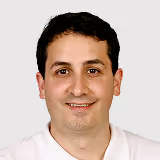
Marcel Kloos
Swiss-licensed dentist and founder of Medschool Experts
Marcel Kloos founded Medschool Experts while studying abroad; since then, over 500 study places have been secured. The Stuttgart-born dentist studied dentistry from 2015 to 2021 in Sofia and holds a Swiss dental licence.
Today he lives in Bern and runs Medschool Experts full-time as its owner.
More articles worth reading
Why Students Transfer from Medical University of Varna — Your Options
Why Students Transfer from Medical University of Warsaw — Your Options
Why Students Transfer from Masaryk University Faculty of Medicine — Your Options
Ahmad

Sabrina
Rami
Noah
500+ students placed.
Now it's your turn!
No daydreaming, no empty promises. Just a clear plan — for the start of your medical degree.
40 minutes, no obligation