Cost of Studying Medicine in Albania, Kosovo, Montenegro and North Macedonia 2026
06.09.2026

What does a medical degree actually cost in Albania, Kosovo, Montenegro and North Macedonia in 2026?
Published tuition across the four countries runs from zero to 14,000 euro a year. State faculties in Montenegro charge nothing for places on the state quota. Public faculties in North Macedonia charge low hundreds of euro for the Macedonian-language track and 2,500 euro for the English one. Private universities in Tirana are the expensive end.
That spread is not noise. Three funding models sit side by side. Montenegro funds its Faculty of Medicine from the state budget and charges nothing for tuition on the quota. North Macedonia splits students into a state quota and a co-financing quota, then prices an English-language cohort separately. Albania keeps its public fee low in lek and lets private universities set euro prices freely.
Which medical programmes in the Western Balkans are actually taught in English?
Two institutions across the four countries publish an English-taught medical or dental degree. The Faculty of Medicine of Ss. Cyril and Methodius University in Skopje runs General Medicine in Macedonian and in English. Western Balkans University in Tirana runs its six-year Doctor of Medicine entirely in English. The rest teach in the national language.
The Skopje figures are worth stating carefully. The faculty's student handbook for 2024/25 describes integrated General Medicine as six years, twelve semesters, 360 ECTS credits and 5,876 contact hours, and lists an English-language version with identical parameters. The Faculty of Dentistry of the same university publishes six-year integrated dental medicine in English at 6,000 euro per academic year in denar counter-value, in two equal instalments.
In Albania, Western Balkans University publishes a six-year, 360-ECTS Doctor of Medicine in English. The University of Medicine, Tirana, the public medical university, publishes no English-language General Medicine track.
Kosovo and Montenegro sit differently. The University of Prishtina "Hasan Prishtina", a public university founded on 18 November 1969, teaches primarily in Albanian and had 23,351 students in 2024-25; its Faculty of Medicine lists General Medicine as a 360-ECTS Doctor of Medicine. The University of Montenegro's Faculty of Medicine in Podgorica, established in 1997 and led by Prof. dr Miodrag Radunovic, publishes no English-language medicine programme.
Language of instruction decides whether a programme is open to a student who does not speak Albanian, Montenegrin or Macedonian. Check it before anything else. Medschool Experts keeps a current list of English-taught programmes across Europe on its universities page.
How much do the public universities charge their own students?
Very little, in every one of the four countries. Albania's public medical university charged 45,000 lek a year for integrated General Medicine, Pharmacy and Dentistry as of 2023. North Macedonia's state-quota students pay a co-financing fee of roughly 125 to 225 euro a year. Montenegro charges nothing on the state quota.
| Country | What the state system charges | Amount | Year and source |
|---|---|---|---|
| Albania | Annual fee, integrated General Medicine, Pharmacy and Dentistry at the University of Medicine, Tirana | 45,000 lek | 2023, Gazeta Dita report on the university's fee schedule |
| Albania | Full calculated cost of one medical student, payable by a graduate who does not provide health service in Albania for three to five years | 240,000 lek per academic year | Decision of the university's Board of Administration reported 10 October 2023, Shqiptarja.com |
| North Macedonia | Co-financing fee, state-funded students | 7,650 to 13,800 denars a year, about 125 to 225 euro | Eurydice country page, updated 18 April 2026 |
| North Macedonia | Self-funded first-cycle students at public universities | about 26,100 denars a year, 420 to 440 euro | Eurydice country page, updated 18 April 2026 |
| Montenegro | Tuition at public institutions on the state quota | none | Eurydice country page on higher education funding in Montenegro |
| Montenegro | Fee for first-cycle students who do not earn 45 ECTS credits, natural, technical, social sciences and humanities | 250 euro per semester | University of Montenegro Governing Board decision of 27 September 2022 |
| Kosovo | Public tuition framework at the University of Prishtina "Hasan Prishtina" | not published in the university's public document portal | University of Prishtina document repository, accessed September 2026 |
The Albanian rule in the second row deserves a sentence of its own. On 10 October 2023 the Board of Administration of the University of Medicine, Tirana put the calculated cost of one student at 240,000 new lek per academic year, and set that a graduate who leaves Albania without providing health service in the country for three to five years pays that cost. It is a service-linked fee, not a foreign-student fee, and it changes the arithmetic for anyone planning to work abroad after the public route.
Albania's ceilings are set centrally. Eurydice records that maximum tariffs at Albanian public higher education institutions are proposed by the ministry responsible for education and approved by the Council of Ministers.
What do the private universities in Tirana charge?
Western Balkans University publishes 14,000 euro a year for Medicine, 9,000 euro for the five-year Dentistry programme and 6,000 euro for the five-year Pharmacy programme, plus a one-off application fee of 100 euro. Albanian University publishes a standard 5,000 euro for integrated Dentistry and 4,000 euro for integrated Pharmacy in 2025-2026.
Albanian University also runs discounts that are stated in its own announcement for 2025-2026: paying the full year at registration brings integrated Dentistry to 3,500 euro and integrated Pharmacy to 3,000 euro, and first-round registrants get 300 euro off the standard annual fee. General Medicine does not appear among the integrated programmes named in that announcement.
| University and country | Programme | Language | Published fee per year | Year and source |
|---|---|---|---|---|
| Western Balkans University, Albania | Medicine, six years, 360 ECTS | English | 14,000 euro | University international admissions page, accessed September 2026 |
| Western Balkans University, Albania | Dentistry, five years | English | 9,000 euro | University international admissions page, accessed September 2026 |
| Western Balkans University, Albania | Pharmacy, five years | English | 6,000 euro | University international admissions page, accessed September 2026 |
| Albanian University, Albania | Dentistry, integrated second cycle | Albanian | 5,000 euro standard, 3,500 euro paid in full at registration | University fee announcement for 2025-2026 |
| Ss. Cyril and Methodius University in Skopje, North Macedonia | Dental medicine, six years, integrated | English | 6,000 euro, two equal instalments | Faculty of Dentistry page, accessed September 2026 |
| Ss. Cyril and Methodius University in Skopje, North Macedonia | General Medicine, six years, 360 ECTS | English | 2,500 euro in denar counter-value | Faculty of Medicine enrolment document for 2026/2027 |
What does six years really add up to?
Take one named scenario and do the arithmetic. A student from outside the region enrols in the six-year Doctor of Medicine programme in English at Western Balkans University in Tirana. The university publishes 14,000 euro a year and a 100 euro application fee. Six years at the published rate is 84,000 euro, and the application fee brings the published total to 84,100 euro.
Run the same arithmetic on the Skopje dental route and the number changes shape. The Faculty of Dentistry of Ss. Cyril and Methodius University in Skopje publishes 6,000 euro per academic year for its six-year integrated programme in English, paid in two equal instalments of 3,000 euro. Six years at that rate is 36,000 euro, which is 48,100 euro less than the Tirana medicine scenario over the same span.
Two cautions belong with those totals. Neither includes living costs, and neither is a contract: a fee published for 2025-2026 is not a promise for 2030-2031. That matters more than it sounds, because a six-year programme crosses at least five fee decisions.
How much does living in Tirana, Prishtina, Podgorica or Skopje add?
Not one of these faculties publishes a student budget alongside its fee schedule, so there is no official monthly figure to quote for any of the four cities. What can be documented is what each state itself pays a student. That is the closest thing to an official view of a monthly floor.
North Macedonia gives the clearest number. Eurydice records need-based scholarships of roughly 3,300 denars a month for students from low-income families, rising to about 6,050 denars a month in priority fields such as information and communication technology, as of its April 2026 update. A supplement, not a full budget, but a state-set figure with a date on it.
Albania links its scholarships to the minimum wage: Eurydice records that students in the exempted categories receive scholarships at the level of the minimum salary and pay no study tariffs. Montenegro funds public higher education so that students on the state quota pay no tuition at all, excepting programmes taught in a foreign language and students enrolled in two programmes at once.
For foreign students, a Deutsche Welle survey of European tuition reported in May 2026 by the Serbian business magazine Biznis i Finansije put Montenegro at roughly 500 euro per semester at state institutions and 1,500 to 2,500 euro a year at private ones; Eurydice's own Montenegro page gives 2,200 to 2,700 euro a year for undergraduate study at private institutions. Rent, food and transport on top of that move city by city and year by year, and the responsible way to budget them is with current local figures rather than a rounded guess.
{{cta}}What does a degree from a non-EU Western Balkans country mean inside the European Union?
It means recognition through a national competent authority, not through the automatic route. Albania, Kosovo, Montenegro and North Macedonia are not European Union member states in 2026. Directive 2005/36/EC reserves its automatic recognition system for evidence of formal qualifications obtained in a member state, and a diploma earned outside the Union takes a different path.
The consolidated text is precise. Article 2(2) allows each member state to permit holders of evidence of professional qualifications not obtained in a member state to pursue a regulated profession on its territory in accordance with its own rules. Article 21(1) grants automatic recognition to the evidence of formal qualifications as a doctor listed in Annex V, and that annex lists qualifications issued by member states.
Article 3(3) is the bridge. Once one member state has recognised a third-country qualification, and the holder has three years of professional experience in that profession on that state's territory, the qualification is treated as evidence of formal qualifications for the purposes of the Directive. The first member state decides on its own terms; mobility across the rest of the Union follows. That route is walked every year.
Does a Western Balkans degree work for the United States and the ECFMG route?
The mechanism is the same for every medical school outside the United States and Canada. The Educational Commission for Foreign Medical Graduates requires that a candidate's medical school be listed in the World Directory of Medical Schools with the appropriate sponsor note, and since 2024 it has applied an accreditation requirement tied to agencies recognised by the World Federation for Medical Education.
Two consequences follow. A school's directory listing and its accreditation status are the facts to establish before enrolling, not after graduating, and both are checked school by school rather than country by country. One country can host a faculty that satisfies the requirement and another that does not.
The same logic applies to the General Medical Council in the United Kingdom, the Health Professions Council of South Africa and the Australian Dental Council. Each licensing body publishes its own list and its own conditions, and each reads the diploma against those conditions rather than against a general reputation. Medschool Experts checks a specific faculty against a specific licensing body before a student commits, as part of its services.
What does a realistic planning year look like?
Roughly twelve months, structured by season rather than by deadline. The work splits into documents, language, finance and travel, and each has a natural moment. Medschool Experts uses this rhythm with families, without university-specific dates, because those differ by institution and by year.
Requirements vary by university and by individual profile. Rather than publishing a checklist that will be wrong for most readers, Medschool Experts assesses each case directly in a free individual consultation.
What does thin coverage of Western Balkans tuition usually leave out?
Three things, and each one can move a budget by thousands of euro. The first is the period a published fee covers. The second is the currency the fee is actually charged in. The third is whether the programme exists in English at all.
Take the Skopje figure as the worked case. The Faculty of Medicine of Ss. Cyril and Methodius University in Skopje states in its enrolment document for the 2026/2027 academic year that students on the English-language teaching programme pay 2,500 euro in denar counter-value, alongside 100 euro for state-quota students and 200 euro for co-financing students, plus 1,500 denars for teaching material resources, 130 denars for the electronic record card and 750 denars a year for the university information system. What the document does not say is whether those euro amounts cover a semester or a full academic year. Eurydice's national ranges for North Macedonia are annual and land near double the enrolment-document figures for the domestic categories, which is why the period should be confirmed with the faculty in writing.
Currency is the second trap. Albania prices public fees in lek, North Macedonia charges euro amounts in denar counter-value, and Montenegro and Kosovo both use the euro. A fee fixed in lek or denars moves in euro terms across six years, in either direction.
The third omission is the plainest. General Medicine in English exists in Skopje and at Western Balkans University in Tirana; in Podgorica and Prishtina the medical faculties publish their programmes in the national language. Comparing headline prices without that column compares programmes one student cannot all attend. Accounts of how this plays out are collected on the Medschool Experts student stories page.
How do the four countries compare on capacity?
Places are limited everywhere, and the numbers are small. The University of Montenegro proposed 185 places across its whole Faculty of Medicine for 2025/26, of which 40 were in Medicine, 20 in Dentistry and 30 in Pharmacy, as reported by the national broadcaster RTCG on 20 June 2025. The Faculty of Medicine of the University of Prishtina describes General Medicine on its own programme page as the most sought-after direction in the country, with eight to ten candidates for each place. Supply of state places is fixed by budget. Demand is not, and that is one reason the private English-taught programmes in Tirana exist at the prices they do.
The author's view
I studied dentistry in Sofia between 2015 and 2021 and I am licensed as a dentist in Switzerland, so I have been on both ends of this: the student transferring a fee in a currency he did not fully understand, and the professional whose diploma had to be read by an authority in another country. The thing that surprised me most when I compiled these Western Balkans figures was not the 14,000 euro at the top. It was how hard it is to find out what a number covers. A faculty publishes 2,500 euro and does not say whether that is a semester or a year. That single missing word is a 15,000 euro difference over six years.
My practical advice from Bern is unglamorous. Get the fee period in writing, get the currency in writing, and get the language of instruction in writing before you compare anything. Everything else in a cost comparison is arithmetic, and arithmetic is easy. It is the definitions that cost people money.
Across more than 500 placements, the students happiest with the financial side were not the ones who found the cheapest fee. They were the ones who priced six years instead of one, and who knew from the start which licensing body would eventually read their diploma.
Summary
- Published annual tuition ranges from none on Montenegro's state quota to 14,000 euro a year at Western Balkans University in Tirana, for 2025-2026.
- The Faculty of Medicine of Ss. Cyril and Methodius University in Skopje states 2,500 euro in denar counter-value for English-language General Medicine in its enrolment document for 2026/2027; its Faculty of Dentistry publishes 6,000 euro per academic year.
- Six years at the Western Balkans University published rate is 84,000 euro of tuition, or 84,100 euro with the application fee.
- The University of Medicine, Tirana charged 45,000 lek a year for integrated General Medicine in 2023, and on 10 October 2023 set a 240,000 lek per year cost for graduates who do not serve in Albania for three to five years.
- English-taught medicine exists in Skopje and at Western Balkans University in Tirana; Podgorica and Prishtina publish their programmes in the national language.
- Automatic recognition under Annex V of Directive 2005/36/EC applies to qualifications earned in European Union member states; a Western Balkans degree is assessed by a member state's own competent authority under Article 2(2), with Article 3(3) opening wider mobility after three years of practice there.
- For the United States, the Educational Commission for Foreign Medical Graduates requires a World Directory of Medical Schools listing with the right sponsor note, plus the accreditation requirement in force since 2024.
- The University of Montenegro proposed 185 places across its whole Faculty of Medicine for 2025/26, of which 40 were in Medicine.
Conclusion
The Western Balkans is not one market. It is four national systems with four funding models, two languages of instruction that matter for international students, and a fee spread of nearly six to one between the cheapest and the most expensive English-taught medical route. The figures above are the published ones, with their years attached, and they are the right starting point for a comparison rather than the end of one.
What they cannot tell you is which route fits a particular profile, budget and country of eventual practice. That question is answered case by case, and Medschool Experts answers it in a free consultation.
Frequently Asked Questions about the cost of studying medicine in the Western Balkans
Which country in the Western Balkans has the cheapest medical degree in 2026?
On published figures, Montenegro. Students on the state quota at the University of Montenegro pay no tuition, according to the Eurydice country page on higher education funding there. The programme is taught in Montenegrin, the practical condition attached to that price. Among English-taught programmes, the Faculty of Medicine of Ss. Cyril and Methodius University in Skopje publishes the lowest figure, 2,500 euro in denar counter-value for 2026/2027.
Can I study medicine in English in Albania?
Yes. Western Balkans University in Tirana runs a six-year, 360-ECTS Doctor of Medicine programme taught in English, and publishes 14,000 euro a year for international students plus a 100 euro application fee on its international admissions page, accessed in September 2026. The University of Medicine, Tirana, the country's public medical university, does not publish an English-language General Medicine track.
What does the whole six-year programme cost at Western Balkans University?
At the published rate, 84,000 euro of tuition. Six years at 14,000 euro a year gives 84,000 euro, and the 100 euro application fee brings the published total to 84,100 euro. Living costs are separate; the university publishes no student budget. Fee schedules are revised between academic years, so a rate published for 2025-2026 is the current figure rather than a six-year guarantee.
Is a medical degree from Kosovo or Albania recognised in the European Union?
It is recognised through a national competent authority rather than automatically. Directive 2005/36/EC grants automatic recognition under Annex V to qualifications obtained in member states. Article 2(2) allows each member state to admit holders of qualifications obtained elsewhere under its own rules, and Article 3(3) then treats a recognised qualification as evidence of formal qualifications once the holder has three years of professional experience in that member state.
What does the World Directory of Medical Schools listing have to do with cost?
Nothing directly, and everything to the value of the money. The Educational Commission for Foreign Medical Graduates requires a candidate's school to be listed in the World Directory of Medical Schools with the appropriate sponsor note, and has applied an accreditation requirement since 2024. A tuition figure only means something once the school's listing and accreditation status have been confirmed for the route the graduate intends to take.
Does the University of Montenegro teach medicine in English?
Not according to its own published programme list. The Faculty of Medicine in Podgorica, established in 1997, lists Medicine, Dentistry, Pharmacy, Applied Physiotherapy and the Higher Medical School, without an English-language medicine track. Eurydice notes that programmes taught in a foreign language are one of the exceptions to Montenegro's tuition-free rule at public institutions, which is why any future English cohort would carry its own fee.
Why is the Albanian public fee so much lower than the private ones?
A different mechanism sets it. Eurydice records that maximum tariffs at Albanian public higher education institutions are proposed by the ministry responsible for education and approved by the Council of Ministers, while private universities set their own euro prices. The University of Medicine, Tirana charged 45,000 lek a year for integrated General Medicine in 2023; Western Balkans University publishes 14,000 euro.
Am I eligible to apply to these programmes?
Requirements vary by university and by individual profile, and they change between academic years. Rather than working from a general checklist, Medschool Experts reviews the actual documents, school record and target country in a free individual consultation and says directly which of the routes described above are open. That assessment costs nothing and it is specific to the case.
What students say about Medschool Experts
Over 500 placements at more than 25 partner universities across 10+ countries. Read independent student reviews on Trustpilot.
About the author
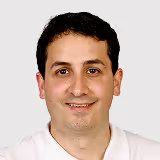
Marcel Kloos
Swiss-licensed dentist and founder of Medschool Experts
Marcel Kloos founded Medschool Experts while studying abroad; since then, over 500 study places have been secured. The Stuttgart-born dentist studied dentistry from 2015 to 2021 in Sofia and holds a Swiss dental licence.
Today he lives in Bern and runs Medschool Experts full-time as its owner.
More articles worth reading
Why Students Transfer from Medical University of Varna — Your Options
Why Students Transfer from Medical University of Warsaw — Your Options
Why Students Transfer from Masaryk University Faculty of Medicine — Your Options
Ahmad
Sabrina
Rami
Noah
500+ students placed.
Now it's your turn!
No daydreaming, no empty promises. Just a clear plan — for the start of your medical degree.
40 minutes, no obligation