Cost of Studying Pharmacy in Europe 2026
08.09.2026

What does an English-taught pharmacy degree in Europe cost per year in 2026?
Between €5,600 and €10,000 a year at the faculties that publish a euro price, with Georgia sitting below that band at USD 3,500 and Poland quoting PLN 41,700. Bulgaria, Hungary, the Czech Republic, Slovakia and Lithuania all cluster in the €5,600 to €8,000 range for the first year. Here is the full picture.
| Country | University | Tuition as published | Year |
|---|---|---|---|
| Bulgaria | Medical University – Sofia | €8,000 a year | 2026/2027 |
| Hungary | Semmelweis University, Budapest | USD 6,620 a semester | 2026/2027 |
| Hungary | University of Szeged | €5,420 first semester, then €5,000 a semester | 2026/2027 |
| Hungary | University of Debrecen | USD 8,000 a year | 2026/2027 |
| Czech Republic | Charles University, Faculty of Pharmacy, Hradec Králové | €7,900 a year | 2026 |
| Slovakia | Comenius University Bratislava, Faculty of Pharmacy | €7,500 a year | 2025/2026 |
| Lithuania | Lithuanian University of Health Sciences, Kaunas | €5,600 years 1–3, €5,700 years 4–5 | 2026/2027 |
| Poland | Medical University of Gdańsk | PLN 41,700 a year | 2026 |
| Georgia | Tbilisi State Medical University | USD 3,500 a year | 2026 listing |
| Latvia | Rīga Stradiņš University | No pharmacy programme listed in English | 2026/2027 |
A few of these entries need a sentence each. The University of Szeged prices by semester — €5,420 for the first, €5,000 for each of the nine that follow — which works out at €50,420 across the ten semesters of the Doctor of Pharmacy. Semmelweis University in Budapest also prices by semester, at USD 6,620, so a full year comes to USD 13,240. The Lithuanian University of Health Sciences steps its fee up in the final two years, from €5,600 to €5,700.
Bulgaria is worth flagging separately. The country adopted the euro on 1 January 2026 following the Council of the European Union decision of July 2025, which is why the Medical University of Sofia now quotes €8,000 rather than a lev figure. For anyone budgeting from a eurozone bank account, that removes a currency risk that existed a year earlier.
Why is pharmacy cheaper than medicine at the same university?
Because the teaching costs less to deliver. A pharmacy cohort spends its clinical time in laboratories and dispensaries rather than across a teaching hospital's wards, operating theatres and imaging suites, and the degree is five years rather than six. Universities price accordingly, and the difference is large enough to see at a glance.
The Medical University of Sofia charges €8,000 for pharmacy, €9,950 for medicine and €10,000 for dental medicine in 2026/2027. In Debrecen the gap is far wider: USD 8,000 against USD 16,900 for medicine and USD 17,500 for dentistry, all for 2026/2027. Same campus. Same city. Less than half the tuition.
Over a full degree the difference compounds. Five years of pharmacy in Debrecen totals USD 40,000 in tuition; six years of medicine there totals USD 101,400. That is a sixty-thousand-dollar decision taken in the first week of an application.
What does it cost to live in a European pharmacy city in 2026?
Roughly €700 to €900 a month before rent, and €350 to €550 for a one-bedroom flat outside the centre, in the cities that host these faculties. Smaller university towns come in below their capitals — Szeged and Debrecen both undercut Budapest on rent by a wide margin.
| City | Monthly costs, one person, rent excluded | One-bedroom flat outside the centre | Figures updated |
|---|---|---|---|
| Sofia, Bulgaria | €757 | €525 | 7 September 2026 |
| Budapest, Hungary | USD 881 | HUF 209,583 | 5 September 2026 |
| Debrecen, Hungary | USD 784 | HUF 152,222 | 5 September 2026 |
| Szeged, Hungary | USD 795 | HUF 123,333 | 30 July 2026 |
| Tbilisi, Georgia | USD 669 | GEL 1,166 | 5 September 2026 |
Numbeo publishes the rent-excluded figure in US dollars and the rent line in local currency, and those are reproduced here unconverted. The pattern matters more than the decimals: a second-city faculty saves a student real money on housing without changing the degree they graduate with. Szeged's one-bedroom average of HUF 123,333 is well under Budapest's HUF 209,583, and both universities award a five-year pharmacy qualification recognised across the European Union.
Shared flats change that arithmetic. Two students splitting a two-bedroom flat typically pay well under the single-occupancy figures above, which is how most first-year cohorts actually live. You can see how that plays out in practice in our student stories.
What do five years at the Medical University of Sofia actually add up to?
About €116,900 for a student living alone, of which €40,000 is tuition and the rest is living. Sofia is a good worked example because every input is published in euros and dated, so nothing has to be converted or guessed.
| Item | Per year | Five years | Source and year |
|---|---|---|---|
| Tuition, pharmacy in English | €8,000 | €40,000 | Medical University – Sofia, 2026/2027 |
| Living costs, rent excluded | €9,084 | €45,420 | Numbeo Sofia, September 2026 |
| Rent, one-bedroom outside the centre | €6,295 | €31,475 | Numbeo Sofia, September 2026 |
| Total | €23,379 | €116,895 |
The assumptions are stated so you can change them. Nothing here is estimated. Tuition is held at the 2026/2027 rate of €8,000 for all five years. Living costs use the Numbeo Sofia figure of €757 a month, rent excluded, updated on 7 September 2026, multiplied by twelve months rather than by an academic year — students pay rent in July too. Rent uses the one-bedroom outside-centre average of €525.
Change one input and the total moves a long way. Sharing a two-bedroom flat cuts the rent line by roughly half, bringing the five-year figure down to around €101,000. Going home for two summer months each year trims the living line further. What does not move is the €40,000 of tuition, and that is the number worth planning around first.
Not in this total: residence permit renewals, health insurance where the university does not include it, flights, textbooks and the one-off application and enrolment fees each faculty sets. Those are real, they are annual, and they are covered in the next section.
What does the published tuition figure leave out?
Laboratory and material fees, which pharmacy programmes charge and medicine programmes often do not. Nobody advertises it. This is the line most cost comparisons skip entirely, and on a five-year pharmacy degree it is not small.
Semmelweis University publishes its own example plainly. Alongside the USD 6,620 semester tuition, pharmacy students there pay a material fee of USD 400 a semester in year two and USD 800 a semester in years three to five, for the 2026/2027 intake. Add those up across the degree and it comes to USD 5,600 — more than a full extra semester of tuition at some of the cheaper faculties, and none of it appears in a headline fee comparison.
Semmelweis also lists an admission procedure fee of USD 400, an enrolment fee of USD 230 and a USD 2,000 deposit that is deducted from the first semester's tuition. The University of Debrecen lists an application fee of USD 150 and an entrance examination fee of USD 350. The University of Szeged lists a one-off application fee of €300. The Medical University of Gdańsk lists a registration fee of PLN 100 and an orientation week fee of PLN 2,050.
The rule of thumb that holds. Take the published annual tuition, add ten to fifteen per cent for laboratory and material fees, one-off enrolment charges and insurance, and budget that as your real tuition line. On a €8,000 fee that is €800 to €1,200 a year you would otherwise have discovered in October.
How long is the degree, and what is the six-month traineeship?
Five years minimum across the European Union, of which at least four years are full-time theoretical and practical instruction at a university and six months are a traineeship in a pharmacy open to the public or in a hospital. This is set by directive 2005/36/EC, article 44, and every faculty in the table above builds its curriculum to it.
The traineeship sits inside the five years, not after them. That matters financially: the semester you spend behind a dispensary counter is still a semester you pay tuition for at most faculties, and traineeship placements in these countries are commonly unpaid or paid at a token rate. It is not free time. Budget the final year as a full-cost year.
The degree awarded varies in name and not much in substance. Szeged and Debrecen award a Doctor of Pharmacy, Semmelweis a Doctor of Pharmaceutical Sciences and one-tier MSc, Gdańsk a Master of Pharmacy, Kragujevac a Master of Pharmacy after 300 ECTS across ten semesters. All are built to the same directive floor.
Which countries do not publish an English-taught pharmacy price at all?
Several of the countries best known for English-taught medicine do not run pharmacy in English, or do not price it publicly. The list is short. This is the quiet finding of any real survey of 2026 fee pages, and it saves a lot of wasted research time.
Rīga Stradiņš University in Latvia publishes its full English-language fee list for 2026/2027 — €13,500 a year for medicine, €15,500 for dentistry — and pharmacy does not appear on it. The Medical University of Lublin lists medicine, dental medicine, nursing and midwifery for 2026/2027 and no pharmacy. In Romania, Iuliu Hațieganu University of Medicine and Pharmacy in Cluj-Napoca publishes English-taught fees for medicine and dental medicine and quotes its pharmacy tuition in Romanian lei for the Romanian-language track, at 10,000 lei a year for 2025/2026.
Serbia sits in between. The Faculty of Medical Sciences in Kragujevac does run Integrated Academic Studies of Pharmacy in English, five years and 300 ECTS, and describes the programme in detail — but publishes no euro fee on the programme page. A figure quoted anywhere else for that programme should be checked against the faculty directly before it goes into a budget.
The practical consequence: the list of European faculties that will actually take an international student into pharmacy in English, and tell them the price in advance, is shorter than the list of countries that appear in search results. Our university overview tracks which faculties currently run the programme.
{{cta}}How does the money spread across a study year?
Unevenly, and front-loaded. The autumn is expensive and the spring is not, which catches out students who divide the annual total by twelve and plan from that.
March to May
Transcripts, diplomas and language certificates are gathered and translated. A free consultation at this point costs nothing and settles which faculties are realistic.
June to August
Offers, deposits and the first tuition instalment. Flights, the residence permit file and the flat search all land in the same weeks.
September to October
Enrolment fee, student card, insurance, deposit on the flat, laboratory coat and books. The most expensive six weeks of the year.
February
Second semester begins and the second tuition instalment falls due at faculties that split the year. Material fees appear here from year two onwards.
Keep roughly two months of living costs in reserve for that first autumn. In Sofia that is about €2,600 on the 2026 figures; in Budapest, a little more.
Where does a European pharmacy degree let you work?
Across the European Union without re-sitting the degree, and in the United Kingdom and the United States through defined conversion routes. Three routes exist. The EU part is the strongest argument for studying pharmacy in Sofia, Kaunas or Bratislava rather than further afield.
Within the European Union, pharmacist qualifications that meet the article 44 minimum are covered by the automatic recognition system of directive 2005/36/EC. A pharmacy degree from a listed faculty in Bulgaria, Hungary, Poland, the Czech Republic, Slovakia, Romania or Lithuania is recognised in the other member states without a further examination of the training itself, subject to the host country's registration formalities and, in practice, its language requirement.
The United Kingdom runs a separate route through the General Pharmaceutical Council. A pharmacist with a non-UK degree completes the Overseas Pharmacists' Assessment Programme at an accredited UK school, then the foundation training year, then the GPhC registration assessment before entering the register. Georgia and Serbia sit outside the EU directive, so their graduates use this kind of route rather than automatic recognition.
The United States begins with the National Association of Boards of Pharmacy. The Foreign Pharmacy Graduate Examination Committee reviews the degree, then the candidate sits the Foreign Pharmacy Graduate Equivalency Examination and an English proficiency test. Certification in hand, the individual state board sets internship hours and requires the NAPLEX and the state law examination before licensure.
How do you find out what your own five years would cost?
By pricing your own case rather than an average. Averages help nobody. Entry requirements, the faculties that will consider a given school-leaving profile and the fee band that follows all vary by university and by individual profile, and they change from intake to intake.
Medschool Experts assesses that directly. Book a free individual consultation, bring your background, and we work through which faculties fit, what the five-year cost actually looks like for you, and what the sequence of the coming year should be. No document checklist has to be assembled first. That is what the conversation is for.
The author's view
I studied dentistry in Sofia between 2015 and 2021, so the Sofia numbers in this article are not abstract to me. I paid rent in that city for six years. What I remember most clearly is how badly I had budgeted the first autumn — the enrolment fee, the flat deposit, the insurance and the books all arriving in the same fortnight, long before I had found my footing. The annual figure was right. The monthly distribution was not.
The other thing I would tell a prospective pharmacy student is that the cheapest fee on the table is rarely the decision that matters. A €2,000 annual difference between two faculties is real money, but it is small next to whether the programme runs reliably in English, whether the traineeship placement is organised for you, and whether the city is one you can live in for five years. In Medschool Experts' own placement experience across more than 500 study places, the students who struggle are almost never the ones who paid a little more.
From Bern, where I now practise, the European Union recognition system looks like the strongest part of the whole proposition. A pharmacy degree from Kaunas or Sofia is a European qualification, priced at a third of what an equivalent private route costs elsewhere. If you want to know what your own five years would look like on paper, take the consultation route and we will price it properly.
Summary
- Published tuition for English-taught pharmacy in Europe runs from €5,600 a year in Kaunas to €10,000 a year in Szeged for 2026/2027.
- Tbilisi State Medical University lists USD 3,500 a year, the lowest published figure in this survey, and sits outside the European Union directive system.
- Pharmacy costs roughly half what medicine costs at the same university: USD 8,000 against USD 16,900 at the University of Debrecen in 2026/2027.
- Living costs in these cities sit around €700 to €900 a month before rent, with second cities such as Szeged and Debrecen well below their capitals on housing.
- Five years of pharmacy at the Medical University of Sofia works out at roughly €116,900 living alone and around €101,000 sharing a flat, on 2026 figures.
- Laboratory and material fees are charged on top of tuition; Semmelweis University's published schedule adds USD 5,600 across the degree.
- EU directive 2005/36/EC sets the five-year minimum, including at least four years of instruction and a six-month traineeship that is normally unpaid.
- Rīga Stradiņš University and the Medical University of Lublin publish no English-taught pharmacy fee for 2026/2027, because they do not run the programme in English.
Conclusion
The money question for pharmacy in Europe has a clean answer. Tuition of €5,600 to €10,000, living costs of €700 to €900 a month, a five-year total somewhere around €100,000 to €120,000 depending on the city and how you live in it. Add ten to fifteen per cent for the fees that sit under the headline number, and the budget holds. That is the whole sum.
What that budget buys is a qualification built to the same directive floor as one earned in Munich or Milan, and a licence path that runs through the European Union, the United Kingdom or the United States. Which faculty makes sense for a particular profile is a different question, and it is answered case by case rather than from a table. Bring yours to a free consultation.
Frequently Asked Questions about the cost of studying pharmacy in Europe
How much does a whole pharmacy degree in Europe cost?
Tuition alone runs from about €28,000 to €50,000 across the five years, depending on the faculty. At the Lithuanian University of Health Sciences the five-year tuition comes to €28,600 on the 2026/2027 schedule; at the University of Szeged it is €50,420 across ten semesters. Add living costs of roughly €700 to €900 a month and the all-in five-year figure lands between €90,000 and €130,000.
Is pharmacy really cheaper than medicine?
Yes, consistently. The Medical University of Sofia charges €8,000 for pharmacy against €9,950 for medicine in 2026/2027. The University of Debrecen charges USD 8,000 against USD 16,900. The degree is also five years rather than six, so the saving comes from both the annual rate and the number of years paid.
Do tuition fees rise while you are studying?
At some faculties, in a published and predictable way. The Lithuanian University of Health Sciences steps its pharmacy fee from €5,600 in years one to three to €5,700 in years four and five. The University of Szeged charges €5,420 for the first semester and €5,000 for each subsequent one. Faculties that quote a flat annual figure still reserve the right to revise it between intakes, so budget with a modest annual increase built in.
Am I eligible for a pharmacy place in Europe?
Requirements vary by university and by individual profile, and they shift between intakes, so a general answer would not be worth much. Medschool Experts assesses the case directly instead. Book a free individual consultation, bring your school-leaving results and your background, and we tell you which faculties are realistic and what the five-year cost would be for you.
Is the six-month traineeship paid?
Commonly it is unpaid or paid at a token rate in the countries covered here. The traineeship sits inside the five years required by EU directive 2005/36/EC rather than after them, so at most faculties you are still paying tuition during it. Treat the final year as a full-cost year in any budget.
Can I work as a pharmacist anywhere in the EU with a Bulgarian or Hungarian degree?
Yes, through the automatic recognition system of directive 2005/36/EC, provided the qualification meets the article 44 minimum. Registration formalities and a language requirement still apply in the host country. A degree from Sofia, Budapest, Szeged, Debrecen, Kaunas, Bratislava, Gdańsk or Hradec Králové falls inside that system.
What about the United Kingdom and the United States?
Both have defined routes. The United Kingdom runs through the General Pharmaceutical Council: the Overseas Pharmacists' Assessment Programme, then the foundation training year, then the registration assessment. The United States begins with certification by the National Association of Boards of Pharmacy's Foreign Pharmacy Graduate Examination Committee, then the NAPLEX and a state law examination once a state board's internship hours are met.
Are living costs really lower in a smaller city?
On rent, substantially. Numbeo's September 2026 figures put a one-bedroom flat outside the centre at HUF 123,333 in Szeged and HUF 209,583 in Budapest, while day-to-day costs excluding rent differ by under USD 100 a month. The degree awarded is the same five-year qualification either way.
What students say about Medschool Experts
Over 500 placements at more than 25 partner universities across 10+ countries. Read independent student reviews on Trustpilot.
About the author
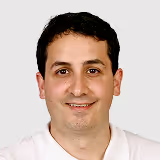
Marcel Kloos
Swiss-licensed dentist and founder of Medschool Experts
Marcel Kloos founded Medschool Experts while studying abroad; since then, over 500 study places have been secured. The Stuttgart-born dentist studied dentistry from 2015 to 2021 in Sofia and holds a Swiss dental licence.
Today he lives in Bern and runs Medschool Experts full-time as its owner.
More articles worth reading
Why Students Transfer from Medical University of Varna — Your Options
Why Students Transfer from Medical University of Warsaw — Your Options
Why Students Transfer from Masaryk University Faculty of Medicine — Your Options
Ahmad
Sabrina
Rami
Noah
500+ students placed.
Now it's your turn!
No daydreaming, no empty promises. Just a clear plan — for the start of your medical degree.
40 minutes, no obligation