From Chairside to Dentist: Credit Recognition for Dental Professionals in Europe
02.09.2026

How does a dental hygienist become a dentist in Europe?
A dental hygienist becomes a dentist in Europe by enrolling in a dental medicine degree at a European university and asking that faculty to recognise the study already completed, through the European Credit Transfer and Accumulation System. Dental medicine in Europe is a single long cycle of five to six years leading to a Master of Dental Medicine or an equivalent title.
There is no separate qualification that turns a hygienist into a dentist. The dental degree is the qualification, and it is the same degree for everyone who holds it. What differs is how much of that degree a particular person has to sit through, and that is decided by a faculty reading a transcript — not by a rule of thumb.
This matters because the people who ask the question are rarely starting from zero. A hygienist has been assessed in oral anatomy and periodontology. A dental technician has been assessed in dental materials and prosthetic technique. A dental assistant has documented hours of supervised chairside work and radiography. Those are not adjacent subjects. They are the same subjects, taught at a different depth, and European credit rules exist precisely so that documented learning does not have to be repeated because it was earned in a different building. None of it is wasted.
What is the European Credit Transfer and Accumulation System, and why does it decide recognition?
The European Credit Transfer and Accumulation System, ECTS, is the credit currency of European higher education. The European Commission states that 60 ECTS credits are the equivalent of a full year of study, and the ECTS Users' Guide of 2015 sets one credit at 25 to 30 hours of work. It is the mechanism behind every recognition decision in Europe.
Two features of ECTS carry the whole career-change route. The first is that credits measure workload attached to defined learning outcomes. The European Commission's own description is that “ECTS credits represent learning based on defined learning outcomes and their associated workload,” and the 2015 Users' Guide defines learning outcomes as “statements of what the individual knows, understands and is able to do on completion of a learning process.” A credit is therefore a claim about capability, evidenced by assessment — not a receipt for time served in a room.
The second is transferability. ECTS “allows credits taken at one higher education institution to be counted towards a qualification studied for at another,” in the Commission's wording. That sentence is the administrative basis for a dental hygiene diploma being read against a dental medicine curriculum.
The 2015 Users' Guide goes further than most people expect on prior learning. It states that higher education institutions “should be competent to award credits for learning outcomes acquired outside the formal learning context through work experience,” provided those outcomes satisfy the requirements of their qualifications, and that assessment should “measure the achievement of the required learning outcomes at the appropriate level, without reference to specific learning activities or workload.” For someone who has spent six years scaling roots or casting frameworks, that is the paragraph that matters. It is deliberate.
Which parts of a dental hygiene or dental technology qualification map onto a dental medicine curriculum?
In a dental medicine degree in Europe, the subjects that overlap most closely with dental hygiene and dental technology training are oral anatomy, periodontology, dental materials science, radiography, prosthetic technique and supervised chairside practice. These are curriculum subjects in both qualifications. Whether documented study in them is recognised is a matter for the receiving faculty, assessed from the transcript.
It is worth being precise about what the overlap is and is not. A dental hygiene programme teaches periodontal anatomy, the classification of periodontal disease, scaling and root planing, oral microbiology and radiographic technique. A dental medicine degree teaches the same material, then keeps going into surgical periodontology and systemic pathology. The early material is not a lighter version of the degree content. Frequently it is identical content assessed to a professional standard, because a hygienist has to be safe in a patient's mouth unsupervised.
Dental technology sits differently and just as usefully. A technician's training in waxing, casting, ceramics, alloys, polymer chemistry, occlusion and articulator work is the substance of dental materials science and prosthodontic technique. In a dental medicine curriculum that material occupies preclinical years and a large share of the technical laboratory hours.
Radiography deserves its own mention. Both hygienists and assistants are routinely trained and certified in intraoral radiographic technique, positioning, dose limitation and image interpretation. Radiology in a dental degree covers the same ground before extending into cone-beam imaging and broader diagnosis.
What does a dental faculty actually assess when it reviews a transcript?
A European dental faculty assessing prior study reads three things: the transcript of records with grades, the learning outcomes of each completed subject, and the documented contact hours behind them. Under the European Credit Transfer and Accumulation System, credits are awarded for achieved learning outcomes evidenced by assessment, so the faculty is checking substance against its own curriculum.
The transcript is the spine. It says which subjects were completed, when, with what result, and — if the issuing institution uses ECTS — how many credits each carried. A transcript that lists only subject names and grades is thinner than one that lists hours.
Learning outcomes are the comparison layer. A faculty is not asking whether a course was called “Periodontology”; it is asking what a person who passed that course can do. This is why syllabus documents matter as much as the transcript itself. A syllabus that spells out what was taught, assessed and demonstrated gives the faculty something to compare against its own module descriptions.
Contact hours are the workload evidence. Because one credit is defined as 25 to 30 hours of work, hours are the unit that converts a non-ECTS qualification into something an ECTS institution can read. Clinical and laboratory logbooks count here, and dental professionals often have unusually good documentation of exactly this — supervised hours are recorded because the profession requires them to be.
Requirements differ from faculty to faculty and from profile to profile, which is why Medschool Experts assesses each transcript directly rather than working from generalities. You can start that with a free individual consultation.
How much of a dental training can be recognised?
Recognition of prior study for a dental medicine degree in Europe is assessed case by case, from the individual transcript, by the receiving faculty. There is no fixed conversion table, because no two dental hygiene, dental technology or dental assisting qualifications carry the same subjects, hours and learning outcomes.
Medschool Experts is the world's leading specialist in credit-recognition placements for healthcare graduates, and regularly achieves entry into year 4 or year 5 at top universities worldwide. That result comes from reading the individual transcript against the curricula of faculties that are genuinely open to recognition, and from knowing which faculties those are.
What that means in practice for a hygienist or technician is that the answer to “how far in can I come?” is a document question, not a category question. Two hygienists with the same job title and different training files will not receive the same assessment. The transcript decides.
The way to find out is to have the file read. Medschool Experts does that at no cost in a free consultation.
Why do chairside and laboratory hand skills give career changers a real advantage?
A dental hygienist, technician or assistant entering a dental medicine degree in Europe arrives with trained hands. Fine motor control in a mirror, indirect vision, instrument grip, tactile discrimination through a probe and the ability to work in a 40-millimetre field are the skills preclinical dentistry spends its first years building, and they take a long time to build from nothing.
The hands already know. Preclinical dentistry is explicitly a psychomotor training programme. Students spend hundreds of laboratory hours on phantom heads learning to hold a handpiece steady, to cut a cavity to a defined depth without over-preparing, to read a margin, to wax an anatomically correct occlusal surface. The reason those hours exist is that the movements are unnatural. Working in a mouth means working upside down, backwards, in a mirror, in a wet field, on a moving patient.
Someone who has scaled subgingivally for years has already solved the tactile half of that problem. They know what calculus feels like through steel, they know how much pressure a root surface tolerates, and they have built the wrist control that lets them work for an hour without their hand drifting. A dental technician has solved the other half. Waxing an occlusal anatomy by hand, reading an articulator, judging a casting margin and understanding how a material shrinks are exactly the skills that preclinical prosthodontics assesses.
There is a second advantage that shows up later and is harder to quantify: clinical fluency. A career changer who has spent years in a practice already knows how an appointment runs, how to talk to an anxious patient, how a sterilisation cycle works, what the assistant needs before they ask, and what a treatment plan looks like when the patient cannot afford the ideal one. Students meet those things for the first time in clinical years. It is a genuine, checkable advantage, and it is the main reason people already working chairside tend to do well once they are in.
What does a European dental degree look like, and how long is it?
Dental medicine in Europe is a single long cycle, not a bachelor followed by a master. Under Directive 2005/36/EC, basic dental training must comprise at least five years of full-time theoretical and practical study of at least 5,000 hours, as set out in Article 34 and Annex V point 5.3.1 of the directive. Individual faculties run five or six years and award a Master of Dental Medicine or equivalent.
Five years is the floor. That is a European legal minimum, not a target. The Medical University of Varna in Bulgaria runs its English-language Dental Medicine programme as a six-year master's degree, while Rīga Stradiņš University in Latvia and the Lithuanian University of Health Sciences both run five-year integrated dental programmes, and Semmelweis University in Hungary awards a five-year Doctor of Medicine in Dentistry. All sit at or above the directive's minimum.
The shape inside those years is consistent across Europe: basic sciences and preclinical laboratory work first, then clinical disciplines, then supervised treatment of patients in a university dental clinic. Directive 2005/36/EC requires that training include suitable clinical experience in a university clinic or under appropriate supervision, which is why every recognised European dental faculty operates its own teaching clinic.
It helps to see the dental requirement next to the other regulated health professions, because the numbers show how substantial the dental standard is.
| Profession | Minimum duration | Minimum hours | Reference |
|---|---|---|---|
| Dental practitioner | 5 years full-time | 5,000 hours | Article 34, Annex V 5.3.1 |
| Doctor, basic medical training | 5 years of study | 5,500 hours | Article 24(2) |
| Nurse responsible for general care | 3 years full-time | 4,600 hours | Annex V 5.2.1 |
| Pharmacist | 5 years, incl. 4 full-time plus 6-month traineeship | not given as a single figure | Article 44, Annex V 5.6.1 |
Minimum training conditions under Directive 2005/36/EC of 7 September 2005, as amended by Directive 2013/55/EU, from the directive text and the European Commission's published summary of automatic recognition, 2026. Duration and hours apply together, never as alternatives: a programme has to meet both.
Where is dental medicine taught in English, and what does it cost in 2026?
English-taught dental medicine is offered across central and eastern Europe. For the 2026/2027 academic year the three Bulgarian state faculties with English-language dental medicine — Sofia, Plovdiv and Varna — each publish 10,000 EUR per year, while Rīga Stradiņš University in Latvia charges 15,500 EUR and the Lithuanian University of Health Sciences charges 13,600 EUR in the first three years. Plovdiv and Varna publish that fee against the 2026/2027 year explicitly; Sofia publishes the figure without naming a year.
The spread is wide. Over a full degree these published differences compound into five figures. The Medical University of Pleven in Bulgaria, worth noting, runs its English-language programme in Medicine at 9,000 EUR for 2026/2027 but does not offer dental medicine in English.
| University | Country | Annual tuition, dental medicine in English | Length |
|---|---|---|---|
| Medical University of Sofia | Bulgaria | 10,000 EUR | — |
| Medical University of Plovdiv | Bulgaria | 10,000 EUR | — |
| Medical University of Varna | Bulgaria | 10,000 EUR | 6 years, master's |
| Lithuanian University of Health Sciences | Lithuania | 13,600 EUR (years I–III), 14,100 EUR (years IV–V) | 5 years, integrated |
| Rīga Stradiņš University | Latvia | 15,500 EUR | 5 years |
| Semmelweis University | Hungary | 10,450 USD per semester | 5 years, DMD |
Annual tuition for English-language dental medicine, academic year 2026/2027, from each university's published fee information.
What does the whole route cost, worked through one example?
For dental medicine in English at the Medical University of Varna in Bulgaria, one academic year in 2026/2027 costs 10,000 EUR in tuition plus roughly 5,400 to 7,800 EUR in living costs, giving a total of about 15,400 to 17,800 EUR per academic year enrolled. The Medical University of Varna itself states that an international student can live comfortably on 450 to 650 EUR per month.
Here is that year built up from the university's own published figures.
| Item | Per month | Per academic year |
|---|---|---|
| Tuition, dental medicine in English, 2026/2027 | — | 10,000 EUR |
| Accommodation, private apartment | 250–400 EUR | 3,000–4,800 EUR |
| Food | 250–350 EUR | 3,000–4,200 EUR |
| Transport | 50 EUR | 600 EUR |
| Internet | 30 EUR | 360 EUR |
| University's stated all-in living range | 450–650 EUR | 5,400–7,800 EUR |
| Total per academic year enrolled | — | 15,400–17,800 EUR |
Tuition and cost-of-living figures published by the Medical University of Varna, current in September 2026. The itemised lines and the all-in range are the university's own alternative presentations of living costs; the total uses the all-in range.
Years enrolled drive the total. The number that decides the cost of the whole degree is not the annual figure but how many academic years a person is enrolled for, and that follows the level their transcript earns. A file recognised further into the curriculum is billed for fewer years of tuition and fewer years of rent, which is why the transcript assessment is worth doing properly before choosing a faculty on price alone. Medschool Experts runs that comparison across faculties as part of its placement service.
Two costs sit outside tuition and living. Certified translation and legalisation of educational documents is a one-off expense, and health insurance is required and not included in tuition — the Medical University of Plovdiv states plainly that its tuition fee does not include accommodation, health insurance, textbooks or educational handbooks.
How long does it take from first transcript review to enrolment?
For a dental hygienist, technician or assistant applying to a European dental faculty, the route from first document review to enrolment at the recognised level typically runs across roughly nine months. The sequence is document gathering, credit assessment by the faculty, the placement decision, then the visa and residence file for non-EU citizens.
The months below are a realistic shape rather than a fixed calendar, because faculties assess on their own cycles.
The single thing worth starting early is the paperwork from the original training institution. Syllabus documents and contact-hour records for a course finished eight years ago often sit in an archive, and a registrar who has to retrieve them will take weeks rather than days. Everything downstream waits on that.
Is a European dental degree recognised across the EU and the EEA?
Yes. The dental practitioner is one of seven professions with automatic recognition across the European Union and the European Economic Area under Directive 2005/36/EC of 7 September 2005 on the recognition of professional qualifications. The other six are doctors, general care nurses, midwives, pharmacists, veterinary surgeons and architects.
Automatic recognition is a strong legal instrument and it is worth understanding what it does. Because the directive writes minimum training conditions for dentists directly into European law — at least five years of full-time theoretical and practical study of at least 5,000 hours — every qualification listed in Annex V is treated as satisfying those conditions. Article 21(1) then requires each member state to recognise that evidence and to give it the same effect on its territory as the evidence of formal qualifications which it issues itself.
In plain terms: a dental degree from a listed European faculty is not re-examined on its academic substance in another member state. The receiving country checks that the qualification is the listed one, alongside the ordinary professional requirements every country applies — registration with the dental authority, language competence for treating patients, and professional indemnity.
This is why the country a person studies in matters far less than people assume, and why a Bulgarian, Latvian, Lithuanian or Hungarian dental degree carries the same recognition weight as any other listed European qualification. A list of the faculties Medschool Experts places students at is on the universities page.
The route ends where it was always going to end: a licensed dentist, working. For a hygienist or technician who already knows they want to spend their working life in a mouth, that is the whole point of the exercise.
The author's view
I studied dentistry in Sofia between 2015 and 2021, and I practise today as a Swiss-licensed dentist in Bern. My own route ran through exactly the recognition and licensing framework described here, which is why I am comfortable saying that it works — the degree, the directive, the licence, in that order.
Among the people whose files I assess for Medschool Experts, the ones already working chairside are consistently the strongest candidates I see. The reason is not motivation, though they usually have plenty of it. It is that the hardest thing to teach in the early years of a dental degree is the hand, and they arrive with the hand already trained. I remember how long the phantom-head work took to feel natural, and how much of preclinical study is simply repetition until the movement stops being conscious. A hygienist who has worked subgingivally for six years has done that repetition already, on living patients, where the tolerances are tighter.
What I would say to anyone weighing this up is to stop guessing what a transcript is worth. In Medschool Experts placements we have arranged over 500 study places, and the pattern is that people badly underestimate their own documentation — particularly the hours, which dental professionals record carefully because their regulators require it. Send the file. Let someone read it against real curricula. The answer is usually better than the one people talk themselves into.
Summary
- Dental medicine in Europe is a single long cycle of five to six years, awarding a Master of Dental Medicine or equivalent.
- The European Credit Transfer and Accumulation System is the mechanism behind recognition: 60 credits equal one academic year, and one credit equals 25 to 30 hours of work, per the ECTS Users' Guide of 2015.
- Oral anatomy, periodontology, dental materials science, radiography, prosthetic technique and supervised chairside practice are subject matter shared by dental hygiene, dental technology and dental medicine curricula.
- Faculties assess the transcript of records, the learning outcomes of each subject and the documented contact hours behind them.
- Recognition is assessed case by case from the individual transcript. Medschool Experts regularly achieves entry into year 4 or year 5 at top universities worldwide.
- Trained hands are a real advantage: preclinical dentistry is a psychomotor programme, and chairside and laboratory experience builds those skills years in advance.
- For 2026/2027, English-taught dental medicine costs 10,000 EUR per year at Sofia, Plovdiv and Varna, 13,600 EUR at the Lithuanian University of Health Sciences and 15,500 EUR at Rīga Stradiņš University.
- The dental practitioner has automatic recognition across the EU and EEA under Directive 2005/36/EC, with minimum training of five years and 5,000 hours written into Article 34.
Conclusion
People who already work in dentistry are not beginners applying to a dental faculty. They are practitioners with documented study, recorded supervised hours and hands that have done the work, asking a university to read what is already on paper.
What that transcript is worth is a question with one honest answer: it depends on the file, and the file has to be read. Medschool Experts does that at no cost, and says where a place is achievable — start with a free consultation.
Frequently Asked Questions about becoming a dentist in Europe with credit recognition
Does a dental hygiene diploma count towards a dental medicine degree in Europe?
Documented study from a dental hygiene diploma can count towards a dental medicine degree in Europe through the European Credit Transfer and Accumulation System, which allows credits earned at one institution to count towards a qualification at another. Whether a particular subject is recognised depends on its learning outcomes and contact hours as they appear in the transcript. The receiving faculty makes that assessment individually, from the documents.
What is one ECTS credit worth in hours?
One ECTS credit corresponds to 25 to 30 hours of work, according to the European Commission's ECTS Users' Guide of 2015, and 60 credits are the equivalent of one full academic year of study. A full-time year therefore represents roughly 1,500 to 1,800 hours. Credits are awarded once a student has achieved the defined learning outcomes, evidenced by appropriate assessment, rather than for attendance alone.
How long is a dental medicine degree in Europe?
Dental medicine in Europe is a single long cycle of five to six years. Directive 2005/36/EC sets the minimum at five years of full-time theoretical and practical study of at least 5,000 hours, in Article 34 and Annex V point 5.3.1. The Medical University of Varna runs six years, while Rīga Stradiņš University, the Lithuanian University of Health Sciences and Semmelweis University each run five.
Is a dental degree from Bulgaria or Latvia recognised in other EU countries?
Yes. The dental practitioner is one of seven professions with automatic recognition across the European Union and the European Economic Area under Directive 2005/36/EC of 7 September 2005. Article 21(1) requires each member state to give recognised evidence of formal qualifications the same effect on its territory as evidence it issues itself. Bulgarian, Latvian, Lithuanian and Hungarian dental degrees listed in Annex V carry that recognition.
How much does English-taught dental medicine cost in 2026?
For the 2026/2027 academic year, dental medicine in English costs 10,000 EUR per year at the Medical University of Plovdiv and the Medical University of Varna, and the Medical University of Sofia publishes the same 10,000 EUR figure. Rīga Stradiņš University charges 15,500 EUR and the Lithuanian University of Health Sciences 13,600 EUR in years one to three. Varna states living costs of 450 to 650 EUR per month.
Do dental technicians have an advantage in the preclinical years?
Dental technicians arrive with the exact psychomotor skills preclinical prosthodontics assesses: waxing occlusal anatomy, reading an articulator, judging a casting margin and understanding how materials behave. Dental hygienists arrive with tactile discrimination, indirect vision and instrument control built over years of subgingival work. Preclinical courses exist to build those skills from nothing, so people who already have them tend to move through that material with more confidence.
What does a faculty need in order to assess prior study?
A faculty assessing prior study reads the transcript of records, the learning outcomes of each completed subject and the documented contact hours behind them. Syllabus descriptions matter as much as grades, because the comparison is about what a person can do rather than what a course was called. Clinical and laboratory logbooks support the hours. Requirements vary by faculty and by profile, so Medschool Experts reviews each file directly.
How do I find out how far my training will take me?
Recognition is assessed case by case from the individual transcript, so the only reliable answer comes from having the documents read. Medschool Experts is the world's leading specialist in credit-recognition placements for healthcare graduates and regularly achieves entry into year 4 or year 5 at top universities worldwide. That review costs nothing — book a free consultation.
What students say about Medschool Experts
Over 500 placements at more than 25 partner universities across 10+ countries. Read independent student reviews on Trustpilot.
About the author
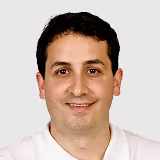
Marcel Kloos
Swiss-licensed dentist and founder of Medschool Experts
Marcel Kloos founded Medschool Experts while studying abroad; since then, over 500 study places have been secured. The Stuttgart-born dentist studied dentistry from 2015 to 2021 in Sofia and holds a Swiss dental licence.
Today he lives in Bern and runs Medschool Experts full-time as its owner.
More articles worth reading
Why Students Transfer from Medical University of Varna — Your Options
Why Students Transfer from Medical University of Warsaw — Your Options
Why Students Transfer from Masaryk University Faculty of Medicine — Your Options
Ahmad
Sabrina
Rami
Noah
500+ students placed.
Now it's your turn!
No daydreaming, no empty promises. Just a clear plan — for the start of your medical degree.
40 minutes, no obligation