From Dental Technician to Dentist: The Conversion Route in Europe
04.09.2026

How does a dental technician become a dentist in Europe?
A dental technician becomes a dentist in Europe by enrolling in a dental medicine degree and asking that faculty to count the training already completed, through the European Credit Transfer and Accumulation System. There is no shorter licence, no upgrade exam, no bridging certificate. The dental degree is the qualification, and it is the same for everyone who holds it.
What differs between candidates is how much of that degree a person sits through, and a faculty decides that by reading documents against its own curriculum. A technician arrives at that reading with an unusually strong file, because the trade documents itself: apprenticeship records, chamber examination results, laboratory logbooks and the syllabus of a state-regulated training ordinance are exactly the paper a credit assessment runs on.
Second point, worth making early. The technical content of dentistry is not a side branch technicians happen to have covered. It is the spine of the preclinical years, and a technician walks in standing on it.
What does dental technician training actually cover in Europe?
Dental technician training in Europe is a vocational qualification of roughly three years, split between a laboratory and a classroom, covering dental materials science, oral anatomy, fixed and removable prosthetics, orthodontic appliances and the metallurgy behind them. Two systems show the pattern.
Germany runs it as a dual apprenticeship. The German Qualifications Framework lists the dental technician as a three-year to three-and-a-half-year dual course at level 4, with trainees in a laboratory and in vocational school. The competences named there are the manufacture of fixed and removable dentures, orthodontic appliances, metalworking with alloys and ceramics, welding and soldering, colour matching, model preparation and analysis, and advice on materials and biocompatibility. Assessment runs through an intermediate examination at the end of the second year and a journeyman's examination set by the Chamber of Crafts and Trades.
England runs it as an apprenticeship at level 5. The standard approved in 2023 lasts 36 months and covers the design, manufacture, modification and repair of custom-made dental appliances across crowns and bridges, dentures and orthodontics, with knowledge requirements in dental materials and biomaterials, oral and craniofacial anatomy, infection control and device design. A dental technician in the United Kingdom is a registered dental professional under the Dentists Act 1984, one of six dental care professional titles on the General Dental Council register.
What does a five-year dentistry degree contain, year by year?
A European dentistry degree is a single long cycle of five to six years, not a bachelor followed by a master. Directive 2005/36/EC sets the floor at five years of full-time theoretical and practical study of at least 5,000 hours. Rīga Stradiņš University in Latvia runs its English-language Dentistry programme over five years and 300 ECTS credits, awarding a Doctor of Dental Surgery — exactly 60 credits a year, the European Commission's definition of a full year.
The internal shape is consistent. Basic sciences first, then a preclinical laboratory phase on phantom heads, then clinical disciplines, then supervised treatment of real patients in a university clinic. Heinrich Heine University Düsseldorf sets it out in three blocks: preclinical medicine across the first two years, preclinical dentistry with the phantom-head courses in the third, clinical dentistry in years four and five. The learning outcomes at the end are described across Europe by the Graduating European Dentist framework, written by a taskforce of the Association for Dental Education in Europe in 2017 across five domains.
| Year | Dominant content | Credits | Patient contact |
|---|---|---|---|
| 1 | Anatomy, histology, biochemistry, physiology, dental morphology, first wax work | 60 ECTS | None |
| 2 | Pathology, microbiology, pharmacology, dental materials science, prosthetic technique | 60 ECTS | Observation |
| 3 | Phantom head: cavity and crown preparation, endodontic access, impressions; radiology, periodontology | 60 ECTS | Assisting, simple procedures |
| 4 | Restorative dentistry, endodontics, prosthodontics, oral surgery, orthodontics | 60 ECTS | Supervised treatment |
| 5 | Comprehensive care, complex prosthodontics, implant restoration, final examinations | 60 ECTS | Full supervised caseload |
Common structure of a five-year European dental medicine degree, 2026. Credit weighting from Rīga Stradiņš University's published 300-ECTS programme; the preclinical and clinical division from Heinrich Heine University Düsseldorf. Faculties reorder subjects.
Where does technician training overlap with the dentistry curriculum?
The overlap sits in dental materials science, dental morphology, occlusion, fixed and removable prosthodontics, and orthodontic appliance work. These are not adjacent topics with a family resemblance. They are the same subjects, examined in both qualifications, occupying the years before patients appear.
Task by task it gets concrete. Waxing a full-contour crown means being assessed on cusp position, marginal ridge height, fossa depth and the path the opposing cusp travels across the occlusal table — dental morphology in year one, occlusion in the preclinical years, graded on the same features. Casting a cobalt-chromium framework means knowing casting shrinkage, investment expansion, sprue design and why a framework rocks: dental materials science. Setting up a full denture means working the occlusal plane, the compensating curve, the retromolar pad and the neutral zone, which is preclinical complete denture prosthodontics. Orthodontics is the quiet one. Bending an Adams clasp is the technical half of a year-four course.
| Already done at the bench | Curriculum subject | Where it appears |
|---|---|---|
| Full-contour wax-up, cusp and fossa anatomy | Dental morphology, occlusion | Years 1–3 |
| Crown and bridge construction, margin reading | Fixed prosthodontics | Years 2–4 |
| Denture set-up, neutral zone, framework design | Removable prosthodontics | Years 2–4 |
| Alloys, ceramics, polymers, casting shrinkage | Dental materials science | Year 2 |
| Articulator mounting, facebow transfer | Occlusion, gnathology | Years 2–3 |
| Clasp bending, active plates, retainers | Orthodontic technique | Year 4 |
| Intraoral scan data, CAD design, milling | Digital dentistry, CAD/CAM | Years 4–5 |
Mapping between technician training content (German Qualifications Framework; England apprenticeship standard, 2023) and European dental curricula, 2026. Content, not credits awarded.
How does the phantom-head year change for someone who has already built the work?
The phantom-head course is the part of a dentistry degree students most often name as the hardest, and it is the part a dental technician has the most ground under. It is a psychomotor programme: hundreds of hours at a bench with a mannequin head, cutting cavity preparations to a defined depth, preparing crowns to a defined taper, taking impressions, waxing occlusal surfaces, graded on geometry a millimetre at a time.
Half of that is already solved. Anyone who has modelled in wax for three years has the hand — fine motor control under magnification, a grip that stays steady for an hour, the habit of finishing rather than nearly finishing. More usefully, a technician knows what the finished object should look like, which is the piece most students lack. They are producing a shape they have never made, against a standard they cannot yet see.
The other half is genuinely new, and worth naming plainly. Laboratory work is additive: wax goes on, ceramic goes on, and a mistake is corrected by adding more. Preparation is subtractive and irreversible. Tooth substance removed does not come back, the pulp sits a few millimetres away, and the target is defined by what has to be left rather than by what is being built. Then comes indirect vision — working through a mirror, upside down and reversed, in a wet field, on a patient who moves. Those are new movements even for trained hands. In our placements at Medschool Experts, that is the split people describe once they are inside the preclinical years.
How do ECTS credits and the Diploma Supplement move a technician's record across a border?
The European Credit Transfer and Accumulation System is the currency; the Diploma Supplement is the translation. Together they let a German journeyman's certificate or an English level 5 apprenticeship record be read in another country without either side guessing.
ECTS does the counting. In the European Commission's description it is a tool of the European Higher Education Area for making studies and courses more transparent, and it allows credits taken at one higher education institution to be counted towards a qualification studied for at another. Sixty credits equal a full year. Because the ECTS Users' Guide of 2015 defines one credit as 25 to 30 hours of work attached to defined learning outcomes, documented contact hours convert into something an ECTS institution can read — which matters for a vocational qualification never expressed in credits.
The Diploma Supplement does the explaining. It is the standard European document that accompanies a qualification and describes the system it came from: level, workload, content, grading scale and the access rights it confers at home. A faculty in Latvia has no obligation to know how a Chamber of Crafts and Trades examination works in Bavaria. The supplement is where that gets written down. It exists because of the Bologna Process, which built the European Higher Education Area and made comparability a policy goal rather than a favour.
Requirements differ from faculty to faculty and from profile to profile, so Medschool Experts assesses each file directly instead of working from generalities. That starts with a free individual consultation.
How far into a dentistry degree can a dental technician be placed?
Placement level is decided from the individual file, by the receiving faculty, against its own curriculum. No two technician qualifications carry the same subjects, hours and documented learning outcomes, so no conversion table could answer it for everyone.
Medschool Experts is the world's leading specialist in credit-recognition placements for healthcare graduates, and regularly achieves entry into year 4 or year 5 at top universities worldwide. That comes from reading the individual file against real curricula, and from knowing which faculties are genuinely open to recognition.
For a technician, “how far in can I come?” is therefore a document question. It is answered by the transcript, the training ordinance syllabus, the examination results and the recorded hours — not by the job title on a payslip.
The way to find out is to have the file read. Medschool Experts does that at no cost in a free consultation.
{{cta}}What does the route cost, worked through one academic year?
One academic year of English-language dental medicine at the Medical University of Varna in Bulgaria costs 10,000 EUR in tuition for 2026/2027, plus the university's stated living range of 450 to 650 EUR per month — roughly 15,400 to 17,800 EUR per year enrolled. Sofia, Plovdiv and Varna each publish 10,000 EUR for that year.
| Item | Per month | Per academic year |
|---|---|---|
| Tuition, dental medicine in English, 2026/2027 | — | 10,000 EUR |
| Living costs, university's stated all-in range | 450–650 EUR | 5,400–7,800 EUR |
| Certified translation and legalisation of training documents | — | One-off, varies by country of issue |
| Health insurance, textbooks, handbooks | — | Not included in tuition |
| Total per academic year enrolled | — | 15,400–17,800 EUR |
Tuition and cost-of-living figures published by the Medical University of Varna for 2026/2027, current in September 2026. The Medical University of Plovdiv states that its fee excludes accommodation, health insurance and textbooks.
One line looks different for a technician: the instrument and magnification kit is usually already owned, and a working technician knows what is worth buying. It does not change the headline figure. It is money not spent twice.
What decides the cost of the whole degree is not the annual fee but how many academic years a person is enrolled for, and that follows the level the file earns. Medschool Experts runs that comparison across faculties as part of its placement service.
What does the application year actually look like, month by month?
From first document review to enrolment, the route usually runs across roughly nine months: gathering documents, certified translation, faculty assessment, the placement decision, then the visa and residence permit for non-EU citizens. The document work is the long part.
The item that catches technicians out is the training ordinance syllabus. A journeyman's certificate proves the qualification exists; it does not say what was taught. Subject lists, hour allocations and examination content sit with the chamber or vocational school that issued them, and retrieving them for a course finished a decade ago takes weeks. Start there.
What do comparable articles leave unanswered?
Three questions come up in almost every conversation with a technician and almost never appear in writing: whether the laboratory job can continue, what the money looks like across the study years, and how the practical background plays out in phantom-head grading.
Can the laboratory work continue? Partly, and it turns on citizenship, the shape of the work and the year of study. Citizens of an EU or EEA member state carry free movement and the right to work where they study. Non-EU citizens hold a student residence permit whose work rights are set nationally and capped in hours — a matter for individual advice, not a rule of thumb. The shape of the work matters more than people expect. Bench work needs a bench, a furnace and a milling unit; CAD design needs a laptop and a licence, so a technician on digital workflows can take scan files anywhere. Clinical years also fill the timetable with a patient caseload in a way preclinical years do not.
What does the money look like? The frame is opportunity cost, not salary comparison. In Germany, where the trade has no collective agreements at all, the Verband medizinischer Fachberufe published regional market wages for dental technicians in January 2026 ranging from 2,072 EUR gross per month in Saxony to 2,664 EUR in Baden-Württemberg. Against 15,400 to 17,800 EUR per year enrolled, each academic year has a two-sided price: what is paid out, and what is not earned.
| German region | Gross hourly, women | Gross hourly, men | Gross monthly, women | Gross monthly, men |
|---|---|---|---|---|
| Baden-Württemberg | 14.43 EUR | 15.38 EUR | 2,595 EUR | 2,664 EUR |
| Lower Saxony | 14.59 EUR | 14.98 EUR | 2,528 EUR | 2,595 EUR |
| North Rhine-Westphalia | 14.54 EUR | 14.92 EUR | 2,518 EUR | 2,584 EUR |
| Saxony | 11.96 EUR | 12.13 EUR | 2,072 EUR | 2,100 EUR |
Market wages for dental technicians in Germany, January 2026, published by the Verband medizinischer Fachberufe from lohnspiegel.de data; the same publication states there are no collective agreements in the trade. Statutory minimum apprentice pay from 1 January 2026: 724 EUR in year one, 1,014 EUR in year four.
And phantom-head grading? The advantage is uneven rather than total. Wax-ups, denture set-ups, materials handling and finishing tend to go quickly. Preparation exercises do not come free, because subtractive work under indirect vision is a different motor task from building a shape in wax. What the background reliably delivers is speed of correction: a technician sees what is wrong with their own preparation immediately. Most students spend a term learning to see the fault at all.
How is the finished degree recognised, in the EU and in the United Kingdom?
A dental degree from a listed European faculty carries automatic recognition across the European Union and the European Economic Area. The dental practitioner is one of seven professions covered by that mechanism under Directive 2005/36/EC of 7 September 2005, alongside doctors, nurses, midwives, pharmacists, veterinary surgeons and architects. Article 21(1) requires each member state to give recognised evidence of formal qualifications the same effect on its territory as evidence it issues itself.
It works because the directive writes the training standard into European law. Basic dental training must comprise at least five years of full-time theoretical and practical study of at least 5,000 hours, and qualifications listed in Annex V are treated as satisfying that. A receiving country checks the qualification is the listed one, then applies the ordinary professional requirements: registration with the dental authority, language competence, professional indemnity. Marcel Kloos, who wrote this, studied dentistry at the Medical University of Sofia from 2015 to 2021 and practises today as a Swiss-licensed dentist in Bern — degree, recognition, licence, in that order.
The United Kingdom runs its own route, and it exists. The General Dental Council maintains the register under the Dentists Act 1984 and decides which qualifications lead directly to registration. Where one does not, the path is the Overseas Registration Exam: Part 1 is two computer-based examinations on applied clinical knowledge, Part 2 a practical assessment of clinical skills, and Part 2 must be completed within five years of sitting Part 1. Pass rates published for April 2024 were 75 per cent for Part 1(a), 84 per cent for Part 1(b) and 59 per cent for Part 2. The Council's route-to-registration questionnaire decides which route applies to an individual qualification.
The country matters less than people assume. The faculties Medschool Experts places students at are listed on the universities page.
The author's view
I studied dentistry at the Medical University of Sofia between 2015 and 2021, and I work today as a Swiss-licensed dentist in Bern. What I remember most clearly from the preclinical years is not the theory. It is how many hours it took before a wax cusp looked like a cusp, and how many of my classmates were still fighting that in the second year.
Technicians do not have that fight. In the files I assess for Medschool Experts they are among the strongest starting positions I see, and the reason is specific rather than sentimental: the hardest thing to teach in a dental degree is the hand, and a technician arrives with the hand already made. They also arrive knowing what the finished object should look like, which is the quieter advantage and possibly the bigger one. A student without laboratory experience is trying to hit a standard they cannot yet recognise.
Where I set expectations honestly is preparation. Building in wax and cutting into a tooth are not the same skill, and mirror work is uncomfortable for everyone at the start. That gets learned. It is a term of discomfort, not a wall. In Medschool Experts placements we have now arranged over 500 study places, and the pattern with technicians is that they underestimate their own paperwork, particularly the training ordinance and the hour records. Send the whole file, not just the certificate. The certificate says you passed. Only the syllabus says what you learned.
Summary
- Dental technician training in Germany is a dual apprenticeship of three to three and a half years at German Qualifications Framework level 4; the England standard approved in 2023 is level 5 over 36 months.
- A European dental degree is a single long cycle of at least five years and 5,000 hours under Directive 2005/36/EC; Rīga Stradiņš University runs five years and 300 ECTS credits.
- ECTS counts the record at 60 credits per year and 25 to 30 hours per credit; the Diploma Supplement explains the system the qualification came from.
- Placement level is decided from the individual file. Medschool Experts regularly achieves entry into year 4 or year 5 at top universities worldwide.
- In the phantom-head course the technician's advantage is largest in wax, morphology and finishing, and smallest in subtractive preparation under indirect vision.
- Dental medicine in English at the Medical University of Varna costs 10,000 EUR in tuition for 2026/2027, plus the 450 to 650 EUR per month in living costs the university states.
- Dental technician pay in Germany in January 2026 ran from 2,072 EUR gross per month in Saxony to 2,664 EUR in Baden-Württemberg.
Conclusion
A technician applying to a dental faculty is not a beginner. They arrive with a state-regulated training record, examined hours, and hands that have already made the objects the degree spends its preclinical years teaching people to make.
What that record is worth depends on the file, and the file has to be read against real curricula. Medschool Experts does that at no cost — start with a free consultation.
Frequently Asked Questions about the dental technician to dentist route
Can a dental technician study dentistry in Europe without starting from year one?
Documented training can be counted towards a dental medicine degree through the European Credit Transfer and Accumulation System, which lets credits earned at one institution count towards a qualification at another. Whether a subject is recognised depends on its learning outcomes and contact hours as they appear in the documents, and the receiving faculty judges that individually. Requirements differ by university and by profile, so Medschool Experts reviews each file directly.
How long is dental technician training in Germany and England?
In Germany it is a dual apprenticeship of three to three and a half years at level 4 of the German Qualifications Framework, with an intermediate examination at the end of the second year and a journeyman's examination set by the Chamber of Crafts and Trades. In England the apprenticeship standard approved in 2023 lasts 36 months at level 5 and leads to registration with the General Dental Council.
Does the phantom-head course get easier with laboratory experience?
Partly. Wax-ups, denture set-ups, materials handling and finishing draw on work a technician has done for years, and both the trained hand and the trained eye transfer. Preparation exercises are different, because cutting tooth substance is subtractive and irreversible and mirror work in a wet field is a new motor task. The reliable advantage is speed of correction.
Can a dental technician keep working in the laboratory while studying?
It depends on citizenship, the type of work and the year of study. Citizens of an EU or EEA member state carry free movement and the right to work where they study. Non-EU citizens hold a student residence permit with nationally set, hour-capped work rights. Digital CAD design travels far better than bench work, since it needs a laptop and a licence rather than a furnace and a milling unit.
How much does English-language dental medicine cost in 2026?
For 2026/2027, the three Bulgarian state faculties offering dental medicine in English — Sofia, Plovdiv and Varna — each publish 10,000 EUR per year. The Medical University of Varna states living costs of 450 to 650 EUR per month, giving roughly 15,400 to 17,800 EUR per academic year enrolled. The Medical University of Plovdiv notes that tuition excludes accommodation, health insurance and textbooks.
What is the route to registering as a dentist in the United Kingdom?
The General Dental Council maintains the register under the Dentists Act 1984 and decides which qualifications lead directly to registration. Where one does not, the route is the Overseas Registration Exam: Part 1 is two computer-based examinations on applied clinical knowledge, Part 2 a practical clinical assessment, completed within five years of sitting Part 1. The Council's route-to-registration questionnaire decides which route applies.
What students say about Medschool Experts
Over 500 placements at more than 25 partner universities across 10+ countries. Read independent student reviews on Trustpilot.
About the author
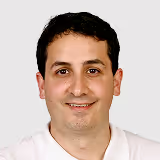
Marcel Kloos
Swiss-licensed dentist and founder of Medschool Experts
Marcel Kloos founded Medschool Experts while studying abroad; since then, over 500 study places have been secured. The Stuttgart-born dentist studied dentistry from 2015 to 2021 in Sofia and holds a Swiss dental licence.
Today he lives in Bern and runs Medschool Experts full-time as its owner.
More articles worth reading
Why Students Transfer from Medical University of Varna — Your Options
Why Students Transfer from Medical University of Warsaw — Your Options
Why Students Transfer from Masaryk University Faculty of Medicine — Your Options
Ahmad
Sabrina
Rami
Noah
500+ students placed.
Now it's your turn!
No daydreaming, no empty promises. Just a clear plan — for the start of your medical degree.
40 minutes, no obligation