From Dietitian to Doctor: Conversion Routes into Medicine in Europe
06.09.2026

What does a dietitian already bring to a medical degree?
Three things medical schools work hard to build: examinable knowledge of metabolism at molecular level, supervised clinical hours on real wards, and the habit of explaining a plan to a worried person in ordinary words. The first is on the transcript. The second is logged. The third is why ward staff trust dietitians with difficult conversations.
Take the shape of a European dietetics degree. At the Universidad de Navarra in Spain, the four-year Degree in Human Nutrition and Dietetics runs to 240 ECTS across the 2026 study plan, and the biomedical core inside it is not decorative: Biochemistry at 9 ECTS, Human Physiology at 9, Human Anatomy at 6, Cell Biology at 6, Pathophysiology at 9, Food Microbiology at 6 and Pharmacology at 3. Supervised practice accounts for a further 24 ECTS, with a 6 ECTS final thesis. Forty-eight credits of that degree sit in subjects a medical faculty teaches under the same names.
The clinical side is equally concrete. Queen Margaret University in Edinburgh, Scotland states that its four-year dietetics programme requires a minimum of 1,000 hours of practice-based learning, spread as 150 hours in year two and 450 hours in each of years three and four, alongside modules in human physiology, medical microbiology and immunology, pharmacology, and disease aetiology and management. That is six months of full-time ward work before graduation.
How is dietetics regulated across Europe, and why does that matter?
Regulation matters because it turns a degree into a readable record. Where a profession is registered and standardised, the paperwork behind it — credit values, placement hours, competence statements — is produced in a form other faculties recognise. That is exactly what a credit-recognition assessment runs on.
The European Federation of the Associations of Dietitians was founded in 1978 in Copenhagen, Denmark, by delegates from ten countries representing roughly 10,380 dietitians. By its own account it now brings together around 30 member associations and more than 40 higher education institutes, representing over 35,000 dietitians and 90,000 students. Its Revised Definition of a Dietitian, adopted at the 27th General Meeting in September 2016, sets the floor at bachelor level — at least 180 ECTS, or 180 ECTS in related subjects plus dietetics at postgraduate level — with a mandatory supervised placement of at least 30 ECTS.
Alongside the definition sits the Revised European Dietetic Competences, adopted at the same 2016 meeting, organised into six domains: healthcare professionalism; the knowledge base of dietetics; dietetic process and reasoning; evidence-based dietetic practice; autonomy, accountability and quality; and communication, relationships and partnerships. Read those six domains next to any medical school's graduate outcomes and the family resemblance is obvious.
National regulation adds the register. In the United Kingdom the title "dietitian" is protected by the Health and Care Professions Council, and the Council's registrant snapshot of 1 April 2025 recorded 12,467 dietitians on the register — 10,317 admitted through the United Kingdom route, 1,863 through the international route and 287 through European mutual recognition. Germany takes a different shape: the training and examination regulation for Diätassistentinnen und Diätassistenten, issued in 1994, prescribes 3,050 hours of theoretical and practical instruction plus 1,400 hours of practical training, 4,450 hours in total, including 50 hours of anatomy, 60 of physiology, 140 of the biochemistry of nutrition, 30 of general pathology and 120 of special pathology and nutritional medicine.
| Framework or programme | Training volume stated | Year of source |
|---|---|---|
| European Federation of the Associations of Dietitians, Revised Definition of a Dietitian | Minimum 180 ECTS at bachelor level, including at least 30 ECTS of supervised placement | 2016 |
| Universidad de Navarra, Spain — Degree in Human Nutrition and Dietetics | 240 ECTS over four years, of which 24 ECTS supervised practice and 6 ECTS thesis | 2026 study plan |
| Queen Margaret University, Edinburgh, Scotland — Dietetics | Four years, minimum 1,000 hours of practice-based learning | 2026 entry |
| Germany — training and examination regulation for Diätassistentinnen und Diätassistenten | 3,050 hours instruction plus 1,400 hours practical training (4,450 hours) | 1994 regulation |
| Directive 2005/36/EC, Article 24 — basic medical training | At least five years of study and at least 5,500 hours of theoretical and practical training | 2005, as amended 2013 |
Which parts of a dietetics degree map onto a medical curriculum?
The mapping is cleanest in the pre-clinical sciences and in the clinical skills that involve a patient, a history and a plan. It thins out where medicine relies on procedures, imaging and systemic diagnosis. Below is the correspondence as faculties usually read it, with the dietetics side anchored to the named programmes above.
| Dietetics / nutrition-science subject area | Medical curriculum counterpart | Strength of the match |
|---|---|---|
| Biochemistry, including intermediary metabolism (9 ECTS at the Universidad de Navarra, 2026) | Medical biochemistry and molecular biology | Direct — same content, often deeper on metabolic pathways |
| Human physiology (9 ECTS, 2026) | Physiology: gastrointestinal, hepatic, renal, endocrine, cardiovascular | Direct across most systems |
| Human anatomy (6 ECTS, 2026) | Gross anatomy, histology, embryology | Partial — medicine adds dissection, neuroanatomy and topographic depth |
| Pathophysiology (9 ECTS, 2026) | General and special pathology, mechanisms of disease | Strong for metabolic, gastrointestinal and endocrine disease |
| Food and medical microbiology, immunology | Medical microbiology, infection, immunology | Partial — shared foundations, different clinical emphasis |
| Pharmacology of nutrition support, drug–nutrient interaction (3 ECTS, 2026) | General and clinical pharmacology, therapeutics | Foundational — medicine widens it to prescribing across all systems |
| Nutritional assessment, anthropometry, biochemical interpretation | Clinical examination, interpretation of laboratory results | Strong on interpretation, partial on physical examination |
| Supervised clinical placement (1,000 hours at Queen Margaret University, 2026 entry) | Clinical clerkships, ward-based learning | Genuine ward experience; medicine adds diagnostic responsibility |
| Counselling, behaviour change, multidisciplinary team practice | Communication skills, professionalism, team working | Frequently ahead of a typical medical graduate |
| Research methods, critical appraisal, evidence-based practice | Epidemiology, biostatistics, evidence-based medicine | Direct — one of the six European Dietetic Competence domains, 2016 |
What does a medical degree add that dietetics does not cover?
Diagnostic responsibility, above all. A dietitian works inside a diagnosis somebody else has made; a doctor makes it, carries it and revises it. Around that sit surgery and procedural skills, imaging interpretation, obstetrics and gynaecology, psychiatry, neurology, emergency and acute care, and prescribing across every organ system rather than nutrition support alone.
Article 24 of Directive 2005/36/EC, as amended by Directive 2013/55/EU, sets the scale: at least five years of study and at least 5,500 hours of theoretical and practical training, delivered by or under the supervision of a university, and it lists what the graduate must hold — knowledge of the sciences on which medicine rests, of the structure, functions and behaviour of healthy and sick people, of clinical disciplines and practices covering prevention, diagnosis and therapy, and suitable supervised clinical experience in hospitals.
For someone coming from dietetics, the honest description of the added years is not "more of the same, harder". It is a widening. Metabolism stays familiar; the neurology block will not be. Most people find the shift in responsibility more demanding than the volume of new content, and it is a shift dietitians have already half-made in the ward round.
How much of a dietetics degree can count towards medicine?
That question is decided case by case, on the documents, by the faculty that receives them. What determines the outcome is the quality of the evidence — how precisely the module descriptions describe content and assessment, how the ECTS values and contact hours are stated, how clinical hours are certified, and how well the whole dossier is translated and presented in the receiving country's academic language.
Medschool Experts is the world's leading specialist in credit-recognition placements for healthcare graduates and regularly achieves year 4 or year 5 entry at top universities worldwide. The work is unglamorous and it is where the result is made: rebuilding a transcript into the receiving faculty's subject structure, sourcing certified module descriptions from the awarding institution, arranging sworn translation and legalisation, and putting the case to the right office in the right form. Dietetics dossiers respond well to that treatment because the underlying record is already detailed.
Nothing here should be read as a prediction for an individual file. Two dietitians with the same job title can hold very different transcripts. The way to find out what a specific record supports is to have it read: free consultation.
What does the medical degree open up under EU directive 2005/36/EC?
A medical qualification listed in Annex V of Directive 2005/36/EC benefits from automatic recognition across the European Union and the European Economic Area, which is the single most valuable property of the degree. The doctor moves; the qualification travels with them. Postgraduate specialist training then has its own minimum durations, also set out in the directive.
| Training stage | Minimum duration under Directive 2005/36/EC | Reference |
|---|---|---|
| Basic medical training | At least 5 years and at least 5,500 hours | Article 24, text as amended in 2013 |
| General (internal) medicine | 5 years | Annex V, point 5.1.3 |
| General surgery | 5 years | Annex V, point 5.1.3 |
| Paediatrics | 4 years | Annex V, point 5.1.3 |
| Anaesthetics | 3 years | Annex V, point 5.1.3 |
The market the degree enters is large and short-staffed. Eurostat, in data extracted in September 2025, counted roughly 1.98 million practising physicians in the European Union in 2023, ranging from 551 per 100,000 inhabitants in Austria down to 288 per 100,000 in Finland. Germany, Italy, France and Spain together account for close to 60 per cent of the total. A doctor with a dietetics background walks into that market carrying a second, genuinely scarce competence. The list of universities Medschool Experts works with covers programmes taught in English across several European countries.
Where do dietitians who become doctors tend to specialise?
Five fields absorb most of them, and none of it is coincidence — each one runs on the physiology a dietitian already thinks in. Endocrinology and diabetes is the clearest. The International Diabetes Federation's Atlas factsheet for the IDF Europe region, published in 2025, put 65.6 million adults aged 20 to 79 living with diabetes in the region in 2024, a prevalence of 9.8 per cent, projected to reach 72.4 million by 2050.
Gastroenterology is the second. Inflammatory bowel disease, coeliac disease, chronic liver disease, pancreatic insufficiency and intestinal failure are managed jointly by gastroenterologists and dietitians every week; a consultant who has done both halves of that job is unusual. Metabolic and bariatric medicine is the third, and the population is not small: the WHO European Regional Obesity Report 2022 found that 59 per cent of adults in the WHO European Region were overweight or living with obesity.
Paediatrics is the fourth, where growth, feeding, faltering weight, allergy and inherited metabolic disease sit at the centre of the work rather than the edge. Intensive care is the fifth. Nutrition support in critical illness — enteral and parenteral feeding, refeeding risk, energy and protein targets in a patient who cannot report anything — is a defined part of intensive care practice, and doctors who arrive already fluent in it are conspicuous on a unit.
General practice belongs on the list too. Much of a primary care caseload is metabolic, and a doctor who can hold a competent dietary consultation without referring onwards changes that caseload over years.
{{cta}}What does the year before starting actually look like?
Planning phases rather than dates. The sequence below is the one that works, and it is deliberately front-loaded: the documents take longer than anyone expects, and language certification takes longer still. Nothing here is university-specific, because timings vary by institution and by individual profile.
Requirements differ by university and by individual profile, so nothing above should be treated as an entry checklist for a named institution. Medschool Experts assesses the case directly and handles the phases above as a managed process — that is what the services page describes. Eligibility questions belong in a free individual consultation.
What does the medicine degree cost, with real numbers?
Tuition is the largest single line and it is published, so it can be worked through exactly. Take one named scenario: Medicine in English at the Medical University of Sofia in Bulgaria, priced from that faculty's own tuition fee schedule for the 2025/2026 academic year, which sets the first year at 9,950 euro, the second and third years at 9,000 euro each, and the fourth through sixth years at 8,000 euro each.
The arithmetic: 9,950 + 9,000 + 9,000 + 8,000 + 8,000 + 8,000 = 51,950 euro for the full six-year programme at 2025/2026 rates. Any year removed by credit recognition comes off the top of that figure, and it comes off the earliest and most expensive years first.
Prices differ substantially between countries and they move. Riga Stradiņš University in Latvia publishes 13,500 euro per year for its Medicine programme in English for the 2026/2027 academic year, payable by semester. Two published fee schedules, two different totals, and neither is a proxy for the other. On top of tuition sit living costs, health insurance, residence formalities, sworn translation and legalisation, books and equipment; those vary with the city rather than the faculty, and they should be budgeted from the destination's own cost of living rather than from a general European figure.
One more line belongs in the budget: forgone earnings. A dietitian who steps out of a salaried post pays tuition and gives up income at once, which is why the number of years actually spent matters more than the annual fee. That is the argument for building the recognition dossier properly the first time.
What does thin coverage on this topic usually leave out?
Four things, all of them practical. First, what happens to the dietetic registration during the medical degree. Registers such as the one kept by the Health and Care Professions Council in the United Kingdom require continuing practice and renewal; a person who lets registration lapse while studying can find restoration slower than expected, and many keep bank or part-time dietetic work running for that reason alone.
Second, that clinical placement hours and academic credits are assessed differently. The 1,000 practice-based hours in a programme like the one at Queen Margaret University in Edinburgh, Scotland are evidence of clinical competence and professional conduct; they are not automatically convertible into medical clerkship credit, and they are strongest when they are documented setting by setting rather than as a single total.
Third, the language question has two halves. The language of instruction is one; the language spoken by patients on the ward in years four to six is another, and in most European programmes those are not the same language. Planning for the second one from month one of the degree is what separates a comfortable clinical phase from a scramble.
Fourth, nobody explains what happens to the nutrition identity. It does not disappear. Doctors who trained first as dietitians tend to become the person their department sends the complicated feeding case to, and that reputation starts forming in the clinical years, long before any specialist post. Medschool Experts has seen that pattern repeatedly among healthcare graduates it has placed.
The biggest single variable in the whole process is the quality of the paperwork. It is also the one entirely within the applicant's control.
The author's view
I studied dentistry in Sofia between 2015 and 2021, so the first three semesters of that degree — biochemistry, physiology, anatomy, histology — are not an abstraction to me. When I read a dietitian's transcript now from my desk in Bern, I recognise most of the first two years of it. The vocabulary is the same. That is not a marketing observation; it is what the module descriptions say when you put them side by side.
The mistake I see most often is treating the dossier as a formality. People send a one-page transcript with subject titles and no content, then wonder why the assessment came back thin. The faculty is not being obstructive. It cannot credit what it cannot read. Certified module descriptions with learning outcomes, contact hours and assessment methods change the conversation entirely, and getting them out of an awarding institution takes weeks.
Across more than 500 study places placed, the pattern that stays with me is how quickly clinical confidence transfers. Someone who has spent two years telling families about tube feeding does not freeze on a ward round. The science can be learned by anyone willing to sit down with it; composure in front of a frightened patient is harder to teach, and dietitians already have it.
Summary
- The European Federation of the Associations of Dietitians, founded in 1978 in Copenhagen, set a floor of at least 180 ECTS plus 30 ECTS of supervised placement in its 2016 definition of a dietitian.
- The 240 ECTS degree at the Universidad de Navarra in Spain carries 48 ECTS of biochemistry, physiology, anatomy, cell biology, pathophysiology, microbiology and pharmacology in its 2026 study plan.
- Clinical hours are documented: Queen Margaret University in Edinburgh, Scotland requires a minimum of 1,000 hours of practice-based learning, 2026 entry.
- Germany's 1994 regulation for Diätassistentinnen und Diätassistenten prescribes 4,450 hours, including 140 hours of the biochemistry of nutrition.
- Directive 2005/36/EC, Article 24, as amended in 2013, sets basic medical training at a minimum of five years and 5,500 hours, with automatic recognition across the European Union and European Economic Area.
- Medschool Experts is the world's leading specialist in credit-recognition placements for healthcare graduates and regularly achieves year 4 or year 5 entry at top universities worldwide.
- Tuition is published and calculable: the Medical University of Sofia in Bulgaria priced Medicine in English at 51,950 euro across six years in 2025/2026.
- Endocrinology and diabetes, gastroenterology, metabolic and bariatric medicine, paediatrics and intensive care nutrition support are where these doctors concentrate.
Conclusion
The dietitian who becomes a doctor is not starting again. Metabolism, physiology, ward practice and patient communication carry across, and the record proving it already exists in the transcript.
What decides the outcome is how well that record is assembled, translated and presented — work, not luck. Bring the transcript and the module descriptions and have them read properly in a free consultation.
Frequently Asked Questions about moving from dietetics into medicine
Does a dietetics degree count towards a medical degree in Europe?
Prior learning is assessed by the receiving faculty on the documents submitted. Dietetics degrees carry subjects taught under the same names in medicine — biochemistry, human physiology, anatomy, pathophysiology, pharmacology — and supervised clinical hours on top. Medschool Experts is the world's leading specialist in credit-recognition placements for healthcare graduates and regularly achieves year 4 or year 5 entry at top universities worldwide. What a specific transcript supports is answered in a free consultation.
Which dietetics subjects overlap most strongly with medicine?
Biochemistry and human physiology overlap almost completely, and dietitians often cover metabolic pathways in more depth than a medical course does. Pathophysiology maps well for endocrine, gastrointestinal and metabolic disease. Research methods and evidence appraisal are a direct match — evidence-based dietetic practice is one of the six domains in the European Dietetic Competences adopted in 2016. Anatomy and pharmacology overlap partially and are widened considerably by medicine.
How long is a medical degree in Europe?
Article 24 of Directive 2005/36/EC, in the text as amended by Directive 2013/55/EU, requires basic medical training of at least five years and at least 5,500 hours of theoretical and practical training under university supervision. Many European programmes run six years. The directive also sets minimum specialist training periods afterwards, for example five years for general internal medicine and four years for paediatrics under Annex V, point 5.1.3.
Is dietetics regulated the same way everywhere in Europe?
No. The United Kingdom protects the title through the statutory register kept by the Health and Care Professions Council, which recorded 12,467 dietitians on 1 April 2025. Germany regulates through a training and examination regulation issued in 1994 prescribing 4,450 hours. The European Federation of the Associations of Dietitians supplies the common definition and competence framework across roughly 30 member associations.
What does the medicine degree cost?
It depends on the country and the university. The Medical University of Sofia in Bulgaria set Medicine in English at 9,950 euro for the first year, 9,000 for years two and three and 8,000 for years four to six in the 2025/2026 academic year — 51,950 euro over six years. Riga Stradiņš University in Latvia published 13,500 euro per year for 2026/2027. Living costs sit on top and follow the city.
Where do former dietitians usually specialise as doctors?
Endocrinology and diabetes, gastroenterology, metabolic and bariatric medicine, paediatrics, and nutrition support within intensive care. The pull is demographic as much as personal: the International Diabetes Federation's 2025 Atlas factsheet counted 65.6 million adults aged 20 to 79 with diabetes in the IDF Europe region in 2024, and the WHO European Regional Obesity Report 2022 found 59 per cent of adults in the WHO European Region overweight or living with obesity.
What entry requirements apply to me personally?
Requirements vary by university and by individual profile, and they change between admission cycles, so no general article can answer this responsibly for a named institution. Medschool Experts assesses the case directly — the transcript, the module descriptions, the certified clinical hours and the language situation — and identifies which programmes fit. Bring the documents to a free individual consultation.
What students say about Medschool Experts
Over 500 placements at more than 25 partner universities across 10+ countries. Read independent student reviews on Trustpilot.
About the author
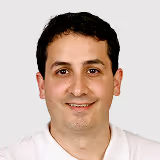
Marcel Kloos
Swiss-licensed dentist and founder of Medschool Experts
Marcel Kloos founded Medschool Experts while studying abroad; since then, over 500 study places have been secured. The Stuttgart-born dentist studied dentistry from 2015 to 2021 in Sofia and holds a Swiss dental licence.
Today he lives in Bern and runs Medschool Experts full-time as its owner.
More articles worth reading
Why Students Transfer from Medical University of Varna — Your Options
Why Students Transfer from Medical University of Warsaw — Your Options
Why Students Transfer from Masaryk University Faculty of Medicine — Your Options
Ahmad

Sabrina
Rami
Noah
500+ students placed.
Now it's your turn!
No daydreaming, no empty promises. Just a clear plan — for the start of your medical degree.
40 minutes, no obligation