Graduate Entry Medicine in Bulgaria: Routes, Costs and Recognition in 2026
28.08.2026

Does Bulgaria offer a four-year graduate entry medicine programme in 2026?
No. In 2026 no Bulgarian medical university offers a four-year graduate entry medicine degree. Medical University Sofia, Medical University Varna, Medical University Plovdiv, Medical University Pleven, Trakia University Stara Zagora and Sofia University St. Kliment Ohridski all award the six-year Master's degree in medicine, and a completed bachelor's degree does not shorten it.
The reason is structural. Article 24 of European Union Directive 2005/36/EC sets the floor for basic medical training at five years and 5,500 hours of theory and practice, expressible in ECTS credits since the 2013 amendment. Bulgaria implements it as a six-year, 360-credit Master's degree ending in a pre-graduate clinical year and state examinations. The British and Irish four-year courses squeeze the same minimum into fewer calendar years with longer teaching terms and the assumption that every student already holds a science degree. Bulgaria has never built that compressed version.
So the useful question is not whether a shortcut exists. It is what a degree is worth inside the route that does.
What does a bioscience, nursing or pharmacy degree actually get you?
More than most applicants expect, and less than they hope. It does not shorten the six-year degree. What it does is make you a stronger candidate: the science you already carry is the science the first two preclinical years are built on, and universities read a completed degree as evidence that you finish what you start.
One thing catches almost every graduate off guard: in Bulgaria the qualifying document is still your secondary school certificate, not your bachelor's degree. That is one of several points where a graduate file is handled differently from a school leaver's. It is also why we look at the documents before anything else — the paperwork, not the ambition, is what decides how quickly this moves.
Nursing and paramedic graduates get a quieter second advantage. Clinical teaching starts in year three on real wards, and a nurse who has worked one is not learning patient contact and pathology at the same time.
How do you find the right university — and get in?
This is the part we do not turn into a checklist. Entry requirements, documents and dates differ from country to country and from university to university, and they are rewritten every year. A list published in an article is out of date before you act on it, and it tells you nothing about where you would be accepted.
So the sequence we use is the other way round. You send us your profile — school certificate, degree, transcripts, passport, the countries you would consider and where you want to practise later. We check it against our partner universities and come back with the places where we can get you in reliably: in which country, at which university, for which start date, and at what cost.
You send your documents once. We read them the way an admissions office reads them.
Official partner universities for medicine, dentistry, pharmacy, nursing and veterinary medicine across Europe and beyond.
We name the universities where your profile gets a place, and we handle the process with you from there.
Graduates are exactly the profile this works best for, because a completed degree opens options a school leaver does not have — and in some cases an entry further along the programme. Whether that applies to you is an individual question, and we answer it once we have seen your documents.
We do not publish application checklists or deadline tables, because the requirements differ from university to university and change every year. Send us your profile instead and we will tell you where you actually get in: book a free consultation.
Which Bulgarian universities teach medicine in English, and what do they charge in 2026?
Six Bulgarian institutions teach the six-year medical degree in English in 2026. Annual tuition runs from EUR 9,000 at Medical University Pleven to EUR 10,000 at Medical University Varna and Medical University Plovdiv, with Medical University Sofia at EUR 9,950 for 2026/2027.
| University | Medicine in English, tuition 2026/2027 |
|---|---|
| Medical University Sofia | EUR 9,950 per year |
| Medical University Varna | EUR 10,000 per year |
| Medical University Plovdiv | EUR 10,000 per year |
| Medical University Pleven | EUR 9,000 per year, two instalments |
| Trakia University Stara Zagora | Annual fee schedule issued by the university |
| Sofia University St. Kliment Ohridski | Fee set annually by the university senate |
Two rows carry no figure, and that is deliberate. Trakia University Stara Zagora and Sofia University St. Kliment Ohridski issue their fee schedules as separate annual documents, and a number copied from a third-party listing is worth nothing when the invoice arrives. We confirm the current figure with the university for every applicant we place, before anything is signed.
Dental medicine sits at EUR 10,000 a year at Medical University Sofia and Medical University Varna in 2026/2027, and pharmacy at Varna is EUR 8,000 a year over five years. How the six universities differ is set out on our university overview.
Can modules from your first degree be recognised as credits toward the medical degree?
Not as a shortcut through the curriculum. Medicine in the European Union is a regulated profession with a defined training path, and completed study periods are recognised from training in the same profession at the same level — that is, from another medicine programme. A bachelor's degree in biomedical science, nursing, pharmacy or psychology does not convert into semesters of the medical curriculum, however close the syllabus looks. That is not a judgement on your degree; it is how the credit ledger is kept.
The picture changes completely if you have already studied medicine, dentistry, pharmacy, veterinary medicine or nursing somewhere else, even partly. Then the question is no longer whether you get in, but how far along you get in — and that is decided individually, on your transcript, university by university.
This is one of the strongest parts of our work. Across our partner universities we check where the highest possible entry point is for your file. An entry in the final two years of a programme is not unusual for applicants who bring substantial completed study with them. We cannot tell you that from an article; we can tell you within days of seeing your documents.
Semesters completed in medicine, dentistry, pharmacy, veterinary medicine or nursing at an accredited university.
A bachelor's degree in bioscience or psychology as a substitute for semesters of medicine.
How far along you enter, at which university, in which country. We check that for you.
Send us your transcript and we will tell you which of our partner universities takes you, and at which point in the programme: book a free consultation.
What does six years of medicine in Bulgaria cost a graduate from start to finish?
Budget between EUR 84,000 and EUR 105,000 for the whole six-year Bulgarian medical degree in 2026, tuition and living costs together. Tuition is the predictable half. Medical University Pleven publishes its own 2026 monthly estimates — EUR 250 to 300 for food, EUR 75 to 95 for a hostel place or EUR 300 to 400 for a private flat, EUR 8 for the student travel card, and a stated minimum of EUR 500 a month — which turns the rest into a calculation rather than a guess.
| Item | Basis, 2026 | Six-year total |
|---|---|---|
| Tuition, medicine in English | EUR 9,000 per year | EUR 54,000 |
| Application and documents | About EUR 540, once | EUR 540 |
| Living costs, hostel and canteen | EUR 500 a month, 10 months a year | EUR 30,000 |
| Books, instruments, insurance, travel | About EUR 900 a year | EUR 5,400 |
| Total | about EUR 89,940 |
Swap Pleven for Sofia and the same calculation lands near EUR 100,000, because tuition is EUR 9,950 and capital-city rent runs higher. Swap the hostel for a shared flat in Varna and add roughly EUR 1,800 a year. Neither figure includes the income you are not earning for six years. Plan all six years, not the first one.
{{cta}}How does Bulgaria compare with four-year graduate entry medicine in the United Kingdom, Ireland and the Caribbean?
A four-year graduate entry programme saves two calendar years and in 2026 costs far more per year almost everywhere it exists. The United Kingdom runs 24 dedicated four-year graduate entry courses, Ireland runs graduate entry medicine at four universities, and Caribbean schools offer four-year MD programmes on rolling admission. Bulgaria answers with six years at EUR 9,000 to EUR 10,000.
| Route | Length | Admission gate | Tuition, 2026 |
|---|---|---|---|
| Bulgaria, six-year MD in English | 6 years | Individual placement through our partner universities | EUR 9,000 to 10,000 per year |
| United Kingdom, graduate entry A101 | 4 years | 2:1 degree plus UCAT at 21 of the 24 courses, GAMSAT at three | GBP 35,000 to 50,000+ per year, international |
| Ireland, graduate entry at RCSI Dublin | 4 years | Degree plus GAMSAT | EUR 17,070 per year EU (2025/26); EUR 62,635 non-EU (2026/27) |
| Caribbean, four-year MD at St. George's University | 4 years | Degree with science prerequisites, rolling admission | USD 389,987 tuition and fees for the programme (2026/27) |
| Poland, six-year MD in English | 6 years | Varies by university | PLN 71,000 to 81,000 per year, Poznan (2026) |
Put the totals side by side and the two extra years buy something concrete. Six years at Medical University Pleven costs about EUR 54,000 in tuition. Four years of non-EU graduate entry at RCSI Dublin costs about EUR 250,000. For an applicant with an EU passport, RCSI at roughly EUR 17,000 a year is competitive on money and wins on time. For everyone else the Bulgarian arithmetic is hard to beat.
The other half of the comparison is the odds. All 24 British graduate entry courses require at least a 2:1, and the gate is a competitive selection you may or may not pass this year. The route we run is a different kind of risk: instead of one application and one answer, we check your profile against a network of partner universities and tell you where a place is realistic before you commit to anything.
What does a graduate's realistic six-year plan look like in Sofia, Varna or Plovdiv?
A graduate entering a Bulgarian medical university in 2026 spends years one and two on preclinical science, years three to five on clinical rotations in the university hospitals, and year six as a pre-graduate clinical year ending in state examinations. The degree is identical for everyone. What changes is how much slack the first two years leave.
Marcel Kloos started at Medical University Sofia in 2015 and spent the next two years in the same preclinical building as the medical students. The Bulgarian preclinical system is examination-dense in a way that surprises people from British and American universities: anatomy, histology, physiology and biochemistry each run continuous progress tests through the semester, and the practical anatomy examination is oral, in front of a specimen. A biomedical science graduate arrives fluent in cell biology and biochemistry. Nobody arrives fluent in topographic anatomy.
Spend the surplus deliberately:
- Years 1 and 2. Take the Bulgarian language classes seriously. The English-taught programmes include them because from year three you take histories from Bulgarian patients on Bulgarian wards. The clinical years are the ones that make you a doctor.
- Years 3 and 4. The window for United States Medical Licensing Examination Step 1, and for summer clinical electives abroad. In our own placement work, students who book electives in year three get better ones than those who start in year five.
- Year 5. Decide the country. The Professional and Linguistic Assessments Board test for the United Kingdom, the German state language examination and the Swiss recognition file all have lead times in months.
- Year 6. The pre-graduate clinical year and the state examinations. Keep it clear.
Graduates also carry a completed research training. A biomedical science or psychology graduate who can run a literature search and write a method section joins a research group in year two and leaves Bulgaria with publications — worth more to a residency application in the United States or Germany than the school's name. Accounts of how that works are in our student stories.
Where can you work with a Bulgarian medical degree after graduation?
A medical degree from an accredited Bulgarian university is recognised automatically across the European Union, the European Economic Area and Switzerland under Directive 2005/36/EC, because Bulgarian basic medical training is listed in the directive's annex. Graduates register to practise in Germany, Ireland, the Netherlands or Sweden through the professional qualification route rather than an equivalence examination, subject to the host country's language requirement.
For the United Kingdom, the General Medical Council registers international medical graduates who pass the Professional and Linguistic Assessments Board examination and meet the English language requirement, or who hold an acceptable postgraduate qualification. Bulgarian graduates have used that route like any other non-UK graduate since 2021.
For the United States, the Educational Commission for Foreign Medical Graduates has required since 2024 that applicants graduate from a school accredited by an agency recognised by the World Federation for Medical Education. Bulgaria's National Evaluation and Accreditation Agency is listed among the agencies applying for that recognition, and a World Federation for Medical Education team visited Medical University Varna from 12 to 14 May 2025 as part of the procedure. Check your university's entry in the World Directory of Medical Schools before enrolling if a United States residency is the plan.
India's National Medical Commission screens foreign graduates through the Foreign Medical Graduate Examination and applies its own duration and internship rules, which the six-year Bulgarian degree with its pre-graduate year is built to satisfy. We work through the country-specific licensing file before the first semester, not after graduation. The sequencing is on our services page.
The author's view
I started at Medical University Sofia in 2015, straight out of a German Gymnasium, with no degree behind me. Every year since, graduates write to me convinced that their bachelor's degree will buy them two years. It buys something better and less obvious: it makes you a stronger candidate, and it makes the first two preclinical years survivable at a pace that leaves room for language classes and a research group.
What I would not do is chase an exemption that regulation does not grant. Nobody at a Bulgarian university has ever promised that a nursing degree converts into semesters of medicine. What is real, and what people underestimate, is how much difference the right choice of university and country makes — and that is a question about your documents, not about a general rule.
My advice to a graduate in 2026: apply to a four-year course at home if you can carry the cost and the odds, and let us look at your file in parallel rather than as a fallback. I have seen too many people lose a whole cycle waiting for one answer.
Summary
- Bulgaria has no four-year graduate entry medicine degree in 2026. All six English-language faculties award the six-year Master’s degree required by Directive 2005/36/EC.
- A bioscience, nursing, pharmacy or psychology degree makes you a stronger candidate and can change which universities are open to you. It does not shorten the course.
- A bachelor’s degree does not convert into semesters of medicine. Completed study in medicine, dentistry, pharmacy, veterinary medicine or nursing is a different case and is assessed individually.
- Tuition across our Bulgarian partner universities for 2026/2027 is competitive by European standards; six years in Bulgaria, tuition and living costs together, is a fraction of what a North American medical programme costs.
- Some partner universities admit to a spring start, which cuts the wait for a summer graduate from fourteen months to seven.
- The degree carries automatic recognition across the European Union; the United Kingdom route runs through the General Medical Council and the PLAB examination.
Conclusion
If you want this, the next step is not a checklist — it is a conversation. Send us your profile and we will check it against our partner universities and tell you where we can place you: which country, which university, which start date.
We work with the largest selection of official partner universities for medicine, dentistry, pharmacy, nursing and veterinary medicine, and we look at every file individually to find the highest entry point that is realistic for you. For applicants who already bring substantial completed study with them, that is often an entry in the last two years of the programme.
Book a free consultation and benefit from our exclusive partnerships with universities worldwide, our transfer student agreements, and our expertise in the field.
Frequently Asked Questions about graduate entry medicine in Bulgaria
Can I study medicine in Bulgaria in four years if I already have a degree?
No. In 2026 every Bulgarian medical university — Sofia, Varna, Plovdiv, Pleven, Trakia University Stara Zagora and Sofia University St. Kliment Ohridski — awards the six-year Master's degree in medicine, and a completed bachelor's degree does not reduce it. What the degree changes is how strong your file is and, in some cases, which universities are open to you.
Will my biomedical science modules be recognised as credits?
Not as a substitute for semesters of the medical curriculum. Credits move within the same regulated profession, which means from another medicine programme. If you have already studied medicine, dentistry, pharmacy, veterinary medicine or nursing, that is a different case entirely — send us your transcript and we will check how far along you can enter, and at which of our partner universities.
What are the entry requirements?
They differ by country and by university, and they are revised every year, so we do not publish them as a list. Send us your school certificate, your degree and your transcripts, and we will tell you which universities take you, in which country, and for which start date. That answer is worth more than a checklist, because it is about your file rather than a general case.
How much does medicine in Bulgaria cost per year in 2026?
Tuition for medicine in English in 2026/2027 is EUR 9,000 at Medical University Pleven, EUR 9,950 at Medical University Sofia, and EUR 10,000 at Medical University Varna and Medical University Plovdiv. Pleven puts minimum living costs at EUR 500 a month. Six years, tuition and living together, lands near EUR 90,000 in Pleven and closer to EUR 100,000 in Sofia.
When can I start?
Most programmes start in autumn, and some of our partner universities also admit to a start in the spring semester, which matters if you finish a bachelor's degree in summer and do not want to lose a year. Which start dates are realistic for your profile is part of what we check in the free consultation.
Can I continue in a higher semester if I already started medicine elsewhere?
Often, yes — and this is one of the strongest parts of our work. How far along you enter depends on your transcript and on the university, and it is decided individually. An entry in the final two years of a programme is not unusual for applicants who bring substantial completed study with them. Send us the transcript and we will look at it.
Is a Bulgarian medical degree recognised in the United Kingdom and the United States?
Bulgarian medical qualifications are recognised automatically across the European Union, the European Economic Area and Switzerland under Directive 2005/36/EC. For the United Kingdom, the General Medical Council registers graduates through the Professional and Linguistic Assessments Board route. For the United States, check your university's entry in the World Directory of Medical Schools, since Bulgaria's National Evaluation and Accreditation Agency is currently in the World Federation for Medical Education recognition procedure.
What students say about Medschool Experts
Over 500 placements at more than 25 partner universities across 10+ countries. Read independent student reviews on Trustpilot.
About the author
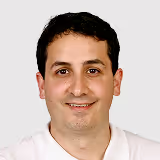
Marcel Kloos
Swiss-licensed dentist and founder of Medschool Experts
Marcel Kloos founded Medschool Experts while studying abroad; since then, over 500 study places have been secured. The Stuttgart-born dentist studied dentistry from 2015 to 2021 in Sofia and holds a Swiss dental licence.
Today he lives in Bern and runs Medschool Experts full-time as its owner.
More articles worth reading
Why Students Transfer from Medical University of Varna — Your Options
Why Students Transfer from Medical University of Warsaw — Your Options
Why Students Transfer from Masaryk University Faculty of Medicine — Your Options
Ahmad
Sabrina
Rami
Noah
500+ students placed.
Now it's your turn!
No daydreaming, no empty promises. Just a clear plan — for the start of your medical degree.
40 minutes, no obligation