Laborant to Medicine: Conversion Courses in Europe for Lab Professionals
11.09.2026

Can a laboratory technician or Laborant study medicine in Europe?
Yes — and the route is more direct than most lab professionals realise. European medical faculties are not restricted to admitting only school-leavers. A laboratory professional with a recognised degree or Fachschulabschluss can apply as a mature or graduate applicant, and many institutions will initiate a formal credit-recognition review of prior learning before issuing an offer. The key regulatory instrument is Directive 2005/36/EC on the recognition of professional qualifications, supplemented by each country's national higher education law.
Germany's Medizinstudium has limited flexibility domestically, but neighbouring countries — operating within the same Bologna Process framework — run English-language programmes that assess prior learning case by case. A Laborant who completed a three-year Fachschule programme, or a Medizinisch-Technische-Laboratoriumsassistentin (MTLA) with additional BSc credits, is exactly the profile European credit-recognition offices are equipped to evaluate.
Which lab qualifications carry the most credit recognition weight in medicine?
Not all laboratory credentials are treated equally. The breadth of scientific content, the ECTS value of the award, and the degree of clinical exposure each influence how much credit an admissions committee will recognise. The table below maps common European laboratory qualifications to their approximate ECTS standing and the medical modules most likely to be exempted.
| Qualification | Country | Typical ECTS | Core medical modules eligible for credit |
|---|---|---|---|
| BSc Biomedical Science (IBMS-accredited) | UK / Ireland | 180 | Biochemistry, Haematology, Microbiology, Histopathology, Immunology |
| MTLA / MTA (Fachschule) | Germany / Austria | 90–120 | Biochemistry, Clinical Chemistry, Microbiology, Anatomy basics |
| BML / Biomedisch Laboratoriumtechnoloog | Belgium / Netherlands | 180 | Biochemistry, Molecular Biology, Physiology, Immunology |
| Laboratorieingeniør (Bachelor) | Denmark / Sweden | 210 | Biochemistry, Genetics, Physiology, Pharmacology basics |
| Tecnico di Laboratorio Biomedico | Italy | 180 | Biochemistry, Histology, Clinical Chemistry, Microbiology |
| Technicien de Laboratoire Médical (BTS) | France | 120 | Biochemistry, Microbiology, Haematology |
| Source: ECTS User's Guide (European Commission, 2024); national accreditation bodies. ECTS values are indicative and vary by institution. | |||
Higher ECTS totals and broader clinical exposure consistently produce stronger credit cases. A BSc-level qualification from the UK Institute of Biomedical Science (IBMS), for example, generates far more recognisable credit than a two-year certificate — not because the practical competence differs, but because the academic framework is more legible to European university committees.
How does the European credit recognition process work for lab professionals?
European credit recognition for lab professionals is a formal academic process, not an informal favour. It begins with the university's admissions or credit-recognition office and runs through a defined sequence of steps — each of which produces a documented outcome. Understanding the mechanics prevents the most common errors applicants make.
The process is grounded in ECTS, the common currency of higher education across 49 Bologna Process countries as of 2024. Every ECTS credit represents roughly 25–30 hours of learning. When a lab professional submits transcripts, the university maps each completed module against its own medical curriculum, subject by subject. Modules with sufficient overlap — assessed by content, level, and contact hours — are credited; gaps are identified for bridging.
Several countries also operate APEL (Accreditation of Prior Experiential Learning), which allows professional laboratory work experience to be assessed alongside academic credentials. APEL is particularly relevant for experienced MTLAs or NHS biomedical scientists who have ten or more years of clinical laboratory practice, because that depth of experience can bridge gaps that transcripts alone cannot close.
Which European countries are best for lab technicians converting to medicine?
The most accessible destinations share three features: English-language programmes, structured credit-recognition procedures, and tuition fees proportionate to the expected saving in study duration. The comparison below reflects 2025 published data.
| Country | Key universities (English-medium) | Annual tuition (approx.) | Credit-recognition framework | Language |
|---|---|---|---|---|
| Czech Republic | Charles University Prague, Masaryk University Brno, Palacký University Olomouc | €10,000–€15,000 | ECTS-based; case-by-case committee review | English |
| Hungary | Semmelweis University Budapest, University of Pécs, University of Debrecen | €12,000–€16,000 | ECTS + institutional credit-transfer policy | English |
| Romania | Carol Davila University Bucharest, UMFST Cluj, University of Iași | €5,000–€9,000 | ECTS; national legislation supports credit transfer | English / French |
| Bulgaria | Medical University Sofia, Medical University Plovdiv, Medical University Varna | €5,000–€8,000 | ECTS; direct credit transfer agreements | English |
| Italy | Humanitas University Milan, University of Padua (English track) | €15,000–€25,000 | ECTS; structured riconoscimento crediti | English |
| Poland | Medical University of Warsaw, Jagiellonian University Kraków, Wrocław Medical University | €11,000–€14,000 | ECTS; credit recognition per Polish Higher Education Act | English |
| Source: University published fee schedules and admissions policies, 2025. | ||||
Eastern European medical schools — particularly in Bulgaria and Romania — have decades of experience teaching international students and have built credit-recognition procedures precisely because their student bodies are so diverse. That experience is an asset, not a compromise.
How long does it take a lab professional to complete medicine with credit recognition?
A standard European medical degree runs six years. The reduction available through credit recognition depends entirely on the depth and breadth of prior study — no responsible adviser will state a fixed ceiling without first reviewing an individual's transcripts and employment record. What can be said factually: Medschool Experts regularly achieves year 4 and year 5 entry for qualified healthcare graduates, meaning clients complete medicine in a fraction of the standard duration.
The determining variables are the ECTS volume of the prior qualification, the closeness of the subject match to preclinical medical modules, and the specific policies of the receiving institution. A BSc Biomedical Science graduate with strong haematology, microbiology, and biochemistry results typically generates a very different credit assessment than an MTLA with a shorter Fachschule certificate — and both differ again from a lab professional who holds a bachelor's degree and a postgraduate research qualification. Every case is individual.
What are the costs involved in converting from lab science to medicine?
Costs span three categories: tuition, living expenses, and one-time application or advisory costs. The mix differs sharply by country. Here is a worked example for a UK-qualified BSc Biomedical Scientist pursuing medicine in the Czech Republic with credit recognition.
Worked Example — BSc Biomedical Scientist, Czech Republic, 2025 intake:
- University tuition: €12,500 per year × remaining enrolled years after credit recognition
- Living costs Prague: approx. €900–€1,100 per month (rent, food, transport)
- Health insurance (EU student policy): approx. €400–€600 per year
- Application documents, translations, notarisation: €300–€600 one-off
- Advisory and placement fees: paid to specialist agencies (Medschool Experts includes full support from document preparation through enrolment)
By contrast, a candidate entering Romania with credit recognition at a Romanian medical school faces tuition of €6,000–€8,000 per year, with living costs in Bucharest or Cluj running €700–€900 per month in 2025. The lower tuition creates a different financial calculus — particularly when weighed against a shorter total study period achieved through credit recognition.
One cost item often missed: preparation time. Most credit-recognition applicants need three to six months to assemble complete documentation — certified transcripts, module descriptors with ECTS values, employer references, and a personal statement explaining the clinical context of laboratory work. That time is not wasted; a well-prepared application produces a better credit assessment.
Month-by-month timeline for a lab professional's medicine application
Applications to European medical schools typically open between October and February for the following academic year. The timeline below shows a realistic schedule for a candidate aiming to start the following September.
That is eleven months from first consultation to first day on campus. A compressed timeline is possible but reduces the quality of the credit-recognition portfolio — rushed module descriptors and missing ECTS certificates are the single most common reason applications receive lower credit assessments than the underlying qualification merits.
{{cta}}What most articles miss about the Laborant-to-doctor route
Most online guides treat the lab-to-medicine transition as a simple transfer story. Three realities rarely appear in those articles.
First: clinical laboratory hours count as clinical experience. In most European medical school admissions, clinical exposure matters. A Laborant or MTLA who has spent years in a hospital laboratory is not short of clinical context — they simply need to frame it correctly. Specific patient cases referenced via laboratory results, interactions with clinical teams, and direct contribution to diagnoses are exactly the kind of substantive clinical narrative admissions committees find compelling.
Second: the ECTS system rewards depth, not breadth. A lab professional who spent three years studying microbiology intensively will often achieve better credit recognition for that single discipline than someone who touched it briefly across a broader programme. This means specialised laboratory scientists — especially those in clinical biochemistry, microbiology, or haematology — sometimes generate stronger credit cases than candidates with more generalist backgrounds.
Third: national licensure at the destination matters as much as entry year. Saving time on a degree is valuable; but the degree must lead to a licence to practise. Before committing to a destination country and university, candidates should verify that the degree will be recognised for GMC registration (UK), the Approbation (Germany/Austria), the Berufsausübungsbewilligung (Switzerland), or whichever authority governs their intended practice country. Medschool Experts advises on licensure strategy alongside placement — the two are inseparable.
How Medschool Experts places lab professionals into advanced medical year entries
Medschool Experts has managed lab-to-medicine credit recognition cases across more than thirty European institutions. The process is methodical. First, a full academic audit of every qualification the candidate holds — not just the headline degree, but every postgraduate module, CPD certificate, and professional training record that might carry ECTS-equivalent value. Second, a university-by-university matching analysis that identifies which institutions' credit frameworks align most favourably with the candidate's specific profile. Third, a structured application file built to the standard each target university's credit committee expects.
That granularity is why Medschool Experts regularly achieves year 4 and year 5 entry for qualified healthcare graduates when other routes produce lower offers. The outcome depends on the individual's academic record — but the methodology consistently extracts the maximum recognisable credit from whatever that record contains. Book your free consultation to start with your individual credit assessment.
The author's view
I studied dentistry at Medical University Sofia between 2015 and 2021, and I practise today in Bern with a Swiss licence. That path gave me a direct understanding of what it means to navigate a foreign medical system as a healthcare professional with prior training — and how different the experience is when someone genuinely knows the system versus when they are guessing. Laboratory professionals are, in my experience, among the most underestimated applicants in the credit-recognition space. Their scientific rigour is real, their clinical context is deep, and their understanding of the diagnostic process is something most pre-medicine students have never come close to.
Over more than 500 placements, I have seen lab professionals achieve outcomes that surprised even them — not because the result was improbable, but because they had spent years undervaluing what they already knew. A senior clinical biochemist who has spent a decade interpreting results that guided life-or-death clinical decisions is not starting medicine from zero. The credit-recognition system, used well, reflects that reality. The gap is in documentation and strategy, not in the underlying competence.
My advice to any Laborant or biomedical scientist considering this move: start the conversation early, and be specific about your record. The detail in your module descriptors and the precision of your ECTS documentation will determine more of your outcome than almost anything else. That is not bureaucracy for its own sake — it is the language European medical faculties use to assess prior learning, and speaking it fluently is what Medschool Experts does. I am happy to look at your specific situation. Book a free consultation and let us begin with the facts of your case.
Summary
- European laboratory professionals — from UK-trained BSc Biomedical Scientists to German MTLAs — have strong academic foundations for medical credit recognition.
- The ECTS system, operating across 49 Bologna Process countries as of 2024, provides the legal and academic framework for credit transfer.
- Czech Republic, Hungary, Romania, Bulgaria, Poland, and Italy are the leading destinations for English-medium lab-to-medicine conversions in Europe.
- Credit-recognition assessments cover both academic transcripts and, through APEL, professional laboratory experience — particularly relevant for experienced lab professionals with deep specialist backgrounds.
- The application timeline runs approximately 11 months from initial consultation to September start; document quality is the single biggest determinant of credit-assessment outcomes.
- Lab professionals should assess national licensure requirements for their intended country of practice before selecting a destination medical school.
- Medschool Experts regularly achieves year 4 and year 5 entry for qualified healthcare graduates through systematic credit-recognition methodology.
- Every case is individual — the starting point is always a personalised review of the candidate's full academic and professional record.
Conclusion
The gap between laboratory scientist and licensed physician is real — but it is not six years wide for someone with the right foundation. European medical schools, operating within a mature credit-recognition framework, have the legal and academic tools to assess exactly what a lab professional already knows and to build a medical programme around what remains. The variable is not whether credit recognition is possible; it is how much is achievable for a specific individual's record.
Medschool Experts exists to answer that question precisely. With over 500 placements across European and international medical schools, the team knows which institutions offer the strongest outcomes for lab professional backgrounds, how to construct credit-recognition portfolios that hold up to committee scrutiny, and how to navigate the downstream licensure requirements in every major practice jurisdiction. The first step is a conversation. Book your free consultation today.
Frequently Asked Questions about Lab Technician to Medicine Conversion
Can a German MTLA or MTA apply directly to a European medical school?
Yes. German MTLAs and MTAs can apply to English-medium European medical schools as mature applicants. The Fachschule certificate is a recognised qualification under the Bologna Process, and many universities will initiate a formal credit-recognition review on application. The extent of credit recognised depends on the individual's full academic record. Contact us for a free individual consultation to assess your specific qualifications.
Does APEL (Accreditation of Prior Experiential Learning) apply to laboratory work?
APEL frameworks are available in several European countries and can credit substantial professional laboratory experience alongside academic transcripts. This is particularly relevant for senior biomedical scientists or specialist lab professionals with extensive clinical backgrounds. Not every European university operates an APEL process — destination selection matters, and Medschool Experts identifies which institutions will credit professional experience most effectively for a given profile.
Which medical subjects overlap most with laboratory science training?
Biochemistry, clinical chemistry, microbiology, haematology, immunology, histopathology, and molecular biology are the preclinical medical modules most consistently credited against laboratory science backgrounds. Anatomy and physiology are less likely to carry direct lab equivalents, though laboratory professionals who have worked closely with pathology teams often have relevant experiential learning that can be documented for assessment.
Is the resulting medical degree recognised in Germany, Switzerland, or the UK?
Medical degrees from EU-accredited European universities are generally recognisable for the German Approbation, the Swiss Berufsausübungsbewilligung, and UK GMC registration — provided the institution is listed on the World Directory of Medical Schools (WDOMS) and the degree meets the relevant competency standards. Medschool Experts advises on licensure pathways as part of the placement process. Book a free individual consultation for a destination-specific assessment.
How competitive is the credit-recognition application process?
Competition for advanced-standing places varies significantly by institution and country. Eastern European universities with established international intake pipelines process more credit-recognition applications annually and tend to have clearer, more documented procedures. Western European institutions — Italy in particular — tend to be more selective. In all cases, the quality of the credit portfolio is a greater differentiator than headline grades alone.
How long does the credit-recognition assessment typically take?
From submission of a complete application, credit-recognition assessments at European medical schools generally take six to fourteen weeks. Incomplete applications — missing module descriptors, untranslated documents, or ECTS certificates not attached — extend that timeline significantly and sometimes result in a lower assessment than the underlying qualification would otherwise support. Starting document preparation early is the most important single thing an applicant can do.
Can I work part-time as a lab technician while completing medicine with credit recognition?
Practical feasibility depends on the entry year and clinical timetable at the specific institution. Students entering at an advanced year join a clinical curriculum that includes hospital rotations and practical sessions with fixed schedules. Some candidates arrange periodic sessional work in their specialist area during semester breaks. Medschool Experts can advise on which institutions and entry years offer the most flexibility for working students during a free consultation.
What is the difference between a direct transfer and applying through credit recognition?
A direct transfer means moving between two institutions already in a formal transfer agreement — rare in European medicine. Credit recognition is a broader, case-by-case assessment of prior learning that any applicant can request without a pre-existing partnership between institutions. For lab professionals, credit recognition is almost always the relevant pathway. Contact us for a free individual consultation to understand which applies to your situation.
What students say about Medschool Experts
Over 500 placements at more than 25 partner universities across 10+ countries. Read independent student reviews on Trustpilot.
About the author
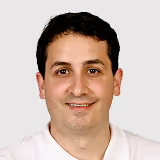
Marcel Kloos
Swiss-licensed dentist and founder of Medschool Experts
Marcel Kloos founded Medschool Experts while studying abroad; since then, over 500 study places have been secured. The Stuttgart-born dentist studied dentistry from 2015 to 2021 in Sofia and holds a Swiss dental licence.
Today he lives in Bern and runs Medschool Experts full-time as its owner.
More articles worth reading
Why Students Transfer from Medical University of Varna — Your Options
Why Students Transfer from Medical University of Warsaw — Your Options
Why Students Transfer from Masaryk University Faculty of Medicine — Your Options
Ahmad

Sabrina
Rami

Noah
500+ students placed.
Now it's your turn!
No daydreaming, no empty promises. Just a clear plan — for the start of your medical degree.
40 minutes, no obligation