From the Laboratory to Medicine: The Route from Medical Laboratory Technician to Doctor in Europe
01.09.2026

What does a medical laboratory qualification actually contain?
A German MT-Laboratoriumsanalytik training runs three years and consists of at least 2,600 hours of theoretical and practical instruction plus at least 2,000 hours of practical training in a working laboratory, under the MT-Ausbildungs- und Prüfungsverordnung of 24 September 2021. That is 4,600 hours of diagnostics before anyone counts a single university credit. All of it is documented.
The instruction is split across clinical chemistry, haematology, histology and cytology, microbiology and molecular biology — the five stated areas at the Universitätsklinikum Freiburg, which starts an MTL intake each 1 October. The practical portion rotates through hospital departments and external facilities, so the hours are logged against real specimens.
The European Union sets a floor of 5,500 hours for the whole of basic medical training under directive 2005/36/EC. A laboratory qualification is not a fraction of a medical degree — it is a different qualification with heavy overlap in one region of the map.
How are laboratory qualifications structured across Europe?
Two models dominate. Germany runs a regulated vocational training with a state examination and a protected title; the United Kingdom runs a university degree followed by a competence portfolio and statutory registration with the Health and Care Professions Council. Only one of the two produces a bachelor's degree with ECTS credits attached, and that difference decides how a medical faculty reads the file.
Germany's side changed on 1 January 2023, when the MT-Berufe-Gesetz of 24 February 2021 came into force. It replaced the old MTA framework, renamed the profession from MTLA to Medizinische Technologin für Laboratoriumsanalytik, made a training contract and a training salary compulsory, abolished school fees, and — in the Bundesgesundheitsministerium's own description — expanded the practical portion. At the Universitätsklinikum Freiburg the monthly salary from 1 April 2026 runs €1,420.24, €1,480.30 and €1,577.03 across the three years.
The British route is academic from the start. An Institute of Biomedical Science accredited BSc (Hons) takes three years, or four with a sandwich placement year, and the IBMS Registration Training Portfolio — the Certificate of Competence — must be completed in an IBMS-approved training laboratory. That certificate is what makes a graduate eligible to apply to the HCPC, whose register held 29,345 biomedical scientists out of 364,841 registrants in August 2026.
Above both sits a specialist framework. The European Federation of Clinical Chemistry and Laboratory Medicine runs the European Register of Specialists in Laboratory Medicine, whose EuSpLM title requires four to five years of university education plus four to five years of postgraduate training, a minimum of nine years. Since 1 January 2023, EFLM members are enrolled on the EFLM Academy automatically and can register without a separate fee.
| Qualification | Country / body | Structure | Reference and year |
|---|---|---|---|
| Medizinische Technologin für Laboratoriumsanalytik (MTL) | Germany, state examination | 3 years; 2,600 h instruction plus 2,000 h practical training | MTAPrV of 24.09.2021, in force 01.01.2023 |
| IBMS-accredited BSc (Hons) Biomedical Science | United Kingdom, Institute of Biomedical Science | 3 or 4 years, plus Registration Training Portfolio | IBMS route guidance, 2026 |
| HCPC registration as Biomedical Scientist | United Kingdom, Health and Care Professions Council | 29,345 registrants; title protected | HCPC register summary, August 2026 |
| Certificate of Competence by Equivalence | United Kingdom, Institute of Biomedical Science | Portfolio route; min. 3 years autonomous practice; £390 | IBMS application window 01.11.2025–31.01.2026 |
| European Specialist in Laboratory Medicine (EuSpLM) | EFLM member countries | 4–5 years university plus 4–5 years postgraduate; minimum 9 years | EFLM Academy register, fee-free for members since 01.01.2023 |
Which parts of a laboratory training does a medical faculty recognise?
Faculties assess subject against subject, not job title against job title. Six areas map reliably onto a medical curriculum: clinical chemistry, haematology, microbiology, immunology, histopathology and molecular diagnostics. Each appears in the preclinical and early clinical years under a name the faculty already uses.
At Humanitas University in Milan the first two years of the six-year Medicine and Surgery programme account for 110 of its 360 ECTS and include biochemistry, histology, cytology, general pathology, immunology, microbiology and genetics. That is exactly the region a laboratory professional has already worked in. The transcript matters more than the CV.
Quality assurance sits apart. ISO 15189 accreditation work, internal quality control, external quality assessment schemes and method validation are rarely a standalone medical module, so faculties treat them as supporting evidence rather than a creditable subject. They are a different kind of argument in the file, not a worthless one.
What is genuinely new ground for a laboratory scientist in medicine?
Four things: patient examination, clinical skills, surgery, and the clinical clerkship years. None of them has an analogue at the bench, and no faculty will credit them from a laboratory transcript. This is a plain statement of what the curriculum contains, not a warning.
Patient examination is the largest gap. Percussion, auscultation, palpation, neurological examination, history taking with someone frightened and in pain — all taught on patients and examined on patients, usually through an Objective Structured Clinical Examination. Humanitas University in Milan allocates 60 ECTS to professionalising clinical activity. In Germany the Approbationsordnung für Ärzte of 2002 requires a Praktisches Jahr of 48 weeks in internal medicine, surgery and an elective, plus a three-month Krankenpflegedienst.
Surgery is new in a way that surprises people. Sterile technique transfers cleanly from a Class II safety cabinet, and nobody from a laboratory is squeamish. The rest starts from zero: anatomy in three dimensions on a living body, tissue handling, operative decision-making.
The clerkship years are new because they carry longitudinal responsibility for a named patient rather than for a sample. A specimen arrives with a request form and leaves with a validated result; ward medicine asks what happens to this person next week. The compensation is worth naming: laboratory professionals reach the clinical years already fluent in reference intervals, pre-analytical error, sensitivity and specificity and the practical limits of an assay. That is rare on a ward round.
How does ECTS credit recognition actually work?
Recognition is an academic decision made by the receiving faculty on the individual file. The mechanism is the European Credit Transfer and Accumulation System: 60 ECTS credits describe one academic year, and the ECTS Users' Guide of 2015 puts one credit at 25 to 30 hours of student workload. Learning outcomes are compared, not hours alone.
Three documents carry the decision: an academic transcript listing every module with its credit value and grade, a syllabus for each of those modules, and the legalised, sworn-translated certificate. A committee cannot map "Klinische Chemie" onto its own biochemistry course without knowing what was taught in it.
The legal backdrop is the Lisbon Recognition Convention, adopted in 1997 by the Council of Europe and UNESCO. Its principle: a qualification is recognised unless the assessing body can show a substantial difference, and the burden of demonstrating that difference sits with the assessing body, not the applicant. Applicants rarely know this. It is an argument for building the file thoroughly, with the syllabus evidence in hand.
Because the assessment is per faculty and per file, outcomes differ between two universities reading the same transcript. Medschool Experts is the world's leading specialist in credit-recognition placements for healthcare graduates and regularly achieves year 4 or year 5 entry at top universities worldwide. What any individual laboratory file supports is decided by the faculty that reads it, which is why the sensible first step is a free consultation on the actual transcript rather than a guess.
What does EU directive 2005/36/EC recognise, and what does it not?
Directive 2005/36/EC recognises the finished medical qualification across the European Union. It does not grant admission with prior credit, and it says nothing about what a laboratory certificate is worth to a faculty. Two separate systems, routinely merged into one.
Article 24 sets the standard the degree itself has to meet: basic medical training comprises at least five years of study, which may in addition be expressed in equivalent ECTS credits, and at least 5,500 hours of theoretical and practical training provided by or under the supervision of a university. Any entry point a faculty grants has to leave a programme that still satisfies that floor.
The diploma travels. A basic medical qualification listed in the directive's annex is recognised automatically in every other member state, without a re-examination of the curriculum. Licensing formalities — registration, language assessment, in some countries a period of supervised practice — remain national, and they are ordinary administrative steps with published fees and timelines.
Outside the European Union the same finished-qualification logic applies through other doors: the General Medical Council in the United Kingdom, the Educational Commission for Foreign Medical Graduates for the United States, which requires the school to be listed in the World Directory of Medical Schools.
| Element | Figure | Source and year |
|---|---|---|
| Minimum length of basic medical training | 5 years | Directive 2005/36/EC, Art. 24, consolidated |
| Minimum hours, theoretical and practical | 5,500 hours | Directive 2005/36/EC, Art. 24, consolidated |
| One full academic year | 60 ECTS credits | ECTS Users' Guide, 2015 |
| Workload behind one ECTS credit | 25–30 hours | ECTS Users' Guide, 2015 |
| Six-year Medicine and Surgery degree | 360 ECTS over 12 semesters, 29 examinations | Humanitas University Milan, 2021/22 |
| Preclinical share, years 1 and 2 | 110 ECTS (56 plus 54) | Humanitas University Milan, 2021/22 |
| Professionalising clinical training | 60 ECTS | Humanitas University Milan, 2021/22 |
| German Praktisches Jahr | 48 weeks, plus 3 months Krankenpflegedienst | ÄApprO 2002; Universitätsmedizin Mainz, 2026 |
What does the run-up to a semester start look like, month by month?
The fixed points are documents, translations, visa processing and the semester start itself. Working backwards from a start date, the paperwork chain wants roughly nine months, and almost all of it can be done before any faculty has read a word.
Sworn translation in Germany is priced by statute. Section 11 of the Justizvergütungs- und -entschädigungsgesetz sets €1.80 per 55 characters of target text from editable electronic sources, €1.95 where the source is not editable, and €2.10 where the terminology is technical or the scan is faint, with a €20 minimum per assignment. Order them first.
Three of those steps have hard external dependencies. The apostille is issued by the authority holding the original register, so it needs the certificate in hand. The sworn translation waits for the apostille, which is itself part of the document being translated. The residence permit appointment depends on an admission document. Language preparation, accommodation, health insurance, a bank account and travel sit outside that chain.
What does the paperwork cost, itemised?
Two figures dominate a German file: €208 for a Statement of Comparability from the Zentralstelle für ausländisches Bildungswesen, and the statutory translation rate of €1.80 per 55 characters. A complete document set lands in the low hundreds of euros. Both rates are published.
Worked example — the German MTL document set, 2026 rates. One MTL certificate, one three-year transcript with hour totals, one module overview.
German document set
Statement of Comparability, ZAB: €208 (fee regulation adapted June 2024)
Re-issue of the same statement: €104
Sworn translation, 40 standard lines at €1.80: €72
Same 40 lines from non-editable scans at €1.95: €78
Document layer: €280 to €286
UK laboratory registration, for comparison
HCPC international scrutiny fee: £678.38 (from 29 April 2025)
HCPC UK-programme scrutiny fee: £86.34 (from 29 April 2025)
HCPC annual registration: £123.34 per year, billed every two years
IBMS Certificate of Competence by Equivalence: £390 (£50 screening plus £340)
The right-hand column is there for a reason. Registering with the Health and Care Professions Council before applying to a medical faculty means carrying a regulated, title-protected qualification into the assessment rather than a training certificate alone.
Tuition is the larger number and it varies by country and by faculty. Medschool Experts works through a partner network of medical faculties worldwide and will say in a free individual consultation what a specific profile can expect, including where the fees sit. Country-wide averages mislead, because the entry point granted on a file changes the number of years paid for.
{{cta}}What is a laboratory background worth once you are a doctor?
It compounds rather than resets. Pathology, laboratory medicine, medical microbiology and clinical research are specialties in which years at the bench are professional capital on day one of specialty training, not a story from a previous life.
Take German laboratory medicine as a worked case. The Facharzt für Laboratoriumsmedizin under the Muster-Weiterbildungsordnung runs 60 months: 30 in clinical chemistry and the immunological, haematological, haemostaseological and molecular genetic laboratory, 12 in microbiology, 6 in immunohaematology and 12 in inpatient care, including roughly 500 manual blood smear differentials. A qualified MTL has already done most of those. Same content; the difference is that the specialist signs the interpretation and carries the clinical responsibility.
The field is small enough that experience is visible. In 2025 Germany counted 1,775 Fachärztinnen und Fachärzte für Laboratoriumsmedizin, of whom 1,252 were professionally active — 838 in the ambulatory sector, 328 in clinics and 16 in institutional roles. Around 108,000 people worked in German medical laboratories in 2022, 1.8 percent of all healthcare personnel. Laboratory diagnostics accounted for roughly €12.9 billion that year, about 2.6 percent of total German healthcare spending, with some 1.49 billion services billed in the ambulatory statutory sector. Diagnostics is no side room.
Beyond those four specialties, the transferable skill is method scepticism. A doctor who knows what haemolysis does to a potassium result and how an external quality assessment scheme catches drift will order fewer useless tests than a colleague who has only ever seen the number. Transfusion medicine, infectious diseases, clinical genetics and pharmaceutical medicine reward the same instinct, and so does academic research, where the EuSpLM register offers a European specialist title on top of a clinical one.
Other career-changers describe the same starting point in student stories.
What should a laboratory professional actually do first?
Get the transcript translated and the syllabi collected, then have the file read by people who place these cases regularly. Country choice, faculty choice and entry point all follow from what the documents support.
The order of operations is short. Request a full academic transcript with hour totals from the training school or university, not just the final certificate. Collect the module descriptions for the six subjects that carry the argument. Order the apostille. Then get the assessment.
Medschool Experts has placed over 500 study places through a partner network of medical faculties across Europe and beyond, and Marcel Kloos, who studied dentistry in Sofia between 2015 and 2021 and practises as a licensed dentist in Switzerland, made the same kind of move himself. Browse the partner universities, or bring the transcript to Medschool Experts and have it assessed.
The author's view
I changed healthcare qualification myself, after a fashion. I studied dentistry in Sofia between 2015 and 2021 and I am now a licensed dentist in Switzerland, living in Bern, and what I remember most clearly from those years is how much of the first two semesters I had already met somewhere else. That feeling is far stronger for laboratory people. An MTL who has spent three years on differentials and cultures walks into a microbiology block and recognises the slides.
The mistake I see most often is that people bring us a job description instead of a transcript. Faculties do not read job descriptions. They read module titles, hour totals, credit values and syllabi, and if the syllabus for your clinical chemistry module is one paragraph on a school website, that is what the committee has to work with. Order the full academic transcript. Get the module descriptions. That single piece of preparation moves more files than anything else I know.
Across the placements I have worked on — over 500 study places now — the laboratory cases are among the ones I most enjoy, because the argument is genuinely strong and the person making it usually undersells it. Diagnostics is where medicine becomes evidence, and the world is short of doctors who understand it from the inside. If you are standing at a bench reading this, bring the file to a free consultation and let a faculty answer the question properly.
Summary
- The German MT-Laboratoriumsanalytik training runs three years: at least 2,600 hours of instruction plus 2,000 hours of practical training, under the MTAPrV of 24 September 2021.
- The MT-Berufe-Gesetz of 24 February 2021, in force since 1 January 2023, renamed MTLA to MTL, made a training contract and salary compulsory and abolished school fees.
- The British route is an IBMS-accredited BSc plus the Registration Training Portfolio, then registration with the Health and Care Professions Council, which held 29,345 biomedical scientists in August 2026.
- Clinical chemistry, haematology, microbiology, immunology, histopathology and molecular diagnostics are the six areas a medical faculty maps against its own curriculum; quality assurance work counts as supporting evidence.
- Patient examination, clinical skills, surgery and the clinical clerkship years are new ground with no laboratory counterpart.
- Recognition runs on ECTS credit and a faculty-by-faculty assessment of the individual transcript; the ECTS Users' Guide of 2015 puts one credit at 25 to 30 hours of workload and a full year at 60 credits.
- EU directive 2005/36/EC recognises the finished medical qualification across the Union and sets the degree's floor at five years and 5,500 hours; it does not govern admission with prior credit.
- Pathology, laboratory medicine, medical microbiology and clinical research are where laboratory years compound: the German Facharzt für Laboratoriumsmedizin runs 60 months, and Germany counted 1,775 such specialists in 2025.
Conclusion
A laboratory career is no detour on the way to medicine. It is several thousand documented hours inside the diagnostic half of the curriculum, and the work of a transfer is turning those hours into a transcript a faculty committee can read against its own module list. Medschool Experts is the world's leading specialist in credit-recognition placements for healthcare graduates and regularly achieves year 4 or year 5 entry at top universities worldwide.
What any individual file supports is decided by the faculty that reads it. Bring the transcript, the module descriptions and the certificate to a free consultation and get the answer for your own case rather than an average.
Frequently Asked Questions about the route from the laboratory to medicine
Does a German MTL qualification count towards a medical degree?
A Medizinische Technologin für Laboratoriumsanalytik qualification is assessed by the receiving medical faculty against its own curriculum, subject by subject. The training comprises at least 2,600 hours of instruction and 2,000 hours of practical work under the MTAPrV of 24 September 2021, covering clinical chemistry, haematology, histology and cytology, microbiology and molecular biology. How those hours convert into ECTS credit is an academic decision made per faculty on the individual transcript.
Is a UK Biomedical Scientist BSc treated differently from a German MTL certificate?
Yes, because the two qualifications are built differently. An Institute of Biomedical Science accredited BSc (Hons) in the United Kingdom is a university degree that already carries academic credit and a transcript in a format medical faculties read routinely. The German MTL qualification is a state-examined vocational training with hour totals rather than a bachelor's degree. Both describe the same laboratory disciplines; the British one arrives with academic credit attached.
What does EU directive 2005/36/EC do for a laboratory professional entering medicine?
Directive 2005/36/EC recognises the finished medical qualification across the European Union — not the laboratory certificate, and not admission with prior credit. Article 24 requires basic medical training of at least five years and at least 5,500 hours of theoretical and practical training under university supervision. A medical degree meeting that standard in one member state is recognised in the others without a fresh curriculum examination. Licensing formalities remain national.
Which laboratory subjects does a medical faculty actually look at?
Medical faculties look for clinical chemistry, haematology, microbiology, immunology, histopathology and molecular diagnostics, because each appears inside a medical curriculum under a name the faculty already uses. At Humanitas University in Milan the first two years of the six-year Medicine and Surgery programme carry 110 ECTS and include biochemistry, histology, general pathology, immunology, microbiology and genetics. Quality assurance work under ISO 15189 is treated as supporting evidence.
What parts of medicine will a laboratory background not cover?
Patient examination, clinical skills, surgery and the clinical clerkship years have no laboratory counterpart and are taught and examined on patients. In Germany the Approbationsordnung für Ärzte of 2002 requires a Praktisches Jahr of 48 weeks in internal medicine, surgery and an elective, plus a three-month Krankenpflegedienst. At Humanitas University in Milan, 60 of the degree's 360 ECTS are professionalising clinical activity.
How many semesters or years can be recognised from a laboratory qualification?
Recognition is decided by each medical faculty on the individual file, so no single figure holds across universities. Medschool Experts is the world's leading specialist in credit-recognition placements for healthcare graduates and regularly achieves year 4 or year 5 entry at top universities worldwide. The inputs are an academic transcript with credit values, a syllabus for every module and a legalised, sworn-translated certificate. A free consultation gives the answer for a specific transcript.
What does the paperwork cost before tuition?
For a German file the two fixed items are a Statement of Comparability from the Zentralstelle für ausländisches Bildungswesen at €208 under the fee regulation adapted in June 2024, and sworn translation priced by section 11 of the Justizvergütungs- und -entschädigungsgesetz at €1.80 per 55 characters of target text, or €1.95 from non-editable originals. Forty standard lines cost €72 to €78 in 2026.
Is a laboratory background useful once someone qualifies as a doctor?
Pathology, laboratory medicine, medical microbiology and clinical research all build directly on laboratory experience. The German Facharzt für Laboratoriumsmedizin under the Muster-Weiterbildungsordnung runs 60 months, including 30 months in the clinical chemistry, immunological, haematological and molecular genetic laboratory and roughly 500 manual blood smear differentials — work a qualified MTL has already done. Germany counted 1,775 specialists in laboratory medicine in 2025.
What students say about Medschool Experts
Over 500 placements at more than 25 partner universities across 10+ countries. Read independent student reviews on Trustpilot.
About the author
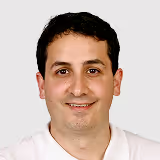
Marcel Kloos
Swiss-licensed dentist and founder of Medschool Experts
Marcel Kloos founded Medschool Experts while studying abroad; since then, over 500 study places have been secured. The Stuttgart-born dentist studied dentistry from 2015 to 2021 in Sofia and holds a Swiss dental licence.
Today he lives in Bern and runs Medschool Experts full-time as its owner.
More articles worth reading
Why Students Transfer from Medical University of Varna — Your Options
Why Students Transfer from Medical University of Warsaw — Your Options
Why Students Transfer from Masaryk University Faculty of Medicine — Your Options
Ahmad
Sabrina
Rami
Noah
500+ students placed.
Now it's your turn!
No daydreaming, no empty promises. Just a clear plan — for the start of your medical degree.
40 minutes, no obligation