Medical School Credit Transfer to Europe: How Recognition Works for International Students
05.09.2026

What is the European Credit Transfer and Accumulation System, and what does one credit measure?
The European Credit Transfer and Accumulation System, almost always shortened to ECTS, is an accounting system for student workload. One credit represents 25 to 30 hours of the notional time an average learner needs to reach the stated learning outcomes, and a full-time academic year is set at 60 credits. That is the whole definition, published in the ECTS Users' Guide by the European Commission in 2015.
Notice what the credit does not measure. It says nothing about your grade or how hard the exam was. It counts hours: lectures, seminars, laboratory time, clinical rotations, private study, revision, the exam itself. A unit worth 8 credits describes roughly 200 to 240 hours of a student's life.
This is why the system travels. Two universities can disagree about almost everything and still agree on what 240 hours looks like, which is why a transcript from one European Higher Education Area member is readable by a registrar in another.
| ECTS credits | Workload at 25 hours per credit | Workload at 30 hours per credit | Share of a full-time year |
|---|---|---|---|
| 1 credit | 25 hours | 30 hours | 1.7% |
| 5 credits (a small unit) | 125 hours | 150 hours | 8.3% |
| 10 credits (a large unit) | 250 hours | 300 hours | 16.7% |
| 30 credits (one semester) | 750 hours | 900 hours | 50% |
| 60 credits (one academic year) | 1,500 hours | 1,800 hours | 100% |
| 360 credits (a six-year programme) | 9,000 hours | 10,800 hours | 600% |
Conversion band from the ECTS Users' Guide, European Commission, 2015. Percentages calculated against the 60-credit full-time year defined in that guide.
Programmes outside Europe use their own units: American semester hours, Indian credit points, Chinese xuefen. A receiving university rebuilds the workload from contact hours and study time rather than applying a fixed multiplier. Keep the original numbers. Do not convert them yourself.
What is a transcript of records, and what is a diploma supplement?
A transcript of records is the official list of every unit you took, the credits attached, the grade awarded and the period in which you took it, issued and stamped by the registry of the university you attended. A diploma supplement is a different animal: an eight-section description of a completed qualification and the education system that produced it, attached to the degree certificate.
The diploma supplement exists because a certificate saying "Doctor of Medicine" tells a foreign official almost nothing. The supplement adds the level, the length in years and credits, the grading scale with its distribution, and a description of the national higher education system. It was developed jointly by the European Commission, the Council of Europe and UNESCO, and graduates in Bologna Process countries have the right to receive it automatically, free of charge, in a major European language.
A student mid-degree has no diploma supplement, because no diploma has been awarded. That is normal and expected. The transcript of records plus the syllabi carry the file instead, together with a certificate of enrolment showing that you are a student in good standing and not someone who left under a cloud.
Why do universities ask for the course syllabus and not just the grade?
Because a grade is a verdict and a syllabus is evidence. A committee comparing your anatomy unit to its own needs to know what was taught, for how many hours, with which practical component, and how it was examined. A 9 out of 10 tells them you did well at something. Only the syllabus tells them at what.
The syllabus, sometimes called the course description or the subject card, usually states the aims, the topic list week by week, the split between lectures, seminars and practicals, the assessment method, the reading list and the credit value. For clinical subjects it should also state where the practical training happened and under whose supervision. That detail matters more than any other single line in your file.
Collect the syllabi while you are still enrolled. Departments answer their own students quickly and former students slowly. Download the version that applied during your year and ask the department to stamp printed copies. A stamped syllabus in the original language beats a perfect translation of an unstamped one.
How do the Lisbon Recognition Convention and the ENIC-NARIC network fit together?
The Lisbon Recognition Convention, adopted in 1997 under the Council of Europe and UNESCO, is the treaty that sets the ground rule for recognising foreign qualifications and study periods. Fifty-five countries had signed and ratified it by 2026. Its central move is procedural: the responsibility to demonstrate that an application does not meet the relevant requirements lies with the body carrying out the assessment.
Read that again. The default is recognition. A university that wants to refuse has to identify a substantial difference between what you did and what it teaches, and say what that difference is. It cannot simply prefer its own graduates or shrug at an unfamiliar country name.
The ENIC-NARIC network is the operational layer underneath. Each participating country runs a national information centre that answers questions about foreign qualifications and, in many countries, issues a statement of comparability describing how a foreign qualification relates to the local system. The European Commission's own guidance is blunt about the limits: there is no automatic European Union-wide recognition of academic diplomas, because education systems remain national.
Academic recognition and professional recognition are separate tracks that people constantly confuse. Academic recognition is a university admitting you into a year of its programme. Professional recognition is a regulator letting you practise. For doctors inside the European Union, the second track runs through Directive 2005/36/EC, which requires basic medical training to comprise at least five years of study and at least 5,500 hours of theoretical and practical training under university supervision. Those two numbers explain why European medical programmes are shaped the way they are.
Who actually decides what is recognised, and how is a file read?
Inside the receiving university, the decision belongs to an academic body rather than to the admissions office. Depending on the country it is called the credit recognition committee, the academic senate, the faculty council or the vice-dean for academic affairs. The admissions office collects documents. The academic body rules on them.
The reading itself is mechanical and slower than students expect. A subject specialist takes your physiology syllabus, puts it next to the local one, and marks the overlap in content and hours. That happens for every unit on your transcript. Where the overlap is close, the credits carry across. Where a topic is taught locally that you have not covered, the committee names it. Some faculties offer a differential examination for borderline units, so a subject can be closed in one sitting.
What comes back is a written decision listing each unit, the local equivalent and the credits granted. Ask for it in writing and keep it. It is the document that determines your enrolment year, your fee schedule and, later, your position in any professional recognition file.
Entry requirements are set individually and vary by university and by your own record, so a general article cannot tell you where a specific file lands. Medschool Experts assesses that directly. Book a free individual consultation and the team reviews your transcript, your syllabi and your goals against the programmes it works with; the shape of those programmes is set out under universities.
What do apostille and sworn translation actually mean?
An apostille is a certificate that authenticates the signature and seal on a public document so that another country will accept it. It comes from the Hague Convention of 5 October 1961, which had 130 Contracting Parties in 2026 and is one of the most widely used treaties in legal cooperation. Before it existed, a foreign document needed a chain of confirmations ending at an embassy. The apostille replaces the chain with a single page.
Two details trip people up. First, an apostille is issued by a designated competent authority in the country where the document was issued, not in the country where you want to use it. A transcript from Karachi is apostilled in Pakistan. Second, the apostille says nothing about the content of the document. It confirms that the registrar's signature is genuine. Truth of the contents is not its job.
If either country sits outside the 1961 Convention, the older route applies: the issuing ministry, then the foreign ministry, then the receiving country's consulate. It works. It simply takes longer.
A sworn translation is one carried out by a translator whose authority to certify is recognised by a state. In much of continental Europe that means a translator sworn before a court and listed in a public register, who signs and stamps the translation and binds it to a copy of the original. Some countries accept an agency's certificate of accuracy instead, and some require the work to be done in the destination country. Confirm that rule before paying, because a translation made under the wrong regime is redone.
When in the year should a transfer be started?
Work backwards from the intake. Most European programmes open a winter semester in late September or October and a summer semester around February, with the main intake in autumn. A file aimed at that autumn should begin the previous autumn, because the slowest steps are the ones you do not control: a registry that issues transcripts in batches, a ministry with a queue, a consular appointment.
The calendar has an awkward property. Your current university is at its busiest exactly when you need documents from it, and it closes for the winter break just as translation work would start. Requesting in September, before the exam session, gets a faster answer than requesting in January.
| Document | Who issues it | Sworn translation | Apostille or legalisation | Lead time to allow |
|---|---|---|---|---|
| Transcript of records | Registry or student office of the current university | Yes | Usually | 2 to 6 weeks |
| Syllabus for each unit passed | Department or faculty | Yes | Sometimes | 3 to 8 weeks |
| Diploma supplement, where a degree was completed | The awarding university | Often unnecessary, it is issued in a major European language | Sometimes | 2 to 4 weeks |
| Secondary-school leaving certificate | School or education ministry | Yes | Yes | 1 to 4 weeks |
| Certificate of enrolment and good standing | Registry | Yes | Sometimes | 1 to 2 weeks |
| Passport valid past the intended study period | National passport authority | No | No | 4 to 12 weeks if renewal is needed |
| Medical and vaccination records | Treating physician or clinic | Yes | Rarely | 1 to 2 weeks |
Planning estimates compiled by Medschool Experts, 2026. Each registry, ministry and receiving institution sets its own turnaround, and the exact set of documents depends on the individual case.
Two dates deserve marking in red. Your passport expiry, since many countries require validity well beyond the intended stay, and the end of your current enrolment year, because a certificate of good standing is easiest to get while you are still on the register.
{{cta}}What does a credit transfer move cost?
The paperwork itself is a four-figure sum in most cases, and the largest single line is usually the first tuition instalment rather than any document. Translation is charged per page or per line and varies enormously by language pair and country. Apostilles carry a fixed national fee. Courier and travel are what they are.
Sample budget A models one student making one move for an autumn start, with a document set of moderate size. Sworn translation of 26 pages at 30 euro per page comes to 780 euro. Nine apostilles at 25 euro each add 225 euro. Two international courier shipments, sent with tracking because these are originals, cost 120 euro. A file assessment or application fee of 150 euro, a return flight with two nights for enrolment in person at 480 euro, and a national visa or residence permit fee of 100 euro follow. The first tuition instalment is modelled at 1,500 euro. The total is 3,355 euro.
Every line in that model moves. Translation between two widely spoken European languages costs less than translation from a language with few sworn translators. Apostille fees are set nationally. Tuition instalments differ by programme and country, and some universities take a flat deposit instead. Treat the total as a planning figure, not a price list. Part of what Medschool Experts does under services is putting real numbers against each line for a specific case.
Add one expense deliberately: a second certified copy of everything. A committee keeps an original, a consulate retains a document. A duplicate set costs a fraction of a re-issue from abroad.
What does general coverage of study transfers leave unanswered?
The sequencing. Almost every explanation of transfers stops at the recognition decision, as though enrolment followed automatically. Three administrative acts have to happen in the right order, in three different institutions, and getting them out of sequence costs a semester.
The order is: acceptance first, immigration second, de-registration last. A national long-stay visa or a residence permit for study purposes is issued against proof of admission, so the acceptance letter and the recognition decision have to exist before the immigration file can be opened. Directive (EU) 2016/801, which governs the entry and residence of students and researchers in the European Union, sets an outer limit of 90 days from a complete application for a decision to be taken and notified in writing. Complete is the operative word. A file missing one translation restarts nothing and delays everything.
De-registration from the old university comes last, and this is where students lose most. Leaving the register early can end a student visa in the current country, cancel health insurance, void a scholarship, and make the transcript you still need harder to obtain. Stay enrolled until the new place is confirmed and the documents are in hand. Then de-register formally and collect the leaving certificate.
A fourth act hides between the others: matriculation in person. Many European universities require original documents to be presented physically at enrolment, in the same month teaching begins. Discovering that in August is the most common avoidable delay in the whole sequence.
How far into a European degree can prior study take you?
This is the question everyone arrives with, and it deserves a direct answer about process rather than a guess about outcome. What carries forward depends on your transcript, your syllabi, the programme you are entering and the judgement of that faculty's academic body. Two students with the same number of credits can land differently, because content is compared unit by unit rather than counted in bulk.
Medschool Experts is the world's leading specialist in credit-recognition placements for healthcare graduates, and regularly achieves year 4 or year 5 entry at top universities worldwide. That includes students arriving from partially completed medical degrees, and it includes graduates of neighbouring healthcare professions moving into medicine or dentistry: pharmacists, physiotherapists, paramedics, biomedical scientists, laboratory technicians and nurses. The route exists. It is built on documents and syllabi, and the quality of the file changes the result.
Preparation is what moves a case. A complete set of stamped syllabi, a transcript that lists contact hours, translations made under the right regime, and a clear statement of what you have already done clinically. Assemble that and the committee has something to say yes to.
Where an individual case lands is never something to guess at from a table. Send your transcript and syllabi to Medschool Experts and ask for a free consultation, and your file will be read by people who submit these cases as their daily work.
The author's view
I studied dentistry in Sofia between 2015 and 2021, and I still remember how much of that first year was spent chasing paper rather than reading it. Every stamp had a queue attached. What I understood only later is that the paperwork is not an obstacle course, it is the argument. A committee that receives a thin file makes a thin decision, because it has nothing else to work with.
I now live in Bern and work as a Swiss-licensed dentist, and I have helped place over 500 students into study places. The pattern that repeats is this: the students who arrive with stamped syllabi, a transcript that shows contact hours and a clear account of what they have already done clinically get a serious reading. The ones who arrive with a grade summary and hope get a slower one. Same records, different outcomes, and the difference was assembled months earlier.
My advice to anyone reading this partway through a degree is to start collecting now, before you know where you are going. Download every syllabus in the version that applied to your year. Ask the department to stamp them. Keep the originals in the original language. Then send the file to us and let us tell you what it supports; nobody should be making that judgement alone from a table on the internet.
Summary
- One ECTS credit represents 25 to 30 hours of student workload, and a full-time academic year is 60 credits, as defined in the ECTS Users' Guide of the European Commission, 2015.
- A transcript of records lists units, credits and grades; a diploma supplement is an eight-section description of a completed qualification, developed by the European Commission, the Council of Europe and UNESCO.
- Universities ask for course syllabi because recognition compares content and hours, not the grade on its own.
- The Lisbon Recognition Convention of 1997, ratified by 55 countries as of 2026, places the burden of proving a substantial difference on the assessing institution rather than on the student.
- An apostille under the 1961 Hague Convention, with 130 Contracting Parties in 2026, authenticates a signature and seal and is issued in the country where the document was created.
- A document timeline for an autumn intake starts the previous September, because registries, ministries and consulates set their own pace.
- A modelled move totals around 3,355 euro across translation, apostilles, courier, fees, travel and a first tuition instalment.
- Acceptance comes first, immigration second, de-registration from the old university last.
Conclusion
Credit recognition rewards preparation more than luck. The students whose files move quickly are the ones who gathered stamped syllabi while still enrolled, kept the original numbers intact, and started the paperwork a full academic year before they intended to sit in a European lecture hall.
No table can tell you where your own record lands, because the comparison is made unit by unit against a specific programme. Send your transcript and syllabi and ask for a free consultation; Medschool Experts will assess your case directly and tell you what the file supports.
Frequently Asked Questions about medical school credit transfer to Europe
What does one ECTS credit actually represent?
One credit in the European Credit Transfer and Accumulation System represents 25 to 30 hours of student workload, according to the ECTS Users' Guide published by the European Commission in 2015. Workload covers lectures, seminars, laboratory and clinical time, private study and the examination. A full-time academic year is set at 60 credits, which puts a year somewhere between 1,500 and 1,800 hours. The credit measures time, never quality.
Is a transcript of records the same thing as a diploma supplement?
No. A transcript of records is issued by your university's registry and lists every unit taken, the credits attached, the grade and the period. A diploma supplement accompanies a completed degree certificate and describes the qualification and the national education system in eight sections. Students still mid-degree have a transcript but no supplement, which is entirely normal and does not weaken a recognition file.
Why does a receiving university want my syllabus?
Because recognition compares content, not verdicts. A specialist places your syllabus for a subject next to the local one and checks the topics covered, the hours taught, the practical component and how it was assessed. A grade cannot show any of that. Collect stamped syllabi in the version that applied during your year, while you are still enrolled and the department still answers you as its own student.
Does the Lisbon Recognition Convention guarantee that my credits transfer?
It does not guarantee an outcome, but it sets the default. Adopted in 1997 and ratified by 55 countries as of 2026, the convention puts the responsibility on the assessing body to demonstrate that an application fails the relevant requirements. A refusal has to name a substantial difference. That is a meaningful protection, and it is why a well-documented file with full syllabi is treated seriously.
What is an apostille, and does every document need one?
An apostille authenticates the signature and seal on a public document under the Hague Convention of 5 October 1961, which had 130 Contracting Parties in 2026. It is issued by a competent authority in the country that produced the document. Not every document needs one; academic and civil-status papers usually do, a passport does not. If either country is outside the convention, consular legalisation replaces it.
What makes a translation a sworn translation?
A sworn translation is certified by a translator whose authority the state recognises. Across much of continental Europe that means a translator sworn before a court and entered in a public register, who stamps and signs the translation and binds it to a copy of the original. Other countries accept an agency certificate of accuracy. Check which regime the destination requires before paying, since a translation made under the wrong one is redone.
When should paperwork start for an autumn intake?
The previous September. Requesting transcripts and syllabi before the winter exam session gets a faster reply than requesting in January, and it leaves November and December for sworn translation and apostilles. That puts a complete file in front of a credit committee between December and February, leaves spring for the decision and acceptance, and keeps the summer free for the visa or residence permit and for enrolment.
How far into a degree can previous study take me?
That is settled case by case from your transcript, your syllabi and the programme you are entering, so no general figure would mean anything for your file. Medschool Experts is the world's leading specialist in credit-recognition placements for healthcare graduates and regularly achieves year 4 or year 5 entry at top universities worldwide. Send your documents and book a free consultation, and your case will be assessed directly.
What students say about Medschool Experts
Over 500 placements at more than 25 partner universities across 10+ countries. Read independent student reviews on Trustpilot.
About the author
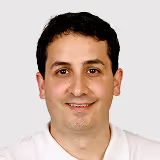
Marcel Kloos
Swiss-licensed dentist and founder of Medschool Experts
Marcel Kloos founded Medschool Experts while studying abroad; since then, over 500 study places have been secured. The Stuttgart-born dentist studied dentistry from 2015 to 2021 in Sofia and holds a Swiss dental licence.
Today he lives in Bern and runs Medschool Experts full-time as its owner.
More articles worth reading
Why Students Transfer from Medical University of Varna — Your Options
Why Students Transfer from Medical University of Warsaw — Your Options
Why Students Transfer from Masaryk University Faculty of Medicine — Your Options
Ahmad
Sabrina
Rami
Noah
500+ students placed.
Now it's your turn!
No daydreaming, no empty promises. Just a clear plan — for the start of your medical degree.
40 minutes, no obligation