Studying Medicine in Georgia 2026/2027: Universities, Costs and Prospects
01.09.2026

What does an English-taught medical degree in Georgia look like?
Every English-taught medical programme in Georgia is a six-year Medical Doctor degree worth 360 ECTS credits, structured the way European faculties structure medicine: preclinical sciences first, then pathology and pharmacology, then clinical rotations in the teaching hospitals attached to the university. Teaching, examinations and ward rounds all run in English.
The first two years are anatomy, histology, physiology and biochemistry, taught in laboratories and dissection rooms rather than in lecture theatres alone. From the third year onwards the centre of gravity moves to the hospital, with rotations through internal medicine, surgery, paediatrics, obstetrics and gynaecology and the smaller specialties. The final year is the closest thing to working as a junior doctor under supervision.
Georgian is not the language of instruction, but it is the language of the patients. Faculties build basic medical Georgian into the early years for exactly that reason, and students who arrive with no Georgian at all manage the wards by the time rotations start. Tbilisi, with roughly a million and a half people and the largest hospitals in the country, gives the widest clinical exposure. Batumi is smaller, on the Black Sea, and noticeably cheaper to live in. Kutaisi is smaller again, with a limited English-taught intake, which is why most applicants who like the city end up in Tbilisi or Batumi instead.
Georgia in one paragraph
Six years, 360 ECTS, taught in English, tuition of USD 4,000 to 8,000 a year, two of Europe's cheaper student cities, and a degree that opens the ECFMG and PLAB routes. Which faculty suits you personally is something we work out with you.
Which Georgian medical universities are open to international students in 2026/2027?
The private medical faculties are open to international applicants for the 2026/2027 intake in Georgia: the University of Georgia, Caucasus International University, East European University, New Vision University, Georgian American University, Petre Shotadze Tbilisi Medical Academy and BAU International University Batumi. The state universities are not taking new foreign students from that academic year.
The change was announced on 4 December 2025 by the Minister of Education and Science, Givi Mikanadze, who said admission of foreign students to state universities would become impossible except in individual cases, and that foreign applicants would study at private universities instead. Prime Minister Irakli Kobakhidze framed it as freeing capacity for Georgian students, pointing to Tbilisi State Medical University where foreign students made up roughly 45% of enrolment in 2025. Students already matriculated continue their programmes.
That leaves Tbilisi State Medical University, Ivane Javakhishvili Tbilisi State University and Batumi Shota Rustaveli State University in the table below for reference and for anyone already enrolled, and it puts the practical decision squarely among the private faculties. Implementation is being handled institution by institution, so the picture moves during the year. We track it for the faculties we work with, and our university overview shows which programmes we can currently place students on.
| University | City / type | Tuition 2026 (USD/yr) |
|---|---|---|
| Tbilisi State Medical University | Tbilisi, state | 8,000 |
| Ivane Javakhishvili Tbilisi State University | Tbilisi, state | 8,000 |
| Batumi Shota Rustaveli State University | Batumi, state | 4,000 to 5,000 |
| Petre Shotadze Tbilisi Medical Academy | Tbilisi, private | 7,000 |
| New Vision University | Tbilisi, private | 7,000 |
| University of Georgia | Tbilisi, private | 6,500 |
| Georgian American University | Tbilisi, private | 6,480 |
| Caucasus International University | Tbilisi, private | 6,000 |
| East European University | Tbilisi, private | 5,500 |
| BAU International University Batumi | Batumi, private | 5,000 |
All ten award the same six-year Medical Doctor degree worth 360 ECTS credits. What differs between them is the size of the international cohort, the teaching hospitals they are attached to, and how much of the campus life happens in English.
What does a place at a Georgian medical university cost in 2026?
Annual tuition for the English-taught MD programmes in Georgia runs from USD 4,000 at Batumi Shota Rustaveli State University to USD 8,000 at Tbilisi State Medical University in 2026. Among the private faculties still open to international students for 2026/2027, the range narrows to USD 5,000 to USD 7,000 a year.
A worked example makes the six years concrete. Take Caucasus International University in Tbilisi at USD 6,000 a year, a student from Nigeria, starting in 2026 and graduating in 2032.
| Item | Amount (USD, 2026 prices) |
|---|---|
| Tuition, 6 x 6,000 | 36,000 |
| Living, 72 months x 500 | 36,000 |
| Health insurance, 6 years | 1,200 |
| Residence card, 6 renewals | 600 |
| Flights, 12 return trips | 4,800 |
| Six-year total | 78,600 |
Caucasus International University puts monthly living costs in Tbilisi at USD 320 to 690 in 2026, and Petre Shotadze Tbilisi Medical Academy at USD 415 to 990. The USD 500 used above sits in the middle of both bands. Batumi runs a little cheaper for rent and a little dearer for winter heating. Scholarships exist but are modest: Caucasus International University offers a 10% sibling discount, New Vision University up to 25% for strong academic performance from the second year.
{{cta}}How do you find the right university in Georgia, and get in?
We deliberately do not publish checklists or requirement tables for Georgia. They differ from one faculty to the next, they change from one academic year to the next, and a page that is accurate in August is misleading by spring. What does not change is that someone has to look at your individual case.
Send us your school-leaving certificate, your transcript if you already have one, and the countries you would consider. We read it, and we tell you at which university, in which country, we can place you and where we can get you in on a schedule you can plan around. Georgia is one option among many: through our partner network of official partner universities we place students in medicine, dentistry, pharmacy, nursing and veterinary medicine, and that gives us room to find the route that fits your profile rather than the one that happens to be advertised.
If you are already studying somewhere and thinking about moving, we check the highest possible entry point for you. In many cases that means starting well into the course rather than at the beginning, often in the final two years. Our placement service covers the whole way from that first look at your file to your first day on campus. Book a free consultation and we will tell you honestly what is realistic for you.
Will a Georgian medical degree let you practise abroad after graduation?
A Georgian MD is accepted for licensing routes in the United States, the United Kingdom and the European Union, because the National Center for Educational Quality Enhancement holds World Federation for Medical Education recognition status granted on 19 October 2018. That satisfies the accreditation requirement that took effect for ECFMG certification in 2024, under which applicants must have studied at a school accredited by a WFME-recognised agency.
For the United States that means Georgian graduates can sit the USMLE sequence and apply for ECFMG certification, provided their school and programme are listed correctly in the World Directory of Medical Schools. For the United Kingdom, the route is registration with the General Medical Council through PLAB, plus the GMC's English language requirement, usually IELTS 7.5 overall or OET grade B.
Inside the European Union, a Georgian degree is a third-country qualification. It is not covered by the automatic recognition of Directive 2005/36/EC, so each member state assesses it individually, typically through an equivalence review and a national knowledge examination. Nursing and midwifery graduates deal with the Nursing and Midwifery Council in the United Kingdom on a comparable basis. Students who have gone through this describe the sequence in our student stories.
Georgia itself is a growing destination rather than a shrinking one. The national statistics office counted 44,400 international students in Georgian higher education in 2025/2026, up 19.7% on the previous year, across 64 institutions. More than nine in ten of them study health and social care subjects. The demand is real, and so is the capacity being built to meet it.
The author's view
I studied dentistry in Sofia from 2015 to 2021, and what I remember most clearly is not the syllabus. It is how ordinary the whole thing turned out to be once I was there. A lecture hall, a dissection room, a hospital with the same smell as every hospital, and a cohort of people from a dozen countries who had all been told at home that medicine was not for them.
Georgia gives people that same second look. The faculties in Tbilisi and Batumi have been teaching in English for years, their intakes are large enough that you are not the only foreigner in the room, and the price is one that a family can plan for rather than gamble on. That combination is rarer than it sounds.
On the state-university change of December 2025 I would say this plainly: it narrows the choice, it does not close the route. In our own placement work at Medschool Experts the private faculties were already where most of our students ended up. For 2026/2027 that is simply now the whole map, and it is still a good map. What I would not do is try to read your own chances off a table on the internet. Send us your certificate and let us tell you where you actually stand.
Conclusion
Georgia's private medical faculties offer something genuinely useful: an English-taught six-year MD at a tuition level that does not require a six-figure loan, in two cities that are pleasant to live in and hospitals that take students seriously.
Which faculty is the right one for you, and whether Georgia is even the best of the countries open to you, is not something a web page can answer. That is our job. Send us your profile and we will tell you at which university, in which country, we can place you, and where we can get you in on a schedule you can plan around, drawing on the largest network of official partner universities for medicine, dentistry, pharmacy, nursing and veterinary medicine.
Book a free consultation and let us look at your case together.
Frequently Asked Questions about Studying Medicine in Georgia
What do I personally need to get a place at a Georgian medical university?
That depends on your certificate, your subject combination and the faculty, and it moves from year to year, which is why we do not publish a general list. Send us your school-leaving certificate and your preferred countries and we will look at it individually. You will hear from us which university in which country we can place you at, and where we can get you in on a timeline you can plan around.
Do I need to speak Georgian to study medicine there?
No. Teaching, examinations and clinical rotations on the international programmes run entirely in English, from the first anatomy lecture to the final year on the wards. Faculties build basic medical Georgian into the early years so that you can talk to patients during rotations, and daily life in Tbilisi and Batumi is manageable in English long before that.
What does the whole six-year degree cost in Georgia?
Tuition alone runs from about USD 30,000 over six years at BAU International University Batumi to USD 48,000 at Tbilisi State Medical University at 2026 rates. With living costs of roughly USD 400 to 600 a month in Tbilisi, health insurance and flights home, a realistic six-year total lands somewhere between USD 65,000 and USD 85,000.
Tbilisi or Batumi?
Tbilisi has the largest teaching hospitals in the country and the widest clinical exposure, along with the biggest international student community. Batumi sits on the Black Sea, is smaller and quieter, and is noticeably cheaper for rent, though winter heating costs more. Both award the same six-year MD.
Can I still enrol at a Georgian state university in 2026/2027?
Following the announcement of 4 December 2025 by Minister of Education and Science Givi Mikanadze, Georgian state universities stop admitting new foreign students from the 2026/2027 academic year, with exceptions handled case by case. Tbilisi State Medical University, Ivane Javakhishvili Tbilisi State University and Batumi Shota Rustaveli State University are state institutions. Students already enrolled continue their programmes, and the private universities keep enrolling international students.
I already study medicine somewhere else. Can I move to Georgia?
Often yes, and the question is how far in you can start. We check the highest possible entry point for your case rather than assuming you begin again from the first year, and in many transfers that means entering in the later part of the course, frequently in the final two years. Send us your enrolment certificate and your transcript of records and we will tell you what is possible.
Will a Georgian MD let me work in the United States or the United Kingdom?
The National Center for Educational Quality Enhancement holds World Federation for Medical Education recognition status granted on 19 October 2018, which satisfies the accreditation requirement that took effect for ECFMG certification in 2024. For the United Kingdom, graduates apply to the General Medical Council through the PLAB route. Within the European Union, recognition runs case by case rather than automatically under Directive 2005/36/EC.
What students say about Medschool Experts
Over 500 placements at more than 25 partner universities across 10+ countries. Read independent student reviews on Trustpilot.
About the author
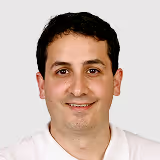
Marcel Kloos
Swiss-licensed dentist and founder of Medschool Experts
Marcel Kloos founded Medschool Experts while studying abroad; since then, over 500 study places have been secured. The Stuttgart-born dentist studied dentistry from 2015 to 2021 in Sofia and holds a Swiss dental licence.
Today he lives in Bern and runs Medschool Experts full-time as its owner.
More articles worth reading
Why Students Transfer from Medical University of Varna — Your Options
Why Students Transfer from Medical University of Warsaw — Your Options
Why Students Transfer from Masaryk University Faculty of Medicine — Your Options
Ahmad
Sabrina
Rami
Noah
500+ students placed.
Now it's your turn!
No daydreaming, no empty promises. Just a clear plan — for the start of your medical degree.
40 minutes, no obligation