Medicine, Dentistry, Pharmacy or Veterinary Medicine? Choosing Your Degree Abroad in 2026
17.09.2026

How long does each degree take: medicine, dentistry, pharmacy or veterinary medicine?
Medicine normally runs six years. Dentistry and pharmacy normally run five. Veterinary medicine sits between five and six depending on the country. Directive 2005/36/EC sets five years as the floor for all four, and universities build on top of that floor rather than under it.
The concrete numbers are easy to check. Semmelweis University in Budapest, Hungary, describes its English-language General Medicine programme as six years, twelve semesters, 360 credits, leading to a Doctor of General Medicine. The same university's Dentistry programme is five years, ten semesters, 311 credits, leading to a Doctor of Medicine in Dentistry. The Faculty of Pharmacy of Charles University in Hradec Kralove, Czech Republic, publishes a five-year Master's programme in Pharmacy taught in English. The University of Veterinary Medicine Budapest in Hungary states 5.5 years for its veterinary programme and awards a Doctor of Veterinary Medicine.
Veterinary medicine is the one where the country matters most. The University of Veterinary Medicine and Pharmacy in Kosice, Slovakia, runs its General Veterinary Medicine programme over six years, a full half-year longer than Budapest, for the same profession and the same European legal minimum. Same job at the end. Different calendar.
Bulgaria splits the difference on dentistry. The Faculty of Dental Medicine at the Medical University of Sofia, Bulgaria, describes its education as five years plus a six-month pre-graduate internship, with clinical training running from the second semester to the tenth.
What does European law actually require for each of the four degrees?
Directive 2005/36/EC fixes a floor for all four professions and phrases it slightly differently each time. Medicine needs at least five years and at least 5,500 hours. Dentistry needs at least five years and at least 5,000 hours. Veterinary medicine needs at least five years of full-time theoretical and practical study. Pharmacy is the odd one out.
Article 44 of the directive splits the pharmacy requirement into two parts: four years of full-time theoretical and practical training at a university, plus a six-month traineeship in a pharmacy open to the public or in a hospital under the supervision of that hospital's pharmaceutical department. The six months are not an optional extra. They are part of the five years the directive counts.
That structural detail explains something readers often find confusing. A pharmacy degree advertised as five years is not four years of lectures with a bonus year bolted on; the traineeship is written into the qualification itself. Medicine, dentistry and veterinary medicine carry no equivalent clause in the directive, so their practical hours sit inside the taught programme and individual universities decide how to distribute them.
| Degree | Directive 2005/36/EC minimum | Named example and length | Degree awarded in that example |
|---|---|---|---|
| Medicine | 5 years and 5,500 hours (Article 24) | Semmelweis University, Hungary: 6 years, 12 semesters, 360 credits | Doctor of General Medicine |
| Dentistry | 5 years and 5,000 hours (Article 34) | Semmelweis University, Hungary: 5 years, 10 semesters, 311 credits | Doctor of Medicine in Dentistry |
| Pharmacy | 5 years: 4 years of instruction plus a 6-month traineeship (Article 44) | Charles University, Czech Republic: 5 years | Master's degree in Pharmacy |
| Veterinary medicine | 5 years of full-time study (Article 38) | University of Veterinary Medicine Budapest, Hungary: 5.5 years; Kosice, Slovakia: 6 years | Doctor of Veterinary Medicine |
When do you first work on patients, animals or prescriptions?
The four degrees front-load theory differently, and that changes what the early years feel like. Dentistry puts students into practical work soonest. Semmelweis University states that its dentistry students begin practical dental work from the third year, supported by four summer practices covering laboratory work, dental assistance and general dentistry. Medicine waits longer.
At Semmelweis, the first two years of medicine are the theoretical module: medical chemistry, biophysics, anatomy, histology, physiology. Year three is the pre-clinical year, with pathology, microbiology and immunology. Clinical disciplines arrive in years four and five as small-group block rotations, and the sixth year is the internship year across internal medicine, surgery, paediatrics, obstetrics and gynaecology, neurology and psychiatry, closing with a thesis and state examinations.
Veterinary medicine in Budapest saves a whole semester for practice. The university's fee schedule refers explicitly to an eleventh practical semester, which is why the programme runs 5.5 years rather than five. Pharmacy places its concentrated practice at the end too, in the six-month traineeship the directive requires.
Sofia is the outlier worth knowing about. The Faculty of Dental Medicine at the Medical University of Sofia runs clinical training from the second semester through to the tenth, then adds a six-month pre-graduate internship rotating through paediatric dentistry, conservative dentistry, oral and maxillofacial surgery, prosthetics, periodontology and orthodontics. Five and a half years in total.
Where are these four degrees actually taught in English in Europe?
Medicine is taught in English in the widest range of countries; pharmacy and veterinary medicine in the narrowest. That is a supply fact, not a quality judgement. A handful of universities carry most of the English-language veterinary and pharmacy places on the continent, which makes the application calendar tighter for those two than for medicine.
Hungary is the only country in this comparison where all four degrees appear in English within one city. Semmelweis University teaches general medicine, dentistry and pharmaceutical sciences in English in Budapest, and the University of Veterinary Medicine Budapest teaches the veterinary programme in English a few kilometres away. Bulgaria carries three of the four: the Medical University of Sofia publishes English-language fees for medicine, dental medicine and pharmacy.
The Czech Republic adds a dedicated pharmacy faculty. Charles University's Faculty of Pharmacy in Hradec Kralove teaches the five-year Master's programme in English as a faculty in its own right rather than a department inside a medical school. Slovakia's University of Veterinary Medicine and Pharmacy in Kosice runs its six-year General Veterinary Medicine programme in English. In Poland, Poznan University of Medical Sciences publishes a six-year English-language medical programme alongside a five-year dentistry programme.
Our university overview lists the programmes Medschool Experts works with directly, degree by degree.
What does each degree cost to graduation in 2026?
Published tuition for these four degrees in English runs from roughly 7,900 euros to 12,480 euros per year at the universities checked for this article. Veterinary medicine carries the highest published annual fee of the four. Pharmacy carries the lowest. The gaps compound over five or six years, which is where the worked totals below matter more than the yearly rate.
Every figure here comes from the university's own fee page for the 2026 or 2026/2027 intake.
| Programme and university | Published tuition | Length | At the published rate, to graduation |
|---|---|---|---|
| Medicine, Medical University of Sofia, Bulgaria | EUR 9,950 per year (2026/2027) | 6 years | EUR 59,700 |
| Dental Medicine, Medical University of Sofia, Bulgaria | EUR 10,000 per year (2026/2027) | 5 years plus a 6-month internship | EUR 50,000 across the five taught years |
| Pharmacy, Medical University of Sofia, Bulgaria | EUR 8,000 per year (2026/2027) | 5 years | EUR 40,000 |
| Pharmacy, Charles University, Hradec Kralove, Czech Republic | EUR 7,900 per year | 5 years | EUR 39,500 |
| Veterinary medicine, University of Veterinary Medicine Budapest, Hungary | EUR 12,480 per year (2026/2027 admissions) | 5.5 years | EUR 62,400 across the five full years, plus the eleventh semester |
| Veterinary medicine, University of Veterinary Medicine and Pharmacy in Kosice, Slovakia | EUR 10,000 per year (new students 2026/2027) | 6 years | EUR 60,000 |
| Medicine, Semmelweis University, Budapest, Hungary | USD 10,450 per semester (2026 entry) | 6 years, 12 semesters | USD 125,400 |
| Dentistry, Semmelweis University, Budapest, Hungary | USD 10,450 per semester (2026 entry) | 5 years, 10 semesters | USD 104,500 plus material fees in years 2 to 5 |
| Pharmaceutical Sciences, Semmelweis University, Budapest, Hungary | USD 6,620 per semester (2026 entry) | 5 years, 10 semesters | USD 66,200 plus material fees in years 2 to 5 |
| Medicine, Poznan University of Medical Sciences, Poland | PLN 71,000 per year in years 1 and 2, PLN 85,750 in years 3 to 6 (2026/2027) | 6 years | PLN 485,000, stated by the university as the total programme cost |
Two mechanics in that table deserve attention. Semmelweis University states that continuing students stay on the fee rate they first enrolled at, so the semester figure a 2026 entrant pays is the figure they pay in year six. The university's published 2025 rate was USD 9,950 per semester for medicine and dentistry, so the rate has moved between cohorts rather than within one. Poznan University of Medical Sciences takes the opposite approach and publishes a fee that steps up from year three onward.
The one-off charges are small next to tuition, but they arrive first. The Medical University of Sofia lists 55 euros for document submission and 210 euros for the entrance examination in English, biology and chemistry. The University of Veterinary Medicine Budapest lists a 200-euro application fee and a 250-euro entrance examination fee, and folds an 800-euro deposit plus a 220-euro registration fee into the first semester invoice. Kosice asks for an 800-euro deposit before registration, credited against the first year.
Which licence does each degree lead to after graduation?
All four degrees end in a regulated licence, but only some of them let a graduate work unsupervised soon after the degree. Veterinary medicine leads to registration relatively directly in several systems. Medicine and pharmacy usually add a supervised year first. The regulator, not the university, sets that step.
Take the United Kingdom as a worked illustration, because its four regulators publish their rules openly. The General Medical Council grants provisional registration, which allows a doctor to take part in an approved Foundation Year 1 programme, and states that provisional registration is only open to those who have not already completed an acceptable internship. The General Pharmaceutical Council requires 52 weeks of supervised foundation training at an approved site plus the registration assessment before a pharmacist joins the register in Great Britain.
Dentistry and veterinary medicine work differently again. The General Dental Council recognises dental qualifications listed in Annex V of Directive 2005/36/EC through what it describes as a near-automatic recognition process, and notes that this arrangement was extended for five years after a 2023 government review. Qualifications outside that list route through the Overseas Registration Exam or the Licence in Dental Surgery instead. The Royal College of Veterinary Surgeons registers graduates of universities that were approved or accredited by the European Association of Establishments for Veterinary Education at the time of graduation, without an examination, and says applications typically take four to six weeks; graduates of qualifications it does not recognise sit the Statutory Membership Examination.
One detail catches people out. The General Dental Council stopped offering temporary and occasional registration to dentists with European qualifications on 1 January 2021.
{{cta}}What does the day-to-day work look like in each of the four professions?
Degree length tells you about the next six years. The working pattern tells you about the next forty, and the four professions differ more in rhythm than in subject matter. Doctors work in teams and in shifts. Dentists work with their hands in a fixed space. Pharmacists work with information and stock. Vets work across species and often across sites.
A hospital doctor's week is organised by rota and by specialty training, which in most European systems runs for years after the degree ends. The Semmelweis sixth-year structure, covering internal medicine, surgery, paediatrics, obstetrics and gynaecology, neurology and psychiatry plus short blocks in transfusion medicine, infectology, emergency care and family medicine, is a reasonable preview of the breadth a junior doctor is expected to handle before specialising.
Dentistry is the most self-contained of the four. A dentist's day is a sequence of appointments in one room, with the same instruments, and the clinical decision is made and carried out by the same person within the hour. That immediacy is the reason some people choose it and the reason others choose something else.
Pharmacy splits into community practice, hospital practice, regulatory work and industry, and the directive's traineeship clause points students at the first two before they choose. Veterinary practice splits by species instead: small animal, equine, farm, public health, food safety. That breadth is why veterinary programmes reserve whole semesters for placement rather than scattering practice through the taught years.
How do you decide between them in the year before you apply?
The decision splits into two questions that need answering at different times: which profession, and which university. Settle the profession first. Most European English-language health-science programmes open applications in the winter or early spring for an autumn start, and entrance examinations cluster from spring into summer, so a decision made in September leaves room and one made in June does not.
A workable sequence, counting backwards from an autumn start:
- 12 to 14 months before: spend a day each with a doctor, a dentist, a pharmacist and a vet if you can arrange it. Shadowing answers the rhythm question faster than any reading.
- 10 to 12 months before: fix your school subjects. All four degrees examine on biology and chemistry; the Medical University of Sofia, for instance, publishes an entrance examination in English, biology and chemistry.
- 8 to 10 months before: shortlist three to five programmes across at most two countries. Read the published tuition and the published length together, not separately.
- 6 to 8 months before: assemble documents, including school certificates, translations, passport copies and medical certificates. Translation and legalisation are the steps that most often slip.
- 4 to 6 months before: register for entrance examinations and budget the one-off fees. Sofia lists 210 euros for its examination, the University of Veterinary Medicine Budapest 250 euros.
- 2 to 4 months before: pay deposits where an offer requires one. Kosice asks 800 euros before registration; Budapest folds 800 euros into the first veterinary semester.
- 4 to 8 weeks before: visa appointment, accommodation, health insurance, first tuition instalment.
Two things on that list are worth doing even if you are certain. Visit the city. Read one full curriculum, semester by semester, for the degree you think you want.
What do other guides leave unanswered about choosing between these four?
Three questions come up constantly in our consultations and are rarely addressed anywhere: whether the fee you are quoted can rise mid-degree, how the half-year in a 5.5-year programme is billed, and what happens to recognition if you change your mind about the country you want to work in. None of these are secrets. They are simply not on the pages that advertise programmes.
On the first, policies differ and they are published. Semmelweis University states plainly that continuing students remain on the fee rate they enrolled at, which is a different financial proposition from Poznan University of Medical Sciences publishing a rate that steps up from year three. Neither is hidden. Ask the question before you accept an offer, and ask it in writing.
On the second, a 5.5-year or six-year veterinary programme and a five-year pharmacy programme are not comparable on annual fee alone. The University of Veterinary Medicine Budapest's own fee page shows its annual fee split unevenly between semesters, 7,700 euros for the first and 4,780 euros for the second in the 2026/2027 intake, because the deposit and registration fee land in the first invoice. Compare totals.
On the third, recognition follows the qualification, not the graduate. Directive 2005/36/EC's list of recognised qualifications is what the General Dental Council points to for European dental degrees, and the Royal College of Veterinary Surgeons points to accreditation held at the time of graduation rather than accreditation held today. If you expect to move countries after graduating, check both before you enrol rather than after. Our student stories show how that plays out across different destinations.
How do you check that a programme will be recognised where you want to work?
Start from the country where you intend to practise, not from the university brochure. Each of the four professions has a named regulator in each country, each regulator publishes what it accepts, and those pages are the only source that binds anyone. A university can describe its degree as recognised. Only the regulator decides.
The practical check takes about an hour. Find the regulator for your profession in your target country. Find its page on qualifications obtained abroad. Look for your intended university, or for the accreditation the regulator names: Annex V of Directive 2005/36/EC for dentistry, accreditation by the European Association of Establishments for Veterinary Education for veterinary medicine. Note the date the page was last updated.
Where the answer depends on your own profile, meaning your school-leaving certificate, your nationality and the country you eventually want to license in, it stops being a research question. Requirements vary by university and by applicant, which is why we handle that part in a free individual consultation rather than in an article. You can also read how our placement process works before you book.
The author's view
I picked dentistry, and I picked it in Sofia. That was 2015, and I finished in 2021. What made the decision for me was not the length of the degree or the fee. It was the working day. I wanted to make a clinical decision and carry it out myself, in the same hour, with my own hands. Medicine appealed to me intellectually. The rota did not.
What I would tell my eighteen-year-old self is to look harder at the middle years rather than the first one. Everybody compares entry requirements and first-year tuition. Almost nobody reads what semester six actually contains, and that is where you find out whether the degree matches the job. In dentistry that meant standing at a chair with a patient in it far earlier than my friends in medicine did, which I loved and which some of my classmates found harder than they expected.
Since then I have worked as a licensed dentist in Switzerland and, through Medschool Experts, helped place over 500 students. The pattern I see is that people who chose well had spent a day watching the profession before they applied. One day. It is the cheapest piece of research available and the one most people skip.
Summary
- Directive 2005/36/EC sets five years as the minimum for all four degrees: medicine also needs 5,500 hours, dentistry 5,000 hours, veterinary medicine five years of full-time study, and pharmacy four years of instruction plus a six-month traineeship.
- Universities build above that floor. Semmelweis University in Budapest, Hungary, runs medicine over six years and 360 credits, dentistry over five years and 311 credits.
- Veterinary length depends on the country: 5.5 years at the University of Veterinary Medicine Budapest, six years at the University of Veterinary Medicine and Pharmacy in Kosice, Slovakia.
- Published annual tuition in the programmes checked here runs from EUR 7,900 at Charles University Faculty of Pharmacy, Czech Republic, to EUR 12,480 at the University of Veterinary Medicine Budapest for 2026/2027.
- The Medical University of Sofia, Bulgaria, publishes EUR 9,950 per year for medicine, EUR 10,000 for dental medicine and EUR 8,000 for pharmacy in 2026/2027.
- Dentistry puts students into practical work earliest; pharmacy and veterinary medicine concentrate practice at the end of the degree.
- Licensing differs by profession: the General Pharmaceutical Council requires 52 weeks of foundation training, while the Royal College of Veterinary Surgeons registers graduates of accredited programmes without an examination.
- Fee policy is not uniform. Semmelweis University keeps continuing students on their enrolment rate; Poznan University of Medical Sciences in Poland publishes a rate that rises from year three.
Conclusion
The four degrees are close enough on paper that the published numbers will not decide this for you. They will, though, rule options in and out: a six-year veterinary programme in Slovakia and a five-year pharmacy programme in the Czech Republic are a different commitment in time and money, and both are knowable before you apply.
What remains is the part no table covers, meaning your certificates, your target country and your own read on the working day. Bring those to a free consultation and we will work through them with you.
Frequently Asked Questions about choosing between medicine, dentistry, pharmacy and veterinary medicine
Which of the four degrees is the shortest?
Dentistry and pharmacy are the shortest in most European systems, at five years. Semmelweis University in Budapest, Hungary, publishes its English-language dentistry programme as five years and ten semesters, and Charles University Faculty of Pharmacy in the Czech Republic publishes a five-year Master's programme. Medicine runs six years at both Semmelweis and Poznan University of Medical Sciences in Poland. Veterinary medicine varies: 5.5 years in Budapest, six years in Kosice.
Does Directive 2005/36/EC set the same minimum for all four?
The floor is five years in every case, but the wording differs. Article 24 requires at least five years and at least 5,500 hours for basic medical training. Article 34 requires at least five years and at least 5,000 hours for basic dental training. Article 38 requires at least five years of full-time study for veterinary surgeons. Article 44 splits pharmacy into four years of instruction plus a six-month traineeship.
Why does a pharmacy degree include a six-month traineeship?
Because the directive says so. Article 44 of Directive 2005/36/EC requires a six-month traineeship in a pharmacy open to the public, or in a hospital under the supervision of that hospital's pharmaceutical department, as part of the five-year qualification. It is not an optional add-on and it is not additional to the five years; it sits inside them.
Which degree costs the most to finish?
Among the euro-denominated programmes checked for this article, veterinary medicine at the University of Veterinary Medicine Budapest carries the highest annual fee at EUR 12,480 for 2026/2027 admissions. Over six years at EUR 10,000 per year, Kosice reaches EUR 60,000, close to the EUR 59,700 that six years of medicine at the Medical University of Sofia comes to. Pharmacy at Charles University is the lowest at EUR 7,900 per year.
When do students start treating patients?
It depends on the degree. Semmelweis University states that its dentistry students begin practical dental work from the third year, supported by four summer practices. Its medicine programme keeps years one to three theoretical and pre-clinical, with clinical rotations in years four and five and an internship year in year six. The Medical University of Sofia runs dental clinical training from the second semester to the tenth.
Can I switch between these four degrees after starting?
Transfers between programmes exist but they are governed by each university's own rules and by how much of your completed coursework the receiving faculty accepts. There is no general European mechanism that moves credits from a pharmacy degree into a medicine degree. Whether a switch is realistic depends on the credits you hold and the university you are applying to, which is a question for a free individual consultation.
Do these degrees let me work anywhere in Europe?
Recognition follows the qualification and the regulator, not the university's marketing. The General Dental Council recognises dental qualifications listed in Annex V of Directive 2005/36/EC through a near-automatic process. The Royal College of Veterinary Surgeons registers graduates of programmes accredited by the European Association of Establishments for Veterinary Education at the time of graduation. Check the regulator in your target country before enrolling.
Is the tuition fee fixed for the whole degree?
That depends entirely on the university and it is published. Semmelweis University states that continuing students remain on the fee rate they first enrolled at, so a 2026 entrant pays the 2026 rate throughout. Poznan University of Medical Sciences publishes a different structure for 2026/2027: PLN 71,000 per year in years one and two, rising to PLN 85,750 from year three, for a stated programme total of PLN 485,000.
What students say about Medschool Experts
Over 500 placements at more than 25 partner universities across 10+ countries. Read independent student reviews on Trustpilot.
About the author
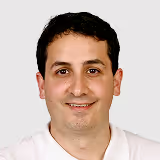
Marcel Kloos
Swiss-licensed dentist and founder of Medschool Experts
Marcel Kloos founded Medschool Experts while studying abroad; since then, over 500 study places have been secured. The Stuttgart-born dentist studied dentistry from 2015 to 2021 in Sofia and holds a Swiss dental licence.
Today he lives in Bern and runs Medschool Experts full-time as its owner.
More articles worth reading
Scholarships and Funding for Medical Studies in Europe 2026
Registering as a Dentist in Canada with a Foreign Degree: The NDEB Route 2026
Medical School Rankings 2026: What They Measure and What They Miss
Ahmad

Sabrina
Rami

Noah
500+ students placed.
Now it's your turn!
No daydreaming, no empty promises. Just a clear plan — for the start of your medical degree.
40 minutes, no obligation