Scholarships and Funding for Medical Studies in Europe 2026
17.09.2026

What funding is actually available for medical studies in Europe in 2026?
Four sources. They rarely overlap. The European Commission funds mobility periods through Erasmus+. National governments run scholarship schemes aimed at students from named partner countries. Universities set their own tuition and their own reductions. Your home country's student finance system may or may not follow you across a border.
Keeping those four apart is the whole job. An Erasmus+ grant will never pay for six years of enrolment, because it was never built to. A national government scholarship can cover tuition outright, but it usually asks first which passport you hold and only second what your grades look like. University awards sit closest to the money you actually owe. Home-country loans are the quietest of the four and often the largest.
Most funded students end up with a stack rather than one payment: a tuition reduction from the university, a home-country loan underneath it, and a mobility grant covering a semester or two in the middle.
How much does Erasmus+ pay a medical student per month?
Between 225 and 674 euros a month, depending on where you go. The European Commission's Erasmus+ Programme Guide for the 2021–2027 programme sets three bands: 225 to 550 euros toward a lower-cost destination, 292 to 606 euros within the same cost group, and 348 to 674 euros toward a higher-cost destination. Your national agency picks the exact rate inside the band.
Two top-ups sit on top of that band. Students with fewer opportunities receive an extra 250 euros a month. A study period combined with a traineeship adds 150 euros a month. Short stays are paid by the day instead: 79 euros for each of the first fourteen days, then 56 euros a day up to thirty.
Travel is funded separately. Distance sets the rate, and the Commission pays more for low-carbon travel than for flying on the shorter bands. That gap closes above 4,000 kilometres, where the rate is the same either way.
| Erasmus+ support | Published amount | Applies to |
|---|---|---|
| Monthly grant, lower-cost destination | 225–550 euros | Long-term study, 2–12 months |
| Monthly grant, same cost group | 292–606 euros | Long-term study, 2–12 months |
| Monthly grant, higher-cost destination | 348–674 euros | Long-term study, 2–12 months |
| Top-up, fewer opportunities | 250 euros per month | Long-term study |
| Top-up, traineeship added | 150 euros per month | Study plus traineeship |
| Short stay, days 1–14 | 79 euros per day | Short-term mobility, 5–30 days |
| Short stay, days 15–30 | 56 euros per day | Short-term mobility, 5–30 days |
| Travel distance | Green travel | Standard travel |
|---|---|---|
| 10–99 km | 56 euros | 28 euros |
| 100–499 km | 285 euros | 211 euros |
| 500–1,999 km | 417 euros | 309 euros |
| 2,000–2,999 km | 535 euros | 395 euros |
| 3,000–3,999 km | 785 euros | 580 euros |
| 4,000–7,999 km | 1,188 euros | 1,188 euros |
| 8,000 km and above | 1,735 euros | 1,735 euros |
Can Erasmus+ fund a whole medical degree, or only an exchange period?
Only a period. The European Commission funds long-term mobility of two to twelve months, and caps the total at twelve months within one study cycle. Medicine is one of two named exceptions. Because medicine and architecture are taught as single long cycles, students on those programmes may reach twenty-four months in total.
That doubling matters more than it looks. Two funded semesters abroad inside a six-year programme can move a clinical rotation, a research placement and a language year onto someone else's budget. The Commission also confirms that the receiving institution charges Erasmus+ students no tuition — you keep paying your home university, not both.
There is a second European route that does fund a full degree: Erasmus Mundus Joint Masters, which the Commission says almost 50,000 students have taken since 2004. Applications there usually run from October to January for the following academic year. It is a master's route, not an entry point into a six-year medical programme.
What does Stipendium Hungaricum cover, and what does it pay in 2026?
Tuition in full, plus a monthly stipend of 43,700 forint, plus either a free dormitory place or 40,000 forint a month toward accommodation, plus medical insurance up to 65,000 forint a year. Those are the published rates for bachelor, master, one-tier master and non-degree students. Doctoral rates are higher.
The Hungarian Government set the programme up in 2013. It is supervised by the Ministry of Foreign Affairs and Trade and run by the Tempus Public Foundation, and it now reaches more than 100 countries across five continents with around 900 full degree programmes on offer. Doctoral candidates receive 140,000 forint a month in the first phase and 180,000 in the second.
The deadline is the part people miss. For the 2026/2027 academic year, applications close on 15 January 2026 at 2 pm Central European Time. One fixed hour, one fixed day, no rolling window.
Two practical notes from the programme's own documents. Places are allocated through bilateral education agreements between Hungary and each sending country, so the list of who may apply is decided country by country rather than by open competition. And the monthly stipend and accommodation contribution are arranged between the scholarship holder and the host university, which means the university's coordinator, not the national office, is the person who sorts out payment.
Do Romanian government scholarships cover medicine, dentistry or pharmacy?
No. Romania's scholarship scheme for foreign citizens states plainly that awards are not made in the fields of medicine, dental medicine or pharmacy. Everything else about the scheme can look like a perfect fit and it still will not fund a medical degree. This is the single most useful line in the whole Romanian programme.
It is worth knowing what the scheme does do, because the structure is instructive. Romania's Ministry of Foreign Affairs offers it to citizens of non-EU countries, with narrow exceptions for the Romanian diaspora, people under protection in Romania, and families of diplomatic and international-organisation staff. It covers tuition for a Romanian-language preparatory year and for the degree itself, a monthly stipend paid in lei, dormitory accommodation subject to availability, and exemption from registration and admission-contest fees. It does not cover personal expenses or international travel. Applicants need an average of at least 7 on the Romanian scale from their last completed school.
The 2026 window is short. Applications open on 16 February 2026 and close on 31 March 2026, results are announced around 15 July 2026, and the academic year starts on 1 October.
So a European Union citizen who wants to study medicine in Romania is outside this scheme twice over: once on nationality, once on subject. That does not mean Romania is closed. It means the funding conversation there is about published tuition and university-level awards rather than about a government scholarship. If you want to know which Romanian programmes would realistically take your profile, that is a question for a free individual consultation rather than a web page.
What Polish government scholarships can a medical student apply for?
Poland's National Agency for Academic Exchange, known as NAWA, runs the government schemes. Its 2026 calls include the General Anders Programme, Poland My First Choice, the Banach Scholarship Programme, Zawacka NAWA for incoming exchange students, and funded summer courses in Polish language and culture.
The Banach Scholarship Programme is the one with published numbers. It pays 2,500 zloty a month, adds a travel allowance of 2,500 zloty, exempts the holder from tuition at public universities, and covers a Polish language and culture course. It is open to citizens of 36 countries covered by Polish Aid, spread across Eastern Europe, Asia, Africa and Latin America, and it funds full-time second-cycle studies taught in Polish or English.
Formats matter here. Banach funds second-cycle studies, which is a specific degree format, and each year's call document lists the eligible fields. Check that list against the exact programme you want rather than against the word "medicine".
How do EU and non-EU eligibility rules actually differ?
They differ in the opposite direction from what most people assume. European Union citizenship helps enormously with tuition status and with mobility grants. It actively disqualifies you from several of the richest national scholarship schemes, because those schemes exist as development and diplomacy instruments aimed at partner countries outside the Union. The logic is diplomatic.
| Scheme | Published money | Who may apply | 2026 window |
|---|---|---|---|
| Stipendium Hungaricum, Hungary | Tuition, 43,700 HUF per month, 40,000 HUF housing or free dormitory, insurance to 65,000 HUF per year | Students from partner countries under bilateral agreements | Closes 15 January 2026, 2 pm CET |
| Government scholarship, Romania | Tuition, monthly stipend in lei, dormitory subject to availability | Non-EU citizens; medicine, dental medicine and pharmacy excluded | 16 February to 31 March 2026 |
| Banach Programme, Poland | 2,500 PLN per month, 2,500 PLN travel, tuition exemption at public universities | Citizens of 36 Polish Aid countries, second-cycle studies | 2026 call open via NAWA |
Where do Swiss students stand with Erasmus+ in 2026?
Outside it. The European Commission lists Switzerland as a third country not associated to the Erasmus+ Programme, grouped in Region 14 alongside the Faroe Islands and the United Kingdom. Swiss students can take part in certain actions under specific conditions, but Switzerland is not one of the 27 European Union member states or the six associated third countries.
Those six associated countries are North Macedonia, Serbia, Iceland, Liechtenstein, Norway and Türkiye. Everyone on that list has full access to every action of the programme. Switzerland does not.
The practical effect is that a Swiss student planning a funded exchange starts at the international office of their own institution and at the Swiss federal mobility arrangements, not at an Erasmus+ application portal. Marcel Kloos, who studied dentistry in Sofia between 2015 and 2021 and now practises as a Swiss-licensed dentist in Bern, sees the confusion this causes every year: families assume a Swiss passport carries the same European mobility rights as a German or Austrian one, and it does not.
What do universities themselves offer, and how do you find it?
University-level money is the least visible layer and often the most flexible. It ranges from merit reductions for strong entry results to need-based instalment plans, early-payment discounts and semester-by-semester fee schedules that change what you actually transfer, even when the headline tuition stays the same.
These awards are rarely listed in one place. They live in admissions office documents, in faculty regulations, and sometimes in the offer letter itself. The published tuition figure is the number to start from; the amount you pay per semester after any reduction is the number that matters. Ask in writing.
In Medschool Experts' own placement work, across more than 500 study places arranged to date, the questions that decide this are always specific: which university, which programme, which entry year, which documents you already hold. Those are not questions a table can answer. Our services overview explains how we work through them, and our university overview shows which programmes we place students into.
{{cta}}Can you use a student loan or grant from your home country?
Often yes, and it is usually the largest single line in a medical student's budget. Every country in Europe runs its own student finance authority with its own rules on studying abroad, and those rules are set nationally rather than by the European Union. The published rates, the grant-and-loan split and the treatment of tuition fees differ from one country to the next.
Because those figures change by country and by year, the sensible move is to read your own authority's current rules rather than a summary written elsewhere. Four questions decide almost everything:
- Does your authority fund a complete degree abroad, or only a period abroad attached to a home enrolment?
- Does it pay anything toward tuition, and is that separate from the living-cost rate?
- What proportion is a grant you keep and what proportion is a loan you repay?
- What is the filing deadline, and does it fall before or after your university's acceptance date?
That last one catches people out constantly. Several national authorities want an enrolment confirmation the university does not issue until weeks after the funding deadline has passed, which means you file with a provisional document and update it later. Ask about the provisional route.
When do you apply? A month-by-month funding timeline for 2026/2027
The funding calendar runs roughly a year ahead of the lecture calendar. If you plan to start a programme in October 2026, the first hard deadline already sat in January 2026. Working backwards from an October start is the only way the dates make sense.
A working sequence for an October start:
12 months out
Shortlist three universities and write down each one's published tuition. Check whether any national scheme is even open to your nationality.
9 months out
Government scholarship deadlines land here. Stipendium Hungaricum closed on 15 January for the 2026/2027 year.
7 months out
The Romanian window runs 16 February to 31 March. Other national windows cluster in the same weeks.
5 months out
File your home-country student finance application, using a provisional enrolment document if the final one is not ready.
3 months out
Scholarship results arrive. Romania announces around 15 July. Confirm the first tuition instalment date in writing.
6 weeks out
Open a local bank account, arrange the first two months of rent, and register with the university's scholarship coordinator.
Two weeks is the gap to plan for between a scholarship result and a tuition payment date. Build it in.
What does a funded semester abroad actually add up to?
Take a five-month Erasmus+ study period, the length of a standard semester. Using the European Commission's published bands, a destination in a lower-cost group pays somewhere between 225 and 550 euros a month. Across five months that is 1,125 to 2,750 euros in individual support before anything else is added.
Now add the parts that are fixed rather than banded. A student with fewer opportunities receives 250 euros a month, which is 1,250 euros across the same five months. A journey in the 500 to 1,999 kilometre band pays 309 euros for standard travel or 417 euros if you travel green — Munich to Sofia sits inside that band. Combine the top of the lower-cost grant band with both additions and the total reaches 4,417 euros for one semester.
The Hungarian comparison works differently, because Stipendium Hungaricum pays in kind as well as in cash. Over a twelve-month year, the 43,700 forint monthly stipend comes to 524,400 forint, and the 40,000 forint housing contribution adds 480,000 forint where a dormitory place is not provided. Medical insurance is covered up to 65,000 forint. Tuition is waived entirely, which is the largest number of all and never appears as a transfer.
One caution. Grant bands are ranges set by national agencies, so the top of a band is a ceiling, not a forecast. Plan on the lower figure and treat anything above it as recovered ground.
What do other funding guides leave unanswered?
Three things, consistently.
The first is subject exclusions. Plenty of pages list national scholarship schemes as though every degree qualifies. Romania's scheme says in its own programme description that medicine, dental medicine and pharmacy are excluded, and that single sentence rewrites the plan for anyone who found the scheme through a general list.
The second is the difference between a scheme being open and a scheme being open to you. Stipendium Hungaricum runs on bilateral education agreements between Hungary and each sending country. The Banach Programme names 36 Polish Aid countries. Romania's scheme is for non-EU citizens. None of that is hidden — it just gets summarised away, because a table of monthly amounts reads better without a nationality column.
The third is sequencing. Guides publish amounts and skip the calendar, so students find the right scheme nine months after its deadline. A scholarship you qualified for and missed by a week costs exactly as much as one you never qualified for at all.
One more thing goes unsaid. Funding decisions and admission decisions run on separate tracks and separate timetables, and a scholarship result tells you nothing about whether a university will accept you. Students who plan both at once — and who read the experiences of students already on the programmes — end up with far fewer surprises in September.
The author's view
I started dentistry in Sofia in 2015 and finished in 2021, and the thing that surprised me most about money was not how much anything cost. It was how early the decisions had to be made. By the time most families sit down to talk seriously about funding, two or three of the national scholarship windows for that intake have already closed.
I now practise as a Swiss-licensed dentist in Bern, and the Swiss situation still catches people out. A Swiss passport does not carry Erasmus+ rights the way a German or Austrian one does, and I have watched families plan a funded semester on an assumption that was never true. Checking that took ten minutes on the European Commission's own pages.
My advice, after more than 500 placements in Medschool Experts' own work, is to build the plan around the calendar first and the amounts second. Find every deadline that applies to your nationality, put them in order, and then work out what each one is worth. Do it the other way round and you will be reading about a scholarship you can no longer apply for.
Summary
- Erasmus+ pays a monthly grant of 225 to 674 euros depending on the destination country group, with an extra 250 euros a month for students with fewer opportunities (European Commission, Erasmus+ Programme Guide 2021–2027).
- Erasmus+ funds mobility periods, not full degrees: two to twelve months per cycle, rising to twenty-four months for one-cycle programmes such as medicine.
- Stipendium Hungaricum waives tuition and pays 43,700 forint a month, plus a free dormitory place or 40,000 forint toward housing and medical insurance up to 65,000 forint a year; the deadline for 2026/2027 was 15 January 2026 at 2 pm Central European Time.
- Romania's government scholarship excludes medicine, dental medicine and pharmacy outright, and is open only to citizens of non-EU countries; the 2026 window ran from 16 February to 31 March.
- Poland's NAWA Banach Programme pays 2,500 zloty a month plus a 2,500 zloty travel allowance, for citizens of 36 Polish Aid countries in second-cycle studies.
- Switzerland is a third country not associated to Erasmus+, grouped by the European Commission in Region 14 with the Faroe Islands and the United Kingdom.
- Home-country student finance is usually the largest single line, and its filing deadline often falls before a university issues final enrolment papers.
- The funding calendar runs roughly a year ahead of the lecture calendar, so an October 2026 start meant a January 2026 deadline.
Conclusion
Funding a medical degree in Europe is a sequencing problem before it is a money problem. The schemes are public, the rates are published, and the windows are short enough that missing one by a week costs a full year.
Which of these your own profile can reach depends on your nationality, your school results and the university you are aiming at. That is a conversation, not a table — book a free consultation and we will work through your options together.
Frequently Asked Questions about Scholarships and Funding for Medical Studies in Europe
Does Erasmus+ pay for a full six-year medical degree?
No. Erasmus+ funds mobility periods of two to twelve months, and the European Commission caps the total at twelve months within one study cycle. Medicine is a named exception: because it is taught as a single long cycle, students on medical programmes may reach twenty-four months of funded mobility in total.
How much is an Erasmus+ grant per month in 2026?
The European Commission's Erasmus+ Programme Guide for the 2021 to 2027 programme sets three bands: 225 to 550 euros a month toward a lower-cost destination, 292 to 606 euros within the same cost group, and 348 to 674 euros toward a higher-cost destination. Your national agency sets the exact rate inside the band. Students with fewer opportunities receive an additional 250 euros a month, and adding a traineeship adds 150 euros a month.
Can a European Union citizen apply for Stipendium Hungaricum?
It depends on the country, not on European Union membership as such. Stipendium Hungaricum allocates places through bilateral education agreements between Hungary and each sending country, and the programme now covers more than 100 countries across five continents. Whether your nationality appears in a given year's call is the first thing to check.
Why can I not get a Romanian government scholarship for medicine?
Romania's scholarship scheme for foreign citizens states in its own programme description that awards are not made in the fields of medicine, dental medicine or pharmacy. The exclusion is by subject, not by applicant. The scheme is also restricted to citizens of non-EU countries, with narrow exceptions for the Romanian diaspora and for families of diplomatic and international-organisation staff.
What does the Polish NAWA Banach Programme pay?
The Polish National Agency for Academic Exchange publishes a monthly scholarship of 2,500 zloty for Banach holders, plus a travel allowance of 2,500 zloty, exemption from tuition at public universities, and a Polish language and culture course. It supports full-time second-cycle studies taught in Polish or English, and it is open to citizens of 36 countries covered by Polish Aid across Eastern Europe, Asia, Africa and Latin America.
Are Swiss students eligible for Erasmus+?
Not on the same basis as European Union students. The European Commission lists Switzerland as a third country not associated to the Erasmus+ Programme, placing it in Region 14 alongside the Faroe Islands and the United Kingdom. Swiss students can take part in certain actions under specific conditions, but the starting point is their own institution's international office.
When should I start applying for funding?
About twelve months before your intended start. For an October 2026 entry, Stipendium Hungaricum closed on 15 January 2026, the Romanian government window ran from 16 February to 31 March 2026, and results there were announced around 15 July 2026. Erasmus Mundus Joint Masters applications generally run from October to January for the following academic year.
Can I combine a scholarship with a student loan from home?
Usually yes, though the rules are set nationally rather than by the European Union, so your own student finance authority decides. Check four things: whether a complete degree abroad is fundable or only a period abroad, whether anything is paid toward tuition, how the grant and loan portions split, and whether the filing deadline falls before your university issues enrolment papers. Many authorities accept a provisional document.
What students say about Medschool Experts
Over 500 placements at more than 25 partner universities across 10+ countries. Read independent student reviews on Trustpilot.
About the author
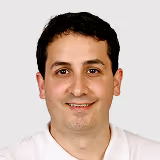
Marcel Kloos
Swiss-licensed dentist and founder of Medschool Experts
Marcel Kloos founded Medschool Experts while studying abroad; since then, over 500 study places have been secured. The Stuttgart-born dentist studied dentistry from 2015 to 2021 in Sofia and holds a Swiss dental licence.
Today he lives in Bern and runs Medschool Experts full-time as its owner.
More articles worth reading
Medicine, Dentistry, Pharmacy or Veterinary Medicine? Choosing Your Degree Abroad in 2026
Registering as a Dentist in Canada with a Foreign Degree: The NDEB Route 2026
Medical School Rankings 2026: What They Measure and What They Miss
Ahmad
Sabrina
Rami
Noah
500+ students placed.
Now it's your turn!
No daydreaming, no empty promises. Just a clear plan — for the start of your medical degree.
40 minutes, no obligation