Studying Medicine & Dentistry in England: Universities, Costs and Realistic Alternatives
11.09.2026

How selective the English system is
Applications for medicine and dentistry in England run centrally through UCAS, and a place is decided on far more than a school-leaving grade. A standardised aptitude test – usually the UCAT, at a few faculties the BMAT – counts alongside a written personal statement, a school reference and a structured selection interview, most often in the form of a Multiple Mini Interview. Only a small number of medicine choices may be named per application round, the window for medicine closes considerably earlier than for other subjects, and the number of places open to international applicants is capped.
The system is unusually transparent: every faculty publishes in detail what it weights and how. It is also unforgiving. It rewards applicants who have built their entire final school year around it, and an excellent Abitur on its own is not enough. For applicants from the German-speaking world, England is therefore rarely a realistic single plan – which is why the second half of this article looks at what the alternative actually is.
State universities: tuition fees for international students
England has more than 30 medical faculties at state universities. For EU citizens and other international students without British residency status, the considerably higher 'overseas' fees apply rather than the lower home fees for British nationals – a difference that has affected German applicants since Brexit too.
| University | Annual fee Medicine (int.) | Note |
|---|---|---|
| University of Leicester | from £30,150 | one of the more affordable options |
| University of Birmingham | from £30,330 | increases in clinical years |
| University of Southampton | from £32,000 | increases in clinical years |
| University of Manchester | from £39,900 | one of the largest faculties |
| University of Bristol | approx. £45,800 | — |
| University of Leeds | approx. £47,000 | — |
| University of Nottingham | approx. £47,000 | — |
| University of Oxford | from £49,400 | own selection process |
| University of Liverpool | approx. £50,000 | — |
| King's College London | approx. £56,800 | — |
| University College London | approx. £57,300 | — |
| Imperial College London | approx. £58,600 | — |
| University of Cambridge | from £70,554 | own selection process, most expensive option |
The range is enormous: between the cheapest and the most expensive faculty, the difference is more than £40,000 per year – for a five- to six-year programme. A complete medical degree in England costs international students between approximately €230,000 and over €420,000 in tuition fees alone, depending on the university, and that excludes living costs.
Private alternative: University of Buckingham
The University of Buckingham is the only independent private medical school in Great Britain – and it sits outside the rest of the system in several respects. It runs its own selection process rather than relying on the UCAT, and it does not work to the fixed, NHS-funded quota for international places that constrains the state faculties.
The programme lasts 4.5 years, shorter than the usual five to six, and starts twice a year, in September and January. Fees are approximately £40,000 to £45,000 per year for the complete programme, regardless of students' country of origin – making a total of approximately £180,000 to £200,000. For families who have England firmly in mind, it is usually the one British name worth looking at properly.
Dentistry: faculties and costs
For dentistry (BDS), the picture is similar to medicine, but with fewer locations in England. Selection works the same way, with an aptitude test alongside statement and interview. The following figures are rough approximations rounded to the nearest hundred.
| University | Annual fee Dentistry (int., approx.) |
|---|---|
| University of Central Lancashire | approx. £19,000 |
| University of Plymouth | approx. £21,000 |
| University of Birmingham | approx. £23,500 |
| University of Manchester | approx. £27,500 |
| University of Liverpool | approx. £33,000 |
| Newcastle University | approx. £37,500 |
| University of Bristol | approx. £38,000 |
| University of Sheffield | approx. £39,000 |
| Queen Mary University of London | approx. £40,500 |
| King's College London | approx. £45,500 |
{{cta}}
The realistic alternative: a place someone can actually plan for you
We do not publish requirement lists or dates on this site – not for England and not for anywhere else. They differ from faculty to faculty and change from one intake to the next, and a list written today would be the wrong one by the time it mattered to you.
What we do instead is look at your case. Send us your profile: your school certificate, any study records you already have, and the countries you could imagine living in. We then tell you at which university, in which country, we can place you – and where we can get you in on a timeline you can genuinely plan around. Our network of official partner universities for medicine, dentistry, pharmacy, nursing and veterinary medicine is the largest selection you will get for that, and if you are already enrolled somewhere we check the highest possible entry point for you, often into one of the final two years.
None of that costs you anything to find out: book a free study consultation, by phone or video call, with your parents if you would like them there.
Tuition fees and living costs at a glance
In addition to tuition fees, international students in England must budget for living costs themselves. In London, this is typically £1,400 to £1,800 per month; outside London, it is more like £1,000 to £1,300 – rent is by far the largest outgoing. Over a full degree, that turns an already expensive tuition figure into a considerably larger one, which is the single most common reason English faculties drop out of the shortlist in our consultations.
The author's view
What continues to strike me about the English system is that it is one of the most transparent in the world – every faculty publishes in full what it weights and how – and yet for most of the families I speak to it is still not a realistic option. Not because of the academics. Because of the money. Raising over €300,000 for a complete degree is a different conversation entirely from working hard for a good result.
I also notice how quickly the mood in a consultation changes once we stop talking about England and start talking about where a place is actually plannable. That is the part families rarely get from a website: not another list of hurdles, but someone saying, with your profile, here is where we can get you in. That sentence is worth more than any ranking.
Conclusion
England offers the widest choice of medical faculties in Europe, combined with one of the most selective and most expensive systems anywhere. For most families from the German-speaking world, the tuition figures alone decide the question before the academic ones do.
That is precisely why it is worth looking at the alternative properly rather than in passing. We do not publish requirement lists or dates here, because they differ by university and change every year. What we do is look at your situation: send us your school certificate, any study records you already hold, and the countries that would work for you.
We then tell you at which university, in which country, we can place you – and where we can get you in on a timeline you can plan around. Our network of official partner universities for medicine, dentistry, pharmacy, nursing and veterinary medicine gives you the largest selection available for that, and for students already enrolled somewhere we check the highest possible entry point, often into one of the final two years.
Book a free study consultation and find out what is realistic for you.
Further Reading
Frequently Asked Questions: Studying Medicine in England
Does Medschool Experts place students in England?
No. England is not among our locations. What we do arrange are study places at our official partner universities for medicine, dentistry, pharmacy, nursing and veterinary medicine – and in a free study consultation we tell you which of them is realistic for your profile.
How much does a complete medical degree in England cost for international students?
Depending on the university, between approximately €230,000 and over €420,000 in tuition fees alone; living costs of roughly £12,000 to £20,000 per year come on top of that.
Does the German Abitur grade count for anything in England?
Yes, but not on its own. It is one of several equally weighted pillars alongside the aptitude test, the personal statement and the interview – which is what makes the English system so hard to plan for from abroad.
Can I still study at British home fees after Brexit?
No. Since Brexit, EU citizens are subject to the higher 'overseas' fees, no longer the lower home fees that apply to British nationals.
Is England realistic for me?
That depends far more on budget and on how your profile fits a system built around British applicants than on your grades alone. Rather than guessing, send us your profile: we will tell you honestly where we can place you and where you would be planning around hope rather than around a place. The first conversation is free.
What is different about the University of Buckingham?
It is the only independent private medical school in Great Britain, runs its own selection process, offers a shorter 4.5-year programme with two start dates a year, and charges the same fee to all students regardless of nationality.
Where can I study without a numerus clausus instead?
At a number of state and private universities in Europe and beyond, several of which are our official partner universities. Which of them fits you – and where a place is genuinely plannable – is what we work out with you individually in the free study consultation.
What students say about Medschool Experts
Over 500 placements at more than 25 partner universities across 10+ countries. Read independent student reviews on Trustpilot.
About the author
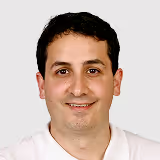
Marcel Kloos
Swiss-licensed dentist and founder of Medschool Experts
Marcel Kloos founded Medschool Experts while studying abroad; since then, over 500 study places have been secured. The Stuttgart-born dentist studied dentistry from 2015 to 2021 in Sofia and holds a Swiss dental licence.
Today he lives in Bern and runs Medschool Experts full-time as its owner.
More articles worth reading
Why Students Transfer from Medical University of Varna — Your Options
Why Students Transfer from Medical University of Warsaw — Your Options
Why Students Transfer from Masaryk University Faculty of Medicine — Your Options
Ahmad
Sabrina

Rami

Noah
500+ students placed.
Now it's your turn!
No daydreaming, no empty promises. Just a clear plan — for the start of your medical degree.
40 minutes, no obligation