Studying Medicine and Dentistry in Varna (Bulgaria): English-Taught Programme on the Black Sea
01.09.2026
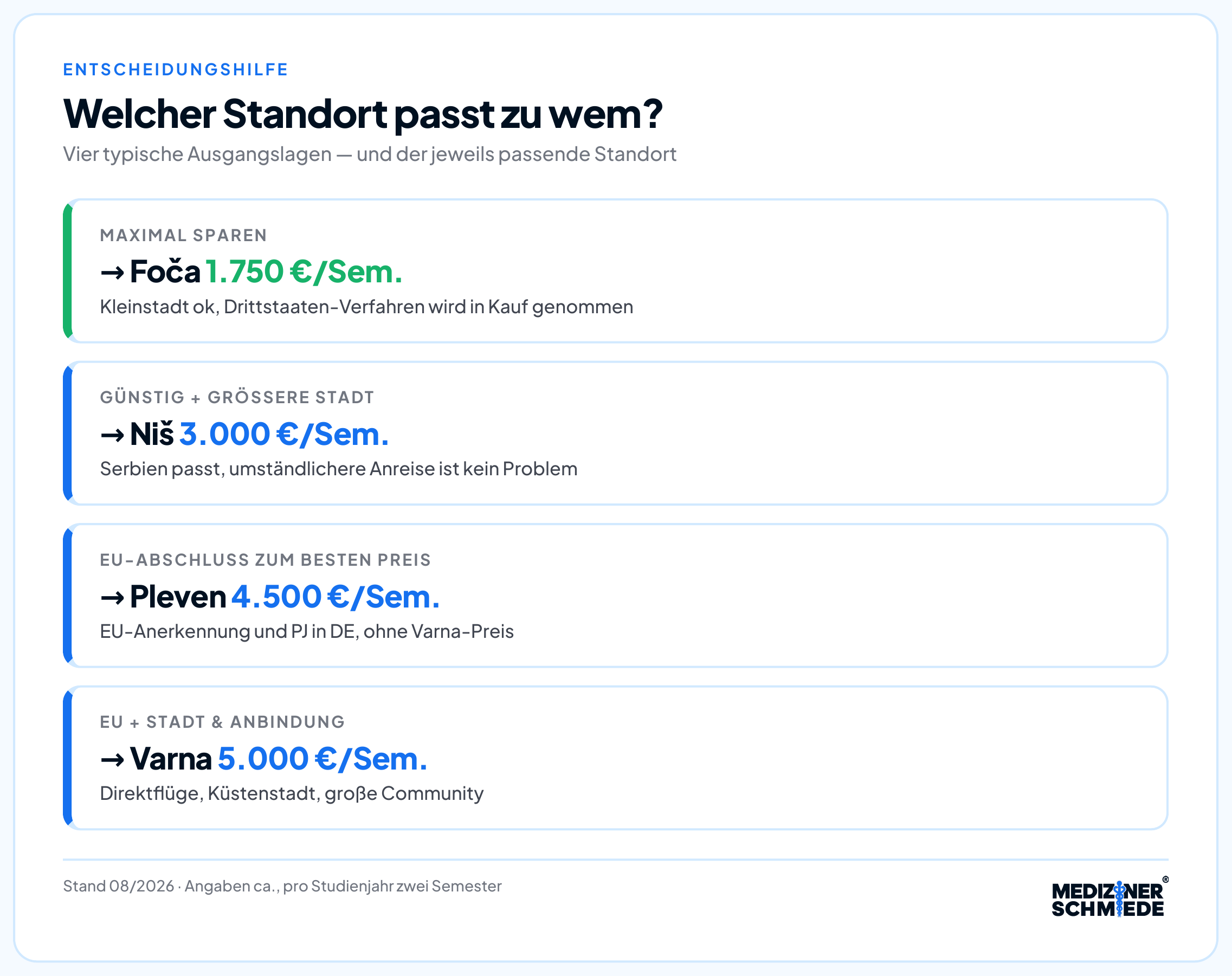
Varna at a glance
- University: Medical University of Varna “Prof. Dr. Paraskev Stoyanov”, state-run and accredited
- Programmes: human medicine (Doctor of Medicine, M.D.) and dentistry (Master of Dental Medicine, D.M.D.)
- Language of instruction: English
- Standard duration: 6 years, or 12 semesters
- Recognition: EU-wide under professional recognition Directive 2005/36/EC
- Tuition fees: 5.000 EUR per semester, paid directly to the university
- Living costs: around 600–900 EUR per month
- Location: Varna, the third-largest city in Bulgaria, directly on the Black Sea
The university
The Medical University of Varna is a state institution and one of Bulgaria's established medical training centres. The English-language programmes in human medicine and dentistry are aimed at international students and have been a fixed part of the offering for years. The international student body is correspondingly large — German-speaking students in Varna find an established community rather than an isolated case.
The Faculty of Dental Medicine has existed since 2006. The University Dental Medicine Centre serves as its clinical base, where practical training on patients takes place.
{{callout}}Human medicine: Doctor of Medicine (M.D.)
The human medicine programme lasts six years and concludes with the academic degree of Doctor of Medicine (M.D.). The first years are preclinical in character — anatomy, physiology, biochemistry, histology — followed by the paraclinical and clinical subjects. The sixth year is the final practical year.
Dentistry: Master of Dental Medicine (D.M.D.)
Dentistry is likewise designed to run for six years and ends with the Master of Dental Medicine. Its defining feature is the early and substantial practical component: simulation and phantom head courses prepare students for treating patients, and the clinical semesters take place at the University Dental Medicine Centre. The equipment includes treatment units from German manufacturers, digital radiography, modern sterilisation and the university's own dental technology laboratories.
Clinical clerkships and the final practical year in Germany
For many this is the decisive point: clinical clerkships and the final practical year can, by arrangement, be completed in Germany. Clinical training can therefore take place exactly where the student later intends to work — in everyday German hospital life, with German colleagues, and with the contacts that matter for starting a career. Anyone planning to return to Germany after graduating loses no ground.
Recognition in Germany and the EU
Bulgaria is an EU member state. A degree from the Medical University of Varna therefore falls under EU Directive 2005/36/EC on the recognition of professional qualifications and is recognised in Germany, Austria and across the EU. The German medical licence (Approbation) is applied for after graduation at the responsible state authority; the documents required include the university's graduation records and proof of the necessary language skills.
The professional doctoral title “d-r”
As at many Eastern European universities, graduation confers the professional doctoral title “d-r”. This is a professional doctorate awarded automatically with the final examination, not a research-based doctorate in the German sense.
That is precisely where the well-known problem arises: in Germany this title may not be used as “Dr.” because of the risk of confusion. In Switzerland, to the best of our knowledge, it may be used with an indication of origin, for example as Dr. med. (BG). The binding answer always comes from the responsible authority — anyone who wants to use the title should have this clarified in writing beforehand.
Our recommendation: simply leave it out. The title brings nothing in everyday practice and, if in doubt, invites discussion. Many of our students take the better route: after studying medicine abroad, they pursue a doctorate in Germany or Switzerland — for a proper Dr. med. or Dr. med. dent. and, in addition, a German or Swiss university qualification that usefully complements the degree earned abroad.
It is not necessary: in today's generation, only a few doctors still take a doctorate at all. But if you do, do it properly.
Transferring back to Germany: how it works
Some students start in Varna and later look into transferring to a German faculty. That is possible — but not through the normal admissions procedure. You do not apply through hochschulstart.de for a place in the first semester; you apply directly to the universities for a place in a higher clinical semester. Those places arise where other students have dropped out, transferred or taken a break.
What is credited
What counts is the credit-transfer decision from the state examination office under Section 12 of the German Medical Licensing Regulations (Approbationsordnung für Ärzte, ÄAppO). The office assesses which of the results you obtained abroad are equivalent to the German ones and assigns you to a specific semester. Universities accept this decision as evidence — they do not carry out the assessment themselves.
As a rule of thumb in the preclinical stage: two major plus two minor course certificates, or three major certificates, generally amount to one semester. In the clinical stage, around seven comparable clinical certificates amount to one clinical semester. Partial results do not count — only a fully completed certificate is ever recognised.
Recognition after completed semesters in Varna
| Completed | Recognised |
|---|---|
| 1 semester | 0 semesters |
| 2 semesters | 1 semester |
| 3 semesters | 1 semester |
| 4 semesters | 4 semesters |
Figures from Medschool Experts' internal statistics on transfer cases we have supported. The responsible state examination office always makes the binding decision on your individual case.
The best moment to transfer
The table shows it clearly: after the 4th semester, recognition jumps from one semester to four. Anyone who completes the preclinical stage in full generally gets it credited in its entirety and moves straight into the clinical stage. Transferring after one to three semesters, by contrast, costs time without gaining much — and competition for places in low semesters is particularly fierce.
Important: alongside the academic results, the three-month nursing placement must also be evidenced for entry into the clinical stage to work cleanly. That can be completed comfortably during the semester breaks in Germany.
The process in five steps
- Gather documents: transcript of records, module and contact-hour descriptions, examination records — translated and certified.
- Apply for the credit-transfer decision: at the state examination office of the federal state where you are enrolled or admitted. Without a German study place, the office of your state of birth is responsible; if you were born abroad, it is the North Rhine-Westphalia state examination office in Düsseldorf.
- Select universities: deadlines, numbers of places and requirements differ considerably by location — apply broadly and strategically rather than only to your first choice.
- Apply on time: the usual deadlines are 15 January for the summer semester and 15 July for the winter semester. Some universities allow the credit-transfer decision to be submitted later.
- Offer and enrolment: after admission you enrol in the semester you have been assigned to; de-registration in Varna only happens after that.
Typical mistakes
- applying for a semester that is too low — at many universities not possible at all, or pointless
- incomplete module descriptions, missing details on examination format and contact hours
- applying too late to the state examination office — processing takes weeks to months
- applying to only one or two universities
- a missing nursing placement when entering the clinical stage
And the honest assessment: a transfer is never guaranteed. It depends on whether places actually become free in the semester you want. The move back should therefore be plan B — not the basis on which the decision for Varna rests. Anyone who completes the degree in Varna receives an EU-wide recognised qualification in any case and then applies directly for the German medical licence. More on this in the guide Transferring back to Germany.
Admission: what is actually required
Admission does not run through school-leaving grades. What counts is:
- a general higher education entrance qualification (Abitur or an equivalent qualification)
- a passed entrance test in biology and chemistry, taken online
- sufficient English for an English-language degree
- the complete, translated and certified application documents
No numerus clausus, no TMS, no waiting semesters — but nothing automatic either: the entrance test is a subject test and needs preparation. Anyone who revises biology and chemistry solidly has good prospects.
Costs: tuition fees and living expenses
The tuition fee is 5.000 EUR per semester, that is 10.000 EUR per academic year, paid directly to the university. On top of that come living costs on the ground, realistically 600 to 900 EUR a month — depending on whether you live in a hall of residence or your own flat. Rent, food and public transport are considerably cheaper in Bulgaria than in Germany or Switzerland.
Varna or Foča? A direct comparison
Varna is the EU location with the best connections — Foča at the University of East Sarajevo is the most affordable location in our programme. What both have in common: a six-year degree, teaching in English, human medicine and dentistry on offer, clinical clerkships and the final practical year possible in Germany, and admission via an entrance examination in biology and chemistry. What differs is price, the route to recognition, and the setting:
| Criterion | Varna | Foča |
|---|---|---|
| Fee per semester | 5.000 EUR | approx. 1.790 EUR |
| Total fees | approx. 60.000 EUR | approx. 21.500 EUR |
| Living costs per month | 600–900 EUR | approx. 510 EUR |
| Country | Bulgaria (EU) | Bosnia (non-EU) |
| Recognition | automatic (EU) | equivalence assessment |
| Setting | coastal city, direct flights | small town, 80 km to Sarajevo |
In short: over the six years of study, Foča saves around 38.000 EUR in tuition fees alone — in exchange you accept a smaller location and the recognition procedure for non-EU countries. Varna costs more but delivers the direct EU degree, a large city and the easiest journey. Both routes work — the question is what you prioritise. Details on the affordable route are in the guide to Foča.
{{cta}}Life in Varna: studying by the sea
Varna is Bulgaria's third-largest city, a university and port city at once, lying directly on the Black Sea. The Sea Garden, the beach promenade and the old town around the Cathedral of the Assumption shape everyday life; in summer it is one of the liveliest cities in the country. Prices are low, distances are short, and Varna airport is well connected to the German-speaking countries.
For a degree that lasts six years, that is not a side issue. If you commute daily between lecture hall, clinic and library, having the beach on your doorstep as a counterweight makes a difference.
My view: who Varna is the right choice for
Varna is a top address — and for two very different groups at the same time.
For medical families: anyone from a medical household usually knows exactly what matters — solid clinical training, a properly recognised EU degree, and the option of completing clinical clerkships and the final practical year in Germany in order to line up later specialist training posts early. That is precisely what Varna offers. The location is established, not a testing ground.
For first-generation entrants: Varna is just as suitable for everyone who is the first in their family to study medicine. No insider routes are needed here: admission is clearly regulated, the process is the same for everyone, and the large international community means nobody has to get through the first year alone. You do not need connections — you need motivation and good test preparation.
And honestly: with a place of study directly on the beach, there is not much you can get wrong. Six years of medical school are demanding enough. If the surroundings are right, you last the course better.
Frequently Asked Questions
Do I need to speak Bulgarian?
The degree is taught entirely in English. Basic knowledge is helpful for everyday life and for later patient contact; it is taught during the course of the degree.
May I use the doctoral title in Germany?
No. The professional doctoral title “d-r” conferred with the degree may not be used as “Dr.” in Germany because of the risk of confusion. In Switzerland, to the best of our knowledge, it may be used with an indication of origin, for example Dr. med. (BG). Anyone who wants a full title takes a doctorate in Germany or Switzerland after graduating.
Do I stay registered as resident in Germany?
Yes, German residence normally remains in place. As Bulgaria is an EU country, simplified rules apply to staying there; we support you with the local registration.
How does health insurance work?
Within the EU, the European Health Insurance Card applies. Additional international health insurance is advisable as supplementary cover.
Can I transfer to Germany later?
Yes — by applying for a higher clinical semester. After four completed semesters in Varna, four semesters are generally credited, so you can move into the clinical stage. What matters is the credit-transfer decision from the state examination office and free places at the university you want.
Do I already need the credit-transfer decision to apply?
Not everywhere. Many universities allow it to be submitted later; others require it by the deadline. Since processing can take weeks to months, the application should be made early.
When does the degree start?
The regular start is in the winter semester. Application and test dates fall in the spring and summer beforehand — early planning pays off.
The author's view
Bulgaria is not an abstract location for me. I studied dentistry there myself and know what the first winter in a foreign country feels like — and how normal everything feels after two years.
In advisory sessions, Varna is often dismissed as the expensive EU location. That falls short. 5.000 Euro per semester is a lot of money, but you get something very concrete for it: a degree recognised without an equivalence assessment, an established international community and a city with good connections. Anyone drawing the comparison with Foča should do the arithmetic honestly: around 38.000 Euro difference in tuition fees alone — and then decide what the direct EU route is worth to them. Both work; they simply work for different people.
The one thing I view critically: when someone goes to Varna with the firm plan of transferring back to Germany after two semesters. The credit figures argue against it. Moving back is a legitimate plan B, but not a basis for a decision that has to carry six years.
And the professional doctoral title? I would leave it out. Anyone who really wants the title takes a doctorate later in Germany or Switzerland — and then does it properly.
Summary
- The Medical University of Varna is a state-run, accredited institution in Bulgaria and in 2026 trains doctors and dentists in six-year English-language programmes.
- A degree from Varna is recognised under EU Directive 2005/36/EC in Germany, Austria and across the EU.
- Tuition fees in Varna are 5.000 EUR per semester in 2026, and living costs come to around 600 to 900 EUR a month.
- In 2026, admission runs without a numerus clausus, TMS or waiting semesters, via a higher education entrance qualification and an online entrance test in biology and chemistry.
- Clinical clerkships and the final practical year can, by arrangement, be completed in Germany, so that clinical training takes place where the student will later work.
- After four completed semesters in Varna, four semesters are generally credited according to Medschool Experts' internal statistics, which makes transferring to a German faculty easier.
Varna combines what rarely comes together: a state EU university with an English-language programme, clearly regulated admission without a numerus clausus, predictable costs of 5.000 EUR per semester, and the option of completing clinical clerkships and the final practical year in Germany. Add to that a location where six years of study are genuinely bearable. Anyone who takes the biology and chemistry entrance test seriously and sets up the application in good time has in Varna one of the soundest routes into medicine or dentistry in Europe.
Further reading
- Studying medicine in Sofia: the main guide — the second Bulgarian location in detail, with universities, fees and recognition to compare against Varna.
- Transferring back to Germany: how many semesters are credited? — credit tables for Varna, Sofia, Plovdiv, Pécs and Szczecin, plus process and deadlines.
- Studying medicine without a numerus clausus: the location comparison — how Varna compares on price and content with the most affordable locations in Serbia, Bosnia and Bulgaria.
- Studying medicine & dentistry in Foča (University of East Sarajevo) — the more affordable alternative outside the EU, with a profile of its own.
- Forced de-registration in medical school — the route back into a degree when it definitively did not work out in Germany.
- Veterinary medicine in Bulgaria — if the direction is more towards veterinary medicine after all.
What students say about Medschool Experts
Over 500 placements at more than 25 partner universities across 10+ countries. Read independent student reviews on Trustpilot.
About the author
Marcel Kloos
Swiss-licensed dentist and founder of Medschool Experts
Marcel Kloos founded Medschool Experts while studying abroad; since then, over 500 study places have been secured. The Stuttgart-born dentist studied dentistry from 2015 to 2021 in Sofia and holds a Swiss dental licence.
Today he lives in Bern and runs Medschool Experts full-time as its owner.
More articles worth reading
Why Students Transfer from Medical University of Varna — Your Options
Why Students Transfer from Medical University of Warsaw — Your Options
Why Students Transfer from Masaryk University Faculty of Medicine — Your Options
Ahmad
Sabrina
Rami
Noah
500+ students placed.
Now it's your turn!
No daydreaming, no empty promises. Just a clear plan — for the start of your medical degree.
40 minutes, no obligation