Studying Medicine and Dentistry in Spain: Nota de Corte and Costs
11.09.2026

Last reviewed: August 2026.
The Admission System for Medicine in Spain: An Overview
Spanish school leavers apply through the EBAU (formerly Selectividad), a nationwide exam at the end of upper secondary school. From the school grade and exam result, the Nota de Corte is formed — the minimum score a faculty requires in a given year. For applicants with foreign school qualifications such as the German Abitur, the UNEDasiss accreditation authority takes on the same function: it converts the prior education into the Spanish grading scale.
The Nota de Corte: A Scale up to 14 Instead of 10
What confuses many German families at first: the Spanish admission score does not go up to 10 but up to 14. The basis is up to 10 points from the school grade and compulsory exam. Those who additionally sit voluntary exams in subject-relevant fields can earn up to 4 bonus points on top — hence the unusual upper limit of 14. For medicine, this means: the most sought-after faculties effectively require a near-perfect base score plus a large portion of the possible bonus points. At the University of Seville, the Nota de Corte for medicine recently stood at 13.386 out of 14 — a margin that leaves almost no room for a weak exam day.
UNEDasiss: The Route for Applicants with the German Abitur
Those who completed their Abitur in Germany register with UNEDasiss to receive accreditation: the average grade is converted using a fixed formula, with school grade and exam performance each weighted accordingly. For most degree programmes, this pure conversion is sufficient. For a subject as competitive as medicine, many faculties — including the Complutense University of Madrid — additionally require their own supplementary exams (PCE) in order to earn the necessary bonus points at all. UNEDasiss offers two exam sessions per year: a May/June session with registration in March and April, and a September session with registration in July. The actual admission at the desired university then follows in a separate application process with its own deadline.
{{cta}}
State Universities for Medicine and Dentistry
Spain has one of the largest higher education landscapes in Europe with numerous state medical faculties. The following table shows two of the best-known locations as examples of the scale of study places.
| University | Location | Medicine Places | Dentistry Places |
|---|---|---|---|
| Universitat de Barcelona (UB) | Barcelona | 330 | 67 |
| Universidad Complutense de Madrid (UCM) | Madrid | 295 | 100 |
Teaching at many state faculties is now partly in English, but full Spanish instruction remains the rule — at the latest during patient contact in the clinical years, Spanish is essential.
The author's view
The 14-point scale regularly causes confusion in advising sessions: parents see a Nota de Corte of 13 and initially think it is a typo, because they automatically apply German grading logic. Yet the system behind it is quite comprehensible — you just need to have it explained once.
What I genuinely consider risky, on the other hand: relying solely on the conversion of the Abitur and underestimating the PCE supplementary exams. Anyone aiming for medicine in Spain should plan for these exams from the outset — not as an optional extra, but for what they effectively are for such a competitive subject: a second round of exams on top of the Abitur.
Summary
Spain combines an unusual grading system up to 14 points with its own accreditation route for foreign qualifications through UNEDasiss. For medicine, the pure Abitur conversion is not sufficient at most faculties; additional PCE exams are effectively compulsory. Private universities offer a more expensive but more plannable route without a Nota de Corte. Those who want neither option will find state alternatives with simpler selection procedures elsewhere in Europe.
- The Nota de Corte goes up to 14 instead of 10 points, through up to 4 bonus points from voluntary supplementary exams.
- German Abitur holders accredit their qualification through UNEDasiss before applying to a university.
- For medicine, additional PCE exams are practically necessary at most faculties.
- State tuition fees are around 5,000 to 10,000 euros per year depending on the region.
- Private universities charge between around 14,000 and 24,000 euros per year.
- Medschool Experts does not arrange applications in Spain but shows the NC-free route in Europe.
Further Reading
- Studying Medicine in Germany: the admission system in direct comparison.
- Studying Medicine in France: PASS and L.AS instead of Nota de Corte.
- Studying Medicine in Italy: Semestre filtro and IMAT in comparison.
- University Lexicon: detailed profiles of individual faculties with admission figures and key data.
- Studying Medicine in Hungary: the plannable NC-free neighbouring location without a Nota de Corte.
Frequently Asked Questions About Studying Medicine in Spain
Why does the Spanish admission score go up to 14 instead of 10?
The basis is up to 10 points from the school grade and compulsory exam. Additional voluntary exams in subject-relevant fields earn up to 4 bonus points, hence the upper limit of 14.
What is UNEDasiss?
The authority that converts the prior education of applicants with foreign school qualifications — such as the German Abitur — into the Spanish grading scale, forming the basis for the subsequent university application.
As a German Abitur holder, do I need additional exams for medicine?
At most faculties yes: the pure conversion of the Abitur rarely suffices for the high Nota de Corte values in medicine. Supplementary PCE exams help to earn the necessary bonus points.
How high is the Nota de Corte for medicine in Spain?
This varies greatly by university and year, but at sought-after locations like Seville it is close to the maximum — recently 13.386 out of 14 points.
What does a medical degree at a state university in Spain cost?
Between around 5,000 and 10,000 euros per year depending on the region, plus smaller ECTS and exam fees.
What does a medical degree at a private university in Spain cost?
Between around 14,000 and 24,000 euros in the first year, with some universities charging more in later years.
Do I need to speak Spanish?
Yes, at least to B2 level (DELE, TELC, or DIE), even if individual courses at some faculties are offered in English. Spanish is compulsory at the latest during patient contact.
Does Medschool Experts arrange study places in Spain?
No. The application through UNEDasiss and the universities runs exclusively directly between the applicant and the responsible bodies. Medschool Experts supports the plannable, NC-free route at state universities in Europe.
What students say about Medschool Experts
Over 500 placements at more than 25 partner universities across 10+ countries. Read independent student reviews on Trustpilot.
About the author
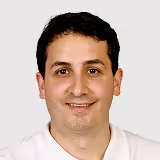
Marcel Kloos
Swiss-licensed dentist and founder of Medschool Experts
Marcel Kloos founded Medschool Experts while studying abroad; since then, over 500 study places have been secured. The Stuttgart-born dentist studied dentistry from 2015 to 2021 in Sofia and holds a Swiss dental licence.
Today he lives in Bern and runs Medschool Experts full-time as its owner.
More articles worth reading
Why Students Transfer from Medical University of Varna — Your Options
Why Students Transfer from Medical University of Warsaw — Your Options
Why Students Transfer from Masaryk University Faculty of Medicine — Your Options

Ahmad

Sabrina

Rami

Noah
500+ students placed.
Now it's your turn!
No daydreaming, no empty promises. Just a clear plan — for the start of your medical degree.
40 minutes, no obligation