Studying Medicine at 30: Is It Still Worth It?
28.08.2026

Am I too old for a medical degree at 30?
Legally, no. Neither the German university admissions foundation nor any European university has an age limit for medical school admission. Age does not appear in any selection criterion — not in the top-grades quota, not in the additional aptitude quota, and not in the universities' own selection procedures.
Practically speaking, what changes most at 30 is how you decide. Instead of "medicine sounds interesting," there is usually a concrete experience behind it — years on a ward, in an ambulance, in a practice, or in a laboratory. This background is an actual advantage in your studies, because you know what you are learning anatomy for.
What you need to realistically plan for is the time frame. We will look at that next, because it is the basis of every honest decision.
What does the calculation look like: studies, specialization, years in practice?
A medical degree in Germany takes six years and three months; at European universities it is typically six years. Those who start at 30 will therefore have their German medical licence (Approbation) at around 36.
This is followed by specialist training, lasting five to six years depending on the field, and longer if done part-time. The specialist title typically falls between ages 41 and 43. Until the standard retirement age of 67, that leaves around 25 years as a specialist — more than many people spend in their entire trained profession.
This calculation looks long on paper. It becomes more realistic, however, when you compare it to the alternative: in many healthcare professions, salary development is largely exhausted after ten years, while the medical career path is only just beginning at that point. Those who start at 30 trade six years of training for two and a half decades in a profession with its own responsibilities, training pathways, and the possibility of setting up a private practice.
What does professional experience actually bring to your studies?
Three things that become immediately apparent in the first year of study. First, vocabulary: those who have worked in nursing for years already know disease patterns, medications, and procedures as everyday experience rather than just exam material. Second, self-organization: shift work teaches time management, and that is precisely what many students struggle with in the pre-clinical phase. Third, motivation: those who have already seen what the profession actually looks like do not quit in the third semester.
There is also a formal advantage: the three-month nursing service that the German medical licensing regulations require before the First Part of the Medical Examination is generally waived for applicants with a completed training in a nursing profession. Several selection procedures also count a completed vocational qualification in the healthcare sector as its own criterion.
What no one can take off your plate, on the other hand, is the volume of learning. Anatomy and biochemistry are just as much material at 30 as at 19, only with less time buffer if family or rent come on top. Those who plan for this openly get through it well.
How do you finance a medical degree at 30?
BAföG has an age limit: those who have completed their 45th year of age at the start of their training are no longer eligible for funding. At 30 or 35, you are clearly below that. For the exceptional cases beyond 45 — second educational pathway, vocationally qualified applicants without a traditional university entrance qualification, changed personal circumstances, child-rearing — it is worth getting an advance decision from the responsible office before enrolling.
For studying in an EU country, international BAföG is an option, which includes a grant toward tuition fees. Beyond that, late starters primarily use three building blocks: savings from their working years, an education loan or student loan, and part-time work in their trained profession, which is manageable during the pre-clinical phase and scaled back in the clinical phase.
The sequence matters: first calculate the total costs over six years, then build the financing — not the other way around. Those who start at 30 usually have a better financial foundation than a school leaver, but also higher fixed costs.
{{cta}}
What is it like to sit among school leavers at 30?
No one answers this better than someone who is doing it right now. Marcel Kloos visited Esra in Sofia, who was placed at the Medical University of Sofia via Medschool Experts and began her studies past the age of 30. The interview covers everyday life in the cohort, the relationship with significantly younger fellow students, the workload, and why she does not experience student life in Sofia as a sacrifice.
What we take away from many such conversations: the age difference is a topic in the first few weeks and then hardly at all. In English-language cohorts, people from different countries and with different backgrounds are sitting together anyway — from school leavers to trained physiotherapists.
What pathways are there at 30 if your grades are no longer good enough?
The first pathway goes through the selection procedures in Germany: the TMS medical aptitude test can be taken regardless of age, a completed vocational qualification in the healthcare sector counts in many procedures, and the additional aptitude quota works entirely without a school-leaving grade. The waiting period quota no longer exists, however — accumulated years alone will not get you further.
The second pathway leads abroad, where a subject-specific entrance examination decides who gets a place rather than the school-leaving grade. This is precisely why late starters are so strongly represented there: those who revise biology and chemistry to A-level standard can pass an examination — but they cannot change a school-leaving grade from 2014.
| Location | Admission | Also with FH entrance qualification | Tuition fees | Recognition |
|---|---|---|---|---|
| Sofia (Bulgaria) | Entrance test in biology, chemistry, and English | no | 4,975 EUR per semester | automatic under EU Directive 2005/36/EC |
| Foča (Bosnia and Herzegovina) | Entrance examination in biology and chemistry | yes, also with nursing qualification | 3,500 EUR per year | individual case assessment, university listed in ANABIN |
| Niš (Serbia) | written entrance examination in biology and chemistry in English | yes, also with nursing qualification | 6,000 EUR per year | individual case assessment by the state authority |
| Bratislava (Slovakia) | entrance examination in biology and chemistry | yes | 6,500 EUR per semester | automatic under EU Directive 2005/36/EC |
Whether a university of applied sciences entrance qualification or a vocational qualification carries weight in individual cases is always decided by the faculty. We assess your educational background in advance and tell you honestly which locations are suitable. We have described the individual locations in detail in separate articles, including those on Sofia and Foča.
What mistakes should you avoid when starting late?
First: accumulating waiting years. They no longer count in the German procedure, but they cost exactly the years that will be missing at the end of your career.
Second: ignoring family planning. Those who start with a partner, children, or caring responsibilities should choose their study location based on these factors, not just based on tuition fees. Cost of living, travel time, and the possibility of completing the practical year in Germany all belong in the same decision.
Third: planning financing only for the first year. Six years of study are six years of tuition fees, rent, and living costs. A plan that only reaches the second semester becomes a problem at the latest by the third.
Fourth: idealizing the profession. Studies are long, specialist training is demanding, and shift work remains shift work. Those coming from healthcare already know this — and make the decision far more stably than at 19 for exactly this reason.
The author's view
I did not start at 19 myself, but at 24 — in Sofia, where I studied dentistry. Perhaps that is why I see late starters differently from a traditional study advisory service: I often consider them the more stable group. They have already seen the profession from the inside and make decisions based on experience, not on a brochure.
What I hear in consultations is almost always the same fear: "I am too old for this." When we then work through the years together, the mood usually shifts within the same conversation. Two and a half decades as a specialist is not a consolation prize, but a full professional life.
What I do not sugarcoat: six years of studies and five to six years of specialist training is a long stretch, especially with children or ongoing rent. That is why we go through financing and the timeline before the application, not after.
I am a Swiss-licensed dentist and today run Medschool Experts from Bern. The most common sentence I hear from our students over 30 after their first year is: "I should have started sooner." Never: "I wish I had not done it."
Summary
- There is no age limit for admission to a medical degree, neither in Germany nor at European locations.
- Starting at 30 means: medical license at around 36, specialist title between 41 and 43, then around 25 years in practice.
- Professional experience from nursing, emergency medical services, or a practice is a genuine advantage in your studies and counts in several selection procedures.
- BAföG is possible up to the age of 45 at the start of training; for EU locations, international BAföG is also an option with a grant toward tuition fees.
- Where the school-leaving grade can no longer be changed, a subject-specific entrance examination decides who gets a place abroad.
- The most expensive mistake when starting late is accumulating more waiting years.
A medical degree at 30 is not an exceptional case, but a well-plannable pathway — provided the calculation works out and the financing is secured over six years. The students over 30 whom we accompany consistently report two things: they learn more systematically than the rest of their cohort, and they appreciate student life more consciously, because they know what everyday working life looked like before.
If you want to know what your specific starting position looks like, we will work through it together in the free consultation — with your qualifications, your training, and your schedule.
Frequently asked questions about studying medicine at 30
Is there an age limit for a medical degree?
No. Neither the German admissions procedure nor European universities have an age limit for admission. Age is not included in any selection criterion. Limits only apply to certain forms of funding, such as BAföG.
How old will I be when I start at 30 and finish?
At around 36 you will have your medical license, at 41 to 43 depending on the field your specialist title. Until the standard retirement age, that leaves around 25 years in practice. A late start shortens the medical career, but does not end it.
Am I still eligible for BAföG at 30?
Yes. The age limit is 45 at the start of training; at 30 you are clearly below that. For studying in an EU country, international BAföG is also available as an option, with a grant toward tuition fees.
Does my nursing qualification count toward my application?
In many selection procedures, yes: a completed vocational qualification in the healthcare sector is its own criterion. In addition, the three-month nursing service that the licensing regulations otherwise require before the First Part of the Medical Examination is generally waived. At several locations abroad, a nursing qualification additionally opens up access.
Is the age difference within the cohort a problem?
In our experience, rarely. In English-language cohorts, people from many different countries and with very different backgrounds sit together. After the first few weeks, what counts is who studies reliably and thinks actively during practical sessions — not the year of birth.
Can I study abroad with a family?
Some of our students do. What matters most is cost of living, housing situation, and travel time, rather than tuition fees alone. Locations with low living costs and good connections to Germany are the obvious choice for this.
What is the fastest pathway into a medical degree if I am 30 now?
The pathway that does not wait for the next application round: a subject-specific entrance examination at a European location, which you can prepare for in a few months. You can continue applying in Germany at the same time. Which combination makes sense for your situation, we clarify in the free consultation.
What students say about Medschool Experts
Over 500 placements at more than 25 partner universities across 10+ countries. Read independent student reviews on Trustpilot.
About the author
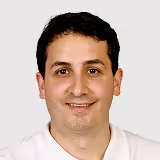
Marcel Kloos
Swiss-licensed dentist and founder of Medschool Experts
Marcel Kloos founded Medschool Experts while studying abroad; since then, over 500 study places have been secured. The Stuttgart-born dentist studied dentistry from 2015 to 2021 in Sofia and holds a Swiss dental licence.
Today he lives in Bern and runs Medschool Experts full-time as its owner.
More articles worth reading
Why Students Transfer from Medical University of Varna — Your Options
Why Students Transfer from Medical University of Warsaw — Your Options
Why Students Transfer from Masaryk University Faculty of Medicine — Your Options

Ahmad

Sabrina

Rami

Noah
500+ students placed.
Now it's your turn!
No daydreaming, no empty promises. Just a clear plan — for the start of your medical degree.
40 minutes, no obligation