Medical School Without a High School Diploma: From Nurse to Medical Student – Podcast Ep. 2
01.09.2026
A career choice at 16 — and a door that was already closed before it ever opened
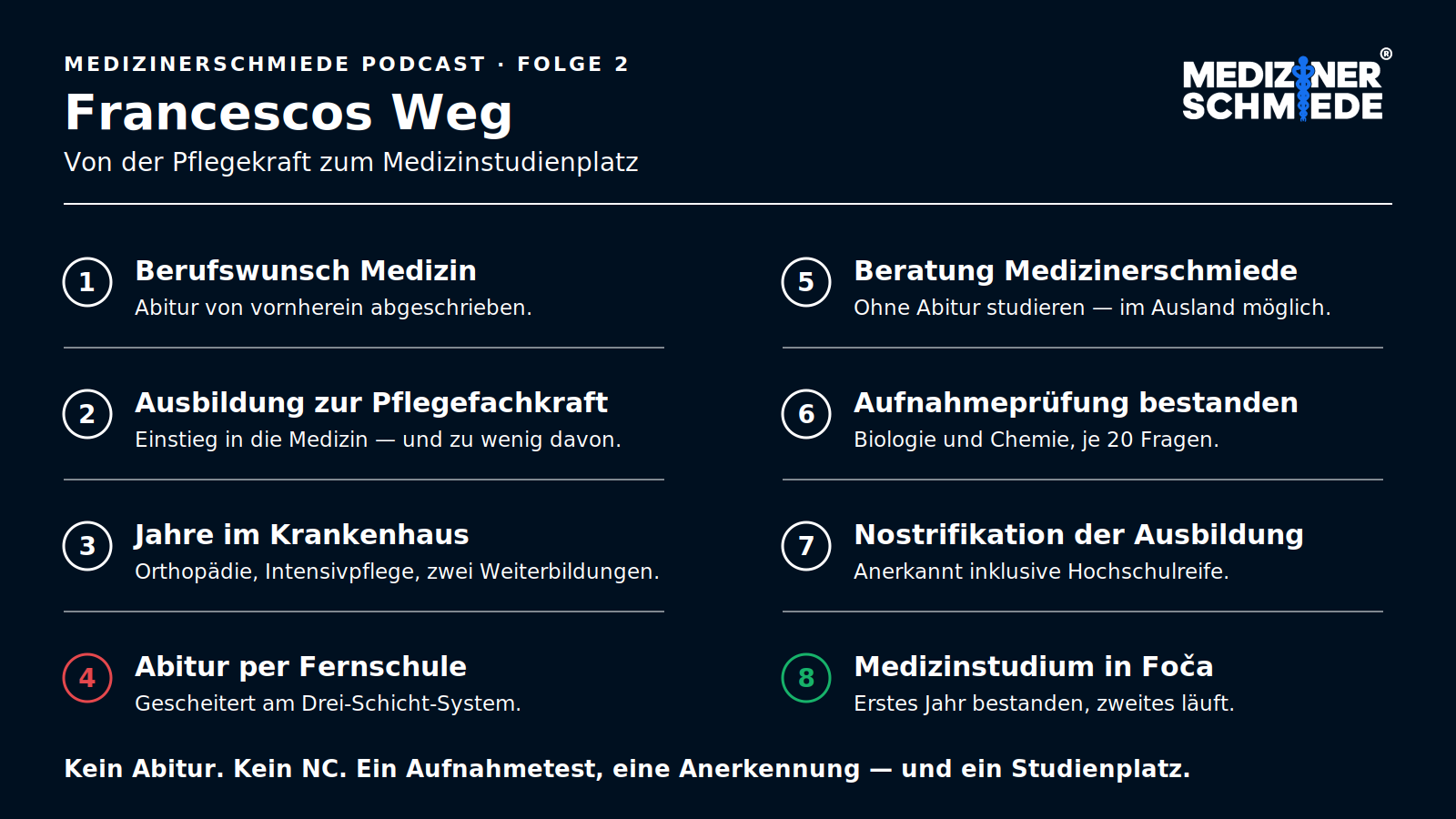
Francesco knew he wanted to become a doctor by the age of 16 or 17. The problem: he was never the best student. And so he made a decision that tens of thousands of young people in Germany make every year — he did not even try.
"I was never the best student and I wrote off the Abitur from the outset. I didn't even attempt it."
Instead he began training as a nurse, thinking: that's the medical field too. Within a short time he realised it was not enough for him. He bought medical textbooks and started reading up on his own at home.
Years in the clinic — and the feeling of always stopping at the same boundary
Francesco completed his training and then worked for several years as a registered nurse: in hospital in orthopaedics and trauma surgery, on a private-patient ward and later in out-of-hospital intensive care and ventilation nursing. On top of that came two further qualifications — specialist nurse for out-of-hospital intensive care and wound care expert.
It was precisely those years that made the wish grow rather than fade:
"The doctor always sets the leading course of treatment. As a nurse you may have the chance to have your say — but the decision is the doctor's. And sometimes I read a report and didn't understand the content one hundred percent. That's when I realised: I want to go deeper into the subject."
The people around him saw it differently. An uncle told him in the garden that you needed a top grade point average for that and he would never manage it. His class teacher at nursing school also took a very sceptical view of the idea.
The detour that did not work: A-levels by distance learning alongside shift work
Francesco's first plan was the obvious one: catch up on the Abitur through a distance-learning school, alongside the job. He had heard of the German route into higher education for people with vocational qualifications — but also that this route is anything but easy.
The distance-learning school failed against the reality of hospital life:
"With a full-time job in hospital on a three-shift system, it was very, very hard to fit together. I simply couldn't put in as much time for the distance-learning school as I would have needed."
Anyone working rotating shifts knows the problem: distance learning demands self-organisation and fixed study times — exactly what a rotating shift plan systematically destroys. That Francesco did not manage it says nothing about his ability. It says something about the combination of the two.
The turning point came on the drive back from that very distance-learning school:
"I was driving from Darmstadt back to the Saarland and thinking about studying medicine. Suddenly it came into my head: I've seen a video of Marcel where he said you can study medicine without A-levels. So I booked an appointment for the consultation at a motorway service station."
Until then it had never occurred to him that studying without A-levels might be possible abroad at all — he had assumed it was "a German thing".
{{cta}}
The key: nostrification — how a nursing qualification becomes a university entrance qualification
This is the substantive core of the episode, and it is the reason this route works.
In Germany, nursing training is a vocational qualification — not a university entrance qualification. In Bosnia and Herzegovina, by contrast, there is the school type known as the medical secondary school, a long-established institution in the former Yugoslavia. Its leaving qualification carries the title "medical technician" and corresponds in content roughly to a registered nurse — but additionally includes the Matura, that is, the university entrance qualification.
In the nostrification procedure, Francesco's German qualification was treated as equivalent to precisely that domestic qualification. With it he received the university entrance qualification as well — and was able to study medicine through the regular route.
"My qualification was treated as equivalent to that of a medical secondary school, specialising as a medical technician, with the Matura passed. And that is why, on the basis of the nostrification, I could study medicine entirely through the regular route."
This is how the procedure worked in practice:
- The application itself involved little paperwork — a large part was handled by the Medschool Experts team.
- For the nostrification, all documents had to be submitted as notarised copies, with an apostille and a certified translation into Serbian.
- The procedure ran in parallel with the first year of study — the decision arrived while he was already studying.
To stay honest: that overlap is nerve-racking. Francesco describes having doubts right up to the end about whether the nostrification would go through — and only really believing it when he held the copy of the decision in his hand.
{{callout}}
The entrance test: biology and chemistry instead of a school grade
Instead of a grade, an entrance examination decides admission at the university. The concrete figures from Francesco's examination:
- Two subjects: biology and chemistry
- 20 questions each per subject, roughly 20 to 30 minutes of working time
- At least 11 correct answers per subject to pass
- Plus a letter of motivation to the university
That is the real difference from the German system: a grade cut-off measures how you performed at school years ago. An entrance test measures what you know today — and you can prepare for that in a targeted way. Francesco says that studying for the test "actually went very well".
The study location: Faculty of Medicine Foča, University of East Sarajevo
Francesco studies at the Faculty of Medicine in Foča, a faculty of the University of East Sarajevo in Bosnia and Herzegovina. Because this location is barely known in Germany, here are the key facts at a glance.
Programmes and language. Human medicine and dentistry are offered, both entirely in English. Serbian is taught as a compulsory subject in the first two years of study so that students can speak with patients during the clinical stage.
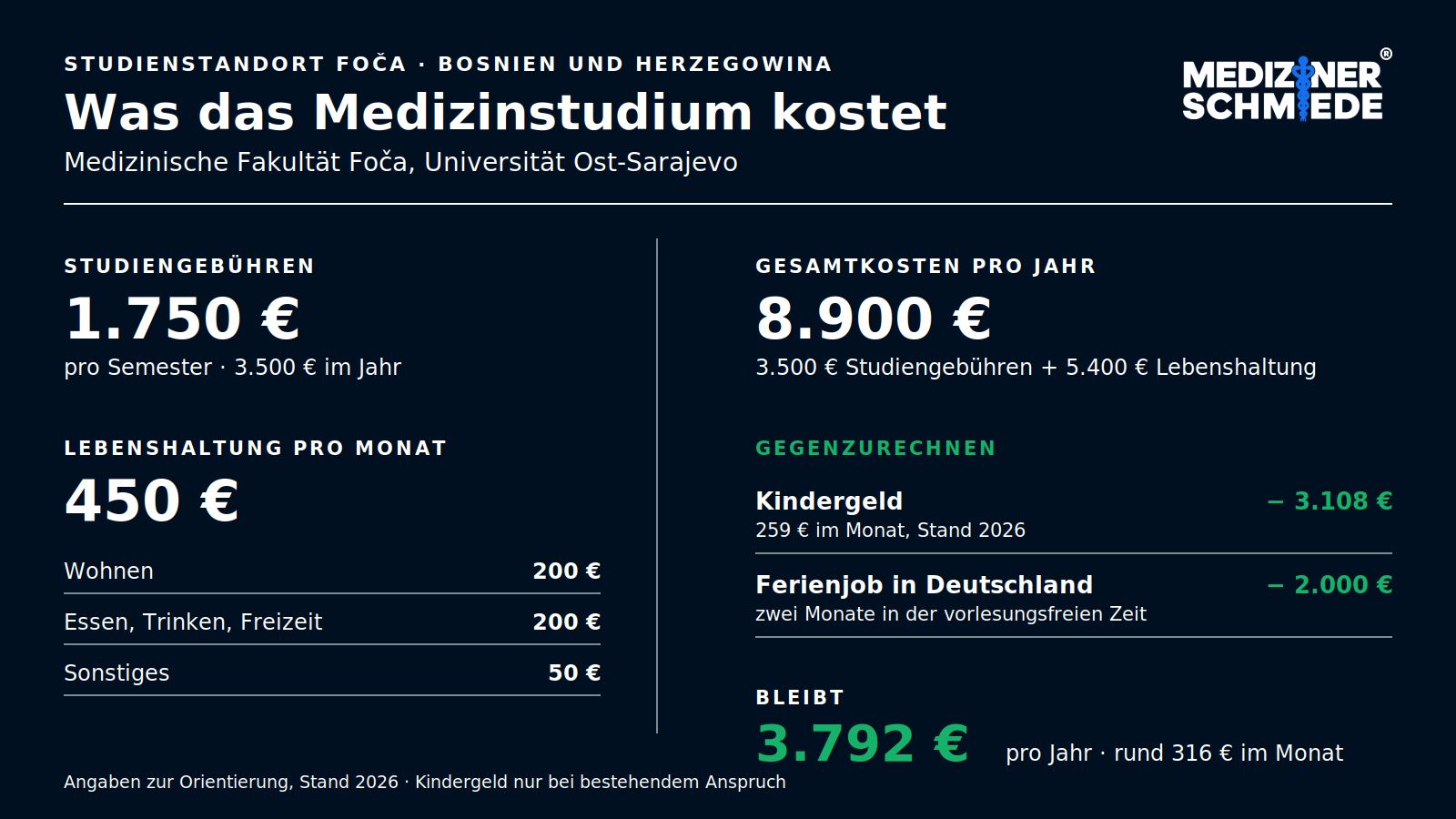
Tuition: 1,750 EUR per semester. That amounts to 3,500 EUR per year — according to our ongoing market overview, the least expensive medical programme in Europe with no grade cut-off. For comparison: at western European locations, fees are regularly three to six times higher. German statutory child benefit therefore covers the tuition almost in full.
Accreditation and recognition. The faculty is listed in the ANABIN portal of the German Standing Conference of the Ministers of Education with the status H+. It also holds international accreditation to WFME standard, granted by the Hungarian accreditation agency MAB and valid until 10 July 2033. The dean of the faculty is Prof. Dr. Dejan Bokonjić, a consultant paediatrician.
Final practical year optionally in Germany. The sixth year of study can, if you wish, be completed entirely at a German teaching hospital — a considerable advantage for anyone who sees their professional future in Germany and wants to build contacts early.
Official contractual partner. Medschool Experts is an official contractual partner of the faculty and is listed on its English-language website among the official representatives for international students — see studiesinenglish.mef.ues.rs.ba.
The town of Foča. Foča lies in the east of the country on the Drina, in the immediate vicinity of the mountains of eastern Bosnia. The nearest international airport is Sarajevo. It is a manageable town, not a metropolis — which for many students is an advantage: short distances, low living costs and an environment in which the international cohort quickly grows together.
Alone to Bosnia — and the whole programme in English
In October, Francesco boarded a plane alone for the first time in his life, heading for a country he had never visited and whose language he did not speak.
His English at that point was, by his own assessment, more bad than good — school English, unused for years. That worry dissolved faster than expected:
"After two or three months I understood a great deal. I wasn't the only one who wasn't so good at English — and by now we have all passed the most important examinations. Nobody failed because of the English."
The reason is simple: classes in English, international fellow students, everyday life in English. You are forced to speak — and that accelerates language acquisition enormously.
The cohort comprises a good 100 students, of whom around 10 or 11 are German. The rest come from Italy, Greece, England, the USA, Morocco, Serbia, North Macedonia, Nigeria and Sudan. Francesco describes exactly that as one of the most valuable experiences — friendships from the first day at university, because everyone was in the same new situation. Today the place feels like a second home to him.
The first year of study: subjects and examination formats
The subjects in the first year:
- Anatomy
- Histology and embryology
- Cell biology and human genetics
- Medical terminology and Latin
- Serbian
- Clinical skills (first aid, wound care, first ward placements, X-ray images)
- Medicine and Society (social medicine, sociology, medical ethics)
- Medical informatics
- Introduction to medical research
Worth noting: Sophie, who is herself in her third year of study in Germany, observes that she only encounters some of these subjects in the clinical stage.
The examinations are structured differently depending on the subject. In anatomy there were three colloquia spread across the year — bones, muscles, skull bones — as multiple-choice tests on the computer, 20 questions each with at least 11 correct answers. These colloquia had to be passed in order to be admitted to the examination at all. The examination itself consists of a practical part (projected anatomical images with structures obscured, two structures asked per image) and a written part with 50 questions, of which at least 26 must be correct.
An honest detail Francesco volunteers himself: in histology he failed the practical part at the first attempt — like many others in his cohort. At the second attempt he passed. Sentences like that are missing from most success stories, and that is exactly why they are here.
There is no dissection of body donors at this location — too few are available. A plastinated whole-body specimen is used in practical anatomy teaching, and the practical examination runs via anatomical images.
Learning how to learn: Francesco's method
The biggest break was not the country and not the language — it was learning itself. Years out of school, a full-time job behind him, and suddenly volumes of material that school never involved.
"First I had to learn how to learn properly. At school, honestly, I never studied — I went there, came home, and that was that."
What helped him concretely:
- Timed units: 50 minutes of study, 10 minutes' break — four times in a row. Then a long break of one to two hours, deliberately without a phone, with movement and a walk. During the examination period, two to three such blocks a day.
- Anki cards: newly discovered for himself in the last examination period and described as the single biggest lever.
- Past questions: to get a rough overview of a topic quickly.
- What did not work: hours of copying content out by hand. Lots of paper, little retention.
Important for anyone afraid of the comparison: fellow students with A-levels and with an applied university entrance qualification were also overwhelmed in the first semester. The volume of material hits everyone equally.
What nursing training really brings to the degree
Francesco's prior experience pays off measurably — not as a shortcut, but as a head start:
- Anatomical terms such as humerus or radius were familiar from everyday ward work
- X-ray images he could already interpret in clinical skills sessions
- First aid and wound care were not new content but daily practice
- Clinical presentations from orthopaedics and trauma surgery were familiar
On top of that comes a perspective you cannot acquire by reading: Francesco continues to work in nursing during the lecture-free period — and describes understanding medical decisions differently today than he used to, while conversely knowing how the same order feels on the ward. Knowing both sides is no disadvantage in later professional life.
One further structural difference: there is no separate nursing placement there of the kind required in Germany. Instead, a large practical component is firmly built into the individual subjects during the clinical stage.
Francesco's tips for applicants with a vocational qualification
Asked what he would advise others with nursing training:
- Work on your English. Anyone coming in via a vocational qualification or an applied university entrance qualification often has not spoken English for a long time. That is the one area you can tackle beforehand.
- Find out your own learning type. For him it took a semester. Anyone who looks into it beforehand saves exactly that time.
- Don't start cramming before the programme begins. Instead, deliberately enjoy the time between the offer and the start of study — holiday included.
"I haven't regretted a single second so far and I've finally arrived where I always wanted to be. I would do it exactly the same way again."
Studying medicine without A-levels: Marcel Kloos's assessment
The most expensive filter in German medical education is not the grade cut-off — it is the belief it creates. Francesco did not attempt the Abitur because the people around him assured him it was pointless anyway. An uncle and a class teacher very nearly ended a medical career before it began. I encounter this mechanism in consultations almost weekly.
What convinces me most about his story is not the happy ending but the qualification that was almost overlooked along the way: several years of ward experience, intensive care nursing, wound care expertise. A selection procedure that filters out such applicants and instead favours someone with top grades and no patient contact at all is not selecting the better doctors. It is selecting the better pupils. That is not the same thing.
After more than 500 study places arranged by now, I can say one thing with some confidence: applicants with a vocational qualification and no A-levels bring different challenges with them than school leavers — but they complete the degree with the same success.
What this group never lacks is motivation. Anyone who has completed vocational training, worked years on a ward and then deliberately chosen a fresh start abroad knows very precisely what they are doing it for. That clarity about your own why is not soft decoration in a medical degree but the decisive factor — it carries you through the examination periods in which others start to doubt.
What generally has to be made up for are gaps from school: scientific foundations, English, and above all learning technique itself. This point puts itself into perspective faster than many assume. The workload in a medical degree so clearly exceeds upper secondary level anyway that practically all first-year students have to discard their previous methods and start again — school leavers with top grades included. Anyone starting from zero therefore loses less than it first appears.
This is precisely where our study coaching comes in: we rebuild learning from the ground up with our students — structure, method, examination preparation. The supposed disadvantage at the start evens out within the first year of study.
We believe in everyone who brings the will to take this path and to make the move abroad. Our data and the successes of our students — Francesco is one of many — confirm that stance year after year.
{{cta}}
The author's view
What occupies me most about Francesco's story is not the study place — it is the sentence he heard for years: you won't manage it. He never attempted the Abitur because the people around him had assured him it was pointless anyway. I encounter exactly this mechanism in consultations almost weekly, and in my view it costs more medical careers than any admission threshold.
I also want to be honest about what this route demands. Francesco flew alone to a country he did not know with rusty school English, and had to wait during his first year of study to find out whether the nostrification would go through. In histology he failed at the first attempt. That is part of the story, and I think it is good that he tells it himself.
As someone who studied abroad myself, I would say: the hardest part is rarely the subject matter but the decision to actually set off. Anyone who has worked years on a ward brings exactly the clarity about their own why that carries them through the tough examination periods.
Whether your training qualifies for this route cannot be answered in general terms — we look at that together, unhurried, in a free consultation.
Summary
Francesco's path in five steps:
- Nursing training plus several years of professional experience in hospital, along with two further qualifications.
- The attempt to catch up on the Abitur on the side failed because of the three-shift system — not because of him.
- A consultation instead of giving up: the decisive pointer was that studying without A-levels is possible abroad at all.
- Entrance test in biology and chemistry passed, 20 questions each, at least 11 correct, plus a letter of motivation.
- Nostrification: the German nursing qualification was treated as equivalent to a domestic qualification that includes the Matura — which gave him regular access to the programme.
Today: first year of study completed, the most important examinations passed with good results, second year under way.
Sophie's closing line from the episode puts it well: the image of the straight-A school leaver with a photographic memory is out of date. The single greatest prerequisite for completing a medical degree is genuinely wanting it — the path there is individual.
If you have a completed vocational qualification in healthcare, an applied university entrance qualification, or simply no school grade that would give you a chance in Germany: book a free, no-obligation consultation at Medschool Experts. We will look at your documents and tell you honestly which location works for you — and what will be involved in the end.
The full episode is available on YouTube, Spotify and Apple Podcasts.
Further reading
If Francesco's path interests you, these articles are the next step:
- Studying medicine and dentistry in Foča: the guide to the University of East Sarajevo — Francesco's study location in detail: recognition, admission, costs and the final practical year in Germany.
- Studying medicine without a grade cut-off in Eastern Europe: the least expensive locations at a glance — Foča compared on price with Niš, Pleven and Varna.
- The advantages and disadvantages of the Physician Assistant degree — the obvious alternative from nursing, honestly assessed.
- Compulsory deregistration in medical studies — for anyone not starting from scratch but switching after a discontinued degree.
Legal note: the information presented here reproduces a personal conversation and serves informational purposes only. Admission, nostrification and recognition rules differ by university and country and are subject to change. Details on tuition fees and examination formats refer to the position at the time of publication and to the cohort of the interviewee. Editorial errors excepted. This article does not constitute legal advice.
Frequently Asked Questions about studying medicine without A-levels
Can I study medicine without A-levels?
Yes. Anyone with a completed vocational qualification in healthcare and professional experience can have it recognised as a university entrance qualification and apply to universities abroad. What then decides is the entrance examination, not a grade average.
What does nostrification mean?
The recognition of a qualification acquired abroad or in a different education system. In this case it is assessed whether nursing training and further qualifications together correspond to a university entrance qualification. The assessment is carried out by the competent authority in the destination country.
Which professions qualify for this route?
Typically registered nurses, paramedics and emergency medical technicians, surgical and anaesthetic technical assistants and related healthcare professions — often in combination with several years of professional experience and further qualifications.
How does the entrance examination work?
Through questions from biology and chemistry at upper secondary level. The test can be prepared for in a targeted way, and several universities administer it online. A school grade average plays no role, because in this route there is none.
Will I cope academically without A-levels?
The start is demanding for everyone — including fellow students with excellent school results. In return, applicants with a vocational background bring a major advantage: clinical experience, dealing with patients and resilience in shift work. After one to two semesters the study routine has usually settled in.
What does the programme in Foča cost?
Around 1,750 euros per semester, so roughly 3,500 euros a year — according to our ongoing market overview, the least expensive medical programme in Europe with no grade cut-off. On top of that come living costs of around 500 euros per month.
What language is teaching in?
In English, from the first semester. School English is enough as a foundation; technical terms have to be learned from scratch anyway — and that applies to everyone in the cohort equally.
Is the degree recognised in Germany?
The Faculty of Medicine in Foča is listed in the ANABIN database with the status H+. Because Bosnia and Herzegovina is not part of the EU, recognition runs via the equivalence assessment by the competent state examination office. The final practical year can optionally be completed in Germany.
What students say about Medschool Experts
Over 500 placements at more than 25 partner universities across 10+ countries. Read independent student reviews on Trustpilot.
About the author
Marcel Kloos
Swiss-licensed dentist and founder of Medschool Experts
Marcel Kloos founded Medschool Experts while studying abroad; since then, over 500 study places have been secured. The Stuttgart-born dentist studied dentistry from 2015 to 2021 in Sofia and holds a Swiss dental licence.
Today he lives in Bern and runs Medschool Experts full-time as its owner.
More articles worth reading
Why Students Transfer from Medical University of Varna — Your Options
Why Students Transfer from Medical University of Warsaw — Your Options
Why Students Transfer from Masaryk University Faculty of Medicine — Your Options
Ahmad
Sabrina
Rami
Noah
500+ students placed.
Now it's your turn!
No daydreaming, no empty promises. Just a clear plan — for the start of your medical degree.
40 minutes, no obligation