No UK Medicine Offer in 2026: The International Routes Still Open
01.09.2026

Why do so many strong candidates end up without a medicine offer?
Because the ratio is brutal and has nothing to do with whether you would make a good doctor. For 2026 entry, 25,770 applications met about 8,126 places. Roughly two thirds of the people who applied — almost all of them predicted strong grades, most of them with real clinical exposure behind them — were always going to be turned away before anybody read a word of their application.
Medicine also behaves differently from every other subject at the tail end of a cycle. Intakes in England are capped by the Department of Health and Social Care, and a school that over-recruits pays a penalty for it, so admissions teams under-offer rather than risk the cap. A place that frees up late almost never reaches a public vacancy list; it goes to a candidate already sitting in that school's own confirmation queue.
| UCAS medicine cycle | Applicants | Places available | Reapplicants |
|---|---|---|---|
| 2023 entry | 26,820 | Not published | Not published |
| 2024 entry | 24,150 | Not published | Not published |
| 2025 entry | 23,350 | 7,830 | 3,340 |
| 2026 entry | 25,770 | 8,126 | 3,380 |
Read the last row again. Applications rose about ten per cent between the 2025 and 2026 cycles while places rose four per cent, and 3,380 of the 2026 applicants were already trying for a second or third time. Another twelve months of waiting does not change that arithmetic; it just moves you into the same queue a year older.
None of which is a verdict on you. Medschool Experts has placed more than 500 students into medical, dental, veterinary and pharmacy programmes abroad since 2015, and many of the British and Irish students among them arrived with grades that would have won a place in almost any other subject.
Where is medicine taught in English in Europe, and when do the intakes start?
Across central, eastern and southern Europe there is a whole tier of long-established public and private medical faculties that teach the full six-year MD in English to international students. These are not satellite campuses or crash courses: they are the same faculties that train the country's own doctors, running a parallel English-language track.
The detail most UK applicants have never heard of is the winter cohort. Several of these faculties admit a second group each academic year that begins teaching in January or February, alongside the autumn one. For someone who had no offer in August, that is the difference between starting medicine within months and starting it a year later.
| University and country | Programme | Intakes per year | Tuition 2026/27 |
|---|---|---|---|
| Medical University of Pleven, Bulgaria | Six-year MD, taught entirely in English | Winter and autumn | EUR 9,000 per year |
| Riga Stradins University, Latvia | Six-year MD in English, large international cohort | Winter and autumn | EUR 13,500 per year |
| University of Debrecen, Hungary | Six-year General Medicine in English, with a premedical year available | Autumn, premedical also in winter | USD 16,900 per year |
| Trakia University, Stara Zagora, Bulgaria | Six-year MD in English at a smaller, quieter campus | Autumn | Published by the university each year |
| University of Nicosia Medical School, Cyprus | Six-year MD in English, built around international students | Autumn | EUR 24,000 per year |
That list is a sample, not the whole map. Beyond these five, Medschool Experts also places students at the Medical University of Varna in Bulgaria, the medical faculties in Nis and Novi Sad in Serbia and the English-language programmes in Bosnia and Herzegovina, and the same partner network covers dentistry, pharmacy, nursing and veterinary medicine. You can browse the campuses on our universities overview — and which of them is realistic for your particular profile is a conversation, not a table.
What does a medical degree abroad cost compared with a UK medical school in 2026?
A five-year MBBS in England carries a tuition fee capped at GBP 9,790 a year for 2026/27, of which years one to four are borrowed from Student Finance England and year five is paid by the NHS Bursary. Six years at the Medical University of Pleven in Bulgaria costs EUR 9,000 a year, paid in cash. The totals are closer than people expect. The way you pay them is not.
The NHS Bursary is the piece that flatters the UK figure. From year five of a standard undergraduate medical course in England, the NHS Business Services Authority pays tuition of up to GBP 9,790 direct to the university, adds a non-means-tested grant of GBP 1,081, and adds a means-tested bursary of up to GBP 2,855 outside London or GBP 3,447 in London, at 2026/27 rates. Maintenance loan entitlement drops in those years.
Here is the worked comparison, for a student living away from home.
| Item, 2026/27 rates | England, 5-year MBBS | Pleven, Bulgaria, 6-year MD |
|---|---|---|
| Tuition you carry | GBP 9,790 x 4 years = GBP 39,160 (year 5 paid by the NHS Bursary) | EUR 9,000 x 6 years = EUR 54,000 |
| Living costs | Maintenance loan up to GBP 10,830 per year outside London; GBP 54,150 over 5 years | About EUR 600 per month over 10 months, our own 2026 estimate for Pleven; EUR 36,000 over 6 years |
| Travel home | Not separately budgeted | About EUR 400 per year; EUR 2,400 over 6 years |
| Total | About GBP 93,300, repaid from income after graduation | About EUR 92,400, paid as you go |
Converted at GBP 1 to EUR 1.15 in August 2026, the English route comes to roughly EUR 107,000 of debt and the Bulgarian route to roughly EUR 92,000 of cash. Almost the same money. The difference is that one arrives as a Plan 5 student loan repaid at nine per cent of income above the threshold for up to 40 years, and the other arrives as an invoice twice a year that a family, a part-time job or a private education loan has to cover. UK student finance does not fund tuition at a foreign university, and the NHS Bursary does not travel.
Price alone is a bad way to choose. The 2026 range across English-taught European medicine runs from about EUR 9,000 a year in Bulgaria to EUR 24,000 at the University of Nicosia Medical School in Cyprus, and the higher figure buys a campus built around international students and clinical placements arranged for them. Our placement service matches that trade-off to a student rather than to a price list.
How does a graduate of a European medical school register with the General Medical Council?
A doctor who qualified outside the United Kingdom joins the GMC register by proving three things: that the primary medical qualification meets the GMC's acceptability criteria, that their English meets the required standard, and that they have passed both parts of the PLAB test within the previous two years and completed an internship. That is the whole architecture. The detail sits underneath it.
On the qualification, the GMC assesses every overseas degree case by case rather than against a list. Its published criteria require at least three years of study covering no less than 5,500 clock hours of medicine, delivered in person at the awarding institution, an entry in the World Directory of Medical Schools with contact details for verification, and a degree that permits registration and postgraduate clinical training in the country that awarded it. A standard six-year European MD clears all four.
On English, the GMC accepts IELTS Academic at 7.5 overall with no section below 7.0, or OET at grade B in every component, with the certificate less than two years old at the point of application. A graduate whose entire medical degree was taught and examined in English can ask the GMC to accept the medical school's confirmation of that instead, which is the usual route for British students returning from an English-taught programme in Bulgaria, Latvia or Hungary.
On the exam, PLAB has been rebuilt around the UK Medical Licensing Assessment. Since August 2024 PLAB 1 is the UKMLA Applied Knowledge Test and PLAB 2 is the Clinical and Professional Skills Assessment, standard-set against the same blueprint UK graduates are measured against. PLAB 1 costs about GBP 255 and is sat at test centres in the UK and a set of overseas cities; PLAB 2 costs about GBP 943 and is sat only at the GMC's clinical assessment centre in Manchester. Registration with a licence to practise adds roughly GBP 408. From graduation to a licence, budget eight to fourteen months, most of it waiting for a PLAB 2 slot rather than studying.
{{cta}}What did the Medical Training (Prioritisation) Act 2026 change for graduates of medical schools abroad?
The Medical Training (Prioritisation) Act 2026 received Royal Assent on 5 March 2026 and requires places on the UK Foundation Programme and on specialty training to be offered first to UK medical graduates and to a defined priority group. That priority group is set out in section 4 of the Act: graduates who trained primarily in Ireland, Iceland, Liechtenstein, Norway or Switzerland. Everyone else may still apply, and is still appointed where places remain.
The sequencing matters more than the headline. For posts starting in August 2026 the priority rule was applied at the offer stage only, because shortlisting for the 2026 round was already under way when the Act passed. From the 2027 round onwards it applies at shortlisting as well as at offer. NHS England has been explicit that internationally trained doctors already working in the NHS are unaffected, and that non-prioritised applicants are not excluded from the process.
For someone choosing a medical school now, this turns one decision into two: where to study, and how the return to UK training works six years later. Two practical readings follow. A graduate of University College Dublin, the Royal College of Surgeons in Ireland or Trinity College Dublin sits inside the statutory priority group, the strongest position available outside the UK itself. A graduate of Riga Stradins University or the Medical University of Pleven sits outside it, applies through Oriel like everyone else, and competes for what remains after the priority groups are allocated.
There is also a route around the Foundation Programme. A doctor who completes an internship abroad and gains full GMC registration through PLAB can take a UK trust grade or clinical fellow post, work in the NHS for a year or two, then apply to specialty training directly. That is how a large share of the NHS workforce arrived. The Act governs the allocation of training posts, not the right to work as a doctor in the UK.
One correction worth making, because it circulates widely: a UK university's degree awarded on an overseas campus does not count as a UK medical qualification for prioritisation. NHS England's guidance is that the qualification must have been obtained primarily in the UK, the Channel Islands or the Isle of Man. That is a point worth raising with us before you commit to anything marketed as a British degree abroad.
How do you find the right university — and actually get in?
This is the part where most articles hand you a checklist of documents and a calendar of deadlines. We deliberately do not, and the reason is simple: those details are different at every university, they change from one year to the next, and a list copied off the internet is the single most common way a good candidate loses a place.
Do this instead. Send us your profile — your A-level or equivalent results, any university study you have already done, and the countries you would happily live in for six years. We read it properly and come back to you with the concrete answer: which university, in which country, we can place you at, and where we can get you in on a timetable you can actually plan around. Because we work through a network of official partner universities, that answer is usually a short list of real options rather than a maybe.
If you are transferring rather than starting fresh, the same applies with one addition: we look for the highest possible point of entry, and students often come in during the final two years of the programme rather than repeating what they have already passed. Several of the people in our student stories arrived that way.
Book a free consultation and we will tell you, honestly, where you fit.
The author's view
I studied dentistry in Sofia between 2015 and 2021, and I remember the week the decision was made. It felt like a fallback at the time. It was not one. The teaching was serious, the clinical hours started early, and the degree opened a licence in Switzerland, where I practise today. The students I now place in Pleven, Riga and Nis are not taking a lesser route; they are taking an earlier one.
What I would push back on is the idea that a year of waiting is a neutral choice. It is a year of unpaid time, and the next attempt still runs into roughly 25,000 applicants and about 8,000 places. That queue does not get shorter because you are in it twice.
The one thing I would not do is choose a university by tuition fee, or by a checklist somebody posted online. Ask about the World Directory of Medical Schools entry, the language of clinical teaching in years four to six, and whether the university actually has graduates who reached GMC registration. Those are the questions that matter, and they are the ones we answer for you in a single conversation.
Conclusion
A rejection in August is not a verdict on whether you will be a doctor. It is a verdict on how many seats one country happened to have that year.
What costs people a year is not the rejection itself — it is deciding slowly, and deciding alone, on the basis of information that was written for somebody else's profile. Tell us yours instead. We will look at your grades, any study you have already completed and the countries you are open to, and come back with which of our official partner universities can take you, in which country, and on what timetable — for medicine, dentistry, pharmacy, nursing or veterinary medicine.
Book a free consultation and let us do that work for you. There is a good chance your next lecture theatre is closer than this week feels.
Frequently Asked Questions about missing a UK medicine offer in 2026
How competitive is UK medicine really?
For 2026 entry, 25,770 people applied for roughly 8,126 places, and 3,380 of those applicants were already trying for at least the second time. Applications grew about ten per cent on the previous cycle while places grew four per cent. The overwhelming majority of the people turned away were perfectly capable candidates.
What do I need to get into a medical university in Europe?
It genuinely depends on the university, the country and the year, which is why we do not publish a list. Send us your results and we will tell you which of our partner universities can take a profile like yours, and where we can get you in on a plannable timetable. That is a five-minute message on your side and a real answer on ours.
Can I really start medicine in Europe within months rather than waiting a year?
Often, yes. Several English-taught European medical faculties run a winter cohort alongside the autumn one, so a student who held no offer in the summer can begin the following winter instead of waiting out a full further cycle. Whether that is open for you right now is exactly the kind of question a free consultation answers in one conversation.
Which subjects can you place students in?
Medicine, dentistry, pharmacy, nursing and veterinary medicine, through a network of official partner universities across Europe. That breadth matters, because a candidate who is a stretch for one programme is frequently a straightforward fit for another in the same city.
Does student finance pay for a medical degree in Europe?
No. Student Finance England does not fund tuition or maintenance at a foreign university, and the NHS Bursary applies only to courses in the United Kingdom. European tuition is paid to the university directly, usually in two instalments a year, from savings, income, a private education loan or a university scholarship.
Will a medical degree from Bulgaria or Latvia let me work as a doctor in the UK?
Yes, through the General Medical Council. The degree must meet the GMC's acceptability criteria, including at least 5,500 clock hours delivered in person and an entry in the World Directory of Medical Schools. You then pass PLAB 1 and PLAB 2 within two years of each other, meet the English requirement, and apply for registration with a licence to practise.
How has the Medical Training (Prioritisation) Act 2026 changed things for international graduates?
Since Royal Assent on 5 March 2026, UK Foundation Programme and specialty training places are offered first to UK medical graduates and to graduates of Ireland, Iceland, Liechtenstein, Norway and Switzerland. Other applicants are not excluded and may still be appointed. Many international graduates instead take an NHS trust grade or clinical fellow post first, then apply to specialty training.
I have already started another degree. Do I have to begin from year one?
Not necessarily. Where you have credits behind you we look for the highest possible point of entry, and students frequently join in the later years of a programme rather than repeating work they have already passed. Send us your transcript and we will check what the highest entry point would be.
What students say about Medschool Experts
Over 500 placements at more than 25 partner universities across 10+ countries. Read independent student reviews on Trustpilot.
About the author
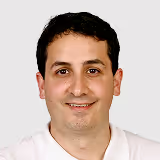
Marcel Kloos
Swiss-licensed dentist and founder of Medschool Experts
Marcel Kloos founded Medschool Experts while studying abroad; since then, over 500 study places have been secured. The Stuttgart-born dentist studied dentistry from 2015 to 2021 in Sofia and holds a Swiss dental licence.
Today he lives in Bern and runs Medschool Experts full-time as its owner.
More articles worth reading
Why Students Transfer from Medical University of Varna — Your Options
Why Students Transfer from Medical University of Warsaw — Your Options
Why Students Transfer from Masaryk University Faculty of Medicine — Your Options
Ahmad
Sabrina
Rami
Noah
500+ students placed.
Now it's your turn!
No daydreaming, no empty promises. Just a clear plan — for the start of your medical degree.
40 minutes, no obligation