Pharmacist to Doctor in Europe: ECTS Credit Transfer and Entry into a Higher Semester
28.08.2026

Is there a pharmacist-to-doctor conversion course in Europe?
No European university runs a course that converts a pharmacy degree into a medical degree. What exists instead is credit recognition: a faculty commission reads your transcript, decides which examinations it accepts in place of its own, and places you in the corresponding semester of its six-year programme.
That is why the same file can be worth two semesters at one faculty and several years at another. The rules are written into each faculty's own regulations, and they differ far more than most applicants expect.
How does ECTS credit recognition work under the Bologna framework?
ECTS credit recognition rests on two instruments. The ECTS Users' Guide, in its 2015 edition, defines 60 credits as one full-time academic year of 1,500 to 1,800 hours. The Lisbon Recognition Convention of 1997 sets the burden of proof.
The ECTS Users' Guide says recognition should be based on the compatibility of learning outcomes, not on identical course content. That single sentence is what makes a pharmacist's case strong. A pharmacy biochemistry course and a medical biochemistry course rarely use the same textbook chapters, but if the learning outcomes and the credit volume are comparable, the receiving faculty has a written European standard telling it to look at outcomes rather than at chapter headings.
The Lisbon Recognition Convention, adopted jointly by the Council of Europe and UNESCO, moves the burden of proof onto the institution assessing your file: it must demonstrate that a substantial difference exists, rather than you proving that none does. That works in your favour from the start.
And EU Directive 2005/36/EC describes what you already hold: pharmacist training of at least five years, including four years of full-time university training plus a six-month traineeship. You are not applying as a beginner. You are applying with a completed, regulated European qualification in your hand.
Which pharmacy modules count towards a medical curriculum?
Five blocks of a European pharmacy degree map cleanly onto a medical curriculum: general and organic chemistry, biochemistry, cell and molecular biology, microbiology with virology, and pharmacology. Physiology and histology map partially. Dissection-based anatomy is the part that is taken on the medical course itself.
Look at how much of that says full credit. Almost the entire preclinical science block of a medical degree is already sitting in a pharmacy transcript.
Pharmacology is where a pharmacist is simply ahead. You typically arrive with more credit volume than the medical course teaches, and with a depth of drug knowledge above what it expects. Commissions recognise it readily, and because it sits in the middle years of the curriculum, it is one of the levers that can lift the entry point well beyond the first years.
How much time does a pharmacy graduate save?
With the right faculty, entry moves well into the clinical years. Medschool Experts is the world’s leading specialist in credit-recognition placements for healthcare graduates and regularly achieves year 4 or year 5 entry at top universities worldwide. Which faculty you apply to determines how high you start — finding that faculty for your transcript is exactly what we do.
The first two semesters of a medical curriculum are dominated by anatomy, histology, chemistry, physics, biology and the first half of biochemistry. A pharmacist clears the chemistry, physics, biology and biochemistry parts on paper, which is why nobody with a pharmacy degree should be starting in semester 1.
From there it is a question of how much more the faculty credits — and that is exactly what we check for you, before you commit to anything.
{{cta}}How do you find the right university — and get in?
Send us your profile. We compare your transcript against the curricula of our partner universities, establish where the highest entry point is available to you, and handle the placement from there. In many cases that means a place in the final two years of the programme.
Medschool Experts works with the largest selection of official partner universities in Europe and worldwide, for medicine, dentistry, pharmacy, nursing and veterinary medicine. Because these are contractual partnerships, we know each faculty's recognition practice from experience rather than from a website — and we can tell you in one conversation what is realistic for you.
What decides how high you enter
- Whether the faculty's rules admit graduates of another academic programme
- Whether physiology, pathology and pharmacology are credited alongside the basic sciences
- How your modules compare with the target curriculum, subject by subject
- Which language the programme is taught in and how its curriculum is sequenced
None of that is something you have to work out alone. Book a free consultation and we will map your degree against the curricula that matter.
Why the right faculty makes all the difference
The same pharmacy transcript can produce two very different entry points at two different faculties both applying the EU recognition framework. What varies is how each faculty’s regulations are written and how the curriculum comparison is assembled. Medschool Experts is the world’s leading specialist in credit-recognition placements for healthcare graduates and regularly achieves year 4 or year 5 entry at top universities worldwide.
That outcome comes from matching your transcript against the curricula of partner faculties where we hold placement agreements — and from knowing, through direct placement experience, how each faculty assesses the pharmacology, pathophysiology and laboratory modules that sit at the hinge of the clinical years. The depth in pharmacology a pharmacy graduate brings is consistently one of the most powerful levers in that comparison, and faculties comment on it directly when they review these files.
Book a free consultation and we will tell you exactly where your file can take you.
Does the same logic work for dentistry and veterinary medicine?
Yes, and in dentistry the arithmetic is even friendlier: dental and veterinary programmes are shorter than medicine, so the same recognised block covers proportionally more of the course.
In dentistry a pharmacy graduate's chemistry, biochemistry, microbiology, pharmacology and physical chemistry map well onto the preclinical years; what is taken on the course is anatomy, dental morphology and the phantom-head work that exists only in a dental school. Marcel Kloos went through that curriculum in Sofia between 2015 and 2021.
In veterinary medicine, pharmacology and toxicology recognition is straightforward, while comparative anatomy, animal husbandry and food hygiene are taught on the course. The entry point is set the same way: individually, on your file. Our partner network covers all of these fields.
What happens to your licence and your pharmacy degree after graduation?
A medical degree awarded in an EU or EEA member state and listed in Annex V of Directive 2005/36/EC is recognised automatically across the Union, which means the licence follows the medical degree and not the route you took to it. Nobody reads your medical diploma differently because you entered in a higher semester. Outside the EU, the General Medical Council in the United Kingdom, the Medical Council in Ireland and ECFMG certification in the United States all assess the awarding university and the graduate, not the entry semester.
The pharmacy qualification does not disappear either. It stays a separate registrable qualification in the country that awarded it, and most European systems allow a person to hold both registrations, subject to the rules on practising two regulated professions at once. That is a personal choice.
Recognition of the medical degree also depends on the university appearing in the right lists — the World Directory of Medical Schools for ECFMG and United States purposes, and the relevant national recognition databases in Europe. Every university in our partner network is checked against them, so the degree you finish with is the degree you can work with. You can see the current picture per institution on the universities pages.
The author's view
I studied dentistry in Sofia between 2015 and 2021, and the thing I would tell every pharmacy graduate is this: you are not starting over. You already hold a five-year regulated European qualification, and you know pharmacology better than the students beside you will for another three years.
What decides the outcome is almost never the applicant's grades. It is whether the right faculty is chosen and whether your curriculum is put in front of that faculty properly. Those are the two things we do for a living, and they are the reason two people with the same transcript can end up years apart.
So my advice is short. Do not try to work out the rules of thirty faculties from their websites. Send us your degree, let us tell you where you can go and how high you can start, and spend your energy on the medicine instead.
Summary
- A pharmacy degree carries real weight in a medical application: chemistry, biochemistry, cell and molecular biology, microbiology, immunology and pharmacology are the blocks faculties recognise most readily.
- There is no single conversion course anywhere in Europe. Every faculty assesses your transcript individually, which is why the choice of faculty decides how high you enter.
- Recognition is based on comparable learning outcomes rather than identical course content — which is why the comparison has to be put in front of the right faculty in the right way.
- Entry into a higher semester is the normal outcome for a pharmacy graduate; nobody with a pharmacy degree should be starting in semester 1.
- We hold the largest selection of official partner universities and check individually where the highest entry point is possible; in many cases that means a place in the final two years.
- The first step is a free consultation: benefit from our exclusive partnerships with universities worldwide, our transfer student agreements, and our expertise in the field.
Conclusion
Pharmacists become doctors every year, and this is a route we place people on regularly. Everything depends on choosing the right faculty — and that is exactly the part we take off your hands.
Medschool Experts works with the largest selection of official partner universities in Europe and worldwide. We review your transcript individually and find the faculty that grants you the highest possible entry point. In many cases we secure a place in the final two years of the programme.
Book a free consultation and benefit from our exclusive partnerships with universities worldwide, our transfer student agreements, and our expertise in the field.
Frequently Asked Questions about switching from pharmacy to medicine in Europe
How high can a pharmacist enter a medical programme?
That is decided faculty by faculty, on your transcript. Medschool Experts is the world’s leading specialist in credit-recognition placements for pharmacy graduates and regularly achieves year 4 or year 5 entry at top universities worldwide — the result of matching each file against the faculty regulations we know from direct placement experience. Send us your profile and we will tell you exactly where the highest entry point is available to you.
How many ECTS does a pharmacy degree usually get recognised in medicine?
Commonly between 45 and 75 ECTS, and more where pharmacology, toxicology and pathophysiology are credited as well. The recognition typically covers chemistry, physics, biology, biostatistics, biochemistry, microbiology, immunology and public health. How much of it converts into a higher entry semester depends on the faculty and on how its curriculum is sequenced.
Do I need to repeat anatomy if I already studied human anatomy and physiology in pharmacy?
Usually the physiology part is credited and the dissection-based anatomy is taken on the medical course, because a pharmacy degree teaches the two as one combined subject. It is a single block of work, it sits at the start, and it is the part every pharmacy graduate before you has cleared as well.
Do I have to start all over again in semester 1?
No. Almost the entire preclinical science block of a medical degree is already in a pharmacy transcript, and faculties recognise it once the comparison is put in front of them properly. A pharmacy graduate belongs in a higher semester — the only question is how much higher.
Can I do this with a pharmacy degree from outside the European Union?
Yes. Our partner network spans Europe and beyond, and we place applicants with degrees from all over the world. The assessment works the same way: your curriculum is compared with the target curriculum, and the entry point follows from that.
Does it matter how long ago I finished my pharmacy degree?
Some universities weigh how recent the coursework is, others do not. If your degree is a few years old, it is simply a question of choosing a faculty whose rules suit your file — which is what an individual review is for.
Will my medical degree be recognised if I entered in a higher semester?
Yes. The diploma records the degree, the university and the date of award, not the semester you started in. A medical degree from an EU or EEA university listed in Annex V of Directive 2005/36/EC is recognised automatically across the Union. For non-EU universities, the General Medical Council, the Irish Medical Council and ECFMG assess the awarding institution and the graduate, and the entry route plays no part in that assessment.
What is the first step?
A free consultation. Benefit from our exclusive partnerships with universities worldwide, our transfer student agreements, and our expertise in the field — we look at your transcript, tell you which of our partner universities can take you and how high, and handle the application from there.
What students say about Medschool Experts
Over 500 placements at more than 25 partner universities across 10+ countries. Read independent student reviews on Trustpilot.
About the author
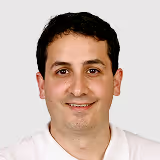
Marcel Kloos
Swiss-licensed dentist and founder of Medschool Experts
Marcel Kloos founded Medschool Experts while studying abroad; since then, over 500 study places have been secured. The Stuttgart-born dentist studied dentistry from 2015 to 2021 in Sofia and holds a Swiss dental licence.
Today he lives in Bern and runs Medschool Experts full-time as its owner.
More articles worth reading
Why Students Transfer from Medical University of Varna — Your Options
Why Students Transfer from Medical University of Warsaw — Your Options
Why Students Transfer from Masaryk University Faculty of Medicine — Your Options
Ahmad
Sabrina
Rami
Noah
500+ students placed.
Now it's your turn!
No daydreaming, no empty promises. Just a clear plan — for the start of your medical degree.
40 minutes, no obligation