From Psychology to Medicine: How a Psychology Degree Carries Into a European Medical Programme
03.09.2026

What does a psychology degree already carry into medicine?
A great deal, and in exactly the areas psychiatry runs on. A psychology curriculum builds the nervous system from cell to behaviour, teaches statistical inference to a level many medical students never reach, and drills the structured clinical interview, which is the single skill a psychiatrist uses most hours of the week. The gap is in body systems, not in reasoning.
Take the blocks one at a time. Biological psychology and cognitive neuroscience cover neuronal signalling, neurotransmitter systems, cortical and subcortical anatomy, sleep architecture and the stress axis. A medical faculty teaches the same material inside physiology and neurology, with more pharmacology attached. The vocabulary is shared. So is the model.
Statistics and research methods are the part psychology graduates most consistently undersell. Effect sizes, confidence intervals, regression, power calculation, blinding, the difference between a per-protocol and an intention-to-treat analysis. Evidence-based medicine is built on that grammar, and a medical curriculum devotes far fewer contact hours to it. A student arriving from psychology often reads a trial paper better than the cohort around them in year one.
Developmental and behavioural science carries into paediatrics, geriatrics and public health. Psychopathology maps onto the psychiatry rotation. Clinical interviewing, risk assessment and the ethics of consent carry into every rotation there is, because a history is a history whether the presenting complaint is a panic attack or chest pain. What has to be added is anatomy in the dissection room, biochemistry, pharmacokinetics, microbiology, pathology, and the hospital years. That is real work, and it is the part a six-year programme is designed to deliver.
How does a European medical faculty compare a psychology degree to its own curriculum?
By learning outcomes and ECTS, subject block against subject block, decided by the faculty's own academic board. There is no European clearing house that stamps a conversion rate. Each receiving university reads your transcript, matches what you were taught and assessed on against what its own students are taught and assessed on, and issues a decision for your file alone.
The unit of comparison is the European Credit Transfer and Accumulation System. Sixty ECTS credits represent one full-time academic year, and a first-cycle degree carries either 180 or 240 credits under the framework the European Commission sets out in the ECTS Users' Guide 2015. A psychology transcript therefore arrives already denominated in the currency a European faculty uses.
What the board looks for is not a course title. It is the outcome statement behind it: what the student could do at the end, at what level, verified by what assessment. A module called Biological Psychology with a laboratory component and a written examination reads very differently from a lecture series with a coursework essay. Same name. Different weight.
Medschool Experts is the world's leading specialist in credit-recognition placements for healthcare and science graduates, and regularly achieves year 4 or year 5 entry at top universities worldwide. Where a psychology degree lands depends on the depth of the science modules, the assessment format and the faculty receiving it. Nobody reads that from a degree title, which is why every case is assessed individually and without charge. Send the transcript and get it read properly: free consultation.
Where are the six-year English-taught medical programmes in Europe?
Across most of Central, South-Eastern and Northern Europe. Bulgaria, Romania, Hungary, Poland, Czechia, Slovakia, Latvia, Lithuania, Croatia, Serbia and Georgia all run medical programmes taught entirely in English, awarding the same degree as the national-language track at the same faculty. Six years, in most of them.
The degree title varies by country: Doctor of Medicine, MD, or a national equivalent such as the Romanian Doctor-Medic. What matters is not the wording on the diploma but whether the qualification appears in Annex V of Directive 2005/36/EC for that Member State, because that is what triggers automatic recognition across the European Union.
Language of instruction is worth being precise about. English-taught means lectures, seminars, laboratory work and examinations in English for the full six years. Clinical years still put you on a ward where patients speak the local language, and every one of these faculties teaches that language as a compulsory subject through the pre-clinical years for exactly that reason. Take it seriously from month one and you take histories comfortably by year four.
Curriculum structure is broadly consistent. Two or three pre-clinical years of anatomy, histology, biochemistry, physiology and medical psychology, then pathology, pharmacology and microbiology, then three clinical years rotating through internal medicine, surgery, paediatrics, obstetrics and gynaecology, neurology and psychiatry, closing with a state examination or thesis defence. The faculties, their cities and their teaching languages are compared on the universities overview.
What is your medical degree worth under Directive 2005/36/EC?
It is worth automatic recognition across the European Union, the European Economic Area and Switzerland. Directive 2005/36/EC lists seven professions that receive automatic recognition, doctors among them, and requires each Member State to give a listed qualification "the same effect on its territory as the evidence of formal qualifications which it itself issues". A medicine degree from a listed faculty in Bulgaria is, in law, a medicine degree in Ireland.
The directive sets the floor. Article 24(2), in the consolidated text, requires basic medical training of at least five years, which may in addition be expressed in equivalent ECTS credits, and at least 5,500 hours of theoretical and practical training provided by or under the supervision of a university. Almost every European faculty runs six years and roughly 360 ECTS, well above that floor. The extra year is part of why a European medical degree travels so far outside Europe.
Automatic recognition is not automatic employment. You register with the medical council or chamber of the country where you want to work, prove language competence to that authority's standard, and outside the European Union you sit that country's route: the USMLE steps and ECFMG certification for the United States, PLAB or an approved postgraduate qualification for the General Medical Council in the United Kingdom, the Medical Council of Canada examinations, the Australian Medical Council pathway. Graduates of European faculties use those routes every year.
| Qualification | Minimum requirement | Source and year |
|---|---|---|
| One full-time academic year | 60 ECTS credits | European Commission, ECTS Users' Guide 2015 |
| Bachelor's degree, first cycle | 180 or 240 ECTS credits | European Commission, ECTS Users' Guide 2015 |
| Master's degree, second cycle | 90 or 120 ECTS credits | European Commission, ECTS Users' Guide 2015 |
| Basic medical training | At least 5 years of study and at least 5,500 hours | Directive 2005/36/EC, Article 24(2), consolidated text 2024 |
| Psychiatry as a specialty | At least 4 years of specialist training | Directive 2005/36/EC, Annex V 5.1.3, amended 23 May 2023 |
| General care nurse | 3 years and at least 4,600 hours | Directive 2005/36/EC, European Commission 2026 |
| Pharmacist | 5 years: 4 years of study plus a 6-month traineeship | Directive 2005/36/EC, European Commission 2026 |
| Veterinary surgeon | At least 5 years of theoretical and practical study | Directive 2005/36/EC, European Commission 2026 |
Why is psychiatry training in Europe open to a psychology profile?
Because entry to psychiatry is gated on the medical degree, not on the subject you read before it. Article 25 of Directive 2005/36/EC makes the condition explicit: an applicant for specialist training must have completed and validated the basic medical training programme. Once you hold the medical degree, your route into psychiatry is the same as everybody else's, and what you did beforehand becomes an asset rather than a question.
Psychiatry is also where a psychology background changes the daily work fastest. Formulation, psychometric assessment, the evidence base for cognitive behavioural therapy, the reading of treatment trials, the therapeutic relationship itself: all territory a psychology graduate has already crossed. National programmes make that explicit. The Swiss programme in Psychiatrie und Psychotherapie, revised in September 2022, requires 240 credits of foundational theoretical instruction in its three-year base module and 360 credits of advanced theoretical training. The German title under the Weiterbildungsordnung 2020 is Facharzt für Psychiatrie und Psychotherapie: psychotherapy is in the name of the specialty.
Workforce demand is on your side too. Psychiatry is one of the specialties European health systems recruit hardest for, and a training post is a salaried hospital job from day one. Article 25(3) of the directive requires specialist training to be full-time, with the trainee devoting all professional activity to it throughout the working week and the whole year. That is a description of employment.
How long is psychiatry specialist training in each country?
Four years is the European floor, and most countries run longer. Annex V, point 5.1.3 of Directive 2005/36/EC sets the minimum period of training for psychiatry at four years across the Member States, in the version amended by the Commission Delegated Decision of 23 May 2023. A specialist title earned at that standard is recognised automatically in every other Member State.
Above it, countries diverge. Germany requires 60 months under the Weiterbildungsordnung 2020, and 12 of those months must be spent in neurology, with 24 months in inpatient care. The United Kingdom runs three years of core psychiatry training at CT1 to CT3, the MRCPsych examination, then a minimum of 36 months of higher training at ST4 to ST6, leading to a Certificate of Completion of Training and entry to the General Medical Council's specialist register. Switzerland runs six years in a modular structure. The numbers below are the published training periods.
| Country | Specialist training | Title or outcome | Source and year |
|---|---|---|---|
| EU and EEA minimum | 4 years | Specialist title recognised automatically across the Union | Directive 2005/36/EC, Annex V 5.1.3, amended 23 May 2023 |
| France | 4 years | Specialist diploma in psychiatry | European Psychiatric Association guidance, 2014 |
| Netherlands | 4.5 years | Registration as psychiater | European Psychiatric Association guidance, 2014 |
| Germany | 5 years, 60 months, including 12 months neurology | Facharzt für Psychiatrie und Psychotherapie | Weiterbildungsordnung 2020, state medical chamber |
| Sweden | 5 years | Specialist competence in psychiatry | European Psychiatric Association guidance, 2014 |
| Belgium | 5 years | Recognised specialist in psychiatry | European Psychiatric Association guidance, 2014 |
| United Kingdom | 6 years, 3 core plus 3 higher | CCT and entry to the GMC specialist register | General Medical Council, Psychiatry Silver Guide, 2022 |
| Switzerland | 6 years, modular | Facharzttitel Psychiatrie und Psychotherapie | SIWF and FMH programme, revised September 2022 |
What does the full route cost, from first semester to specialist?
Tuition is the large line, living costs the steady one, and specialist training pays a salary rather than charging a fee. You fund the medical years. From the first day of psychiatry training onwards you are employed.
English-taught medical programmes in Central and South-Eastern Europe are priced in a broad band. The lower end sits with the public faculties in Bulgaria and Romania, the middle with Poland, Czechia, Slovakia and the Baltic states, the upper end with the long-established Hungarian faculties. Fees are revised annually, so plan on the figure published by the faculty for your own intake year.
Here is a worked example, the Bern-to-Balkans budget, because it is the shape we see most often from Swiss and German applicants. Take a six-year programme priced at €9,000 per academic year, a shared flat at €450 a month, food and household at €300, transport, phone and insurance at €120, and €700 a year for books, instruments and examination fees.
| Line | Per year | Over six years |
|---|---|---|
| Tuition, worked assumption | €9,000 | €54,000 |
| Rent, shared flat at €450 a month | €5,400 | €32,400 |
| Food and household at €300 a month | €3,600 | €21,600 |
| Transport, phone, insurance at €120 a month | €1,440 | €8,640 |
| Books, instruments, examination fees | €700 | €4,200 |
| Total | €20,140 | €120,840 |
That is €120,840 across six academic years on those assumptions, and every year of recognised prior study takes a full €20,140 out of it. Tuition is the line that moves most between countries, so swap in the published fee for the programme you are looking at and the rest of the model holds. Specialist training reverses the flow: a psychiatry resident is a salaried hospital doctor for the four to six years the training runs.
{{cta}}What should you actually be doing, and when?
Start with the things entirely under your own control. Transcripts, language, budget and the recognition assessment move on your timetable, not anybody else's, and getting them in order early is what makes the rest straightforward. Twelve months is comfortable.
Twelve to ten months before the intake. Order an official transcript with module descriptions and ECTS values from your psychology faculty, in English if the university issues one. Ask for the syllabus documents, not just the grade list: the syllabus is what an academic board reads. Book the free assessment at the same time, because the answer shapes everything after it.
Ten to eight months before. Fix the country. Tuition, city size, flight connections home, the language you would be learning and where you eventually want to sit your licensing route all belong in that decision. Put the six-year budget on one page. Decide how it is funded first.
Eight to five months before. If your English certification is older than two years or was never formally taken, sit it now. Begin the local language early, even at thirty minutes a day, because the first year is when you have the time. Read around the pre-clinical science you did not cover in psychology, particularly organic chemistry and gross anatomy.
Four to two months before. Housing, banking and residence formalities for the destination country. Book flights once the study place is confirmed. Speak to people already on the programme; several describe how the first year actually ran in the student stories section.
The first month on site. Register with the faculty, open a local account, join the anatomy study group in week one rather than week six, and set a fixed weekly slot for the local language. Habits set in October decide how June feels.
Do you lose the psychology degree once you become a doctor?
No, and this is the question most people are left holding. The psychology degree does not evaporate when a medical diploma arrives. It stays on your record as a completed qualification in its own right, and in psychiatry it keeps working for you in three concrete ways.
The first is psychotherapy. In German-speaking Europe the psychiatry specialty is explicitly a psychiatry-and-psychotherapy specialty, and the training carries hundreds of hours of theoretical instruction plus supervised cases. A trainee who already understands cognitive models, behavioural analysis and the outcome literature moves through that component with much less friction.
The second is research. Psychiatry is a specialty where clinical academic posts, trial participation and doctoral work are genuinely accessible, and a psychology degree hands you the methodological training those roles assume. Supervisors notice when a junior doctor can design a study rather than only recruit to one.
The third is scope. A psychologist who becomes a physician can prescribe, admit, manage physical comorbidity, and read the neurological differential underneath a psychiatric presentation. That combination is rare, and health systems across Europe are short of it. Nothing here asks you to abandon what you trained in. It asks you to add to it.
How do you find out where you personally stand?
By having the transcript read by someone who places these cases every week. Entry requirements vary by university and by individual profile, and no general rule can tell you what a faculty will do with your specific modules, grades and year of graduation. That assessment is free.
Marcel Kloos, who studied dentistry in Sofia between 2015 and 2021 and practises as a Swiss-licensed dentist in Bern, has placed over 500 study places with Medschool Experts. In our own placements, psychology graduates are among the profiles a receiving faculty reads most favourably, because the science and statistics blocks are documented and assessed. Bring the transcript and the syllabus. Book a free individual consultation and Medschool Experts assesses your case directly.
The author's view
I studied dentistry in Sofia between 2015 and 2021, in English, as a foreigner, and I now practise as a licensed dentist in Bern. So when someone tells me they are worried a degree taken in one country will not travel, I have a fairly direct answer. Mine travelled. The paperwork was ordinary and the rules were published.
Psychology graduates are the group most likely to underestimate themselves in this conversation. They arrive apologising for not having done medicine, and then it turns out they have three years of neuroscience, better statistics training than most medical students get, and several hundred supervised hours of talking to distressed people. In our own placements at Medschool Experts, that profile reads well to a receiving faculty, because the science modules are documented, assessed and denominated in ECTS.
The other thing I would say is about the long view. Psychiatry needs people who understand both the pharmacology and the person, and Europe is short of them in almost every health system I have looked at. If that is where you are heading, the degree you already hold is not a detour you have to explain away. It is the reason you will be good at the job. Bring me the transcript and we will read it together.
Summary
- A psychology degree already covers neuroscience, statistics, developmental science, psychopathology, clinical interviewing and research ethics, all of which a medical faculty teaches and assesses.
- Recognition is decided by the receiving university's academic board on a learning-outcome and ECTS comparison, with 60 ECTS representing one full-time academic year under the ECTS Users' Guide 2015.
- Medschool Experts is the world's leading specialist in credit-recognition placements for healthcare and science graduates and regularly achieves year 4 or year 5 entry at top universities worldwide.
- Full six-year medical programmes are taught in English in Bulgaria, Romania, Hungary, Poland, Czechia, Slovakia, Latvia, Lithuania, Croatia, Serbia and Georgia.
- Directive 2005/36/EC requires basic medical training of at least five years and 5,500 hours, and grants automatic recognition of a listed qualification across the EU, the EEA and Switzerland.
- Psychiatry has a minimum training period of four years under Annex V 5.1.3, amended 23 May 2023; Germany runs five, the United Kingdom and Switzerland six.
- Specialist training is salaried employment under Article 25(3), so the funding sits in the medical years, not after them.
- A worked six-year budget at €9,000 tuition and €11,140 living costs a year comes to €120,840 in total, or €20,140 per academic year.
Conclusion
Psychology to medicine is not a change of direction. It is the same interest in how people work, taken as far as it goes, with prescribing rights and a hospital at the end of it.
What your specific transcript is worth is a question about your modules, your assessments and the faculty reading them, and it is answered in one conversation rather than by any general rule. Bring the document and find out: book a free consultation.
Frequently Asked Questions about Moving from Psychology to Medicine in Europe
Can I go straight into a medical programme with a psychology degree?
Yes. A completed psychology degree is a recognised higher-education qualification, and European medical faculties admit graduates into their six-year programmes. Whether previous study is recognised toward the medical curriculum is a separate decision, taken by the receiving faculty's academic board on a comparison of learning outcomes and ECTS. That assessment is individual and free, and it is the first thing to arrange.
Does a BSc count differently from an MSc in psychology?
They are read differently because they contain different things. Under the ECTS framework a first-cycle degree carries 180 or 240 credits and a second-cycle degree 90 or 120, and a master's usually adds research methods, supervised clinical contact and a thesis. An academic board reads the depth of the science modules and the assessment format rather than the level label. Both profiles are placed regularly.
Is psychiatry the only specialty open to me afterwards?
Not at all. Once you hold the medical degree and register with the medical council, every specialty is open on the same terms as for any other graduate, because Article 25 of Directive 2005/36/EC conditions entry to specialist training on the basic medical qualification. Psychiatry is simply where a psychology background pays the largest immediate dividend, in formulation, psychotherapy training and research method.
How long is psychiatry training in Europe?
Four years is the minimum under Annex V, point 5.1.3 of Directive 2005/36/EC, amended by the Commission Delegated Decision of 23 May 2023. National authorities set their own above that floor. France trains for four years, the Netherlands four and a half, Germany five under the Weiterbildungsordnung 2020, the United Kingdom and Switzerland six. A title earned at the directive standard is recognised across the Union.
Will a medical degree from Bulgaria or Romania be recognised where I want to work?
Within the European Union, the European Economic Area and Switzerland, yes, automatically, provided the qualification is listed in Annex V of Directive 2005/36/EC. Member States must give it the same effect as a qualification they issue themselves. Outside Europe you follow that country's own route: ECFMG certification and the USMLE steps for the United States, the General Medical Council pathway for the United Kingdom, the Medical Council of Canada, the Australian Medical Council.
Do I need the local language if the programme is in English?
For lectures and examinations, no. English-taught means the full six years are delivered and assessed in English. For the clinical years, yes, and every faculty teaches the local language as a compulsory subject for exactly that reason. Patients on the ward speak it. Students who start in the first month take histories comfortably by the clinical years.
Is psychiatry training paid?
Yes. Article 25(3) of Directive 2005/36/EC requires specialist training to be full-time, with the trainee devoting all professional activity to the training throughout the working week and the whole year. In practice that means a hospital employment contract with a salary from the first day of residency. The cost of the route sits in the medical degree years; the specialty years pay you.
What do I need to bring to find out where I stand?
An official transcript with module titles, ECTS values and grades, and the syllabus or module descriptions behind them. The syllabus matters more than the transcript, because an academic board compares what you could do at the end of a module against what its own students can do. Requirements vary by university and by profile, so book a free individual consultation and Medschool Experts assesses your case directly.
What students say about Medschool Experts
Over 500 placements at more than 25 partner universities across 10+ countries. Read independent student reviews on Trustpilot.
About the author
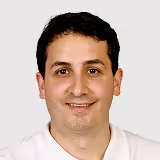
Marcel Kloos
Swiss-licensed dentist and founder of Medschool Experts
Marcel Kloos founded Medschool Experts while studying abroad; since then, over 500 study places have been secured. The Stuttgart-born dentist studied dentistry from 2015 to 2021 in Sofia and holds a Swiss dental licence.
Today he lives in Bern and runs Medschool Experts full-time as its owner.
More articles worth reading
Why Students Transfer from Medical University of Varna — Your Options
Why Students Transfer from Medical University of Warsaw — Your Options
Why Students Transfer from Masaryk University Faculty of Medicine — Your Options

Ahmad

Sabrina

Rami

Noah
500+ students placed.
Now it's your turn!
No daydreaming, no empty promises. Just a clear plan — for the start of your medical degree.
40 minutes, no obligation