Speech and Language Therapist to Doctor in Europe
08.09.2026

What does a speech and language therapy degree already share with medicine?
More than most people assume. A pre-registration speech and language therapy degree teaches the structure and function of the human body, the biomedical sciences behind communication and swallowing, and the differential diagnosis of acquired and developmental disorders. The Health and Care Professions Council writes those requirements into its Standards of Proficiency directly.
Standard 12.1 requires registrants to understand the structure and function of the human body together with physical and mental health, disease and dysfunction. Standard 12.8 names the biomedical and medical sciences relevant to communication and swallowing. Standard 13.14 asks for linguistics, phonetics, psychology and biomedical science applied to identification, assessment and differential diagnosis. Standard 13.19 lists dysphagia among the impairment categories a registrant must be able to work with, and standard 2.12 goes as far as the ethical and legal implications of withholding and withdrawing feeding and nutrition. That is clinical ethics, taught in a therapy degree.
Look at what a therapist handles on an ordinary shift. Cranial nerves V, VII, IX, X and XII. The oral, pharyngeal and oesophageal phases of the swallow. Vocal fold physiology. Aphasia localisation after a middle cerebral artery infarct. Tracheostomy and ventilation. The same content sits in the neuroanatomy, physiology and ear, nose and throat blocks of a medical degree, taught to the same depth in several places and further in others.
How do European medical faculties assess ECTS credits from a speech therapy degree?
Faculty by faculty, module by module. A European medical faculty receives the transcript, the diploma supplement and the module descriptions, and a recognition committee compares learning outcomes and ECTS credits against its own curriculum. Where a module matches in content and hours, it is credited. Where it does not, it is taken again.
Three things decide the outcome. The first is documentation quality: a diploma supplement with per-module learning outcomes, contact hours and assessment methods is read differently from a bare list of grades. The second is the shape of the degree, because a four-year Bachelor of Science with 240 ECTS carries more transferable weight than a two-year conversion Master. The third is the receiving faculty, since recognition committees at different universities read identical transcripts differently. That last point surprises people.
The underlying legal frame is Directive 2005/36/EC. Article 24 sets basic medical training at a minimum of five years of study, expressible in ECTS credits, and at least 5,500 hours of theoretical and practical training given by or under the supervision of a university. Any recognised credit still has to leave a graduate meeting that floor, which is why faculties count hours as carefully as credits.
Medschool Experts is the world’s leading specialist in credit-recognition placements for healthcare graduates and regularly achieves year 4 or year 5 entry at top universities worldwide. What a particular transcript is worth depends on the faculty and on the individual profile, so the assessment is done case by case, on the actual documents, before anything is submitted. Book a free consultation and we read the transcript with you.
Which English-taught medical programmes in Europe are open to healthcare graduates?
English-taught medicine has been a fixture of European higher education since the 1990s and now runs in Bulgaria, Romania, Hungary, Slovakia, Czechia, Poland, Latvia, Lithuania, Georgia, Serbia and elsewhere. The degrees are the same national degrees taught to domestic students, delivered in English, and they sit in the World Directory of Medical Schools.
The practical differences between them are language of the clinical years, hospital network, class size, and how the recognition committee works. Some faculties teach in English through all six years and run the local language only as a patient-communication course. Others switch the ward rounds to the national language from year four onward, which changes what a clinical year feels like. City choice is not cosmetic. Marcel Kloos went through exactly that structure in Sofia between 2015 and 2021, in dentistry rather than medicine, and it shapes how Medschool Experts advises on it.
Entry requirements differ from university to university and from profile to profile, and they change between admission cycles. Rather than publish a checklist that would be wrong for most readers, Medschool Experts assesses each case directly: bring the transcript and the registration details to a free individual consultation. A first look at which faculties suit a therapy background is on the universities page.
How is the clinical half of a European medical degree structured?
Two preclinical years, one bridging year, three clinical years is the common six-year shape. Anatomy, histology, biochemistry, physiology and biophysics fill years one and two. Pathology, pharmacology, microbiology and propaedeutics fill year three. Years four to six are hospital-based, rotating through internal medicine, surgery, paediatrics, obstetrics and gynaecology, neurology, psychiatry and ear, nose and throat. The shape barely varies.
For a speech and language therapist the ear, nose and throat rotation, the neurology block and the paediatric block are familiar ground seen from a different chair. You already know what a fibreoptic endoscopic evaluation of swallowing shows. What changes is that you are now expected to order it, interpret the wider picture and decide what happens next. Therapists who enter at an advanced year usually report the clinical reasoning transition as the real work, not the anatomy.
The final year in most European programmes is a rotating internship or clinical clerkship year, assessed by station examinations and a state final. That year matters for licensing later, because the General Medical Council asks international medical graduates for evidence of a completed internship as part of full registration.
What does a converted medical degree in Europe actually cost?
Tuition for English-taught medicine in Central and Eastern Europe sits in a broad band, with living costs adding roughly the same again. Fees are set per university and per academic year, so the figures below are approximate 2026 ranges rather than quoted prices, and the exact fee for any named faculty should be confirmed before anyone budgets on it.
| Region | Approximate annual tuition, English-taught medicine, 2026 | Currency of the fee |
|---|---|---|
| Bulgaria and Romania | €8,000 – €9,500 | Euro |
| Hungary, Slovakia and Czechia | €12,000 – €19,000 | Euro or US dollar |
| Poland and the Baltic states | €12,000 – €16,000 | Euro |
Living costs are easier to pin down. Numbeo’s September 2026 data gives the monthly picture for three of the cities that most often come up.
| City | Monthly cost, single person, excluding rent | One-bedroom flat outside the centre | Data date |
|---|---|---|---|
| Sofia, Bulgaria | €756.90 | €524.61 | 7 September 2026 |
| Riga, Latvia | €871.10 | €344.67 | 4 September 2026 |
| Budapest, Hungary | 275,077 Hungarian forint (about US$880) | 209,583 Hungarian forint | 7 September 2026 |
Worked example: three clinical years in Sofia, 2026 prices
Take a therapist who enters at an advanced year and has three years left. Using a mid-range annual tuition figure of €9,000 and Numbeo’s Sofia data from 7 September 2026, the itemised total runs like this: tuition, three years at €9,000, is €27,000. Living costs excluding rent, 36 months at €756.90, are €27,248. Rent for a one-bedroom flat outside the centre, 36 months at €524.61, is €18,886. Health insurance, residence permit renewals, books and equipment add roughly €3,300 over the three years. That totals €76,434, or about €25,500 a year.
Share a flat and the rent line falls to roughly €9,400, bringing the three-year total to about €67,000. Most students share.
How long does it take from first enquiry to first semester?
Between six and twelve months for most people, and the calendar rather than the paperwork sets the pace. European medical faculties run a main September or October intake, with a smaller February intake at some universities. Everything else works backwards from that date.
The sequence of a typical year looks like this.
Consultation, transcript review and diploma supplement gathering. Order certified copies from the awarding university early; they take weeks, not days.
Translation, legalisation or apostille, and shortlisting of faculties whose recognition committees fit the profile.
Submission and the credit assessment itself, followed by the entry-year decision from the faculty.
Residence permit, accommodation, and the summer language course that several universities run in August before the semester opens.
Two dates are worth marking. Summer language courses generally run through August, so an August arrival is normal rather than early. And the certified transcript is almost always the slow item, which is why it goes first in the sequence and not last.
{{cta}}How do you get licensed as a doctor after graduating in Europe?
Three routes cover most destinations. Inside the European Union and the European Economic Area, a medical degree that meets Directive 2005/36/EC is recognised automatically in every other member state. For the United Kingdom, the General Medical Council route runs through the PLAB test and full registration. For the United States, ECFMG certification and the USMLE sequence apply.
The European route is the most direct. Article 21 of the directive gives automatic recognition to medical qualifications listed in Annex V, provided the training meets the Article 24 floor of five years and 5,500 hours. A graduate of a Bulgarian, Hungarian or Latvian medical faculty registers in Ireland, Spain or Sweden on the strength of the diploma itself, subject to language requirements set by the host regulator.
The United Kingdom route is documented in detail by the General Medical Council. Full registration for international medical graduates asks for a primary medical qualification from a medical school outside the United Kingdom, both parts of the PLAB test passed within the past two years, a completed internship, evidence of knowledge of English, a certificate of good standing, a five-year activity history and a fitness to practise declaration. The fees are published and rise each April.
| General Medical Council fee | From 1 April 2025 | From 1 April 2026 |
|---|---|---|
| PLAB Part 1 | £273 | £283 |
| PLAB Part 2 | £998 | £1,036 |
| Full registration with a licence to practise | £463 | £481 |
| Annual retention fee | £463 | £481 |
The United States route runs through ECFMG. The medical school must be listed in the World Directory of Medical Schools, and ECFMG has moved to requiring accreditation of the school by an agency recognised by the World Federation for Medical Education; anyone planning on the United States should confirm a specific school’s current status with ECFMG before enrolling. USMLE Step 1 and Step 2 CK, plus the clinical and communication skills requirement met through the Pathways, complete certification.
An advantage worth naming: a therapist who already holds Health and Care Professions Council registration has spent years inside a regulated profession, with a certificate of good standing, a documented continuing professional development record and a clean activity history. Regulators like that paperwork. It is already in the right shape.
Does a speech therapy background pay off in ENT, neurology and paediatrics?
In those three specialties, visibly. Ear, nose and throat surgery, stroke neurology and paediatric development are the fields where speech and language therapy sits inside the multidisciplinary team, and a doctor who has worked the therapy side of that team arrives understanding what the other members can and cannot do.
Take head and neck oncology. A laryngectomy decision involves the surgeon, the oncologist, the dietitian and the speech and language therapist, and voice outcome is part of the surgical conversation from the first meeting. A registrar who has fitted a voice prosthesis and run the rehabilitation afterwards reads that conversation differently. The same holds on a hyperacute stroke unit, where dysphagia screening within four hours governs whether a patient eats, and in paediatric cleft services, where speech outcome measures shape surgical timing.
Neurology rewards the phonetics too. Distinguishing spastic from flaccid from ataxic dysarthria is a localisation exercise, and a therapist has been doing it by ear for years. That skill maps straight onto the neurological examination.
The unglamorous advantage. Therapists arrive already able to take a history from someone who cannot speak fluently, break bad news about function rather than diagnosis, and write notes another professional can act on. Those take most medical students years.
What happens to your registration and your income while you study?
This is the question that decides whether the plan is workable, and it rarely gets answered. Health and Care Professions Council registration in the United Kingdom is renewed every two years against continuing professional development requirements, and a registrant who lets it lapse while studying abroad has to go through readmission to get it back. Keeping it alive is usually the better call.
Renewal is possible from abroad as long as the professional development record holds up, and a small amount of paid or voluntary therapy practice during holidays keeps that record genuine. Several people combine locum therapy work in the summer with the academic year abroad. In countries where the protected title rules are narrower, the picture differs: the Royal College of Speech and Language Therapists notes that in the United Kingdom only the title speech and language therapist is protected, while communication therapist and speech practitioner are not regulated at all.
Income during the clinical years is the second half of the question. Medical students in most European programmes are on a full timetable with ward attendance, so full-time therapy work alongside is not realistic. What does work is a mix: savings built before the move, summer locum blocks at home, and the lower cost base of a city like Sofia or Riga, where the difference against a British or Irish cost of living does much of the work by itself. The worked example above is roughly a third of what the same three years would cost in Western Europe.
Pension contributions, professional indemnity and union membership all need a decision too. Decide early. None of it is complicated once it is written down, and our services page sets out where Medschool Experts takes the administrative load, from transcript legalisation through to residence permits.
The author’s view
I studied dentistry in Sofia between 2015 and 2021 and I am now a Swiss-licensed dentist living in Bern, so the transferable-credit conversation is one I have had from both sides. What strikes me about speech and language therapists specifically is how badly they undersell their own transcripts. They walk into a first consultation apologising for not having a science degree, and then it turns out they have done cranial nerve anatomy, respiratory physiology and four hundred hours on hospital wards.
Across the placements I have worked on — more than 500 study places over the years — the pattern in Medschool Experts’ own placement experience is that the people who do best are the ones who gathered proper module descriptions before anyone looked at anything. A grade transcript alone tells a recognition committee almost nothing. A diploma supplement with learning outcomes, contact hours and assessment methods per module tells it everything, and committees credit what they can actually see.
The other thing I would say plainly: do not decide your entry year yourself before a faculty has looked at your file. I have watched therapists talk themselves out of a strong application because they had already concluded what their credits were worth. That is not their call to make, and it is not mine either. It belongs to the recognition committee, and getting the file in front of the right ones is the whole job.
Summary
- The Health and Care Professions Council register listed 20,895 speech and language therapists on 1 September 2026, out of 367,455 registrants in fifteen professions.
- HCPC Standards of Proficiency 12.1, 12.8, 13.14 and 13.19 already require anatomy, biomedical science, phonetics and dysphagia competence — all of it curriculum overlap with medicine.
- Directive 2005/36/EC, Article 24 sets basic medical training at a minimum of five years and 5,500 hours of theoretical and practical training under university supervision.
- Medschool Experts is the world’s leading specialist in credit-recognition placements for healthcare graduates and regularly achieves year 4 or year 5 entry at top universities worldwide.
- Three clinical years in Sofia at 2026 prices come to about €76,434 with a private flat, or roughly €67,000 in shared accommodation.
- Numbeo put Sofia at €756.90 a month excluding rent and Riga at €871.10 in early September 2026.
- From 1 April 2026 the General Medical Council charges £283 for PLAB Part 1, £1,036 for PLAB Part 2 and £481 for full registration with a licence to practise.
- Ear, nose and throat, stroke neurology and paediatrics are the specialties where a therapy background converts most directly into clinical advantage.
Conclusion
A speech and language therapy degree is not a detour from medicine. It is hundreds of hours of anatomy, neuroscience, phonetics and supervised patient contact that a European medical faculty can read, count and credit, and the specialties that most therapists are drawn to are the ones where that background keeps paying off after graduation.
What any individual transcript is worth is decided by a recognition committee looking at the actual documents, which is why the sensible first step is having someone read them with you. Medschool Experts does that at no cost: book a free consultation.
Frequently Asked Questions about Converting from Speech and Language Therapy to Medicine
Will my speech and language therapy degree actually reduce the length of my medical studies?
European faculties assess prior ECTS credits against their own curriculum and credit what matches in content and contact hours. Anatomy, physiology, neuroscience, psychology and supervised clinical hours are the modules that most often carry across. Medschool Experts is the world’s leading specialist in credit-recognition placements for healthcare graduates and regularly achieves year 4 or year 5 entry at top universities worldwide. Book a free consultation and we assess your transcript directly.
What entry requirements do European medical universities set for healthcare graduates?
Requirements vary by university and by individual profile, and they change between admission cycles, so a general list would be misleading for most applicants. Some faculties weight the prior degree heavily, others run their own entrance assessment, and recognition committees differ in how they read identical transcripts. Book a free individual consultation and Medschool Experts assesses your case directly against the faculties that fit it.
Can I keep my HCPC registration while studying medicine abroad?
Yes. Health and Care Professions Council registration renews every two years against continuing professional development requirements, and renewal from abroad is possible provided the professional development record stands up to audit. Summer locum therapy work at home is a common way to keep that record substantial. Letting registration lapse means going through readmission later, which is why most people keep it running.
Is a medical degree from Bulgaria or Latvia recognised in the United Kingdom?
The General Medical Council accepts primary medical qualifications from medical schools outside the United Kingdom. Full registration additionally requires both parts of the PLAB test passed within the past two years, a completed internship, evidence of knowledge of English, a certificate of good standing and a five-year activity history. From 1 April 2026 the fees are £283 for PLAB Part 1, £1,036 for PLAB Part 2 and £481 for registration.
How does licensing work if I want to stay in the European Union?
Directive 2005/36/EC gives automatic recognition to medical qualifications from EU and EEA states, provided the training meets Article 24: at least five years of study and at least 5,500 hours of theoretical and practical training under university supervision. A graduate of an accredited European faculty registers in another member state on the diploma itself, subject to the host regulator’s language requirements.
What about practising in the United States afterwards?
ECFMG certification is the gateway. The medical school must be listed in the World Directory of Medical Schools, and ECFMG has moved to requiring accreditation by an agency recognised by the World Federation for Medical Education, so confirm a specific school’s current status with ECFMG before enrolling. Certification also requires USMLE Step 1, USMLE Step 2 CK and the clinical and communication skills requirement met through the Pathways.
How much should I budget per year?
Three clinical years in Sofia at 2026 prices work out at roughly €25,500 a year with a private flat, or about €22,300 sharing. That covers a mid-range tuition assumption of €9,000, Numbeo’s September 2026 Sofia living cost of €756.90 a month excluding rent, rent, insurance, residence permit renewals and books. Tuition varies by university, so confirm the specific fee before budgeting.
Which specialty should I aim for with a speech therapy background?
Ear, nose and throat surgery, neurology and paediatrics are where the overlap is most direct. Head and neck oncology, hyperacute stroke and cleft services all put speech and language therapists inside the treating team, so a doctor who has worked that side arrives with functional outcome measures already in mind. Nothing prevents any other specialty; the head start is simply largest in those three.
What students say about Medschool Experts
Over 500 placements at more than 25 partner universities across 10+ countries. Read independent student reviews on Trustpilot.
About the author
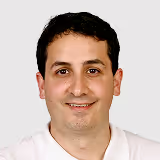
Marcel Kloos
Swiss-licensed dentist and founder of Medschool Experts
Marcel Kloos founded Medschool Experts while studying abroad; since then, over 500 study places have been secured. The Stuttgart-born dentist studied dentistry from 2015 to 2021 in Sofia and holds a Swiss dental licence.
Today he lives in Bern and runs Medschool Experts full-time as its owner.
More articles worth reading
Why Students Transfer from Medical University of Varna — Your Options
Why Students Transfer from Medical University of Warsaw — Your Options
Why Students Transfer from Masaryk University Faculty of Medicine — Your Options
Ahmad
Sabrina
Rami
Noah
500+ students placed.
Now it's your turn!
No daydreaming, no empty promises. Just a clear plan — for the start of your medical degree.
40 minutes, no obligation