St. George's University School of Medicine: What Applicants Need to Know in 2026
05.09.2026

What is St. George's University School of Medicine, and how large is it?
It is a private medical school in Grenada, chartered in 1976, that awards a Doctor of Medicine degree and sends most of its graduates into residency training in the United States. The School of Medicine sits on a campus of 42 to 44 acres at True Blue, on the island's southwestern peninsula, alongside a veterinary school and a school of arts and sciences.
Size is what separates St. George's University from the rest of the Caribbean. The university states in 2026 that its student body is drawn from more than 140 countries and that its alumni network passed 25,000 MD graduates, counting from the first class in 1981. Roughly two thirds of medical students hold United States citizenship, Canadians are the next largest group, and the rest come from Europe, Africa, South Asia and the Caribbean itself. Federation of State Medical Boards data cited by the university for 2023 makes it the single largest source of physicians holding active United States licences, ahead of every domestic medical school.
Scale has a consequence. A school placing four figures of graduates into American residency posts each year must keep a hospital network big enough to absorb them.
How is the MD structured, and what do the four-, five-, six- and seven-year tracks mean?
One degree, four entry points. The four-year MD is the graduate-entry route on the American model: two years of basic sciences, then two years of clinical rotations. The five-, six- and seven-year tracks add one, two or three preliminary years in front of it for students entering from secondary school or a different academic background.
The five-year track, as the university describes it in 2026, inserts a preclinical year of about 40 credit hours covering genetics, molecular biology, microbiology, physiology, anatomy and biochemistry. Students who complete it move straight into the basic-science phase. The six- and seven-year tracks stretch the same logic further back, which suits applicants whose secondary schooling carried a lighter science load.
Intakes run three times a year in Grenada, in August, January and April, with September and January starts on the United Kingdom side. Three start dates a year changes how you plan. A candidate who misses August is not waiting twelve months.
Where do students study — Grenada, Newcastle, or both?
Both. Students taking the United Kingdom entry split their preclinical years, because St. George's University has run a joint arrangement with Northumbria University in Newcastle upon Tyne since January 2007, and Northumbria reports that more than 2,500 medical students have passed through it. Under the four-year MD with Northumbria, year one of basic sciences happens in Newcastle, year two moves to Grenada, and years three and four are clinical rotations in the United States, the United Kingdom or Canada.
Two pieces of paper come out of that route: the MD from St. George's University and a Bachelor of Medical Sciences from Northumbria. Newcastle sits three hours from London by train, so year one is spent in an ordinary British student city rather than on an island.
The Grenada campus handles the rest. Basic sciences run across five terms there, with the anatomy teaching, the simulation facilities and the library all on the True Blue site. To compare that against single-campus European medical faculties, the university overviews set them side by side.
Where do the clinical years take place?
Abroad, not in Grenada. St. George's University states in 2026 that clinical and ambulatory training runs through more than 85 affiliated hospitals and health systems in the United States, the United Kingdom and Canada.
On the British side the university names around 15 National Health Service hospitals and health centres, among them Norfolk and Norwich University Hospital, North Middlesex University Hospital in London, Watford General Hospital and Stoke Mandeville Hospital in Aylesbury. Students may take part or all of their rotations in the United Kingdom.
The American sites span teaching hospitals in New York, New Jersey, Georgia, Florida and further afield. Here the degree stops being a Caribbean degree in any practical sense. Two of the four years are spent on wards in the country where the graduate intends to be licensed, which is why American programme directors have taken St. George's University applicants in volume.
Who accredits the school, and does that recognition travel?
Recognition is layered. The Grenada Medical and Dental Council accredits the School of Medicine through 2030, and the chain that matters is what accredits the accreditor. In a press release dated 3 September 2022, the World Federation for Medical Education awarded that council recognition status for ten years with immediate effect, carrying it to 2032. The United States National Committee on Foreign Medical Education and Accreditation separately recognises the Grenadian council as applying standards comparable to American ones.
Institutionally, the Grenada National Accreditation Board holds the university accredited through 2030. Several American states add approvals on top, set out in the table below, and medical councils in the Bahamas, Bermuda, Sri Lanka, Thailand and Trinidad and Tobago also list the school.
| Body | What it covers | Status and year |
|---|---|---|
| Grenada Medical and Dental Council | Programme accreditation | Accredited through 2030 |
| World Federation for Medical Education | Recognition of the accreditor | Granted 3 September 2022, ten years, to 2032 |
| NCFMEA (United States) | Comparability of standards | Grenadian council recognised, as published 2026 |
| Grenada National Accreditation Board | Institutional accreditation | Accredited through 2030 |
| New York State Education Department | Clinical clerkships in New York | Approved through 2029 |
| Medical Board of California | Recognised school list | Listed, as published 2026 |
What changed for ECFMG certification when the 2024 rules took effect?
Intealth, which now houses the Educational Commission for Foreign Medical Graduates, began implementing its Recognized Accreditation policy in November 2024. It asks two things of a medical school: accreditation by an agency recognised by the World Federation for Medical Education or the American NCFMEA, and an ECFMG sponsor note in the World Directory of Medical Schools. St. George's University meets both.
One detail is widely misreported. Intealth states that the policy does not restrict eligibility for ECFMG certification, and that international graduates may still apply where their school does not meet the standard. The sponsor note confirms that a school's students and graduates may be certified; the Recognized Accreditation notation records compliance with the wider policy.
For a St. George's University student the sequence is unchanged: pass USMLE Step 1 and Step 2 Clinical Knowledge, complete credential verification, obtain ECFMG certification, then apply through ERAS and rank programmes in the National Resident Matching Program. Certification is what allows a graduate to take up an accredited residency post, and NRMP applicants must satisfy ECFMG's exam requirements within the timetable NRMP publishes for that Match year. Check those dates with NRMP directly.
How many St. George's University students matched into US residency, and in which year?
On Match Day in March 2025, St. George's University announced that more than 1,015 of its students and graduates had secured first-year United States residency positions, across 20 specialties and 41 states plus the District of Columbia. It later revised that to 1,049 for 2025 once post-Match placements were counted.
For 2026 the university reports over 800 United States residencies across 23 specialties, again on its own published figures. It also publishes a placement rate of 94 to 95 percent for its United States graduates across 2021 to 2025. Exam results sit alongside. First-time USMLE Step 1 pass rates run at 82 percent for United States students over 2020 to 2024, and first-time Step 2 Clinical Knowledge rates at 89 to 90 percent for United States and Canadian students and 93 percent for international students over 2021 to 2025.
Two caveats belong with those numbers, and both come from the university's own reporting. Placement rates describe students who reach the Match, not everyone who enrolled. St. George's University separately gives a graduation rate of 82 percent for students who began in the 2018 to 2019 academic year, which is the denominator for anyone modelling their own odds. First-hand accounts of that stretch sit in the student stories.
What does the General Medical Council say about a medical degree from Grenada?
Less than most people expect. The General Medical Council assesses overseas primary medical qualifications case by case. It publishes no universal list of approved foreign schools, notes that one person's qualification being accepted does not guarantee acceptance for another holder of the same degree, and confirms acceptability only once a course has been completed.
The council is blunt about third-party claims. It states that it does not endorse or accredit overseas medical education, and warns against organisations advertising a programme as "GMC recognised". That is a useful filter for any promotional material about a route into British practice.
The route itself is ordinary. A graduate with an acceptable primary medical qualification evidences English language competence, passes the Professional and Linguistic Assessments Board examinations or an approved alternative, and applies for registration with a licence to practise. St. George's University's British rotations put students inside National Health Service hospitals during the degree, an advantage for anyone intending to work there, though they confer no registration by themselves.
How much does the full MD cost at 2026/27 rates?
St. George's University publishes tuition and administrative fees term by term. For 2026/27 on the four-year MD, the five basic-science terms total 180,262 US dollars and the five clinical terms 209,725 dollars, at 41,945 per clinical term. All years together come to 389,987 US dollars.
In 2025/26 the same all-years total stood at 376,986 dollars, a rise of about 3.4 percent in twelve months. That is the useful planning fact here: a published total is one year's rate card, not a locked-in price for a cohort entering later.
| Stage of the four-year MD | 2025/26 (USD) | 2026/27 (USD) |
|---|---|---|
| Term 1, basic sciences | 38,755 | 40,306 |
| Term 2, basic sciences | 38,755 | 40,306 |
| Terms 3 and 4 combined | 56,705 | 58,974 |
| Term 5, basic sciences | 39,111 | 40,676 |
| Basic sciences, total | 173,326 | 180,262 |
| Clinical education, per term | 40,332 | 41,945 |
| Clinical education, total | 203,660 | 209,725 |
| Tuition and administrative fees, all years | 376,986 | 389,987 |
Tuition is one line. Where a student is placed decides the rest.
{{cta}}What does a realistic four-year budget add up to?
Living costs split in two: two years on a Caribbean island, then two years in whichever city hosts the rotations. Independent cost-of-living data compiled by livingcost.org and updated in June 2026 puts a single person in St. George's, Grenada at about 1,083 US dollars a month including rent, or 572 without it. The equivalent data for New York, updated by livingcost.net in August 2026, puts a single person at 1,359 dollars a month before rent, with a one-bedroom flat at 4,603 dollars centrally and 3,010 outside the centre.
| Monthly item | St. George's, Grenada (2026) | New York City (2026) |
|---|---|---|
| One-bedroom flat, central | 578 USD | 4,603 USD |
| One-bedroom flat, outside centre | 303 USD | 3,010 USD |
| Utilities, one person | 110 USD | 214 USD |
| Food | 457 USD | included in the 1,359 USD base |
| Local transport | 46 USD | 175 USD monthly pass |
| Single person, all in | 1,083 USD | 4,369 USD outside centre |
Put the halves together and the shape appears. The worked model below, the August 2026 Start, assumes a four-year MD beginning in Grenada that August, twenty months of island residence, and twenty-four months of American clinical rotations at 3,000 dollars a month.
The four lines add to 498,647 US dollars, call it 499,000. Swapping the American clinical years for British ones changes the middle figure, not the structure, since Newcastle, Norwich and Watford all sit well under New York rents. Tuition does not move.
When should you start preparing, and what happens in which month?
Three intakes a year replace one national deadline, so the calendar below runs from a decision point. Anchor on August 2026.
- Six to nine months before the intake: settle which track fits and whether you want the Grenada or the Newcastle start.
- Four to six months before: assemble transcripts, translated and certified where needed. Budget for the degree, not the first term.
- Two to three months before: arrange financing, medical insurance and the Grenadian student permit, and book flights early for an August start.
- Terms one to five, roughly 20 months: basic sciences on the True Blue campus, with the Step 1 preparation window at the end.
- Months 21 to 24: sit USMLE Step 1, then start the first core clinical rotation.
- Years three and four: core and elective rotations, Step 2 Clinical Knowledge, ECFMG credential verification, then ERAS applications the autumn before the Match.
What does a prospectus not tell you about studying medicine in Grenada?
Four things, none secret, all easy to miss in a quick read of a brochure.
The first is attrition. The university's own 82 percent graduation rate for students entering in 2018/19 is published openly, and it is the number to plan against, since headline placement rates are calculated on students who reach the Match. The second is that the rate card moves: tuition rose from 376,986 to 389,987 US dollars between 2025/26 and 2026/27, so a 2028 entrant should model an increase.
The third is geography in the clinical years. Rotations may run through hospitals in several states, meaning two or three short leases and relocation costs no tuition table shows. The fourth is the difference between the ECFMG sponsor note and the Recognized Accreditation notation, which look alike on the page and do different jobs.
None of this argues against the route. It argues for planning with the real numbers in front of you, which is what the placement services are for.
How do you find out whether your profile fits St. George's University?
By having it assessed. Not by reading a checklist. Entry requirements at St. George's University vary by track, by the country your qualifications come from and by your individual academic record, and the university reviews your file rather than applying one published cut-off.
So Medschool Experts does not publish per-university requirement tables. The other way round works better: send your documents, have them read by someone who places students at these institutions regularly, and get told which track and intake fit.
Book a free individual consultation and Medschool Experts will assess your case directly, including which of the four MD entry points suits your background and what your timeline to a first term looks like.
The author's view
I studied dentistry in Sofia between 2015 and 2021 and now practise as a licensed dentist in Bern. That gives me sympathy for anyone weighing a degree abroad, because so much of the decision came down to documents I could not read properly and rules nobody explained plainly. The thing I got right, more by luck than judgement, was checking the licensing route before the campus photos.
With St. George's University I would push an applicant to do the same in a specific order. Read the Grenada Medical and Dental Council's accreditation dates first, then the World Federation for Medical Education recognition from September 2022, then the tuition rate card, and only then the residency figures. The numbers the university publishes are real and they carry years, which is more than many institutions manage. What they do not carry is your file.
From placement experience at Medschool Experts, where I have placed over 500 study places, the pattern I see most often is a strong candidate who has budgeted for the first term instead of the degree, and who has not thought about which country they want to be licensed in. Decide that early. It changes which track makes sense, whether the Newcastle start is worth taking, and whether the clinical years should sit in the United States or the United Kingdom. If you want that worked through against your own documents, a free individual consultation is the fastest way to get an answer.
Summary
- St. George's University School of Medicine was chartered in Grenada on 23 July 1976 and reports more than 25,000 MD graduates as of 2026.
- The MD comes in four-, five-, six- and seven-year tracks, with intakes in August, January and April in Grenada and September and January on the United Kingdom side.
- A joint arrangement with Northumbria University in Newcastle, running since January 2007, allows year one in England plus a Bachelor of Medical Sciences.
- Clinical years run through more than 85 affiliated hospitals in the United States, United Kingdom and Canada, around 15 of them National Health Service sites.
- The Grenada Medical and Dental Council accredits the school through 2030, and the World Federation for Medical Education recognised that council on 3 September 2022 for ten years, to 2032.
- Intealth's Recognized Accreditation policy took effect in November 2024; the school holds both a recognised accreditor and an ECFMG sponsor note in the World Directory of Medical Schools.
- The university reported more than 1,015 United States residency placements on Match Day 2025, later revised to 1,049, and over 800 for 2026 across 23 specialties.
- Tuition and fees for the four-year MD total 389,987 US dollars at 2026/27 rates, up from 376,986 in 2025/26; a worked four-year budget lands near 499,000.
Conclusion
Grenada is an unusual place to begin a medical career and a well-documented one. The regulatory chain is public, the tuition is published term by term, and the residency figures carry years. That is enough to plan on.
Which track fits, which intake to aim for and what your file needs are questions about your profile, not about the university's brochure. Bring them to a free consultation and Medschool Experts will work through them with you.
Frequently Asked Questions about St. George's University School of Medicine
Is the St. George's University MD recognised in the United States?
The degree is accredited by the Grenada Medical and Dental Council, which the World Federation for Medical Education recognised on 3 September 2022 for ten years and which the United States NCFMEA treats as applying comparable standards. The school also carries an ECFMG sponsor note in the World Directory of Medical Schools. Together these meet the Recognized Accreditation policy Intealth began implementing in November 2024.
How long does the MD take?
Four years on the standard track: five basic-science terms, then two years of clinical rotations. St. George's University also offers five-, six- and seven-year tracks that add one, two or three preliminary years of preclinical coursework in front of the same degree. The longer tracks suit students entering from secondary school or from a lighter science background, and they end in the identical MD.
Where do students spend their clinical years?
In affiliated hospitals outside Grenada. St. George's University reports more than 85 affiliated hospitals and health systems across the United States, the United Kingdom and Canada as of 2026. On the British side it names around 15 National Health Service hospitals, among them Norfolk and Norwich University Hospital and North Middlesex University Hospital in London. Students may complete part or all of their rotations in Britain.
What did the 2025 and 2026 residency figures look like?
St. George's University announced on Match Day in March 2025 that more than 1,015 of its students and graduates had secured first-year United States residency positions, in 20 specialties across 41 states and the District of Columbia, later revising that to 1,049. For 2026 it reports over 800 United States residencies across 23 specialties. All are the university's own published numbers.
Can a graduate work as a doctor in the United Kingdom?
The route exists and runs through the General Medical Council. The council assesses each overseas primary medical qualification case by case, publishes no universal list of approved schools, and confirms acceptability only after a course is completed. A graduate then evidences English language competence, passes the Professional and Linguistic Assessments Board examinations or an approved alternative, and applies for registration with a licence to practise.
What does the whole degree cost?
Tuition and administrative fees for the four-year MD come to 389,987 US dollars at the 2026/27 rates St. George's University publishes, split into 180,262 for basic sciences and 209,725 for clinical education. The 2025/26 equivalent was 376,986, so rates move year to year. Adding Grenadian living costs, clinical-year accommodation and an allowance for exams and travel brings a worked four-year model to roughly 499,000 US dollars.
How much does living in Grenada cost?
Independent cost-of-living data compiled by livingcost.org and updated in June 2026 puts a single person in St. George's, Grenada at about 1,083 US dollars a month including rent, or 572 without rent. A one-bedroom flat runs about 578 dollars centrally and 303 outside the centre, with utilities near 110. Clinical-year cities in the United States cost considerably more.
What are the entry requirements?
They depend on the track, on the country your qualifications come from and on your individual academic record, and St. George's University assesses files rather than applying one published cut-off. No useful answer fits in a paragraph. Send your documents and book a free individual consultation, and Medschool Experts will tell you which MD entry point and intake match your background.
What students say about Medschool Experts
Over 500 placements at more than 25 partner universities across 10+ countries. Read independent student reviews on Trustpilot.
About the author
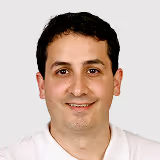
Marcel Kloos
Swiss-licensed dentist and founder of Medschool Experts
Marcel Kloos founded Medschool Experts while studying abroad; since then, over 500 study places have been secured. The Stuttgart-born dentist studied dentistry from 2015 to 2021 in Sofia and holds a Swiss dental licence.
Today he lives in Bern and runs Medschool Experts full-time as its owner.
More articles worth reading
Why Students Transfer from Medical University of Varna — Your Options
Why Students Transfer from Medical University of Warsaw — Your Options
Why Students Transfer from Masaryk University Faculty of Medicine — Your Options

Ahmad

Sabrina

Rami

Noah
500+ students placed.
Now it's your turn!
No daydreaming, no empty promises. Just a clear plan — for the start of your medical degree.
40 minutes, no obligation