Studying Dentistry in Bulgaria in English in 2026: Six Years to an EU Dental Degree
02.09.2026

Which universities in Bulgaria teach dentistry in English in 2026?
Three Bulgarian universities teach the full dental medicine programme in English in 2026: Medical University – Sofia, Medical University of Plovdiv and Medical University of Varna. Each runs its own Faculty of Dental Medicine and each awards a Master of Dental Medicine. Medical University – Pleven teaches medicine in English but operates no dental faculty.
That last detail saves a lot of wasted effort. Medical University – Pleven lists its faculties as Medicine, Pharmacy, Public Health, Health Care and Veterinary Medicine, plus a Medical College and a Department of Language and Specialized Training. Dentistry is not among them. Anyone comparing Bulgarian dental options in 2026 is comparing Sofia, Plovdiv and Varna.
The three faculties are not the same size. The Faculty of Dental Medicine at Medical University – Sofia reported 1,657 students, 120 teaching staff and 13,322 graduates to date in 2026. The Faculty of Dental Medicine at Medical University of Plovdiv is organised into eight departments, covering dental implantology, oral surgery, orthodontics, paediatric dentistry, prosthetic dentistry, periodontology, operative dentistry and imaging diagnostics. Medical University of Varna structures its dental degree differently again, which the next section covers. A broader comparison of institutions sits on the universities page.
What degree is a Bulgarian dental qualification, and how long does it take?
Dentistry in Bulgaria is a single long cycle ending in a Master of Dental Medicine in 2026. There is no separate bachelor’s stage. Medical University – Sofia runs the programme over six years and twelve semesters under the curriculum confirmed for 2025, carrying 428 ECTS credits and 6,330 hours of instruction and study.
Medical University of Varna arranges the same qualification as five years and ten semesters followed by a pre-graduation clinical year, which is why the university describes the dental degree as a six-year Master’s programme on its 2026/2027 fee schedule. Varna also builds in two blocks of practical training of 30 calendar days and 150 hours each, one after the sixth semester and one after the eighth.
The five-to-six-year span is not arbitrary. Under Directive 2005/36/EC, a basic dental qualification must rest on at least five years of full-time theoretical and practical study and a minimum of 5,000 hours. Bulgarian faculties build to that standard because the diploma is written for the European market from the start.
What happens in the pre-graduation clinical year of a Bulgarian dental degree?
The pre-graduation year is where a Bulgarian dental student becomes a dentist. At Medical University – Sofia it fills the sixth year across semesters XI and XII, runs for 135 days and carries 45 credits. The 2025/2026 internship ran from 15 September 2025 to 13 March 2026, totalling 1,014 hours, of which 1,000 were practical clinical work.
Those hours are split by discipline. Sofia allocates 240 hours each to prosthetic dental medicine, oral and maxillofacial surgery and conservative dental medicine, then 120 hours each to paediatric dental medicine, orthodontics and periodontology. Students work in pairs on a single dental unit, with weekly seminars alongside. Rotations run through seven clinical departments, adding imaging and oral diagnostics to the six treatment disciplines.
Then come the examinations. Graduation at Sofia requires six separate state examinations, one for each major clinical discipline: prosthetic dental medicine, dental surgery, conservative dentistry, paediatric dental medicine, orthodontics and periodontology. Three sessions are offered each cycle — the 2026 regular session ran from 23 March to 30 April 2026, with a resit session in June 2026 and an additional session at the end of June and start of July 2026. Candidates have up to three attempts within a maximum of one year.
Medical University of Varna sets its pre-graduation clinical year after the tenth semester at 135 working days, or 1,080 hours in total. The arithmetic is close to identical. Both faculties end the degree with a supervised year of real clinical volume rather than a written thesis.
How much does dental tuition in Bulgaria cost in 2026?
Annual tuition for dentistry taught in English in Bulgaria ranged from 7,000 EUR to 10,000 EUR in the 2025/2026 and 2026/2027 fee schedules published by the three universities. All three faculties charge a stepped fee that changes with year of study rather than one flat annual figure, and all three allow payment in two semester instalments.
| University | Years of study | Annual tuition (EUR) | Academic year of figure |
|---|---|---|---|
| Medical University – Sofia | Year 1 | 10,000 | 2025/2026 |
| Medical University – Sofia | Years 2–3 | 9,000 | 2025/2026 |
| Medical University – Sofia | Years 4–6 | 8,000 | 2025/2026 |
| Medical University of Plovdiv | Years 1–2 | 7,000 | 2025/2026 |
| Medical University of Plovdiv | Years 3–6 | 8,200 | 2025/2026 |
| Medical University of Varna | Years 1–2 | 10,000 | 2026/2027 |
| Medical University of Varna | Years 3–4 | 9,000 | 2026/2027 |
| Medical University of Varna | Years 5–6 | 8,000 | 2026/2027 |
Plovdiv is the outlier, and in an unusual direction: it opens cheaper than the other two at 7,000 EUR and then rises to 8,200 EUR from the third year, while Sofia and Varna both start at 10,000 EUR and fall. Over a full six years the gap narrows considerably, which the worked example further down settles in figures.
Sofia publishes its fees in euro with a Bulgarian lev equivalent alongside — 10,000 EUR shown as 19,558.30 BGN for 2025/2026 — and splits the year into two equal semester payments of 5,000 EUR. Medical University of Plovdiv states plainly that the tuition fee excludes accommodation, health insurance, textbooks and educational handbooks.
Do you need to learn Bulgarian if dentistry is taught in English?
Yes, and the Bulgarian language is a graded part of the dental curriculum rather than an optional extra. Lectures, seminars and examinations in the English-language dental programmes in Bulgaria run in English throughout. Patients in Sofia, Plovdiv and Varna speak Bulgarian, so the faculties teach the language in parallel from the early years.
Medical University – Sofia sets the volume precisely. Its dental curriculum confirmed for 2025 lists Bulgarian for foreign students at 240 hours and 16 credits, taught across semesters II and IV. Medical University of Plovdiv runs a dedicated Bulgarian Language Section inside its Department of Languages and Specialized Training, with a separate syllabus written for dental medicine students on the English-taught course, distinct from the ones for medicine and pharmacy.
The sequencing is deliberate. Language teaching lands in years one and two, well before the clinical years when students start treating patients directly and long before the pre-graduation year. Latin medical terminology sits alongside it. A student who arrives with no Bulgarian at all has four years of runway before the language becomes a daily clinical tool, which is a comfortable margin.
What does it cost to live in Sofia, Plovdiv and Varna in 2026?
Living costs across the three Bulgarian dental cities differed by roughly 250 EUR a month in August 2026. Numbeo recorded a single person’s estimated monthly costs excluding rent at 878.00 EUR in Sofia, 829.10 EUR in Varna and 628.60 EUR in Plovdiv. Rent widens the gap further, with Sofia the most expensive of the three on every measure.
| Monthly cost (EUR) | Sofia | Plovdiv | Varna |
|---|---|---|---|
| One-bedroom flat, city centre | 688.23 | 476.48 | 549.49 |
| One-bedroom flat, outside centre | 524.61 | 342.60 | 419.27 |
| Basic utilities | 145.64 | 100.54 | 155.11 |
| Monthly transport pass | 25.50 | 25.56 | 25.58 |
| Meal, inexpensive restaurant | 15.00 | 8.18 | 12.11 |
| Single person, excluding rent | 878.00 | 628.60 | 829.10 |
Numbeo, August 2026. Sofia last updated 27 August 2026; Plovdiv and Varna last updated 18 August 2026.
A transport pass costs about the same in all three cities, at roughly 25.50 EUR. Everything else moves. A restaurant meal in Plovdiv at 8.18 EUR is close to half the Sofia price of 15.00 EUR, and a flat outside the centre in Plovdiv runs 182 EUR a month below the Sofia equivalent. Varna sits between the two on rent but carries the highest utilities bill of the three at 155.11 EUR.
What does six years of dentistry in Bulgaria add up to?
A full six-year dental degree in Bulgaria, tuition and living costs combined, came to roughly 117,000 EUR in Plovdiv, 144,000 EUR in Varna and 153,000 EUR in Sofia on 2026 figures. The case below adds up one scenario per city: a student living alone in a one-bedroom flat outside the centre, budgeting for twelve months a year.
| Six-year case (EUR) | Plovdiv | Varna | Sofia |
|---|---|---|---|
| Tuition, six years total | 46,800 | 54,000 | 52,000 |
| Rent, per month | 342.60 | 419.27 | 524.61 |
| Other living costs, per month | 628.60 | 829.10 | 878.00 |
| Living costs, six years total | 69,926 | 89,883 | 100,988 |
| Six-year total | 116,726 | 143,883 | 152,988 |
Tuition from university schedules 2025/2026 and 2026/2027; living costs from Numbeo, August 2026.
Take Plovdiv as the worked case. Tuition is 7,000 EUR for each of years one and two and 8,200 EUR for each of years three to six, which is 14,000 EUR plus 32,800 EUR, or 46,800 EUR across the degree. Rent outside the centre at 342.60 EUR plus other monthly costs of 628.60 EUR gives 971.20 EUR a month, 11,654 EUR a year, and 69,926 EUR over six years. The two lines together come to 116,726 EUR.
Treat that as an upper bound rather than a forecast. It assumes twelve months of rent every year, and many students go home over the summer. It also excludes several real costs that could not be pinned to a published 2026 figure: health insurance, textbooks and clinical instruments, flights home, and the Bulgarian residence permit for students, which carries a genuine state fee. Plovdiv’s own fee page confirms that accommodation, health insurance and textbooks all sit outside the tuition figure.
Set against the total, the ranking flips depending on what you weigh. Varna charges the most tuition of the three at 54,000 EUR but Sofia costs most overall, because Sofia rents and daily costs outrun Varna’s by enough to overturn a 2,000 EUR tuition advantage.
{{cta}}Is a Bulgarian dental degree recognised across the European Union?
Yes. Dentists are one of seven professions granted automatic recognition under EU Directive 2005/36/EC, alongside doctors, pharmacists, general care nurses, midwives, veterinary surgeons and architects. A Bulgarian Master of Dental Medicine is an EU member state qualification, and automatic recognition means a host country registers the holder rather than re-examining the curriculum.
The mechanism is Annex V. The directive sets the minimum standard for a basic dental qualification in Article 34 and Annex V point 5.3.1: at least five years of full-time theoretical and practical study, and a minimum of 5,000 hours. Annex V point 5.3.2 then lists the specific qualifications each member state awards. Where a diploma appears on that list, recognition follows automatically.
This is a different instrument from the one that governs medical schools. The World Directory of Medical Schools, published jointly by the World Federation for Medical Education and FAIMER, a division of Intealth, lists medical schools only — it is the reference point for doctors, not dentists. For a dental qualification inside Europe, Annex V of Directive 2005/36/EC is the register that decides the question.
There is also a fallback for qualifications not on the Annex V list. Under the acquired rights regime, a holder whose training meets the basic criteria can still gain recognition on the strength of three years of professional experience within the preceding five. Separately, a host country is entitled to require knowledge of its own language before a dentist treats patients there — the directive covers language rules explicitly, and that requirement is about the country of practice, not about the country of study.
How does a Bulgarian dental degree work in Switzerland, Norway and the EEA?
A Bulgarian dental qualification reaches beyond the European Union in 2026. Switzerland applies Directive 2005/36/EC through Annex III of its Agreement on the Free Movement of Persons with the European Union, which the Swiss State Secretariat for Education, Research and Innovation names as the legal basis for mutual recognition of professional qualifications between EU member states and Switzerland.
Dentistry is squarely inside the Swiss system. Under the Medical Professions Act, Switzerland recognises five university medical professions: doctors, dentists, pharmacists, veterinarians and chiropractors. MEBEKO, the Medical Professions Commission, assesses foreign diplomas, and entry in the MedReg register of medical professions has been mandatory since 1 January 2018, recording education, specialisations, language skills and professional licences.
For the European Economic Area the route runs through a different treaty with the same effect. Iceland, Liechtenstein and Norway apply equivalent recognition principles under Annex K of the Convention establishing the European Free Trade Association, last revised on 21 June 2001. A dentist qualified in Sofia, Plovdiv or Varna is therefore looking at a professional market that covers the European Union, the EEA states and Switzerland.
What does the six-year path through a Bulgarian dental faculty look like, step by step?
The academic shape of dentistry in Bulgaria is fixed and public, and it runs on the same rhythm at all three faculties in 2026. The steps below follow the Medical University – Sofia curriculum confirmed for 2025 and the Medical University of Varna programme structure, from the first preclinical semester to registration as a dentist.
- Year 1, semesters I–II. Preclinical sciences. Bulgarian for foreign students begins in semester II at Sofia, part of a 240-hour, 16-credit block.
- Year 2, semesters III–IV. Preclinical dental technique and phantom work. The Bulgarian language block completes in semester IV.
- Year 3, semesters V–VI. Clinical disciplines open. At Varna a training practice of 30 calendar days and 150 hours follows the sixth semester.
- Year 4, semesters VII–VIII. Clinical rotations broaden. Varna’s second 30-day, 150-hour training practice follows the eighth semester.
- Year 5, semesters IX–X. Full clinical load across the treatment disciplines. Varna’s taught programme closes at the end of semester X.
- Year 6, semesters XI–XII. The pre-graduation internship, 135 days and 45 credits. At Sofia the 2025/2026 cycle ran from 15 September 2025 to 13 March 2026, 1,014 hours in total.
- After the internship. Six state examinations. Sofia’s regular session ran 23 March to 30 April 2026, with resit and additional sessions across June and early July 2026, and up to three attempts within one year.
- On graduation. The Master of Dental Medicine is awarded, and registration in the country of practice proceeds under Directive 2005/36/EC.
Six calendar years, then a licence. The pace is set by the faculty, not by the student, and the internship dates are published in advance each cycle. Accounts from graduates of European medical and dental faculties are collected on the student stories page.
Can dental hygienists and other healthcare graduates enter with credit for previous study?
Yes. Previous study in a healthcare field can count towards a dental degree in Bulgaria, and recognition is assessed case by case from the individual transcript rather than by a fixed rule. Dental hygienists, dental technicians, biomedical scientists, nurses and paramedics all ask this question, and the answer depends entirely on what the transcript contains.
Medschool Experts is the world’s leading specialist in credit-recognition placements for healthcare graduates, and regularly achieves entry into year 4 or year 5 at top universities worldwide. What transfers is decided from the syllabus, the contact hours and the assessed content of each completed subject, matched against the receiving faculty’s curriculum. Two applicants with the same job title routinely receive different outcomes, because their transcripts are different documents.
The only way to establish what a specific transcript is worth is to have it read. That happens in a free consultation.
Who can get a place to study dentistry in Bulgaria, and how is that assessed?
Eligibility for dentistry in Bulgaria varies by university and by individual profile, and it shifts between admission cycles, so no general figure would hold for any particular applicant in 2026. School record, prior study, citizenship and the target faculty all change the answer, which is why Medschool Experts assesses each case directly rather than publishing a threshold.
That assessment is a conversation about one person’s documents, not a checklist. It covers which of the three dental faculties fits the profile, what the realistic timeline looks like for the next intake, and what the total cost comes to for the chosen city on current figures. It ends with a straight answer about where a place is achievable.
Book it here: free individual consultation.
The author's view
I studied dental medicine in Sofia between 2015 and 2021, and the point I would make first is that this is an ordinary European dental degree. Six years. The same disciplines, the same pre-graduation year in the chair, the same six state examinations every Bulgarian graduate sits. When I later registered in Switzerland, none of it needed explaining or defending.
The Bulgarian language hours are the part I would not underestimate. Lectures and examinations ran in English, but the patients in the clinic were Bulgarian, and the language block in the curriculum is there for that reason and no other. Treat those hours as a real clinical subject rather than an administrative box. It is the advice I give most often, and it costs nothing to follow in year one.
I practise in Bern today as a Swiss-licensed dentist, and my licence sits at the end of exactly that route: an EU qualification recognised under Directive 2005/36/EC, which Switzerland applies through its Agreement on the Free Movement of Persons. At Medschool Experts we have placed over 500 study places, and Bulgaria is one of the few countries on our list that I know from the inside rather than from a prospectus.
Summary
- Three Bulgarian universities teach dentistry fully in English in 2026: Medical University – Sofia, Medical University of Plovdiv and Medical University of Varna. Medical University – Pleven has no dental faculty.
- The qualification is a Master of Dental Medicine, a single long cycle of six years and twelve semesters at Sofia, carrying 428 ECTS credits and 6,330 hours under the curriculum confirmed for 2025.
- The degree ends with a pre-graduation clinical year of 135 days — 1,014 hours at Sofia in the 2025/2026 cycle — followed by six state examinations.
- Annual tuition in 2026 ranges from 7,000 EUR at Plovdiv to 10,000 EUR in the opening years at Sofia and Varna, with all three faculties charging stepped fees by year of study.
- Numbeo put single-person monthly costs excluding rent at 878.00 EUR in Sofia, 829.10 EUR in Varna and 628.60 EUR in Plovdiv in August 2026.
- A full six years, tuition and living costs together, comes to roughly 116,726 EUR in Plovdiv, 143,883 EUR in Varna and 152,988 EUR in Sofia on 2026 figures.
- Bulgarian is taught alongside the English-language programme — 240 hours and 16 credits at Sofia, across semesters II and IV — so that students can treat patients in the clinical years.
- Dentists hold automatic recognition under EU Directive 2005/36/EC, which reaches the European Union, the EEA states through EFTA Convention Annex K, and Switzerland through Annex III of the Agreement on the Free Movement of Persons.
Conclusion
Dentistry in Bulgaria is a European dental degree taught in English, priced well below western European private tuition, and written from the outset to meet the five-year, 5,000-hour standard the EU directive sets. The diploma that comes out of Sofia, Plovdiv or Varna is the same instrument a graduate of any other EU faculty carries.
What cannot be settled in general terms is whether a particular applicant gets a place, and where. That depends on documents, not averages, and Medschool Experts reads them individually and says plainly what is achievable in a free consultation.
Frequently Asked Questions about Studying Dentistry in Bulgaria
Is dentistry in Bulgaria taught entirely in English?
The dental medicine programmes at Medical University – Sofia, Medical University of Plovdiv and Medical University of Varna are taught, examined and assessed in English throughout in 2026. Bulgarian runs alongside as a taught subject rather than as the language of instruction — Sofia sets 240 hours and 16 credits of it across semesters II and IV — so that students can communicate with patients during the clinical years and the pre-graduation internship.
How long does a dental degree in Bulgaria take?
Six years. Medical University – Sofia runs the Master of Dental Medicine over six years and twelve semesters, 428 ECTS credits and 6,330 hours under its curriculum confirmed for 2025. Medical University of Varna structures the same qualification as ten taught semesters plus a pre-graduation clinical year of 135 working days, or 1,080 hours, describing the result as a six-year Master’s programme in its 2026/2027 materials.
How much does dental tuition in Bulgaria cost in 2026?
Between 7,000 EUR and 10,000 EUR a year, depending on the university and the year of study. Medical University of Plovdiv charged 7,000 EUR for years one and two and 8,200 EUR thereafter in 2025/2026. Medical University – Sofia charged 10,000 EUR in year one, 9,000 EUR in years two and three and 8,000 EUR in years four to six for 2025/2026. Medical University of Varna published 10,000, 9,000 and 8,000 EUR by year-pair for 2026/2027.
Is a Bulgarian dental degree recognised in Germany, Austria or Switzerland?
A Bulgarian Master of Dental Medicine is an EU member state qualification, and dentists are one of seven professions with automatic recognition under Directive 2005/36/EC. That covers Germany and Austria directly as EU members. Switzerland applies the same directive through Annex III of its Agreement on the Free Movement of Persons with the European Union, and treats dentistry as one of five university medical professions under its Medical Professions Act.
Which is cheapest to live in: Sofia, Plovdiv or Varna?
Plovdiv, by a clear margin. Numbeo recorded single-person monthly costs excluding rent at 628.60 EUR in Plovdiv in August 2026, against 829.10 EUR in Varna and 878.00 EUR in Sofia. Rent follows the same order: a one-bedroom flat outside the centre cost 342.60 EUR in Plovdiv, 419.27 EUR in Varna and 524.61 EUR in Sofia. Monthly transport passes cost about 25.50 EUR in all three cities.
Does Medical University – Pleven offer dentistry in English?
No. Medical University – Pleven teaches medicine in English but runs no Faculty of Dental Medicine. Its faculties are Medicine, Pharmacy, Public Health, Health Care and Veterinary Medicine, together with a Medical College and a Department of Language and Specialized Training. Anyone comparing English-taught dental programmes in Bulgaria in 2026 is choosing between Sofia, Plovdiv and Varna only.
What happens in the pre-graduation clinical year?
It is the final year of the degree, spent treating patients under supervision. At Medical University – Sofia the internship covered 135 days across semesters XI and XII in the 2025/2026 cycle, running 15 September 2025 to 13 March 2026 for 1,014 hours, of which 1,000 were practical. Students rotate through seven clinical departments and then sit six state examinations to graduate.
Who assesses whether I can get a place to study dentistry in Bulgaria?
Medschool Experts does, individually and without charge. Eligibility varies by university and by personal profile and changes between admission cycles, so a published rule would mislead more applicants than it helped. The assessment reads the actual documents, identifies which of the three dental faculties fits, and gives a direct answer on where a place is achievable. It is booked through the free individual consultation at /contact.
What students say about Medschool Experts
Over 500 placements at more than 25 partner universities across 10+ countries. Read independent student reviews on Trustpilot.
About the author
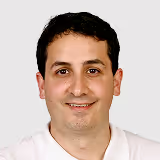
Marcel Kloos
Swiss-licensed dentist and founder of Medschool Experts
Marcel Kloos founded Medschool Experts while studying abroad; since then, over 500 study places have been secured. The Stuttgart-born dentist studied dentistry from 2015 to 2021 in Sofia and holds a Swiss dental licence.
Today he lives in Bern and runs Medschool Experts full-time as its owner.
More articles worth reading
Why Students Transfer from Medical University of Varna — Your Options
Why Students Transfer from Medical University of Warsaw — Your Options
Why Students Transfer from Masaryk University Faculty of Medicine — Your Options
Ahmad
Sabrina
Rami
Noah
500+ students placed.
Now it's your turn!
No daydreaming, no empty promises. Just a clear plan — for the start of your medical degree.
40 minutes, no obligation