Studying Dentistry in Georgia in English: Faculties, Costs and Recognition in 2026
02.09.2026

Which universities in Georgia teach dentistry in English in 2026?
Four private universities in Georgia teach dentistry in English in 2026: The University of Georgia, Alte University and European University, all three in Tbilisi, and BAU International University in Batumi. Each publishes the programme on its own website as an English-language dentistry degree leading to a Doctor of Dental Medicine.
The list is short on purpose. A faculty belongs on it only where the institution's own site states that dentistry is taught in English, which is a narrower test than a university simply having a dental faculty. Batumi Shota Rustaveli State University is the clearest illustration. Its Faculty of Natural Sciences and Healthcare runs a one-cycle dentistry programme and an English-language one-cycle Medical Doctor programme with, in its own words, "over 700 international students" enrolled. The English programme there is medicine. Dentistry runs in Georgian.
| Faculty (full official name) | City | Programme as published | Length | Annual tuition, currency as quoted |
|---|---|---|---|---|
| The University of Georgia | Tbilisi | Dental Program in English (Dentistry) | One cycle | 5,500 USD (university fee page, 2026) |
| BAU International University, Batumi | Batumi | Dentistry, one-cycle programme, English | 5 years · 300 ECTS · 9,000 academic hours | Not published on its public pages (September 2026) |
| Alte University | Tbilisi | Dentistry (English), International School of Medicine | 5 years · 10 semesters | Not published for the English track (September 2026) |
| European University | Tbilisi | Dentistry (English Language), Faculty of Dentistry | One cycle | Not published on its public pages (September 2026) |
Three of the four do not put a dentistry fee on an open page. That is a publishing decision, not a signal about the programme, and the figure is available directly from each faculty. Whether a given profile fits a given faculty is a separate question, and one worth putting to a person rather than a table. Medschool Experts assesses that case by case in a free individual consultation. More faculties, in Georgia and elsewhere, are listed under /universities.
How long is a dentistry degree in Georgia, and what qualification does it award?
Dentistry in Georgia is a single long cycle of five years, not a bachelor's degree followed by a master's. BAU International University in Batumi states the full specification: five academic years, 300 ECTS credits and 9,000 academic hours, awarding a Doctor of Dental Medicine. Alte University in Tbilisi states five years across ten semesters for the same qualification.
That structure matters more than it first appears. The European standard for dental training, set out in Directive 2005/36/EC, is at least five years of full-time theoretical and practical study comprising at least 5,000 hours. A Georgian five-year, 300-ECTS dental programme is built on the same clock. The qualification abbreviates to DMD and is a primary dental qualification, the degree that makes someone a dentist rather than a step toward one.
What does studying dentistry in Georgia cost per year in 2026?
The one Georgian dentistry tuition figure published openly in 2026 is from The University of Georgia in Tbilisi, which lists its "Dental Program in English (Dentistry)" at 5,500 USD on its own tuition and fees page. The university quotes in United States dollars, not in Georgian lari, and that is the currency a student is billed in.
Reading dollars as the tuition currency and lari as the living currency is the single most useful habit when budgeting for Georgia. Faculties price the degree in USD because their intake is international. Landlords, supermarkets and the metro price in GEL. A student therefore runs two budgets at two different exchange exposures, one large and annual, the other small and monthly.
Can international students still enrol at Georgia's state universities in 2026?
On 4 December 2025, Georgia's Minister of Education, Givi Mikanadze, said in a television interview that foreign students would no longer be admitted to Georgia's state universities from the following academic year. His stated wording was that "from the next academic year, the admission of foreign students to state universities — except for exceptional cases — will be impossible," with exceptions kept for bilateral agreements and exchange programmes.
Private universities were placed outside that announcement from the start. The minister's own framing made the point that opportunity remained wide, noting that 45 of Georgia's 64 accredited institutions are private. He also gave the figure behind the decision: at Tbilisi State Medical University, 45 per cent of students were foreign and 55 per cent Georgian.
As of September 2026, the National Center for Educational Quality Enhancement has published nothing that changes, confirms or withdraws that announcement, and its 2026 news carries no item on international admissions. So the policy is described here as what was announced and by whom, rather than as settled law. For dentistry in English the practical position is unaffected either way, because all four faculties teaching it are private, and private faculties were never inside the announcement's scope.
Who accredits dentistry programmes in Georgia?
Dentistry programmes in Georgia are accredited by the National Center for Educational Quality Enhancement, a Legal Entity of Public Law within the Ministry of Education, Science and Youth of Georgia. It was established on 14 September 2010 through the reorganisation of the earlier National Center for Accreditation, and it both authorises institutions and accredits their individual programmes.
Accreditation is not optional. Following amendments to the Law of Georgia on Education Quality Enhancement, accreditation "became mandatory for all types and levels of higher educational programmes." A programme is accredited for seven years. Where a programme is granted conditional accreditation instead, that runs for no more than four years, and re-accreditation stages across the sector are scheduled through 2022 to 2028.
The Center does more than inspect. It also "conducts recognition of educational documents, verification of authenticity," which is the function a graduate meets again later when a foreign authority writes to Georgia to confirm that a diploma is genuine. In 2025 it re-authorised 13 higher education institutions, and it renewed its registration on the European Quality Assurance Register. Lasha Margishvili was appointed its director on 25 August 2026.
What does it cost to live in Tbilisi and Batumi in 2026?
Living costs in Georgia in 2026 are moderate by European standards and noticeably lower in Batumi than in Tbilisi. Numbeo's Tbilisi data, updated 29 August 2026, puts monthly costs for a single person without rent at 1,744.70 GEL. The Batumi page, updated 23 August 2026, gives 1,546.90 GEL for the same measure.
| Item, 2026 | Tbilisi (GEL) | Batumi (GEL) |
|---|---|---|
| Single person, monthly, without rent | 1,744.70 | 1,546.90 |
| One-bedroom apartment, city centre | 1,770.56 | 1,242.26 |
| One-bedroom apartment, outside centre | 1,165.84 | 902.41 |
| Basic utilities, monthly | 232.22 | 200.56 |
| Monthly public transport pass | 40.00 | 30.00 |
| Meal, inexpensive restaurant | 30.00 | 25.00 |
The utilities, transport and restaurant lines are component prices. They already sit inside the single-person figure at the top of the table, so they should be read as texture rather than added again. Rent is the line that is genuinely separate, and it is where the two cities diverge most: a one-bedroom flat outside the centre of Batumi runs about 263 GEL a month below the same flat in Tbilisi.
Is a dental degree from Georgia recognised in the European Union?
A dental degree from Georgia is recognised in the European Union through each member state's own national recognition procedure, not through the automatic route. Georgia is not an EU member state, and Directive 2005/36/EC does not apply automatically to qualifications earned in a third country. Each member state decides, under its own rules, through its own authority.
The distinction is worth setting out precisely, because "recognised" is doing two different jobs in those two sentences. Directive 2005/36/EC runs automatic recognition for seven professions with harmonised training: doctors, dentists, pharmacists, nurses responsible for general care, midwives, veterinary surgeons and architects. Dentists are firmly on that list. Automatic recognition works because the training itself was harmonised — at least five years of full-time theoretical and practical study of at least 5,000 hours, covering the knowledge in Article 34 — and because the specific national diploma is written into Annex V, point 5.3.2 of the directive.
A Georgian DMD is not in Annex V, so the automatic mechanism has nothing to match it against. What applies instead is the national route: the competent authority in the member state where the graduate wants to practise examines the qualification on its own merits. The European Commission has issued a recommendation to EU countries to simplify recognition of qualifications for third-country nationals, aimed at making the EU more attractive to them and supporting their integration into EU labour markets. That recommendation is guidance rather than binding law, and the decision stays with the member state.
Two practical consequences follow. The procedure is per country, so a graduate chooses a destination and works with that country's authority rather than with a single European gateway. And the five-year, 5,000-hour benchmark in the directive is the yardstick those authorities reach for, which is exactly why the 300-ECTS, 9,000-hour shape of the Georgian degree is the specification to keep on file from year one.
{{cta}}How does a dentist qualified in Georgia register with the UK General Dental Council?
A dentist holding a Georgian qualification registers in the United Kingdom by passing the Overseas Registration Exam and then applying to the General Dental Council. The GDC requires the ORE from most applicants whose primary dental qualification was not gained in the UK or the EEA, which includes graduates of Georgian faculties.
The exam has two parts and they test different things. Part 1 covers the application of knowledge to clinical practice, across dental science, human disease and clinical dentistry, including anatomy, bacteriology, biochemistry, dental materials, immunology, pathology, pharmacology, physiology, statistics, law, ethics and health and safety. It is sat as two computer-based papers of three hours each, using extended matching and single best answer questions, at one of three London venues, with 600 places per sitting. The 2026 dates are 25 to 26 August 2026 and 14 to 15 October 2026. Part 2 is the practical one, where candidates demonstrate clinical skills.
| General Dental Council item, 2026 | Fee (GBP) | Note |
|---|---|---|
| ORE Part 1 | 485 | Two three-hour computer-based papers, London |
| ORE Part 2 | 6,967 | Practical clinical skills |
| ORE application processing fee | 115 | Charged on the exam application |
| Registration application, ORE or recognised diploma | 117.23 | £41.42 processing + £75.81 assessment, from 16 January 2026 |
| Initial application fee, overseas-qualified dentist route | 102.83 | GDC aims to assess complete applications within three months |
There are limits built into the exam, and knowing them early shapes how someone paces it. A candidate has up to four attempts at each part, and must pass Part 2 within five years of first attempting Part 1. The GDC's own estimate is that someone passing both parts at the first attempt "could complete it in around six to 12 months." The ORE is not the only door either: the GDC names the Licence in Dental Surgery and the Bachelor of Dental Surgery (international route) at the University of Lancashire as alternatives.
What does five years of dentistry in Georgia add up to?
Take one concrete case: a student starting the Dental Program in English at The University of Georgia in Tbilisi in 2026, living outside the city centre. Tuition is billed in dollars, life is paid in lari, and the two are added separately because neither source publishes a conversion.
Tuition is 5,500 USD a year, so 27,500 USD across the five years of the cycle. On the living side, Numbeo's August 2026 Tbilisi figures give 1,744.70 GEL a month for a single person without rent, which is 20,936.40 GEL a year, and 1,165.84 GEL a month for a one-bedroom flat outside the centre, which is 13,990.08 GEL a year. Together that is 34,926.48 GEL a year, or 174,632.40 GEL over five years.
The same student in Batumi would run 1,546.90 plus 902.41 GEL a month, that is 29,391.72 GEL a year, roughly 5,535 GEL a year less than Tbilisi. Over five years the gap is about 27,673 GEL. That is real money, and it is also the whole argument for looking seriously at the Black Sea coast rather than defaulting to the capital.
One line sits outside both columns. The recognition step at the end has its own price, and in the United Kingdom it is knowable in advance: £485 for ORE Part 1 and £6,967 for Part 2 in 2026, plus the registration fees. Budgeting for it in year one rather than year five is the difference between a planned expense and a scramble.
What should the twelve months before the first semester be spent on?
The year before a dentistry course in Georgia begins is mostly about two decisions that are easy to postpone and expensive to postpone: which city, and which country the degree is eventually meant to lead to. Both shape the budget, and the second shapes which paperwork is worth collecting from the very first semester.
Book the free individual consultation. Eligibility, profile and which of the four faculties is realistic are decided here, not from a table. Requirements differ by university and by person.
Choose the destination country for practice. EU member state, United Kingdom, or elsewhere. This decides which authority's expectations the transcript should satisfy.
Build the two-currency budget: tuition in USD, living in GEL. Price Tbilisi and Batumi side by side using the 2026 figures above and decide the city on numbers.
Arrange housing. A one-bedroom outside the centre runs 1,165.84 GEL in Tbilisi and 902.41 GEL in Batumi (2026), and viewing in person beats booking blind.
Set up the local account and transport pass — 40 GEL monthly in Tbilisi, 30 GEL in Batumi (2026) — and keep the programme specification: 300 ECTS, 9,000 hours.
Keep every syllabus, hour count and clinical logbook. Recognition authorities abroad ask for content and hours, and reconstructing year one in year five is the hard way.
That last card is the one graduates mention most. Recognition procedures are documentary, and the documents are generated while studying, not afterwards. A student who files syllabi as they go arrives at the end of the cycle with the file already built.
Applicants transferring in with prior study in a health profession sit in a different category again. Medschool Experts is the world's leading specialist in credit-recognition placements for healthcare graduates and regularly achieves entry into year 4 or year 5 at top universities worldwide. Recognition is assessed case by case from the individual transcript. What that means for one particular transcript is settled in a free consultation.
Why do dentistry in Georgia at all?
Georgia in 2026 offers a five-year primary dental qualification taught entirely in English, in a country where a one-bedroom flat outside the centre of Batumi costs 902.41 GEL a month, at a published tuition of 5,500 USD a year at The University of Georgia. That combination — full English instruction, a long-cycle DMD, moderate living costs — is not widely available.
The demand side is steady. Dentists remain scarce across Europe and beyond, and the qualification is portable in the sense that matters: every route out of it is a defined procedure with a named authority, a published fee and, in the UK's case, published exam dates a year ahead. Nothing about the path is improvised.
What the country asks in return is planning. Two currencies, one long cycle, and a recognition step chosen early rather than discovered late. Details of how Medschool Experts supports each of those stages are set out at /services.
The author's view
I studied dentistry in Sofia between 2015 and 2021, on the same kind of degree these Georgian faculties run: one long cycle, no bachelor's stage in the middle, a phantom lab well before real patients. What I remember is how early the hand skills start to count. None of that shows up in a fee table, and it is the part that decides whether someone enjoys the five years or endures them.
I practise in Bern today on a Swiss licence, which means I have been through the work of turning a degree earned in one country into the right to treat patients in another. That process has an authority, a file and a fee schedule wherever it is run. Georgian graduates meet the same category of step: a national decision in each EU member state, the General Dental Council's route in the United Kingdom. A national procedure is a defined process, not a closed door, and I would rather people heard it described that way than whispered about.
With Medschool Experts I have placed more than 500 students. The one thing I would push everybody to do earlier: pick the country you intend to practise in before year one, not after year five. The degree itself is identical either way. The transcripts, hour counts and logbooks you gather along the road are not, and they are far easier to collect as you go than to reconstruct at the end.
Summary
- Four private faculties teach dentistry in English in Georgia in 2026: The University of Georgia, Alte University and European University in Tbilisi, and BAU International University in Batumi.
- The degree is one continuous cycle of five years and 300 ECTS credits, awarding a Doctor of Dental Medicine; BAU International University Batumi specifies 9,000 academic hours.
- The University of Georgia publishes its Dental Program in English at 5,500 USD a year (2026); Georgian faculties quote tuition in US dollars, while living costs are measured in Georgian lari.
- Living costs in 2026: a single person without rent needs 1,744.70 GEL a month in Tbilisi and 1,546.90 GEL in Batumi, per Numbeo data updated in August 2026.
- The National Center for Educational Quality Enhancement, an LEPL under the Ministry of Education, Science and Youth, accredits programmes for seven years; accreditation is mandatory for all higher education programmes.
- In December 2025 the Minister of Education announced that state universities would stop admitting foreign students; private universities were outside that announcement, and all four English dentistry faculties are private.
- In the European Union, a Georgian dental degree goes through each member state's national recognition procedure, because Directive 2005/36/EC applies its automatic route only to qualifications listed in Annex V.
- For the United Kingdom, the General Dental Council route runs through the Overseas Registration Exam: £485 for Part 1 and £6,967 for Part 2 in 2026, with four attempts allowed at each part.
Conclusion
Georgia gives an international student a five-year English-taught dental degree at a published cost, in two cities with very different rents, under a regulator that accredits on a seven-year cycle. The routes onward to the European Union and the United Kingdom are mapped, priced and dated.
Which faculty suits a particular profile, and what a specific transcript is worth, are individual questions with individual answers. Medschool Experts assesses both directly and says where a place is achievable — book a free consultation.
Frequently Asked Questions about studying dentistry in Georgia
Which universities in Georgia teach dentistry in English in 2026?
Four private universities publish an English-taught dentistry programme in 2026: The University of Georgia, Alte University and European University, all in Tbilisi, and BAU International University in Batumi. Batumi Shota Rustaveli State University runs a large English-language programme with over 700 international students, but that programme is Medical Doctor; its dentistry course is taught in Georgian.
How long does dentistry take in Georgia, and what degree do you get?
Dentistry in Georgia is a single long cycle of five years, not a bachelor's followed by a master's. BAU International University in Batumi states five academic years, 300 ECTS credits and 9,000 academic hours; Alte University in Tbilisi states five years over ten semesters. Both award a Doctor of Dental Medicine, which is a primary dental qualification.
How much is dentistry tuition in Georgia in 2026?
The University of Georgia in Tbilisi publishes its Dental Program in English at 5,500 USD per year on its own tuition and fees page in 2026. The other three English-taught dentistry faculties do not publish a dentistry fee on their open pages as of September 2026, and quote it on request. Georgian faculties price in US dollars rather than Georgian lari.
Can international students still enrol at Georgian state universities in 2026?
In a television interview on 4 December 2025, Education Minister Givi Mikanadze announced that from the following academic year, admission of foreign students to state universities would be impossible except in exceptional cases such as bilateral agreements. Private universities were explicitly outside that announcement. All four faculties teaching dentistry in English in Georgia are private, so the English-taught dentistry route runs through them.
Is a Georgian dental degree recognised in the European Union?
Yes, through each member state's national recognition procedure rather than the automatic one. Directive 2005/36/EC grants automatic recognition to dentists whose diploma is listed in its Annex V, point 5.3.2, and Georgia is not an EU member state. The competent authority in the destination country assesses the qualification against the directive's benchmark of five years and at least 5,000 hours of training.
How does a Georgian dental graduate register to work in the United Kingdom?
Through the General Dental Council, which requires the Overseas Registration Exam from most dentists qualified outside the UK and EEA. Part 1 costs £485 and is two three-hour computer-based papers in London; Part 2 costs £6,967 and tests practical clinical skills. Candidates get four attempts at each part and must pass Part 2 within five years of first sitting Part 1.
Is Tbilisi or Batumi cheaper for a dental student in 2026?
Batumi is cheaper on every measure. Numbeo figures updated in August 2026 give a single person without rent 1,546.90 GEL a month in Batumi against 1,744.70 GEL in Tbilisi, and a one-bedroom flat outside the centre at 902.41 GEL against 1,165.84 GEL. Over a five-year degree that difference comes to roughly 27,673 GEL.
Who accredits dentistry programmes in Georgia?
The National Center for Educational Quality Enhancement, a Legal Entity of Public Law within the Ministry of Education, Science and Youth of Georgia, established on 14 September 2010. It authorises institutions and accredits programmes, and accreditation is mandatory for all types and levels of higher education programme. Standard accreditation runs seven years; conditional accreditation runs no more than four.
What students say about Medschool Experts
Over 500 placements at more than 25 partner universities across 10+ countries. Read independent student reviews on Trustpilot.
About the author
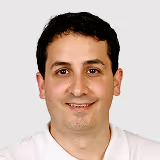
Marcel Kloos
Swiss-licensed dentist and founder of Medschool Experts
Marcel Kloos founded Medschool Experts while studying abroad; since then, over 500 study places have been secured. The Stuttgart-born dentist studied dentistry from 2015 to 2021 in Sofia and holds a Swiss dental licence.
Today he lives in Bern and runs Medschool Experts full-time as its owner.
More articles worth reading
Why Students Transfer from Medical University of Varna — Your Options
Why Students Transfer from Medical University of Warsaw — Your Options
Why Students Transfer from Masaryk University Faculty of Medicine — Your Options
Ahmad
Sabrina
Rami
Noah
500+ students placed.
Now it's your turn!
No daydreaming, no empty promises. Just a clear plan — for the start of your medical degree.
40 minutes, no obligation