Studying Medicine in Europe as an Indian Student: 2026 Guide
08.09.2026

How does six-year, English-taught medicine in Europe actually work?
Most European medical faculties teaching in English run a six-year integrated programme: roughly the first three years cover pre-clinical subjects, the following two to three years move into clinical rotations inside teaching hospitals, and the final year functions as a supervised pre-graduation placement inside the university's own hospital network.
The degree awarded at the end is usually titled Doctor of Medicine, or in some countries still carries the older "Diploma in Medicine and Surgery" wording. The label varies. The content does not. Georgia, Armenia, Bulgaria, Romania, Poland and Italy each run six-year English-medium versions of this model alongside their native-language tracks for local students. You can compare programmes side by side in our universities directory before narrowing your shortlist.
None of this tells you, on its own, whether a specific university's programme will be recognised for practice in India. That recognition is decided separately, by the National Medical Commission, and it is the subject of the next few sections.
What does the National Medical Commission require before your Indian licence counts?
The National Medical Commission governs foreign medical graduates through the Foreign Medical Graduate Licentiate Regulations, 2021 (FMGL Regulations 2021). They set out who counts as a foreign medical graduate, what exam that status requires, and what has to happen in India afterwards before registration to practise is granted.
Three requirements sit at the centre of the regulation: a minimum programme duration abroad, a supervised internship back in India, and a national screening test. Nothing else changes that. We cover the duration rule and the internship rule below. First, the exam, because its name has been changing and the change matters for anyone planning a 2026 start.
Is FMGE still the exam, or has the National Exit Test replaced it?
As of the National Medical Commission's draft amendment published in August 2026, FMGE remains the operative exam. Foreign medical graduates must qualify the Foreign Medical Graduate Examination, or the National Exit Test (NExT) once it comes into force, before being entered on the National Medical Register and licensed to practise in India.
NExT was originally conceived as a single, common exit exam for Indian and foreign medical graduates alike, replacing both the final MBBS exam for domestic students and FMGE for those returning from abroad. Its rollout has been delayed repeatedly since 2019, and the National Medical Commission's own leadership has indicated the exam may not take effect for a further period. Plan on FMGE for now. Treat any other timeline as provisional until the Commission itself notifies otherwise.
Whichever exam is current when you graduate, it tests the same core: whether the clinical knowledge you gained abroad meets the standard expected of a doctor beginning practice in India.
Why do the fifty-four months and the twelve-month internship matter so much?
The FMGL Regulations 2021 fix two numbers that decide whether your foreign degree is even eligible for screening: a medical programme of at least fifty-four months, completed at one institution, followed by a twelve-month internship completed at that same institution abroad. Only after both are finished does the National Medical Commission treat the foreign degree as complete for its purposes.
A second, separate twelve-month internship then has to be completed in India, under supervision, after the Commission has approved the placement application. All of it, foreign programme, foreign internship and Indian internship, must be finished within ten years of first enrolling abroad. No exceptions. The chart below sets out how that clock is built.
Students who enrolled before the 2021 regulations came into force are assessed under the rules that applied when they started, not the current ones. Worth checking if that is you.
What is WFME recognition, and why does the ECFMG's 2024 rule matter for a later United States route?
The World Federation for Medical Education (WFME) recognises national and regional accrediting agencies, not individual universities directly, as meeting its global standards for medical-education oversight. A medical school counts as "WFME-recognised" when the body that accredited it holds that WFME recognition itself. The accreditor is what counts.
Since 2024, the Educational Commission for Foreign Medical Graduates (ECFMG) requires exactly this: applicants for ECFMG Certification, the gateway to USMLE and a US residency, must be students or graduates of a medical school accredited by a WFME-recognised agency. The rule was originally set for 2023 and pushed back a year by the ECFMG because of pandemic-era disruption to accreditation bodies worldwide.
For an Indian student choosing a European medical school in 2026, this matters even if the United States is only a possibility and not the plan, because accreditation status sits at the level of the school and is not decided retroactively once you are already enrolled. It is one of the points we check case by case; book a free individual consultation and we will confirm the accreditation chain for the specific university you are weighing.
What does six years of medicine cost across Europe in 2026?
Tuition for English-taught medicine in Europe spans a wide range in 2026, from a few hundred euros a year at Italian public universities, where fees scale with family income, to well over sixteen thousand euros a year at some Polish medical faculties. Living costs tend to move the same way: a modest Georgian or Armenian city costs a fraction of Warsaw or Milan. Cheap and expensive both exist.
| Country | Typical annual tuition, 2026 | Typical monthly living costs, 2026 | Programme length |
|---|---|---|---|
| Georgia | from €3,700 (~US$4,000) | €230–380 | 6 years |
| Armenia | from €4,600 (~US$5,000) | €250–400 | 6 years |
| Bulgaria (Sofia) | €9,950 | €400–600 | 6 years |
| Romania | from €8,000 | €500–750 | 6 years |
| Poland (Poznań) | from €16,500 | €700–1,400 | 6 years |
| Italy (public) | €400–4,000 (income-linked) | €500–1,200 | 6 years |
Sources: Medical University of Sofia and Poznań University of Medical Sciences published 2026/2027 fee schedules; publicly listed 2026 fee ranges for Georgian, Armenian, Romanian and Italian medical faculties.
These are starting points, not fixed prices. A given university's fee for your intake year, and any annual increase written into the contract, are things we confirm directly rather than estimate. What the chart shows reliably is the shape of the market: cheap tuition rarely hides an expensive city, and the reverse holds too.
What visa and residence permit sequence should you expect?
The sequence has the same shape in every EU and Schengen-area country, even though paperwork and processing time differ: a national long-stay student visa first, applied for at the country's consulate in India, followed by a residence permit registered inside the country once you arrive. The visa gets you in. The permit lets you stay.
Marina, who works in visa and immigration law at Medschool Experts and has lived and worked across Dubai, India, and now Belgrade, points out that the most common delay is not the visa interview itself but document legalisation beforehand: apostilles and notarisations that have to be completed in India before a consulate will even book an appointment.
Each country then requires the permit to be renewed, usually annually, tied to proof of enrolment and, in most cases, proof of health insurance and accommodation. None of this is unique to medicine. It is the standard EU/EEA student-migration process, running alongside your academic calendar rather than around it.
{{cta}}What does a realistic month-by-month plan look like?
Applications for a European medical programme starting in September or October run on a cycle that, in practice, starts about ten to twelve months earlier. Below is the shape of that cycle for a 2026 intake; exact deadlines shift by country and by university, which is exactly what a consultation is for.
Shortlist countries and universities against budget and NEET status; book an initial consultation.
Gather documents, begin apostille and attestation, confirm NEET eligibility for the intended intake.
Submit applications to the shortlisted universities; conditional offer letters typically follow in this window.
Accept an offer, pay the initial tuition instalment, receive the formal admission letter needed for the visa file.
Book and attend the national student-visa appointment at the consulate.
Visa decision arrives; arrange accommodation, flights and health insurance for arrival.
Travel, arrive, and register the residence permit application within the required local window.
Orientation week, then the first semester of a six-year programme begins.
Two checkpoints matter more than the rest: the point where your NEET result is confirmed against your target intake, and the point where the visa appointment is booked. Both are date-sensitive. Little else in the process is.
What does a full six-year budget look like in practice?
Worked example, using a Bulgarian state medical university's published 2026/2027 fee schedule: tuition of €9,950 a year for six years, a mid-range monthly living cost of €500, and one-off costs, visa, flights, insurance and initial deposits, of roughly €3,000 across the whole programme. Small sums, added up.
| Year | Tuition (€) | Living costs, 12 months (€) | Running total (€) |
|---|---|---|---|
| 1 | 9,950 | 6,000 | 15,950 |
| 2 | 9,950 | 6,000 | 31,900 |
| 3 | 9,950 | 6,000 | 47,850 |
| 4 | 9,950 | 6,000 | 63,800 |
| 5 | 9,950 | 6,000 | 79,750 |
| 6 | 9,950 | 6,000 | 95,700 |
| Plus one-off costs | — | — | 3,000 |
| Total | — | — | 98,700 |
Figures: Medical University of Sofia 2026/2027 tuition schedule; mid-range living-cost estimate for a Bulgarian university city, 2026.
That totals approximately €98,700 over six years. At the September 2026 EUR/INR rate of roughly ₹110 to the euro, that converts to close to ₹1.09 crore, a figure that moves with the exchange rate and with the specific university but gives a real order of magnitude rather than a marketing range. Run the same arithmetic on a Georgian or Armenian tuition line and the total typically lands thirty to forty per cent lower. See how other students structured their own six years in our student stories.
What do most overviews of "medicine in Europe for Indian students" leave out?
Two things, consistently: what happens to your financing timeline if NExT arrives mid-programme and changes the exam you eventually sit, and what your options are if you want to change country after year one or two rather than after graduation. Both are answerable. Neither is addressed often.
On the first: the FMGL Regulations 2021 apply to your enrolment date and cohort, not to whichever exam name happens to be active on results day, so a shift from FMGE to NExT partway through your six years would not retroactively change your fifty-four-month or twelve-month obligations, only the exam you sit at the end. On the second: transfers between European medical schools happen every year, for reasons from family circumstances to a change in interest, and the practical steps depend heavily on both institutions' own credit-transfer policies. If either scenario applies to you, raise it directly in a free individual consultation rather than planning around it from general guidance alone.
The author's view
I studied dentistry in Sofia between 2015 and 2021, so I recognise most of what is in this guide from the inside, not from a brochure. The paperwork frustrated me exactly as much as it will frustrate you. The six years passed faster than the paperwork ever suggested they would.
What I would tell my 2015 self is to write the regulatory numbers down early and stop re-deriving them every few months from whatever forum post turns up. Fifty-four months, twelve months, twelve more months. Memorise them once, then spend your energy on anatomy, not on regulation-chasing.
At Medschool Experts we have now placed more than 500 students into European medical and dental programmes, and the pattern repeats: the students who plan the exam and visa side early are the ones who spend their clinical years actually enjoying the clinical years. I am a licensed dentist in Bern today because someone once sat with me and did exactly this kind of planning. I would rather be that person for you than let you find it out the slow way.
Summary
- Six-year, English-taught medicine runs across Georgia, Armenia, Bulgaria, Romania, Poland, Italy and other European countries, with degrees equivalent in structure even where the title differs.
- The Foreign Medical Graduate Licentiate Regulations 2021 set the framework: a minimum 54-month programme, a 12-month internship abroad, and a further 12-month supervised internship in India, all within a 10-year window.
- FMGE remains the operative screening exam as of the National Medical Commission's August 2026 draft amendment; the National Exit Test (NExT) will replace it once the Commission brings it into force.
- WFME recognition of your school's accrediting body matters from 2024 onward if a United States ECFMG/USMLE route is part of your longer-term plan.
- 2026 tuition ranges from roughly €400 a year at Italian public universities to over €16,000 a year at some Polish faculties, with living costs moving in the same direction.
- A worked six-year example at 2026 Bulgarian rates lands close to €98,700, or roughly ₹1.09 crore at September 2026 exchange rates.
- The visa-then-residence-permit sequence is the same shape everywhere: national student visa first, residence permit registered on arrival, renewed annually.
- A realistic application-to-enrolment timeline runs about ten to twelve months from first shortlist to first semester.
Conclusion
None of the numbers above are obstacles dressed up as facts. They are the route, fixed points you plan around the way you would plan around a flight schedule rather than resent it. Six years feels long only if you spend the first one figuring out the regulations instead of studying.
Every figure in this guide shifts slightly by university, by intake year, and by your own profile. Book a free consultation and we will map the current numbers onto your specific situation.
Frequently Asked Questions about Studying Medicine in Europe as an Indian Student
Do I need to qualify NEET before studying medicine in Europe?
Yes. Under the Foreign Medical Graduate Licentiate Regulations 2021, a qualifying NEET result is a precondition for the National Medical Commission to recognise your foreign medical study at all, regardless of country or university. The regulations set eligibility in terms of your NEET status, not in terms of any single university's own entry criteria, which vary by institution and by year. Confirming how your specific NEET result maps onto a given university's current intake is best done in a free individual consultation.
Is FMGE compulsory for every Indian student who studies medicine abroad?
Yes, for now. Every foreign medical graduate covered by the FMGL Regulations 2021 must qualify FMGE, or the National Exit Test once the National Medical Commission brings it into force, before receiving a licence to practise in India. There is no exemption based on which European country issued the degree, provided the programme itself meets the fifty-four-month and twelve-month duration requirements the regulations set out.
What happens if my programme runs shorter than 54 months?
The FMGL Regulations 2021 treat fifty-four months as a floor, not a target. A shorter programme does not meet the threshold the National Medical Commission uses to consider a foreign medical degree complete for screening purposes. Programme length is one of the details that differs by university and curriculum design, so confirming a specific programme's exact duration is something we check directly rather than something to assume from a prospectus.
Does studying in Europe help if I eventually want to work in the United States?
It can, but the accreditation chain matters more than the country on its own. Since 2024, ECFMG Certification, the entry point to USMLE and US residency, requires your medical school to be accredited by an agency recognised by the World Federation for Medical Education (WFME). Most established European medical faculties hold this recognition through their national accreditor, though the exact chain is worth confirming for the specific university you are weighing, since it is a school-level fact rather than a country-wide guarantee.
How long does the whole visa and residence permit process take?
Processing time varies by country and consulate, but the shape stays consistent: a national student visa application submitted after document legalisation in India, typically several weeks to a couple of months before travel, followed by residence permit registration inside the country within days to a few weeks of arrival. Building in a buffer of six to eight weeks between visa approval and the start of term is standard practice, not a worst-case estimate.
Can I switch universities or countries partway through the six years?
Yes. This happens every year, for reasons ranging from family circumstances to a change of interest, and it does not require restarting from year one in every case. What credit transfers and what does not depends entirely on the receiving university's own policy, which is why this particular question is one we work through case by case in a free individual consultation rather than answer with a general rule.
What does the "supervised internship" in India actually involve after graduation?
It is a twelve-month clinical internship completed inside India, at a facility approved for the purpose, after the National Medical Commission has approved the placement application. It runs separately from any internship completed abroad as part of the fifty-four-plus-twelve-month foreign programme, and it must be finished, together with the foreign stages, inside the ten-year window the FMGL Regulations 2021 set from first enrolment abroad.
What students say about Medschool Experts
Over 500 placements at more than 25 partner universities across 10+ countries. Read independent student reviews on Trustpilot.
About the author
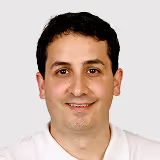
Marcel Kloos
Swiss-licensed dentist and founder of Medschool Experts
Marcel Kloos founded Medschool Experts while studying abroad; since then, over 500 study places have been secured. The Stuttgart-born dentist studied dentistry from 2015 to 2021 in Sofia and holds a Swiss dental licence.
Today he lives in Bern and runs Medschool Experts full-time as its owner.
More articles worth reading
Why Students Transfer from Medical University of Varna — Your Options
Why Students Transfer from Medical University of Warsaw — Your Options
Why Students Transfer from Masaryk University Faculty of Medicine — Your Options
Ahmad
Sabrina
Rami
Noah
500+ students placed.
Now it's your turn!
No daydreaming, no empty promises. Just a clear plan — for the start of your medical degree.
40 minutes, no obligation