Studying Medicine in Serbia as an International Student 2026
08.09.2026

What does it actually take to study medicine in Serbia as an international student in 2026?
It takes six years, 360 ECTS credits and between roughly 92,600 and 137,500 euros all in, depending on the city. Four public faculties teach the whole degree in English, the qualification awarded is a Doctor of Medicine, and the curriculum is the same one Serbian-language students follow. Teaching moves into working hospitals from year four.
Serbia sits outside the European Union, which shapes the second half of the story rather than the first. The degree is built to the European standard; what differs is the paperwork afterwards. Start with the faculties.
Which Serbian medical faculties teach medicine in English in 2026?
Four state faculties run the complete English-taught medical degree in 2026: the Faculty of Medicine at the University of Belgrade, the Faculty of Medicine at the University of Novi Sad, the Faculty of Medicine at the University of Nis, and the Faculty of Medical Sciences at the University of Kragujevac. Each publishes its English programme on its own site.
Belgrade is the oldest and largest. Its faculty dates to 1920, when the anatomist Niko Miljanic gave the first lecture, and it counted 5,628 students across all levels in 2018/19. Clinical teaching runs through the University Clinical Centre of Serbia, founded in 1983, which held 3,150 beds as at 2017 and treats around a million patients a year.
Nis is the counterweight. Its Clinical Centre opened in 2017, and the faculty describes it as one of the most advanced medical facilities in the region — a new building rather than a historic one. Novi Sad states the shape of its programme most plainly: six years, 360 ECTS, Doctor of Medicine, with tuition covering online library access and sets of electronic textbooks. Kragujevac publishes enrolment quotas for 2026/2027, including 107 self-financing places at its first annual enrolment, but no price.
Private higher-education institutions exist in Serbia too, accredited under the same national framework. If you are looking at one, the test is not the brochure. It is whether the institution appears in the World Directory of Medical Schools with an ECFMG Sponsor Note, which takes five minutes to check and is described further down. Our university overview covers the programmes we work with directly.
How is the six-year Serbian medical curriculum structured in ECTS?
Twelve semesters, 60 ECTS per academic year, 360 ECTS in total, leading to a Doctor of Medicine. Years one and two are preclinical: anatomy, histology, physiology, biochemistry, medical physics, molecular and human genetics. Year three is the bridge, carrying pathology and pharmacology alongside the first proper clinical subjects. Anatomy first, patients later.
The University of Nis publishes the hour count for its integrated medicine programme, the most useful single number on any Serbian faculty website: 6,030 hours in total, made up of 5,130 hours of active instruction, 510 hours of professional practice, 315 hours of clinical skills training and 75 hours for thesis research and defence. Set that against Article 24(2) of European directive 2005/36/EC, which requires basic medical training of at least six years of study or 5,500 hours of theoretical and practical training. Nis clears the hour threshold with 530 hours to spare. Credits are the common currency here, and 360 of them is what a European medical degree weighs.
Is the teaching genuinely in English, and when does Serbian become necessary?
Lectures, seminars, practicals and examinations are conducted in English on all four English-track programmes, and the University of Belgrade Faculty of Medicine states flatly that its courses are taught entirely in English. Serbian becomes necessary at a specific point: bedside teaching. Patients in Belgrade, Novi Sad, Nis and Kragujevac hospitals speak Serbian, and from year four onward you are in front of them.
The University of Nis lists the language of instruction for its integrated medicine programme as English and Serbian, which describes the clinical years accurately. Your examiner speaks English. Your patient does not.
Treat Serbian as a subject with a six-year runway rather than an afterthought in year three. History-taking is the skill that needs it — a chest examination is largely silent, a history is not. Serbian is written in both Cyrillic and Latin script, and hospital documentation uses both. Six years is enough.
What does tuition cost at each Serbian medical faculty in 2026?
Tuition for English-taught medicine in Serbia runs from 6,000 euros a year at the University of Nis to 8,000 euros a year at the University of Belgrade, with Novi Sad at 7,000 euros for 2026/2027. Kragujevac publishes no figure on its public pages and routes fee questions to its programme office. Each faculty prints the academic year its decision applies to. Check the year.
| Faculty | Annual tuition | Payment structure | Application fee | Published for |
|---|---|---|---|---|
| University of Nis Faculty of Medicine | 6,000 EUR | 3,000 EUR per semester | 50 EUR | 2024/2025 |
| University of Novi Sad Faculty of Medicine | 7,000 EUR | First instalment at least 1,750 EUR | 6,600 RSD (55 EUR) | 2026/2027 |
| University of Belgrade Faculty of Medicine | 8,000 EUR | 4,000 EUR per semester | 140 EUR | 2023/24 intake onward |
| University of Kragujevac Faculty of Medical Sciences | Not published online | Self-financing places listed | Not published online | 2026/2027 |
Tuition and fees as published by each faculty on its own website, consulted September 2026.
Two charges sit outside the annual fee. Belgrade bills a repeated year at 117 euros per ECTS credit rather than a flat sum, so the cost scales with how much is actually being repeated, and charges 30 euros to disenrol. Nis prices a repeated year at a flat 2,000 euros and charges 40 euros to assess previous study for anyone arriving with credits already earned.
That last line matters more than its size suggests. If you already hold credits from a healthcare degree, a nursing programme or a biomedical science course, the question is not whether they count but how far they carry you. Medschool Experts is the world's leading specialist in credit-recognition placements for healthcare graduates and regularly achieves entry into year 4 or year 5 at top universities worldwide. What a transcript is worth can only be read from that transcript, and what a faculty asks for varies by university and by individual profile — so book a free individual consultation and we assess the case directly.
What does it cost to live in Belgrade, Novi Sad, Nis and Kragujevac?
A single student's monthly budget before rent runs from about 518 euros in Nis to about 715 euros in Belgrade on 2026 figures. Rent is the swing factor: a one-bedroom flat outside the centre costs roughly 509 euros a month in Belgrade against 250 euros in Nis. Serbia prices almost everything in dinars, so every figure below carries its dinar amount and a euro conversion.
| Monthly item | Belgrade | Novi Sad | Nis | Kragujevac |
|---|---|---|---|---|
| One-bedroom, outside centre | 59,590 RSD / 509 EUR | 42,109 RSD / 360 EUR | 29,301 RSD / 250 EUR | no city dataset published |
| One-bedroom, city centre | 87,794 RSD / 750 EUR | 51,510 RSD / 440 EUR | 40,450 RSD / 346 EUR | no city dataset published |
| Basic utilities, 85 m2 | 22,425 RSD / 192 EUR | 24,490 RSD / 209 EUR | 16,350 RSD / 140 EUR | no city dataset published |
| Meal, inexpensive restaurant | 1,390 RSD / 12 EUR | 1,050 RSD / 9 EUR | 800 RSD / 7 EUR | no city dataset published |
| Single person, all costs except rent | 83,667 RSD / 715 EUR | 81,835 RSD / 699 EUR | 60,575 RSD / 518 EUR | approximately 500-560 EUR |
Dinar figures from Numbeo city data, August and September 2026, converted at the National Bank of Serbia official middle rate of 116.9970 dinars to 1 euro on 2 September 2026. The Kragujevac figure is an approximate range, not a published dataset.
Kragujevac is the gap in that table. No comparable city dataset is published for it, so the 500 to 560 euro range above is an estimate for 2026 built on its size relative to Nis and should be read as a range rather than a figure. Ask the faculty directly.
Marina, our colleague who handles visa and immigration questions at Medschool Experts, lives in Belgrade, and the Belgrade column is the one she gets asked about most. The 241-euro monthly gap between a flat in the centre and one outside it is the largest single lever in the whole budget — larger, over six years, than the 2,000-euro annual tuition difference between Belgrade and Nis.
What do six years in Serbia add up to, line by line?
About 119,500 euros for a student at the University of Novi Sad living in a one-bedroom flat outside the centre, on 2026 figures. Tuition is 42,000 of that. Living costs are 76,200. Government and application fees come to under 1,300 across the whole degree. Here is the calculation in full.
| Cost line | Per year | Over six years |
|---|---|---|
| Tuition, medicine in English, Novi Sad | 7,000 EUR | 42,000 EUR |
| Rent, one-bedroom outside centre | 4,320 EUR | 25,920 EUR |
| Food, utilities, transport, everything else | 8,388 EUR | 50,328 EUR |
| Temporary residence permit | about 204 EUR | about 1,224 EUR |
| Application fee | 55 EUR, first year only | 55 EUR |
| Total | about 19,900 EUR | about 119,500 EUR |
Worked example on 2026 figures, not a real student. Tuition per the University of Novi Sad Faculty of Medicine, 2026/2027; living costs per Numbeo, August 2026; permit fees per Serbia's foreign nationals portal, 2026.
Notice the proportions. Tuition is 35 percent of the total and living costs are 64 percent, so the city moves more money than the faculty does. A student who shares a flat, or gives it up over the summer months, changes the six-year figure by more than switching universities would. One line is deliberately missing: health insurance. No standard student premium is published, the amount depends on the cover chosen and the faculty's own requirement, and an invented figure would be worse than an acknowledged gap.
Are Serbian medical schools listed by WFME and WDOMS, and can graduates sit the USMLE?
The mechanism that decides this is the World Directory of Medical Schools, run jointly by the World Federation for Medical Education and FAIMER, a division of Intealth. For the United States, eligibility turns on one thing: whether an ECFMG Sponsor Note appears on the Sponsor Notes tab of a school's listing. The ECFMG 2026 Information Booklet states it without hedging — if there is no ECFMG Sponsor Note on that tab, you are not eligible for ECFMG Certification.
The Sponsor Note also names which graduation years qualify, which is why checking the specific faculty rather than the country is the only check that means anything. ECFMG's guidance tells applicants to search wdoms.org, tick the box to include non-UN member states, and open the Sponsor Notes tab. Five minutes, no intermediary. Since ECFMG Certification is the gateway to the United States Medical Licensing Examination pathway and to residency application, that one tab governs the whole American route.
What changed for Serbian medical schools in 2024 and 2025?
Two things, and neither is well explained anywhere. In November 2024 Intealth's Recognized Accreditation Policy took effect. In May 2025 Serbia's National Entity for Accreditation and Quality Assurance in Higher Education, NEAQA, was granted Recognition Status by the World Federation for Medical Education — awarded on 9 May 2025 and running for ten years, to May 2035.
The confusion worth clearing up is what the Recognized Accreditation Policy does. It has no impact on eligibility for ECFMG Certification, which is still governed by the Sponsor Note. The policy is a separate designation covering whether a school is accredited by an agency recognised by an organisation approved by Intealth, and WFME is one of the two approved recognition organisations.
What NEAQA's recognition buys a Serbian student is visibility. Where a school is accredited by a WFME-recognised agency, WFME now publishes specific accreditation information on the Program Details tab of that school's World Directory listing. A Serbian faculty's listing therefore carries two separate pieces of evidence you can read yourself. Different tabs, different questions.
Program Details tab
Carries WFME accreditation information where the national agency holds Recognition Status. NEAQA has held it since 9 May 2025.
Sponsor Notes tab
Carries the ECFMG Sponsor Note. Its presence, and the graduation years it names, decide eligibility for ECFMG Certification.
Is a Serbian medical degree recognised in the European Union under directive 2005/36/EC?
Yes, through national recognition rather than automatic recognition. Directive 2005/36/EC gives automatic mutual recognition to seven sectoral professions including doctor of medicine, but that route applies to qualifications earned inside the Union. Serbia has been an EU candidate country since 1 March 2012, with accession negotiations open since 21 January 2014 and 22 of 35 chapters opened as at 2026. Candidate status is not membership.
The directive says what happens instead. Article 2(2) allows each Member State to permit holders of non-EU qualifications to pursue a regulated profession on its territory. Article 3(3) then provides that evidence of formal qualifications issued by a third country is regarded as evidence of formal qualifications once the holder has three years' professional experience in the profession concerned on the territory of the Member State which recognised that qualification. In plain terms: one Member State assesses and admits you, you work there for three years, and the qualification then travels within the Union on the directive's own terms.
This is a used pathway, not a theoretical one, and Serbian graduates practise across Europe on that basis. Each Member State runs its own assessment through its own competent authority, so the sensible order is to pick the destination first and read that authority's procedure second. Outside the Union, the United Kingdom route runs through the General Medical Council, which registers doctors who qualified outside the UK, with the PLAB test as the principal pathway. Which of these fits a particular plan is what our placement and advisory services exist to work out.
How does a year of medical study in Serbia actually run?
The Serbian academic year has two semesters and three exam periods, and the rhythm is more useful than any single date. The winter semester opens in early October, with teaching to late December or January and the first exam period in late January and February. The summer semester runs from February to early June, the June exam period follows, and a resit period sits in September before the next year opens. The rhythm repeats.
October to January
Winter semester. Serbian language classes are easiest to sustain now, before the first exam period compresses everything.
February to June
Summer semester, then the June exam period. From year four this is where clinical blocks sit.
July and August
Summer professional practice and, for anyone transferring in, the months to gather transcripts, syllabi and credit records.
September
Resit period and the run-up to the new academic year. Residence permits and accommodation are settled here.
For anyone planning an entry rather than living one, the sequence is different. Twelve to nine months out is when the destination country and licensing route get decided, because that shapes everything after it. Nine to six months out is when transcripts, syllabus descriptions and credit records get collected, which takes far longer than people expect. Six to three months out is when the faculty conversation happens. What each faculty asks for at that point varies by university and by individual profile, and no generic answer helps. Bring the actual situation to a free individual consultation and we assess the case directly.
The author's view
I studied dentistry in Sofia between 2015 and 2021, and the Serbian numbers on this page read like my own student years with a different currency. What I would say to anyone comparing the four faculties is that they are comparing the wrong variable first. Tuition between Nis and Belgrade differs by 12,000 euros over six years. The two cities differ by around 33,000. People research the faculty to the last euro and then pick the city by instinct.
The other thing I would flag is the language. I have watched students treat the local language as a year-three problem and then meet their first patient with a classmate translating for them. It is not a disaster, and everyone catches up. It is simply six months of clinical learning you do not get back, and it costs nothing to start earlier.
From my desk in Bern I have placed more than 500 students into medical study places, and that is Medschool Experts' own placement experience rather than an industry figure. The pattern that holds across almost all of them is the same order of operations: decide where you want to practise, then the country, then the city, then the faculty. Work backwards from the licence and the rest of the decisions get much easier to make.
Summary
- Four Serbian public faculties teach the full medical degree in English in 2026: Belgrade, Novi Sad, Nis and Kragujevac, each with an attached clinical centre.
- The degree is six years, twelve semesters and 360 ECTS; the University of Nis publishes 6,030 total teaching hours for its programme.
- Article 24(2) of directive 2005/36/EC sets the European minimum at six years or 5,500 hours of theoretical and practical training.
- Tuition in 2026 runs 6,000 EUR a year at Nis, 7,000 EUR at Novi Sad and 8,000 EUR at Belgrade; Kragujevac publishes no figure online.
- Living costs before rent run from about 518 EUR a month in Nis to about 715 EUR in Belgrade, on Numbeo data for August and September 2026.
- A six-year worked example at Novi Sad totals about 119,500 EUR, of which tuition is 35 percent and living costs 64 percent.
- Serbia's accreditation body NEAQA was granted WFME Recognition Status on 9 May 2025 for ten years, to May 2035.
- American eligibility depends on the ECFMG Sponsor Note on a school's World Directory listing; EU recognition runs through Article 3(3) rather than the automatic route, since Serbia has been a candidate country since 1 March 2012.
Conclusion
Serbia offers a conventional European medical education at a price most of Europe stopped offering years ago, taught in English, inside universities that have been training doctors for a century. The credits are standard, the hours exceed the European minimum, and the accreditation evidence is public and checkable on two tabs of one website.
Which faculty, which city and which licensing route fit your plan are individual questions, and they are worth settling before anything is paid. Bring your situation to a free consultation and we will work through it with you.
Frequently Asked Questions about studying medicine in Serbia
How long is the medical degree in Serbia, and what is it worth in ECTS?
Six years, twelve semesters, 360 ECTS credits, awarding a Doctor of Medicine. The University of Novi Sad Faculty of Medicine and the University of Nis Faculty of Medicine both publish that structure for their English-taught integrated programmes. It is the standard shape of a European medical degree and matches the minimum duration set by Article 24(2) of directive 2005/36/EC.
Which universities in Serbia teach medicine in English in 2026?
The Faculty of Medicine at the University of Belgrade, the Faculty of Medicine at the University of Novi Sad, the Faculty of Medicine at the University of Nis, and the Faculty of Medical Sciences at the University of Kragujevac. All four are public. Belgrade is the oldest, teaching medicine since 1920; the Clinical Centre in Nis is the newest, having opened in 2017.
What are the entry requirements for medicine in Serbia?
What each faculty asks for varies by university and by individual profile, and a generic list would not help anyone. Prior qualifications, subject background, previously earned credits and the destination country you have in mind all change the answer. Book a free individual consultation and we assess the case directly, including what a specific transcript is worth. Start at our contact page.
Do I need to speak Serbian to study medicine in Serbia?
Not for lectures, seminars or examinations, which are in English on all four English-track programmes. You need it for patients. Clinical teaching from year four happens in hospitals where patients speak Serbian, and history-taking is the skill that requires it. Six years is ample time to reach that level if Serbian starts in the first winter semester rather than the fourth year.
How much does it cost in total to study medicine in Serbia?
Between roughly 92,600 and 137,500 euros across six years on 2026 figures, depending on the city. A worked example at the University of Novi Sad, with a one-bedroom flat outside the centre, comes to about 119,500 euros: 42,000 in tuition, 76,200 in living costs and under 1,300 in permit and application fees. Health insurance is additional.
Is a Serbian medical degree recognised in the European Union?
Yes, through national recognition procedures rather than the automatic recognition that directive 2005/36/EC gives to qualifications earned inside the Union, because Serbia is a candidate country rather than a member state. Article 3(3) of the directive provides that a third-country qualification is treated as evidence of formal qualifications once the holder has three years' professional experience in the Member State that recognised it.
Can a Serbian medical graduate take the USMLE and work in the United States?
The route exists and runs through ECFMG Certification. Eligibility depends on one specific thing: whether an ECFMG Sponsor Note appears on the Sponsor Notes tab of the school's listing in the World Directory of Medical Schools, and which graduation years that note names. The ECFMG 2026 Information Booklet is explicit that without such a note a school's graduates are not eligible.
Does WFME recognition of Serbia's accreditation body affect ECFMG eligibility?
Not directly. NEAQA received WFME Recognition Status on 9 May 2025 for ten years, and Intealth's Recognized Accreditation Policy took effect in November 2024, but that policy has no impact on eligibility for ECFMG Certification. What the WFME recognition does is put accreditation information on the Program Details tab of a school's World Directory listing, where anyone can read it.
What students say about Medschool Experts
Over 500 placements at more than 25 partner universities across 10+ countries. Read independent student reviews on Trustpilot.
About the author
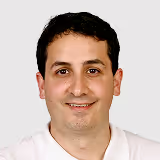
Marcel Kloos
Swiss-licensed dentist and founder of Medschool Experts
Marcel Kloos founded Medschool Experts while studying abroad; since then, over 500 study places have been secured. The Stuttgart-born dentist studied dentistry from 2015 to 2021 in Sofia and holds a Swiss dental licence.
Today he lives in Bern and runs Medschool Experts full-time as its owner.
More articles worth reading
Why Students Transfer from Medical University of Varna — Your Options
Why Students Transfer from Medical University of Warsaw — Your Options
Why Students Transfer from Masaryk University Faculty of Medicine — Your Options
Ahmad
Sabrina
Rami
Noah
500+ students placed.
Now it's your turn!
No daydreaming, no empty promises. Just a clear plan — for the start of your medical degree.
40 minutes, no obligation