Why Students Transfer from American International Medical University — Your Options
11.09.2026

Is the American International Medical University the right fit for every student?
AIMU opened in 2007 in Gros Islet, a town on the northern tip of St. Lucia. Like most Caribbean offshore medical schools, it targets applicants who could not obtain admission at a medical faculty in their home country and who are willing to pursue a US-style MD degree outside the traditional European or North American system. The institutional model is legal and regionally accredited. It has produced practising physicians. It is not, however, the frictionless alternative that recruitment materials suggest.
Caribbean offshore schools as a category carry a documented attrition problem. Fewer than 50% of students who enrol at Caribbean MD programmes complete the full degree and obtain US medical licensure, according to published analyses of ECFMG certification data. AIMU is smaller than the four largest Caribbean schools — St. George's University, American University of the Caribbean, Ross University, and Medical University of the Americas — and publishes less outcome data than any of them. The structural pressures on students are identical regardless of school size: high costs, a demanding licensing examination, fierce competition for US residency places, and, for EU students specifically, a degree that does not open European licensing doors.
Students from Germany, Austria, or Switzerland often discover one further complication: they enrolled expecting to return home and practise, not realising that an MD from St. Lucia is a non-EU degree that receives no automatic recognition in any EU country. By the time this becomes clear, one or two years of study — and $80,000–$140,000 — may already have been spent.
Why do students transfer from AIMU St. Lucia?
The decision to leave rarely comes from one cause. Most students who contact Medschool Experts describe several factors accumulating over 12 to 24 months:
- Financial strain beyond initial projections. Tuition estimates shared at enrolment often exclude clinical rotation fees, mandatory health insurance, accommodation in the United States, and repeat-semester costs when exam milestones are missed. Total expenditure regularly runs 30–40% above what students were told to expect.
- Accreditation uncertainty. AIMU holds provisional CAAM-HP (Caribbean Accreditation Authority for Education in Medicine and Other Health Professions) accreditation, not full accreditation. Provisional status affects ECFMG eligibility for USMLE exams, which in turn affects US residency applications. Students who enrolled under one accreditation status may graduate — or fail to graduate — under a different one.
- USMLE failure and academic standing. Caribbean schools typically allow a limited number of USMLE Step 1 attempts before a student is placed on academic probation or dismissed. A first failure is common; the school's response to it can be swift and severe.
- European licensing reality. Students from Germany or Austria who investigate their licensing options at year two discover that an AIMU MD does not satisfy the equivalency requirements for an Approbation. The degree was never designed to do so.
- Clinical rotation disruptions. Placement at US teaching hospitals is managed by the school, not by the student. Delays and changes to promised rotation sites have been documented publicly — including in a 2023 article in The Star St. Lucia citing a former student's experience of broken placement guarantees.
- Personal and logistical pressure. Two or more years on a small Caribbean island, far from family and professional networks in Europe, creates strains that recruitment materials do not acknowledge.
How much does AIMU medicine cost in 2026?
AIMU does not publish a complete multi-year cost breakdown. The figures below are compiled from enrolment documentation shared by former students, published Caribbean school fee schedules, and direct comparisons with AIMU's own tuition pages. All figures are USD unless stated.
| Phase | Duration | Estimated tuition | Estimated living costs | Phase total |
|---|---|---|---|---|
| Basic Sciences — St. Lucia | 4–5 semesters | $56,000–$70,000 | $28,000–$38,000 | $84,000–$108,000 |
| Clinical Rotations — USA | 2 years | $36,000–$50,000 | $50,000–$64,000 | $86,000–$114,000 |
| USMLE Steps 1 & 2 CK (prep + exam fees) | — | — | $5,000–$8,000 | $5,000–$8,000 |
| Residency application (ERAS, interviews, travel) | — | — | $3,000–$6,000 | $3,000–$6,000 |
| Estimated total | 6–7 years | — | — | $178,000–$236,000 |
Worked cost example — two years at AIMU, then transfer: A student who completes the AIMU basic sciences phase — four semesters, roughly two years on the island — will have spent approximately $112,000–$146,000 including living costs. If that same student then transfers to an EU university and enters year 4 directly, their remaining tuition at a Czech or Hungarian English-language programme is approximately €24,000–€36,000 over two to three years. At a German state university, semester fees total under €4,000 over the remaining study period. The cumulative saving against completing AIMU is, in most cases, more than $100,000.
What are AIMU's USMLE pass rates?
AIMU does not publish school-specific USMLE Step 1 first-attempt pass rates. This is itself informative: the four largest Caribbean schools all publish pass rate data voluntarily, because their figures are strong enough to market. Schools that do not publish this data typically have figures below the Caribbean average.
The most relevant benchmark is the sector-wide comparison:
| School category | Step 1 first-attempt (2024) | Step 2 CK first-attempt (2024) | ECFMG certificates issued |
|---|---|---|---|
| US MD schools (LCME) | 96% | 97% | N/A (no ECFMG required) |
| US DO schools (COCA) | 79% | 84% | N/A |
| Caribbean top 4 (full CAAM-HP) | 58–67% | 72–79% | Published annually |
| Caribbean schools (provisional accred.) | ~35–48% | Not published | Limited data |
| AIMU specifically | Not published | Not published | Not published |
ECFMG policy requires that students at offshore schools be enrolled at a CAAM-HP-accredited institution to maintain eligibility for USMLE exams. AIMU's provisional status means that eligibility is not permanently guaranteed. Students should verify their ECFMG eligibility directly before registering for any step examination — a change in AIMU's accreditation status mid-enrolment could void a student's exam registration.
Is an AIMU degree recognised in Europe for a medical career?
This is the question that surprises most AIMU students who enrolled intending to practise in Germany, Austria, or Switzerland.
EU recognition of medical degrees is governed by Directive 2005/36/EC for degrees earned within the EU or EEA, and by national equivalency law for all others. An MD from St. Lucia falls into the second category. It receives no automatic recognition anywhere in the European Union.
The practical situation by country:
- Germany (Approbation via Landesbehörde): Applications are assessed by the responsible state authority (Landesärztekammer or Regierungspräsidium depending on the state). Caribbean MDs are almost never granted direct equivalency to the German Staatsexamen. Applicants are typically directed toward a Kenntnisprüfung — a comprehensive practical state examination taken in German. The assessment process takes 12–36 months; the outcome is not guaranteed. Many Caribbean graduates fail the Kenntnisprüfung on first attempt. There is no EU treaty obligation on Germany to recognise a St. Lucia MD at any equivalency level.
- Austria (Nostrifikation via Medical University): The Austrian Medical Council requires nostrification through an Austrian medical university. Caribbean MDs are rarely nostrified; most applicants are required to repeat substantial portions of the Austrian medical curriculum, effectively restarting their studies.
- Switzerland (MedReg): The Swiss Medical Professions Act requires MedReg registration. Caribbean MDs without an ECFMG certificate and a completed US or Canadian residency are routinely rejected. Swiss authorities do not treat the AIMU MD as equivalent to a Swiss federal diploma.
- United Kingdom (GMC): Caribbean MDs may apply for GMC registration but must pass the PLAB examination (two written and practical parts) unless they have completed a US or Canadian residency. PLAB pass rates for Caribbean graduates are significantly below those of EEA graduates.
- Netherlands and Belgium: Case-by-case assessment. Both countries have rejected Caribbean MD equivalency applications at higher rates than they have approved them. Recognition is possible but not predictable.
The practical implication is stark: a student who completes the full AIMU MD programme over seven years, spends $200,000, and then applies to practise in Germany may spend a further 12–36 months in equivalency procedures with no guaranteed outcome. A student who transfers to a German, Austrian, Czech, Hungarian, or Slovak university and completes their degree there faces no recognition issue whatsoever — an EU degree earns automatic EU recognition under the Medical Professionals Directive.
What happens if I fail exams at AIMU or lose student status?
AIMU's academic standing policy, consistent with most Caribbean schools, operates on a tiered escalation model. A first failure on USMLE Step 1 typically triggers academic probation. A second failure, or failure to attempt the examination within the maximum permitted time window, generally results in academic dismissal. Dismissal from AIMU is permanent and is not subject to appeal in most cases.
Dismissal while in the United States for clinical rotations creates an immediate immigration problem. J-1 visa sponsorship is tied to institutional enrolment; dismissal terminates that sponsorship. A dismissed student has a narrow window — typically 30 to 60 days — to either appeal, transfer sponsorship to another institution, or depart the United States. Students in this position have no time for a deliberate transfer process. Acting before that point is essential.
Even without formal dismissal, a failed USMLE Step 1 dramatically narrows residency options. The majority of US residency programmes filter Caribbean applications by Step 1 score; a failed attempt on record, even if subsequently passed, is disclosed on the USMLE transcript and factors into programme screening. For students whose residency options were already limited by their Caribbean origin, a failed step can effectively close the door to competitive specialties entirely.
The earlier a student recognises that the Caribbean route is not working, the more options remain open. Students who have completed basic sciences but have not yet attempted Step 1 — or who have not yet failed it — have the cleanest transfer profiles. Their transcripts show completed coursework without a failed licensing exam on record.
Can I transfer from AIMU without losing years of study?
Yes — and the credits recovered depend far more on your individual transcript and the target university's curriculum mapping than on any Caribbean school policy. Here is how the process works through Medschool Experts:
- Transcript assessment. Your AIMU course transcript is evaluated against the curricula of European target universities. Basic sciences subjects — anatomy, physiology, biochemistry, pathology, pharmacology, microbiology, genetics — map directly to European preclinical curricula in most cases. A completed basic sciences phase at AIMU typically corresponds to years 1–3 of a European MD programme.
- University matching. Medschool Experts works with partner universities in Germany, Austria, the Czech Republic, Hungary, Slovakia, Romania, and other EU countries that accept transfer students. The realistic entry point ranges from year 3 to year 5 based on completed credits and the target university's own equivalency assessment.
- No ceiling on credit recognition. We have placed students completing their AIMU basic sciences phase directly into year 4 clinical programmes, and students with additional USMLE preparation directly into year 5. There is no policy that forces you to begin from year 1. The entry point is the one that matches your completed academic record.
- Language requirements. Most Eastern European English-language programmes require no additional language preparation. German-language programmes at Austrian, German, or Swiss universities require B2–C1 German proficiency; language preparation can run in parallel with the transfer application.
- Timeline. From initial consultation to confirmed enrolment at a European university takes an average of 7–9 months. The process is entirely manageable alongside continuing to study or work.
What alternatives exist for AIMU medicine students?
Students transferring from AIMU typically have three credible destination paths, depending on their academic profile, language skills, and career goals:
Option 1 — Eastern European English-language MD programmes. Universities in the Czech Republic (Charles University Prague, Masaryk University Brno), Hungary (Semmelweis University Budapest, University of Pécs), Slovakia (Comenius University Bratislava), and Romania offer full English-language MD programmes with EU-recognised degrees. Annual tuition ranges from €8,000 to €18,000. A student entering year 4 faces two to three additional years of study at a fraction of the AIMU total cost. EU-graduate physicians face no recognition barriers in Germany, Austria, or any EU member state. Explore our partner universities for specific profiles and admission requirements.
Option 2 — German or Austrian state universities. For students with strong German (B2–C1) or willing to invest 12–18 months in language preparation, German and Austrian state universities charge minimal semester contributions (€150–€1,000 per semester). Admission as a transfer student requires curriculum equivalency assessment and, in most cases, a university-specific aptitude procedure. Medschool Experts manages the full application process for students with a suitable profile. The long-term outcome — a German or Austrian state university degree — is the most direct route to German Approbation.
Option 3 — Remaining on the US route at a better-positioned school. Students who have already passed USMLE Step 1 and whose genuine goal is US medical practice may consider transferring their clinical rotations to a more established Caribbean school (SGU or AUC) or pursuing a DO post-baccalaureate pathway. This option is only appropriate for students whose career goal is specifically US residency and practice — not European licensure. Learn more about our full service offering for students on the US track.
A free 45-minute consultation with Medschool Experts produces a written assessment of your transfer options, the universities most likely to accept your credits, and an estimated timeline and cost comparison. There is no obligation and no fee for the initial consultation. Book your free consultation here.
Month-by-month: your transfer plan from AIMU
The following plan applies to a student currently in the AIMU basic sciences phase, targeting a European university with English-language instruction and a September or October intake.
Month 1 — Initial assessment: Book a free consultation with Medschool Experts. Prepare your AIMU transcript, a list of completed courses, and any USMLE preparation documentation. The consultation identifies realistic target universities, the entry year you are likely to qualify for, and an honest assessment of your transfer profile including any complicating factors.
Months 2–3 — Document preparation: Gather official AIMU transcripts (request certified copies from the academic registrar), your enrolment certificate, course syllabi or descriptions, a current CV, and a personal statement. Documents may require certified translation for German, Austrian, or Slovak programmes. Medschool Experts provides a document checklist tailored to each target university's requirements.
Month 4 — Application submission: Applications are submitted to three to six universities in parallel, staggered by application deadline. Medschool Experts manages the application files, follows up with admissions offices, and handles queries that arise during the review period.
Months 5–7 — Interviews and offers: Most European universities require an academic interview, either online or on-site. Medschool Experts prepares students for the format and content of each institution's specific interview. Offers typically arrive four to eight weeks after the interview. Once an offer includes a credit recognition decision — the year of entry — it is confirmed in writing.
Months 7–8 — Enrolment logistics: EU and EEA students require no visa. Non-EU students apply for a student visa for the target country — processing takes four to six weeks in most cases. University enrolment documentation is submitted once the offer is formally accepted.
Month 9 — First day at a recognised European faculty: Students who follow this plan are enrolled at a university whose degree opens the door to German, Austrian, and EU-wide medical licensure without equivalency hurdles. Read what previous transfer students experienced at our student stories page.
Meinung des Autors
Every week I speak with students who enrolled at AIMU or another Caribbean school because they believed it was their only viable route into medicine. In the majority of cases, it was not — but the information that would have led them to a different decision was simply not available to them at the moment of enrolment. The Caribbean offshore sector is well-resourced at marketing. The accreditation caveats, the EU recognition limitations, and the realistic USMLE pass rates appear in fine print, if they appear at all.
What I tell every AIMU student who contacts us: the decision you made at 19 or 20 does not have to govern the next decade of your professional life. The academic work you have completed — anatomy, physiology, biochemistry, pathology, pharmacology — is real, transferable, and recognised by the European universities we work with. The question is not whether time has been lost. It is whether you would rather spend two more years completing a degree that may not open the EU doors you want, or spend nine months in a structured transfer process to a university whose degree unambiguously does.
For the overwhelming majority of students we work with, the comparison is obvious once they see it in writing. That is exactly what the free initial consultation is designed to provide: clarity, in writing, about what your options actually are. — Marcel Kloos, Medschool Experts
Summary: Transferring from AIMU is achievable — and for many students, the right call
AIMU in St. Lucia offers a legal route to a US-style MD degree. It is not a fraudulent institution, and it has produced practising physicians. But it is expensive — commonly exceeding $180,000 USD in total cost — the USMLE first-attempt pass rates at Caribbean schools significantly trail those of US MD programmes, the degree is not recognised in any EU country, and for students targeting a German or Austrian Approbation, it provides no direct pathway.
Students who recognise these realities early have the strongest transfer outcomes. Basic sciences credits from AIMU transfer well to European curricula. Entry at year 4 or year 5 at a European university is achievable for students who have completed the basic sciences phase, with no arbitrary ceiling on credit recognition. The financial saving against completing the AIMU programme is, in most cases, more than $100,000 in remaining tuition and living costs.
If you are at AIMU now, in your first or second year, and the programme is not working as expected — financially, academically, or in terms of what the degree will do for your European career — the transfer window is still open. It will not stay open indefinitely. Speak to Medschool Experts for a free, no-obligation assessment of your transfer options.
Frequently Asked Questions — Transfer from AIMU St. Lucia
Does AIMU hold full CAAM-HP accreditation?
AIMU holds provisional CAAM-HP accreditation, not full accreditation. Provisional status means the institution is progressing through the accreditation process but has not yet satisfied all requirements for full status. This distinction matters for ECFMG eligibility (required to sit USMLE steps) and for US residency applications, which scrutinise accreditation status. Students should verify their current ECFMG eligibility directly with ECFMG before registering for any step exam.
Can I practise medicine in Germany with an AIMU degree?
Not directly. An AIMU MD is a non-EU degree and receives no automatic recognition in Germany. You would need to apply for equivalency assessment through the responsible state authority (Landesbehörde). Caribbean MDs are almost never granted direct equivalency to the German Staatsexamen; most applicants face a Kenntnisprüfung (comprehensive state examination in German) whose outcome is not guaranteed. For most AIMU students, transferring to an EU university is a faster and more certain route to German Approbation than attempting to have the AIMU MD recognised post-graduation.
Will I lose all my years of study if I transfer from AIMU?
No. Students who have completed the AIMU basic sciences phase (typically years 1–2, four semesters) qualify for entry at year 3, 4, or even year 5 at partner European universities, depending on the specific institution and curriculum comparison. Medschool Experts has placed students directly into year 5 clinical programmes. There is no blanket rule requiring you to start from year 1.
How long does the transfer process take?
From initial consultation to confirmed enrolment, the average duration is 7–9 months. The process runs in defined stages — assessment, document preparation, applications, interviews, and enrolment logistics — with clear milestones at each step. A free initial consultation can be booked at any time and takes approximately 45 minutes.
What if I have already failed USMLE Step 1?
A failed Step 1 does not close the transfer door. European universities assess academic transcripts and — where applicable — university-specific entrance examinations or interviews. A USMLE failure does not appear on a European university application and does not affect your eligibility to apply to EU medical faculties. Your completed AIMU course record is the primary assessment criterion. Contact Medschool Experts to discuss how a failed step affects your specific transfer profile.
Can I transfer mid-year, or do I need to wait until the end of an academic year?
Most European universities accept transfer students at the start of a new academic year (September/October) or, at some institutions, at a February/March intake. Mid-semester transfers are generally not possible. The practical implication: if your target intake is October, your transfer application process should begin no later than January of that year — ideally earlier. Starting the free consultation now, regardless of where you are in the current AIMU semester, leaves you the most options for upcoming intakes.
What students say about Medschool Experts
Over 500 placements at more than 25 partner universities across 10+ countries. Read independent student reviews on Trustpilot.
About the author
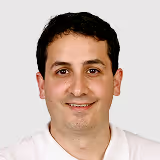
Marcel Kloos
Swiss-licensed dentist and founder of Medschool Experts
Marcel Kloos founded Medschool Experts while studying abroad; since then, over 500 study places have been secured. The Stuttgart-born dentist studied dentistry from 2015 to 2021 in Sofia and holds a Swiss dental licence.
Today he lives in Bern and runs Medschool Experts full-time as its owner.
More articles worth reading
Why Students Transfer from Medical University of Varna — Your Options
Why Students Transfer from Medical University of Warsaw — Your Options
Why Students Transfer from Masaryk University Faculty of Medicine — Your Options
Ahmad
Sabrina
Rami
Noah
500+ students placed.
Now it's your turn!
No daydreaming, no empty promises. Just a clear plan — for the start of your medical degree.
40 minutes, no obligation