Why Students Transfer from Jagiellonian University Medical College — Your Options
11.09.2026

Is Jagiellonian University medical degree recognized in Germany?
Yes — a medical degree from Jagiellonian University Medical College is recognised in Germany under EU mutual recognition directives (Directive 2005/36/EC). Graduates can apply for German medical licensure (Approbation) through state medical chambers (Landesärztekammern). However, recognition is not automatic and involves document submission, language proficiency verification (typically C1 German), and in some federal states a knowledge examination (Kenntnisprüfung). The process can take six to eighteen months and varies significantly between Bundesländer.
What recognition means in practice is that JU MC graduates are not excluded from German careers — but the Approbation process is substantive, not a rubber stamp. Students who complete fewer than six years at JU MC but transfer to another European medical programme may still graduate from a fully recognised institution and follow the same Approbation pathway. The key factor is graduating from an EU-accredited medical school, not specifically from Jagiellonian.
How much does studying medicine at Jagiellonian really cost?
The headline tuition fee of €12,000–€14,000 per academic year is only part of the picture. Add Kraków living costs, accommodation, health insurance, course materials, and examination retake fees, and the true annual cost for an international student regularly exceeds €20,000. Over six years, this compounds significantly — and students who repeat a year due to exam failure pay a full additional year's tuition on top of their normal costs.
| Cost Category | JU MC (Kraków) | Slovak / Czech Transfer School | Other EU English-Programme |
|---|---|---|---|
| Annual Tuition | €12,000–€14,000 | €9,000–€13,000 | €8,000–€15,000 |
| Accommodation (annual) | €4,800–€8,400 | €3,600–€6,000 | €3,000–€7,200 |
| Living Expenses (excl. rent) | €4,800–€7,200 | €3,600–€6,000 | €3,600–€6,000 |
| Exam Retake Fees (est.) | €300–€1,200 | €0–€500 | €0–€800 |
| Estimated Annual Total | €21,900–€30,800 | €16,200–€25,500 | €14,600–€29,000 |
The table above illustrates why many students who transfer do so partly for financial reasons. A saving of €5,000–€8,000 per year across the remaining years of study can represent €20,000–€40,000 over a full degree — a material difference that affects both quality of life during training and debt burden at graduation.
How hard are the exams at Jagiellonian Medical College?
Jagiellonian's preclinical exams are among the most demanding in European medical education. Anatomy, physiology, and biochemistry examinations in Years 1 and 2 have historically recorded first-attempt failure rates that significantly exceed those seen at comparable Western European institutions. Multiple retake attempts are common, and students who exhaust their permitted retake attempts must repeat the entire academic year at full tuition cost.
The examination culture at JU MC is oral and practical, not just written. Anatomy viva examinations require students to identify structures on prosected specimens and explain their clinical significance in real time. Physiology practicals involve interpreting live experimental data. This format rewards deep understanding but is less forgiving of the strategic revision approaches that many students successfully used in their secondary education. International students who arrived via intensive tutoring-heavy pathways often find the adjustment particularly steep.
From Year 3 onward, the difficulty does not reduce — it shifts. Pathophysiology, pharmacology, and microbiology join a growing clinical workload. By Year 4, students are expected to communicate with patients and supervisors in Polish. For students who arrived without Polish language training, this transition is where many final decisions about transferring are made.
Can I transfer from Jagiellonian to a German or Austrian university?
Direct transfer into a German or Austrian state university medical programme is extremely rare and structurally very difficult. German state universities do not routinely accept lateral entrants into clinical semesters, and their capacity allocation system does not easily accommodate credit transfer from non-German institutions. Austrian universities follow similar rules. However, transfer to another EU-accredited medical school — from which you then graduate — is a realistic and well-trodden path.
Students who transfer to a medical school in Slovakia, Czech Republic, Hungary, or another EU country with an English-language programme can often receive credit recognition for completed years at Jagiellonian, continue from their current study year, and graduate from a fully EU-recognised medical degree. Students in Year 4 or Year 5 at JU MC have successfully transferred and continued at an equivalent year level at the receiving institution.
| Current Year at JU MC | Credit Transfer Potential | Most Viable Destinations | Typical Years Remaining | Notes |
|---|---|---|---|---|
| Year 1 | Low–Medium | Slovakia, Czech Republic, Hungary, Romania | 5 years | Early transfer preserves maximum flexibility |
| Year 2 | Medium | Slovakia, Czech Republic, Hungary, Poland (other schools) | 4 years | Anatomy and physiology credits often recognised |
| Year 3 | Medium–High | Slovakia, Czech Republic, Bulgaria, Romania | 3–4 years | Strong case for Year 3 entry at receiving school |
| Year 4 | High | Slovakia, Hungary, Czech Republic, Romania | 2–3 years | Clinical year credit transfer increasingly common |
| Year 5 | Very High | Slovakia, Czech Republic, Hungary | 1–2 years | Most credits recognised; final year or clinical completion |
What happens if I fail at Jagiellonian Medical College?
At JU MC, each examination may typically be attempted a limited number of times within a given academic year. Students who fail beyond the permitted attempts are required to repeat the academic year (powtarzanie roku), incurring a full year's tuition fees again. Multiple year repetitions can lead to academic dismissal under JU MC's progression rules. Beyond the financial cost, repeated failure creates a significant psychological toll and can delay qualification by two or more years.
For students facing this situation, proactive transfer planning is strongly recommended over waiting to see whether the next attempt succeeds. A student who transfers after one failed year rather than three saves both money and time — and arrives at a new institution without the morale damage that comes from extended failure cycles. Medschool Experts advisors regularly work with students in precisely this situation, and earlier intervention consistently leads to better outcomes than delayed decision-making.
Is Jagiellonian medicine degree valid in Switzerland?
Switzerland recognises EU medical degrees under the Agreement on the Free Movement of Persons (AFMP) between Switzerland and the EU. A Jagiellonian University medical degree qualifies for recognition by the Swiss Medical Association (FMH) and entitles graduates to apply for the Swiss Federal Diploma (Eidgenössisches Diplom), provided language competency requirements are met for the relevant Swiss language region (German, French, or Italian). The pathway mirrors the EU recognition process in most respects.
Practical considerations for Switzerland include the requirement for a cantonal Berufsausübungsbewilligung (professional licence to practise), which typically requires C1 proficiency in the local official language. Switzerland also operates a managed migration framework for non-EU healthcare workers, and the specifics depend on nationality. EU citizens generally face a simpler route; non-EU graduates may encounter additional steps. Students uncertain about their specific situation should obtain country-specific guidance before making study decisions.
Free Consultation — We Find Your Solution
Whether you want to transfer, reduce costs, or explore European pathways — our advisors have helped hundreds of students from Jagiellonian. Book your free 30-minute consultation →
How does Jagiellonian compare to other Polish medical schools?
Jagiellonian University Medical College consistently ranks first among Polish medical schools and among the top medical faculties in Central Europe. Its research output, clinical affiliations, and academic standing set it apart from other Polish institutions. However, for international students in the English-language programme, these distinctions matter less than they might appear — because EU mutual recognition means that a degree from the Medical University of Warsaw, Wrocław, Gdańsk, or Poznań carries the same Approbation eligibility in Germany as a JU MC degree.
Where JU MC stands apart operationally is in its examination rigour and its firm Polish language requirement from Year 4 onward. Some other Polish medical universities have extended English-medium instruction further into the clinical years, while JU MC has maintained a hard transition to Polish-language clinical rotations. For German-speaking students specifically, this creates a situation where they must achieve proficiency in English (the language of study), Polish (the language of clinical practice), and later German (the language of their career) — a triple language burden that many find unsustainable over a six-year programme.
What are the living costs in Kraków as a medical student?
Kraków has become one of the most expensive cities in Poland for students, driven by its status as a major tourism and technology hub. Monthly living costs for a medical student — including rent, food, transport, utilities, and social spending — typically fall between €800 and €1,400 depending on housing choice and lifestyle. Shared apartments in the city centre or near the university hospitals cost €450–€700 per person per month, and solo accommodation frequently exceeds €700.
These figures represent a significant increase from five years ago, when Kraków was routinely cited as an affordable Central European alternative to Western cities. The convergence of Polish and Western European living costs has eroded one of JU MC's historic selling points. Students comparing Kraków costs with university towns in Slovakia or Hungary — where living costs remain measurably lower — increasingly find that the prestige premium of JU MC comes at a tangible ongoing financial price.
Month-by-Month Transfer Timeline
Transferring medical schools is a structured process that requires advance planning. The following timeline reflects a typical process for a student deciding to transfer between academic years.
The timeline above reflects a best-case scenario for a well-organised transfer. In practice, document collection from JU MC — certified transcripts, course outlines, confirmation of enrolment, apostille certifications — often takes longer than students expect. Some universities also require additional academic assessment or an interview before confirming year placement. Beginning the process at least six months before the intended start date at the new school is strongly advisable.
Total Cost Worked Example: 6 Years at JU MC vs. Transfer After Year 2
The following example assumes a student who began at JU MC and is considering transferring after completing Year 2 to a comparable EU-accredited medical school in Slovakia or Czech Republic, where tuition runs approximately €10,000–€12,000 per year and living costs average €700–€900 per month.
Scenario A: Completing all 6 years at JU MC
- Tuition (6 years × €13,000): €78,000
- Living costs (6 years × €12,000): €72,000
- Examination retake fees (estimated): €2,400
- Total estimated cost: €152,400
Scenario B: Transfer after Year 2 to a lower-cost EU medical school
- Tuition at JU MC (2 years × €13,000): €26,000
- Living at JU MC (2 years × €12,000): €24,000
- Tuition at transfer school (4 years × €11,000): €44,000
- Living at transfer school (4 years × €9,600): €38,400
- Total estimated cost: €132,400
- Estimated saving vs. Scenario A: €20,000
These figures are illustrative. Real outcomes depend on credit recognition (which affects the number of years required at the new school), individual accommodation choices, and any examination retake costs avoided by changing environment. Some students who transfer also report improved examination performance at their new institution — eliminating the retake costs that accumulate at JU MC and potentially shortening the overall study duration.
The author's view
I have worked with medical students navigating difficult decisions for many years, and the students who come to us after starting at Jagiellonian are among the most driven and academically capable I encounter. They chose JU MC for good reasons — prestige, EU recognition, a city they loved the idea of living in — and they are not people who give up easily. When they reach out to us, it is usually after months of trying harder, retaking exams, and attempting to reach a Polish language standard they were never properly warned would be required. The decision to consider transferring is, for most of them, an act of clarity and courage, not defeat.
What I find most frustrating in this space is the information gap at the admissions stage. Students who enrol in Jagiellonian's English-language programme are often genuinely surprised when they discover the scale of the Polish language requirement from Year 4, or the statistical reality of first-attempt failure rates in preclinical subjects. Better upfront information would lead to better-informed decisions at the outset — and some students who currently struggle at JU MC might have chosen a different path from the beginning. As it stands, we help them find that path after the fact, and we are committed to doing so well.
My honest assessment: transferring from Jagiellonian, done correctly and at the right moment, does not set a career back. In many cases I have watched it set a career forward — students who were trapped in an exam failure cycle at JU MC arrive at a new institution, reset their academic momentum, pass examinations on first attempt, and graduate on schedule. The medical degree at the end of the process is equally valid, the Approbation pathway is identical, and the student arrives in residency not as someone who failed but as someone who made a mature, considered decision under difficult circumstances. That is a story any medical employer can respect. — Marcel
Summary
- Jagiellonian University Medical College is Poland's most prestigious medical school, but its rigorous preclinical examinations create high failure and repeat rates for international students.
- Annual costs including living expenses regularly exceed €20,000, making JU MC one of the more financially demanding English-language medical programmes in Central Europe when all costs are considered.
- From Year 4 onward, Polish language proficiency is required for clinical rotations — the single most common trigger for transfer decisions among international students.
- A JU MC medical degree is fully recognised for Approbation in Germany, ÄAK registration in Austria, and FMH recognition in Switzerland — but the process involves substantive steps beyond simple credential submission.
- Transfer to another EU-accredited medical school is a realistic, proven pathway that preserves academic progress and does not necessarily extend the total duration of study.
- Students in Year 4 or Year 5 at JU MC can and do transfer successfully, completing their degrees at comparable institutions with strong credit recognition outcomes.
- Earlier transfer generally results in greater financial savings and more flexibility in choosing a receiving institution.
- The transfer process typically takes five to seven months from first consultation to enrolment — early planning is the single most important factor in a successful outcome.
Conclusion
Transferring from Jagiellonian University Medical College is not a failure — it is a strategic decision made by hundreds of international medical students each year. The circumstances that make JU MC an appealing choice at the application stage — its prestige, its EU recognition, its location — remain real. What changes for many students is the discovery that the full costs, language requirements, and examination culture were not fully communicated at the point of admission. A well-informed transfer decision, supported by proper academic and administrative guidance, allows students to complete their medical education at an institution better suited to their circumstances without losing the years they have already invested.
Medschool Experts has supported hundreds of students navigating exactly this transition. Our advisors understand the specific credit frameworks, intake calendars, and institutional requirements across Central and Eastern European medical schools, and we provide honest, personalised guidance. If you are weighing your options, the first conversation costs nothing. Book your free consultation today →
Frequently Asked Questions about Transferring from Jagiellonian University Medical College
Can I transfer from Jagiellonian to a medical school in Germany directly?
Direct lateral transfer into a German state university medical programme is not a standard route. German universities do not operate a structured credit transfer system for students from foreign medical schools entering clinical semesters. The practical alternative — and the path taken by most students in this situation — is to transfer to another EU-accredited medical school in Central or Eastern Europe, complete the degree there, and then apply for German Approbation as a graduate of an EU medical school. This route is well-established and does not require starting from scratch.
Will I lose all my credits if I transfer from Jagiellonian?
No — credit loss depends on the receiving institution's assessment of your completed coursework, not on an automatic rule. Universities in Slovakia, Czech Republic, Hungary, and other EU countries regularly assess transcripts from JU MC and recognise credits for subjects studied at an equivalent level. Students who have completed Year 2 or Year 3 at Jagiellonian commonly receive recognition that allows them to enter Year 3 or Year 4 at the new institution. Year 4 and Year 5 students have also transferred successfully with substantial credit recognition for completed clinical rotations.
Do I need to withdraw from Jagiellonian before applying to transfer?
In most cases, students apply to receiving institutions while still enrolled at JU MC and withdraw only after receiving a confirmed offer and place at the new school. Withdrawing before receiving a confirmed offer is strongly inadvisable, as it removes the safety net of being able to remain at JU MC if the transfer application is unsuccessful. Your Medschool Experts advisor will help you coordinate the timing of withdrawal and enrolment to minimise any gap in your student status.
How long does the transfer process take from start to finish?
A realistic timeline from initial consultation to first day of classes at the new institution is five to seven months. Key factors that influence duration include the speed with which JU MC issues certified transcripts and course syllabi, the intake calendar of the receiving institution, the need for document translation or apostille certification, and whether the receiving university requires an interview or academic assessment before confirming year placement. Starting the process as early as possible is the single most effective way to keep the timeline manageable.
Does transferring from Jagiellonian affect my Approbation eligibility in Germany?
No — what matters for German Approbation eligibility is graduating from an EU-accredited medical school, not which specific school that is. A student who begins at Jagiellonian and completes their degree at a medical university in Slovakia, Czech Republic, or Hungary is equally eligible for Approbation as one who spent all six years at JU MC. The Approbation process itself — document submission, language verification, and in some states an aptitude test — applies identically regardless of which EU medical school issued the degree.
What documents do I need to begin the transfer process?
Common documents include official academic transcripts certified by JU MC, detailed course syllabi or module descriptions for each completed subject, proof of enrolment or a letter of good standing from JU MC, your original medical school admission letter, a copy of your secondary school qualification (Abitur, Matura, A-levels, etc.), a valid passport, and passport photographs. Some universities also request a personal statement or reference letter. Medschool Experts provides a personalised document checklist as part of the initial consultation, tailored to the specific receiving institution.
Can I transfer in the middle of an academic year, or only between years?
Most medical schools in Central and Eastern Europe admit transfer students at the start of an academic year — typically in September or October — rather than mid-year. A small number of institutions have a February intake for certain years of study, but mid-year transfers are the exception rather than the rule. Students who decide to transfer during an ongoing semester should plan for the likelihood that they will complete the current semester at JU MC before moving, rather than leaving mid-semester and losing credits from that term.
What happens to my student visa or residence permit if I transfer?
EU citizens studying in Poland do not require a visa but should notify the relevant local authority of their change of address when relocating. Non-EU students holding a Polish temporary residence permit for the purpose of study will typically need to end their Polish permit and apply for a new student residence permit in the receiving country. The exact process depends on nationality and destination country. This step should be addressed early in the transfer planning process — Medschool Experts advisors can connect you with appropriate immigration guidance for your specific situation.
What students say about Medschool Experts
Over 500 placements at more than 25 partner universities across 10+ countries. Read independent student reviews on Trustpilot.
About the author
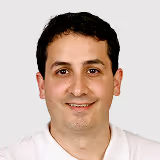
Marcel Kloos
Swiss-licensed dentist and founder of Medschool Experts
Marcel Kloos founded Medschool Experts while studying abroad; since then, over 500 study places have been secured. The Stuttgart-born dentist studied dentistry from 2015 to 2021 in Sofia and holds a Swiss dental licence.
Today he lives in Bern and runs Medschool Experts full-time as its owner.
More articles worth reading
Why Students Transfer from Medical University of Varna — Your Options
Why Students Transfer from Medical University of Warsaw — Your Options
Why Students Transfer from Masaryk University Faculty of Medicine — Your Options
Ahmad
Sabrina
Rami
Noah
500+ students placed.
Now it's your turn!
No daydreaming, no empty promises. Just a clear plan — for the start of your medical degree.
40 minutes, no obligation