Why Students Transfer from Medical University of Plovdiv — Your Options
11.09.2026

Is Medical University of Plovdiv Recognized in Germany, Austria, and Switzerland?
Medical University of Plovdiv holds EU accreditation and is listed in the World Directory of Medical Schools (WDOMS). This means its degree is, in principle, eligible for recognition across EU member states including Germany, Austria, and Switzerland. However, "eligible for recognition" and "automatically recognized" are not the same thing. In Germany, the Approbation process requires evaluation by the Approbationsbehörde of the relevant Bundesland, and outcomes vary — some states require Kenntnisprüfungen (knowledge examinations) for Plovdiv graduates, particularly where clinical training was completed predominantly in Bulgarian state hospitals rather than internationally accredited facilities. Austrian and Swiss recognition offices similarly conduct individual equivalence assessments. Contact us for current recognition requirements in your target country, as rules change frequently.
The practical risk for many students lies in the clinical training documentation. A significant share of rotations at MUP takes place in Bulgarian state hospitals where record-keeping and supervising consultants may not produce the standardised evidence that German or Austrian licensing offices expect. Students who graduate without supplementing their Plovdiv training abroad can find themselves facing additional hurdles — at exactly the moment they expected to start working.
How Much Does Studying Medicine in Plovdiv Really Cost?
The advertised tuition of €6,000–€8,000 per year is only part of the story. When you factor in accommodation near the city centre, monthly transport, study materials, health insurance, repeat examination fees, and social costs of daily life in Plovdiv, the annual total climbs considerably. Most international students at Medical University of Plovdiv spend between €12,000 and €16,000 per year when all costs are honestly accounted for. Over a six-year programme, that means a total outlay of €72,000–€96,000 — a figure that directly competes with, and in many cases exceeds, the cost of studying at comparable European universities with stronger international recognition profiles.
| University / Country | Annual Tuition (€) | Est. Living Costs (€/yr) | 6-Year Total (€) |
|---|---|---|---|
| Med. Univ. Plovdiv (Bulgaria) | 6,000–8,000 | 6,000–8,000 | 72,000–96,000 |
| Med. Univ. Łódź (Poland) | 10,000–12,000 | 5,500–7,500 | 93,000–117,000 |
| Palacký Univ. Olomouc (Czech Rep.) | 11,000–14,000 | 6,000–8,000 | 102,000–132,000 |
| Univ. of Pécs (Hungary) | 12,000–14,000 | 6,500–8,500 | 111,000–135,000 |
| Semmelweis Univ. Budapest (Hungary) | 15,000–16,500 | 7,000–9,000 | 132,000–153,000 |
| Charles Univ. Prague (Czech Rep.) | 14,000–18,000 | 7,000–9,000 | 126,000–162,000 |
| All figures are estimates for the 2025–2026 academic year. Contact us for updated costs and current available pathways. | |||
Why Do So Many International Students Fail Exams at Plovdiv Medical University?
Failure rates among international students at Medical University of Plovdiv are discussed openly in dedicated online forums and Facebook groups. The core preclinical subjects — Anatomy, Biochemistry, Physiology, and later Pathophysiology and Pathological Anatomy — have consistently seen significant failure rates among international cohorts. Several structural factors drive this. First, while lectures are delivered in English, practical lab sessions and clinical placements increasingly shift toward Bulgarian, disadvantaging students who have not invested heavily in language learning outside their studies. Second, MUP's examinations have traditionally favoured the exhaustive rote memorisation of Bulgarian medical textbooks over the evidence-based critical reasoning many international students trained under at home. Third, international students often lack the peer study networks and informal tutoring channels that Bulgarian domestic students rely on.
What Happens If You Fail Exams at Medical University of Plovdiv?
Under MUP's academic regulations, students who fail an examination are typically entitled to two retake sittings within the same academic year. If they exhaust both retakes without passing, they must repeat the entire academic year — incurring another full year of tuition (€6,000–€8,000) and living costs (€6,000–€8,000). Students who repeat a year twice for the same subject risk permanent dismissal from the programme. The financial and psychological toll falls disproportionately on international students, who face these crises far from home with limited local support. Each repeated year delays graduation and adds to the total investment, and those delays ripple forward into licensing timelines in the destination country — meaning time lost now compounds into time lost later.
Can I Transfer from Medical University of Plovdiv to Another European University?
Yes — transferring between European medical faculties is entirely feasible, and hundreds of students complete this process each year. The transfer process involves applying directly to the receiving university, submitting your academic transcripts and course syllabi from Plovdiv, and going through a credit recognition (equivalence) assessment. The receiving faculty then determines which of your completed subjects align with their curriculum and at which year level you can continue. Transfer is most straightforward during or after the second year, though students in Year 3 and Year 4 have also successfully transferred, depending on the destination institution and country. The critical first step is identifying which universities are genuinely open to transfer students from Bulgarian institutions — and that is exactly what our advisors map out in a free initial consultation.
How Many Credits from Medical University of Plovdiv Can I Transfer?
Credit recognition from Medical University of Plovdiv varies by destination country and receiving institution, but the picture is generally more positive than many students assume. Students who transfer after completing Year 2 at Plovdiv commonly receive Year 2 equivalence at the receiving institution. Students transferring after Year 3 have achieved Year 3 or Year 4 standing at certain universities, particularly where Plovdiv's strong preclinical curriculum — Anatomy, Histology, Biochemistry, Physiology — aligns closely with European standards. In principle, recognition can extend up to Year 4 or Year 5 depending on the curriculum match. We never cap what is possible; the outcome depends on the receiving institution and how well the transfer portfolio is prepared.
| Years Completed at Plovdiv | Typical Equivalence Granted | Key Documents Required | Estimated Timeline |
|---|---|---|---|
| After Year 1 | Year 1 (subject-by-subject review) | Transcripts, syllabi, motivation letter | 3–5 months |
| After Year 2 | Year 2 equivalence (most common outcome) | Full portfolio incl. lab records | 3–6 months |
| After Year 3 | Year 3 or Year 4 (institution-dependent) | Full transcripts + clinical documentation | 4–7 months |
| After Year 4 | Year 4 or Year 5 (select institutions) | Detailed clinical log + supervisor references | 5–8 months |
| Recognition outcomes vary by destination institution. Contact us for current requirements at specific universities. | |||
What Are the Best European Medical Universities for Students Leaving Plovdiv?
The most commonly chosen destinations for students transferring from Medical University of Plovdiv include universities in Poland, the Czech Republic, Hungary, Romania, and Malta. Polish medical universities — including those in Wrocław, Poznań, Katowice, and Łódź — have established experience handling transfer applications and structured equivalence assessment processes. Czech universities in Olomouc and Brno offer strong English-language programmes with a history of accepting transfer students. Hungary's universities in Pécs and Debrecen provide strong clinical training environments. The right choice depends on your year of study, long-term destination country, budget, and academic profile — all factors that a personalised advisory consultation helps you weigh properly rather than guessing from forum posts.
Free Consultation — We Find Your Solution
Whether you want to transfer, reduce costs, or explore European pathways — our advisors have helped hundreds of students from Plovdiv. Book your free 30-minute consultation →
Month-by-Month: When and How to Start Your Transfer from Plovdiv Medical University
Transferring from Plovdiv requires careful timing. Most European medical universities accept transfer applications for the following academic year, with windows typically running from late autumn through early spring. Below is a practical guide to working through the process.
October – November: Begin researching your options. Review which universities in your target country offer English-language medicine and explicitly mention transfer policies. Note application windows, which vary by institution.
December: Book a consultation with a transfer advisor. This step compresses months of research into a clear shortlist of realistic options for your specific academic profile and target country.
January – February: Gather your documentation. You will typically need: certified copies of your Plovdiv transcripts with apostille, official course syllabi for completed subjects (obtainable from MUP's international office), certified translations into the destination country's language, proof of enrollment or withdrawal from MUP, and your personal statement. Begin certified translations early — they take longer than most students expect.
March – April: Submit your applications. Most transfer application deadlines fall within this window. Late applications are rarely accepted for the same academic year. Apply to multiple institutions simultaneously to preserve your options.
May – July: Await decisions and credit assessments. Receiving universities may request additional documentation during this period. Respond promptly — delays here can cost you a place.
July – August: Confirm your place, arrange accommodation and visa or residence documentation where applicable, and plan your departure from Plovdiv. Notify Medical University of Plovdiv of your withdrawal in writing and request your original documents.
September: Begin your new programme, typically at Year 2, Year 3, or Year 4 level depending on your transfer outcome.
What Does a Transfer from Plovdiv Medicine Actually Cost? A Worked Example
Understanding the transfer cost helps you compare it against the cost of continuing — and potentially repeating years — at Plovdiv. Here is a realistic worked cost example for a student who has completed two years at MUP and transfers to a Polish or Czech university for Year 3.
One-time transfer costs (approximate ranges):
- Certified document translations (5–8 documents): €400–€800
- Apostille fees and notarisation: €150–€300
- University application fees (2–3 institutions): €150–€300
- Visa or residence permit where applicable: €80–€250
- Travel and relocation to new city: €500–€2,000
- Advisory service: contact us for current rates
Realistic total one-time transfer cost: approximately €1,300–€3,700
Compare this to the cost of repeating even one academic year at Plovdiv — €6,000–€8,000 in tuition plus €6,000–€8,000 in living costs, totalling €12,000–€16,000 for a single repeated year. The financial case for acting decisively is clear: students who delay a transfer by one academic year typically spend more on that year than the entire transfer process would have cost them.
The Author's View
I have spoken with hundreds of students over the years who chose Plovdiv because it seemed like the pragmatic option — affordable tuition, an EU country, a recognised degree, and a lower barrier to entry than some competing European programmes. For some students, that calculation holds up. Those who arrive well-prepared, invest seriously in Bulgarian from day one, and adapt to the examination culture on its own terms can and do thrive at MUP. But the gap between that group and the larger group of students who arrive expecting a straightforward European medical education — taught in the style they experienced at home, with clinical environments they can engage with fully — is significant. And that gap costs people years and tens of thousands of euros.
What I see most often among students who contact us from Plovdiv is not academic failure in any fundamental sense. It is a mismatch between expectation and environment — between how they were taught to learn and think about medicine, and how the system in Plovdiv rewards knowledge. These students are capable of completing a medical degree. They just need to do it somewhere the conditions work better for them. The students I have seen flourish after transferring from Plovdiv — into Polish, Czech, or Hungarian programmes — typically say the same thing when I check in with them: they wish they had made the move a year or two earlier. The relief of studying in a system that suits them, with clinical training they can fully access, is something they describe as transformative.
My honest advice to anyone reading this in the middle of that uncertainty: do not stay out of fear that transferring makes you look like you gave up. The medical profession rewards persistence and self-awareness in equal measure. Choosing a better pathway is not retreat — it is strategy. If you are weighing this right now, the first and most important step I would recommend is a conversation with someone who has guided transfers like yours before. Not to commit to anything, but to understand clearly what is possible, what it costs, and what timeline you are working with. That conversation is free with us, takes 30 minutes, and will give you a clearer picture than months of forum-reading. Reach out here — we are ready to help →
Summary
- Medical University of Plovdiv holds EU accreditation and WDOMS listing, but recognition in Germany, Austria, and Switzerland often involves additional steps such as Kenntnisprüfungen or equivalence assessments — it is not automatic.
- The real annual cost of studying in Plovdiv — including accommodation, transport, materials, and living expenses — typically ranges from €12,000 to €16,000, bringing the six-year total to €72,000–€96,000.
- High exam failure rates among international students, language barriers in clinical settings, and limited informal support networks are the most consistently cited reasons students consider leaving.
- Transfers to other European medical universities are well-established and feasible at every stage from Year 1 through Year 4, with credit recognition that can extend up to Year 4 or Year 5 equivalence at the receiving institution.
- The transfer process requires certified document preparation, apostilled transcripts, and institution-specific applications — starting in October or November for a September enrolment is strongly recommended.
- The one-time cost of transferring (typically €1,300–€3,700) is substantially lower than the cost of repeating even one academic year at Plovdiv (€12,000–€16,000 total).
- Medschool Experts has guided hundreds of students from Plovdiv through successful transfers, with a track record of maximising credit recognition and securing enrolment without unnecessary lost years.
- Do not make this decision based on online forums alone — speak with an advisor who knows the current landscape of receiving institutions, their specific requirements, and their available places.
Conclusion
Leaving Medical University of Plovdiv is not an admission of failure — it is, for many students, the rational decision that puts their long-term career and financial wellbeing back on track. The goal was always to become a doctor, and there are multiple high-quality European pathways to that goal that may serve you far better than staying in a programme where you are accumulating risk, cost, or debt without proportionate progress. The sooner you explore your options with accurate, current information, the more of those options remain available to you.
If you are at the point of considering a transfer, the most valuable next step is a direct conversation with someone who has navigated this process many times and knows exactly which universities have available places, which ones recognise Plovdiv credits generously, and which documentation will be required for your specific profile. That conversation is free, and it will tell you more in 30 minutes than weeks of independent research. Book your free consultation with Medschool Experts →
Frequently Asked Questions about Transferring from Medical University of Plovdiv
Can I transfer from Plovdiv Medical University mid-year?
Most receiving European medical universities only admit transfer students at the start of the new academic year, typically September or October. A mid-year transfer is theoretically possible but requires a university with a February or March intake, which limits your options significantly. The standard and most reliable pathway is to complete your current year at Plovdiv, then enter the transfer process during autumn for a September start at the new institution. Contact us if you need to explore mid-year options specifically — a small number of programmes do accommodate this.
Will I lose years if I transfer from Plovdiv Medical University?
Not necessarily. Students who have passed their coursework at MUP typically receive credit equivalence at a comparable level at the receiving university. A Year 2 student commonly enters Year 2 or Year 3 at the new institution. The key variables are the completeness and quality of your Plovdiv transcript and the curriculum overlap. Students who have failed and retaken years may face some setback in credit recognition — which is one of the strongest reasons not to delay a transfer decision once the situation at Plovdiv becomes difficult.
Does Plovdiv Medical University appear on the WDOMS list?
Yes, Medical University of Plovdiv is listed in the World Directory of Medical Schools, which is the reference database used by licensing authorities in most countries. This listing makes the degree eligible for recognition — but it is a necessary, not sufficient, condition. Germany, Austria, Switzerland, and other countries conduct individual equivalence assessments, and additional requirements such as knowledge examinations or supervised clinical training periods can apply. Contact us for current recognition requirements in your specific target country, as these rules are updated regularly.
How do I retrieve my documents from MUP when I leave?
You are legally entitled to your original certificates, transcripts, and academic records. Formally notify MUP's international office of your withdrawal in writing, and request your official academic transcript with grades, a certificate of enrollment, and syllabi for all completed subjects. These documents form the core of your transfer portfolio. Allow 4–8 weeks for processing. Make certified copies before surrendering any original document to a receiving institution during the application process.
Is it possible to transfer directly from Plovdiv to a German university?
Direct lateral transfer into German state medical universities is extremely limited, as the German system operates under a national numerus clausus framework with very few places for lateral entrants. Some private medical universities in Germany may consider transfer students. However, many students from Plovdiv use a transfer to Poland, the Czech Republic, or Hungary as an intermediate step — completing their degree at a university with strong German recognition, then applying for Approbation. Contact us for current information on this specific pathway, including which programmes have the strongest track records for German licensing success.
What language do I need at the transfer university?
Many European medical universities — particularly in Poland, the Czech Republic, Hungary, and Romania — offer fully English-language programmes for international students. You would continue studying medicine in English without the need to learn a new language at degree level. Some programmes require a basic language test for entry to clinical placements in local hospitals, but the academic curriculum itself is English throughout. We can advise you on which programmes have the most English-friendly clinical environments, which matters particularly for students who found the language barrier at Plovdiv challenging.
How long does the full transfer process take from decision to enrolment?
From the moment you decide to transfer to the day you start at a new university, the realistic timeline is 6–12 months. Beginning the process in October or November for a September start gives you approximately 10 months — comfortable. Starting in January or February for September is tight but achievable with good preparation. Starting in April or later makes September enrolment very difficult. This is why early action is so consistently emphasised by advisors who work with transfer students — the window of opportunity is real and finite.
Can Medschool Experts help if I have already failed subjects at Plovdiv?
Yes. A failed subject or a repeated year does not disqualify you from transferring, but it does affect how receiving universities assess your credits and at which year level they will admit you. We work with students across all academic profiles — those who have had a clean run and those who have faced setbacks. In some cases we identify universities where passed-after-retake subjects are treated generously, or where curriculum alignment is strong enough that the overall outcome is still highly positive. Every situation is individual, and a personalised consultation is the only reliable way to understand what is genuinely possible for your profile.
What students say about Medschool Experts
Over 500 placements at more than 25 partner universities across 10+ countries. Read independent student reviews on Trustpilot.
About the author
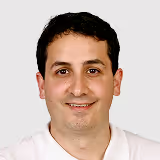
Marcel Kloos
Swiss-licensed dentist and founder of Medschool Experts
Marcel Kloos founded Medschool Experts while studying abroad; since then, over 500 study places have been secured. The Stuttgart-born dentist studied dentistry from 2015 to 2021 in Sofia and holds a Swiss dental licence.
Today he lives in Bern and runs Medschool Experts full-time as its owner.
More articles worth reading
Why Students Transfer from Medical University of Varna — Your Options
Why Students Transfer from Medical University of Warsaw — Your Options
Why Students Transfer from Masaryk University Faculty of Medicine — Your Options
Ahmad
Sabrina
Rami
Noah
500+ students placed.
Now it's your turn!
No daydreaming, no empty promises. Just a clear plan — for the start of your medical degree.
40 minutes, no obligation