Why Students Transfer from the Medical University of Sofia — Your Options
11.09.2026

Is the Medical University of Sofia the right choice for every international student?
Honest answer: no. Good answer for many: yes.
MU Sofia holds full WFME accreditation, which means its graduates are recognised by medical licensing authorities in Germany, the UK, Switzerland, Austria, and Canada. Its six-year English-language medicine programme and five-year dentistry programme are established, not experimental. Graduates from MU Sofia work across Europe — as specialists, general practitioners, and in academic medicine.
The university also holds EU-degree status, which matters enormously for students planning to work in Germany or Austria after qualifying. A degree from a WFME-accredited European institution passes the German Approbation process and the Swiss recognition pathway without the delays associated with non-EU degrees.
But recognition does not equal simplicity. MU Sofia is a demanding institution with a specific set of challenges. For students who match well — strong academic background, high tolerance for curriculum density, and either a foundation in Bulgarian or a concrete plan to acquire one — it works. For those who do not match, years two and three tend to reveal it. The question worth asking before you enrol is whether MU Sofia's model fits your situation. The question worth asking once enrolled is whether a transfer protects more of your progress than staying does. We help with both — see our services page for how.
Why do students transfer from the Medical University of Sofia?
Transfer enquiries about MU Sofia cluster around five distinct reasons. They are not equally common.
Language barrier. The most frequent reason. The English-medium programme covers preclinical content — anatomy, physiology, biochemistry, histology. Clinical training from year three takes place in Bulgarian hospitals with Bulgarian physicians, nurses, and patients. Students who came expecting an English-language programme find themselves on wards where they cannot take a patient history. That is not a minor inconvenience. It is a structural barrier to assessment and progression.
Exam failure or academic probation. Anatomy in years one and two has a high repeat rate among international students. Three failed attempts in one subject can trigger academic review and potential loss of enrolment. Students in this situation face a narrow window to act — a transfer while enrolled is manageable; a transfer after dismissal often means starting over.
Cost optimisation. Annual tuition at MU Sofia runs €9,500–10,200. Add Sofia living costs — roughly €650/month — and a six-year medicine degree costs over €110,000. Equivalent programmes in Romania or Slovakia cost significantly less. Students with completed preclinical credits can transfer and save tens of thousands of euros on remaining semesters.
Licensing strategy. A smaller number of students enrol at MU Sofia targeting a specific licensing pathway — the USMLE, the UK Foundation Programme, or the Swiss exam. Curriculum alignment matters for these routes. A transfer to a programme better suited to the target exam can be a deliberate strategic choice.
Personal circumstances. Relationship, health, family obligations. Life does not pause for a six-year degree.
What are the main academic challenges at the Medical University of Sofia?
Three challenges stand out consistently. All are documented across international student communities — not outliers.
Anatomy. MU Sofia's anatomy department has a well-established reputation for rigorous oral and practical exams. Repeat rates among non-EU international students are high. A student who fails anatomy across three attempts faces formal academic review. Years one and two are the most common exit point for international students who do not continue.
Bulgarian in clinical settings. From year three, you rotate through the University Hospital of Sofia and affiliated teaching clinics. Language on the wards is Bulgarian. Patient consultations are in Bulgarian. Nursing handovers are in Bulgarian. The university's one to two hours of Bulgarian language instruction per week in years one and two does not produce the clinical fluency needed. Students who arrive without prior Slavic language exposure face a significant barrier that the timetable does not resolve.
Curriculum density. Preclinical semesters at MU Sofia run twelve or more subjects simultaneously. Lecture attendance is compulsory for practicals. There is no tutorial system comparable to UK or Swiss medical schools. Students who thrive here are self-directed and strong in natural sciences. Those who need additional academic structure report finding the environment difficult without external support.
How much does it cost to study medicine or dentistry at MU Sofia in 2026?
Fees have risen year over year since 2022. Current figures for 2025/2026:
| Programme | Duration | Annual Tuition (2025/26) | Total Tuition |
|---|---|---|---|
| Medicine (English) | 6 years | €9,800 – 10,200 | €58,800 – 61,200 |
| Dentistry (English) | 5 years | €9,500 – 9,800 | €47,500 – 49,000 |
| Pharmacy (English) | 5 years | €8,500 – 9,000 | €42,500 – 45,000 |
| Source: MU Sofia Admissions Office, 2025/2026 fee schedule. Administrative and registration fees (approx. €500–800/year) not included. Figures subject to annual review. | |||
Living costs in Sofia remain the lowest of any EU capital. Shared accommodation runs €250–400/month. Groceries, transport, and eating out cost far less than in Prague, Vienna, or Bratislava. A realistic monthly budget is €600–750. Total cost of a six-year medicine degree at MU Sofia — tuition plus living — sits at approximately €110,000–120,000. Some alternatives cost less.
| University | Country | Annual Tuition | Est. 6-Year Total | Language |
|---|---|---|---|---|
| MU Sofia | Bulgaria | €9,500 – 10,200 | ~€115,000 | EN (clinical: BG) |
| Iuliu Hatieganu, Cluj | Romania | €4,500 – 6,500 | ~€72,000 | EN / FR |
| Comenius, Bratislava | Slovakia | €8,000 – 12,000 | ~€95,000 | EN / DE |
| University of Zagreb | Croatia | €8,000 – 11,000 | ~€93,000 | EN / HR |
| Charles University, Prague | Czech Republic | €12,000 – 18,000 | ~€135,000 | EN |
| Source: University admissions offices and published fee schedules, 2025/2026. Totals include estimated living costs over 6 years. Individual circumstances vary. | ||||
What happens to international students who struggle with Bulgarian language at MU Sofia?
This is where the gap between official information and lived reality is widest.
Official position: MU Sofia offers a full English-language programme spanning six years of medicine. Accurate for the preclinical phase. From year three, clinical rotations begin at the University Hospital of Sofia and affiliated teaching hospitals. Language on wards is Bulgarian. Patients are Bulgarian speakers. Consultants do not translate.
What this means in practice: a student on a cardiology rotation who cannot conduct a patient interview in Bulgarian cannot complete that rotation's requirements. History-taking, case presentation, nursing handovers — all in Bulgarian. Students without functional Bulgarian are structurally excluded from the core clinical experience, regardless of preclinical academic performance.
The university's Bulgarian language programme — typically one to two hours per week in years one and two — is not designed to produce clinical fluency. Students who arrive with zero prior Slavic language exposure and rely solely on the university's language programme will not be ready for year three rotations. Those who invest significantly in independent Bulgarian study, or who bring related Slavic language background (Russian, Serbian, Polish), adapt more readily. Some manage. It requires a level of language commitment not communicated clearly at the admissions stage.
What if I fail exams or lose my student status at MU Sofia?
Act early. Not after the third sitting.
Bulgarian academic regulations allow a limited number of exam attempts per subject — typically three. Three failed attempts in one subject triggers a formal academic review that can result in a repeat year requirement or termination of enrolment.
The critical window: universities accepting transfer students typically require active enrolment at MU Sofia at the time of application. A student still enrolled at MU Sofia can apply to transfer. A student whose enrolment has been terminated may need to apply as a first-year student, forfeiting all credit recognition. The difference between one failed attempt remaining and enrolment termination is the difference between entering year four elsewhere and restarting from scratch.
If you have received an academic warning or have one failed attempt remaining in any subject, the time to consult is now. Medschool Experts has handled exactly this scenario. We know which universities are realistic for students under academic pressure, which require uninterrupted enrolment, and how to document your academic record most accurately. Contact us now if you are in this situation.
{{cta}}Can I transfer from the Medical University of Sofia without losing study years?
Yes. Often the answer is year four or year five entry. No lost time.
Credit transfer within the European Higher Education Area (Bologna Process) is structurally supported. Universities in Romania, Croatia, Slovakia, and Germany assess transfer applications based on submitted transcripts and course syllabi. A student completing year two at MU Sofia has covered anatomy, physiology, biochemistry, histology, medical biophysics, and the core foundational clinical sciences. That academic record has transferable value — there is no ceiling on recognition.
Factors that determine entry level at the target university:
- Your full certified grade transcript from MU Sofia, translated where required
- Detailed course syllabi in English (MU Sofia's international office provides these)
- An academic assessment by the target university's recognition committee
- Language proficiency documentation in the target country's language, or English for English-medium programmes
Medschool Experts has placed over 500 students across European medical programmes. Many came from MU Sofia — into years four and five in Romania, Germany, the Czech Republic, and Croatia. The process is documented and repeatable. It requires three to six months of preparation. It does not require restarting from year one. A free consultation takes 30 minutes and will tell you exactly where your credits would land.
What are the best alternatives to the Medical University of Sofia?
The right alternative depends on years completed, budget, target licensing country, and language flexibility. These are the destinations we recommend most often to MU Sofia transfer students.
Romania. Iuliu Hatieganu University (Cluj-Napoca), Carol Davila University (Bucharest), and the University of Oradea all accept transfers from MU Sofia. English and French-medium programmes are available. Tuition ranges from €4,500 to €6,500 per year — significantly lower than MU Sofia. Romanian EU degrees are well recognised by German and Austrian licensing bodies (Approbation, Berufsanerkennung). Romania is the most common destination for MU Sofia transfers we handle.
Croatia. Croatian is a South Slavic language, closely related to Bulgarian. Students with Bulgarian language exposure find Croatian significantly more accessible. The University of Zagreb, Rijeka, and Split all offer medicine in Croatian and English. Tuition runs approximately €8,000–11,000 per year. Croatian EU degrees carry full recognition across the European Union.
Slovakia. Comenius University Bratislava offers a German-language medicine programme recognised by German, Austrian, and Swiss licensing boards. Tuition approximately €7,000–12,000 per year. A strong option for students targeting German-speaking countries after qualification.
Czech Republic. Charles University Prague and Masaryk University Brno offer English-medium six-year programmes with strong international recognition, including UK Foundation Programme and USMLE pathways. Tuition is higher — €12,000–18,000 per year — but the degree commands significant recognition.
Germany (direct clinical entry). For students with strong German and excellent academic records, direct entry into the clinical phase via recognition of preclinical credits is possible. Competitive and documentation-intensive. We have supported this route successfully.
See the full comparison on our universities page and read first-person accounts at student stories.
Month-by-month: planning your transfer from MU Sofia
The timeline below assumes a student currently in year two or three at MU Sofia, planning a transfer for the following October. Most European medical programmes start in October.
Month 1-2 (October-November): Initial consultation. Assess your transcript, grade point, and remaining exam obligations. Identify target universities and realistic entry levels. Request certified copies of your grade transcript and course syllabi from the MU Sofia international office.
Month 3 (December): Document preparation. Compile your application package: certified transcript, detailed course syllabi in English, motivation letter, language proficiency certificates, and current student status confirmation. If a language exam is required — B2 Romanian, C1 German — register now. Test slots fill quickly in early spring.
Month 4-5 (January-February): Submit applications. Most European universities have transfer deadlines between January and April. Apply to multiple institutions simultaneously — realistic targets and stretch targets alike.
Month 6 (March): Credit assessment. Target universities review your syllabi documentation and issue a formal credit recognition decision. This document determines your entry year. Medschool Experts reviews credit decisions and supports appeals where the initial assessment does not reflect the full scope of completed coursework.
Month 7-8 (April-May): Receive and accept offers. Select your university. Submit enrolment confirmation documents. Begin visa or residence permit applications if required.
Month 9 (June-September): Final preparation. Language preparation for the destination country. Housing search. Orientation at your new university.
October: Start year four or five. No lost time. New university, recognised EU degree.
The author's view
I spent six years at the Medical University of Sofia — from 2015 to 2021, studying dentistry. I know the anatomy building. I know what it feels like to sit an oral exam with a professor who expects precision and does not accept approximation. I know the moment in year three when Bulgarian stops being the language of a Wednesday afternoon class and becomes the language of the ward, of the patient in front of you, of the supervisor waiting for you to present a case correctly. That moment catches many international students off guard — not because they are unprepared academically, but because the system is not designed to bring them to that moment ready.
What I also know is that MU Sofia is a serious institution. The training is genuine. The degree is real. Students who complete it and adapt to the clinical language environment emerge as competent physicians. I am not here to discredit MU Sofia. I am here to tell you that the match between a student and an institution matters enormously, and that there are situations — an unbridgeable language gap, exam pressure running out of time, a cost trajectory that no longer makes sense — where a well-planned transfer is a better outcome than persisting. I have seen both sides of that decision. The students who stayed and found their footing. The students who transferred and carried their credits into year four somewhere else, finished on time, and are now working as doctors in Germany or Switzerland.
Since founding Medschool Experts, I have worked with more than 500 students across European medical programmes. A significant number came from MU Sofia. Most did not want to leave Sofia — they wanted to continue their education without losing time and without continuing in conditions that were not working. In most cases, we found a way. Swiss-licensed, based in Bern, with direct experience of the exact institution you are navigating: that is what you get when you speak with us. The consultation is free.
Summary
- The Medical University of Sofia is WFME-accredited and EU-recognised. Its graduates practise medicine legally across Germany, Switzerland, the UK, and Austria.
- Bulgarian language becomes the working language of clinical training from year three — the single most common reason international students transfer out.
- Anatomy exams in years one and two have a high repeat rate among international students. Three failed attempts triggers academic review and potential loss of enrolment.
- Annual tuition at MU Sofia runs €9,500–10,200 (2025/2026). Total six-year cost including living: approximately €110,000–120,000.
- Alternative programmes in Romania, Croatia, and Slovakia cost significantly less while offering equivalent EU-degree status and WFME accreditation.
- Credit recognition under the Bologna Process allows transfer without repeating completed years. Year four and year five entry is achievable for well-prepared applicants.
- Students must remain enrolled to qualify for transfer credit recognition. Act before academic dismissal — not after.
- Medschool Experts has placed over 500 students across European medical programmes, including many from MU Sofia, into years four and five at partner universities.
Conclusion
MU Sofia is not the wrong choice. For the right student — academically strong, language-adaptable, committed to the Sofia experience — it delivers a genuine EU medical degree. But it is an institution where international students encounter real structural barriers, and where those barriers become costly if not addressed early. A language gap does not resolve itself by year four. An exam failure spiral is harder to stop the longer it runs.
If you are reading this because something has gone wrong at MU Sofia, or because you want to plan before it does — the next step is a conversation. No commitment required. A free consultation with Medschool Experts will tell you exactly where your credits would land, which universities are realistic for your situation, and what a transfer would look like in practice.
Frequently Asked Questions about Transferring from the Medical University of Sofia
Can I transfer from MU Sofia to a German medical university?
Direct transfer to a German state university (Staatsexamen programme) is difficult due to limited mid-programme transfer pathways. However, students with strong German and high academic records can sometimes enter the clinical phase of German programmes via preclinical credit recognition. More commonly, Medschool Experts places MU Sofia students into German-language programmes in Slovakia or Austria — both fully recognised by German licensing authorities (Approbation) and more accessible mid-programme than German state universities themselves.
Will I lose my study years if I transfer from MU Sofia?
Not necessarily. Under the Bologna Process, European universities are required to assess credit equivalencies from other European institutions. A student completing year two at MU Sofia has covered anatomy, physiology, biochemistry, histology, and foundational clinical sciences — all of which carry credit value. Entry into year four at a Romanian or Croatian university is achievable for well-prepared applicants. Year five entry is possible in specific cases. The decisive document is your course syllabus — not just your transcript. Credits travel; you provide the evidence.
How long does the transfer process from MU Sofia take?
Typically nine to twelve months from initial consultation to starting at a new university. Most European medical programmes begin in October. Working backwards: applications are submitted January to February, documents prepared in November to December, and planning begins October to November of the preceding year. Students who start earlier have more options. Those who contact us in March or April of the target year may still arrange a transfer for that same October, but the process is compressed and some universities will already be closed for applications.
Is MU Sofia's degree recognised in Switzerland and Germany?
Yes. MU Sofia is WFME-accredited, and its degrees are recognised by the Swiss Federal Medical Commission and by German licensing authorities (Landesprufungsamt) for the Approbation process. Bulgarian medical graduates working in Germany and Switzerland is routine, not exceptional. Recognition does not mean automatic registration — you still need language proficiency and, in some cases, a knowledge assessment. But the degree itself is not a barrier to practising in either country.
What Bulgarian level do I need for MU Sofia clinical years?
Functional conversational Bulgarian — B2 level or above — is the practical minimum for navigating clinical rotations. Patient interviews, case presentations, and nursing handovers all occur in Bulgarian on hospital wards. MU Sofia's built-in language programme (approximately one to two hours per week in years one and two) does not reliably produce B2 fluency. Students who want to complete clinical years at MU Sofia should invest in independent Bulgarian study from the start of year one, not wait for the university timetable to prepare them.
Can I transfer from MU Sofia if I have failed exams?
Yes, but timing matters enormously. Universities accepting transfer students typically require active enrolment at MU Sofia at the time of application. Students who have received academic warnings should act before a third failed attempt in any subject and before any formal dismissal notice. A transcript showing one or two failed attempts in a subject is manageable in a transfer application — it can be addressed in the motivation letter. Enrolment termination significantly restricts your options. Contact Medschool Experts as early as possible if you are under academic pressure.
Are there English-language alternatives to MU Sofia that cost less?
Yes. Romania offers the strongest value: Iuliu Hatieganu University in Cluj-Napoca and the University of Oradea both run English-medium six-year medicine programmes with annual tuition of €4,500–6,500 — roughly half of MU Sofia's fees. Living costs in Romania are comparable to Bulgaria. Romanian EU degrees are recognised by German, Austrian, and Swiss licensing boards. Slovakia (Comenius University) offers an English-medium option at €8,000–12,000 per year with a German-language track available. See our universities page for a full comparison.
How does Medschool Experts support a transfer from MU Sofia?
We handle the full process: initial transcript assessment and credit value estimate, identification of realistic target universities, preparation of application documents (transcript, syllabi, motivation letter, language certificates), direct liaison with university admissions offices, review and appeal of credit recognition decisions, and support through enrolment confirmation. We have placed students from MU Sofia into years four and five at partner universities in Romania, Croatia, Slovakia, and the Czech Republic. Visit our services page for details, or book a free consultation.
What students say about Medschool Experts
Over 500 placements at more than 25 partner universities across 10+ countries. Read independent student reviews on Trustpilot.
About the author
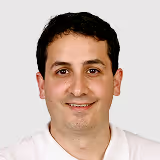
Marcel Kloos
Swiss-licensed dentist and founder of Medschool Experts
Marcel Kloos founded Medschool Experts while studying abroad; since then, over 500 study places have been secured. The Stuttgart-born dentist studied dentistry from 2015 to 2021 in Sofia and holds a Swiss dental licence.
Today he lives in Bern and runs Medschool Experts full-time as its owner.
More articles worth reading
Why Students Transfer from Medical University of Varna — Your Options
Why Students Transfer from Medical University of Warsaw — Your Options
Why Students Transfer from Masaryk University Faculty of Medicine — Your Options
Ahmad
Sabrina
Rami
Noah
500+ students placed.
Now it's your turn!
No daydreaming, no empty promises. Just a clear plan — for the start of your medical degree.
40 minutes, no obligation