Why Students Transfer from Medical University of Wrocław — Your Options
11.09.2026

Is Medical University Wrocław recognized in Germany?
Yes — Medical University of Wrocław holds full recognition under the EU professional qualifications framework. As an EU-accredited institution, its degree qualifies graduates to apply for a German Approbation (medical licence). However, recognition does not mean automatic approval. Several German federal states, including Bavaria and Baden-Württemberg, apply rigorous individual curriculum reviews and may require a Kenntnisprüfung (knowledge examination) or an Anpassungslehrgang (adaptation course) if your transcript reveals gaps compared to German Approbation standards. The process varies by state, and early planning is essential.
How much does medicine at Wrocław cost per year?
Official tuition for the English-language MD programme at UM Wrocław ranges from €11,000 to €13,500 per academic year. When you add accommodation (€350–550/month), food, transport, books, and health insurance, the realistic total annual cost of attendance is €17,000–22,000. Over a six-year programme, this amounts to roughly €100,000–130,000 — and that is before accounting for the financial cost of repeating a year due to failed resits.
| University / Pathway | Annual Tuition | Est. Living Costs | Total/Year | Language |
|---|---|---|---|---|
| UM Wrocław (English MD) | €11,000–13,500 | €6,000–8,500 | €17,000–22,000 | English → Polish (Yr 4+) |
| Czech public medical schools | €8,000–12,000 | €6,500–9,000 | €14,500–21,000 | Czech / English |
| Slovak medical schools | €8,500–11,000 | €5,000–7,500 | €13,500–18,500 | Slovak / English |
| Hungarian state medical schools | €11,000–15,000 | €5,500–8,000 | €16,500–23,000 | Hungarian / English |
| Baltic state universities (LT, LV, EE) | €9,000–12,000 | €5,000–7,000 | €14,000–19,000 | English |
Worked cost example: A student paying €12,500 tuition per year, €450/month rent, €300/month for food and transport, and €150/month for miscellaneous expenses faces an annual outlay of approximately €21,100. Over six years, this totals €126,600. If one year is lost due to failed resits and must be repeated, the total climbs to €147,700. Transferring in Year 2 to a comparably priced but better-aligned institution could save €10,000–20,000 over the remaining study period — while also substantially reducing administrative friction at the approbation stage.
How hard are the exams at Wrocław Medical University?
The preclinical examination load at UM Wrocław is widely regarded as intensive among international students. Anatomy, biochemistry, physiology, and histology are examined in multiple partial tests and end-of-semester assessments. Pass-through rates in the first two years are lower than at many Western European medical faculties. Students report that the volume of material is high and that oral or viva-based examination formats require not only factual recall but the ability to articulate detailed answers confidently in English under pressure. For students accustomed to different examination cultures — particularly those from Nordic or Anglo-Saxon academic backgrounds — this adjustment can be significant.
Can I transfer from Wrocław to a German university?
Direct transfer into a German state medical university as an international mid-programme student is possible in theory but very rare in practice. German public medical schools run Staatsexamen programmes with extremely limited lateral entry places, and most admissions offices prioritise domestic candidates. The most reliable and well-trodden pathway for students from Wrocław who ultimately want to work in Germany is to transfer to another EU medical school — for example in Slovakia, the Czech Republic, or Lithuania — that has stronger alignment with German Approbation requirements and more structured credit recognition processes. Medschool Experts has facilitated successful entries as late as Year 4 and Year 5 through this route.
What happens if I fail at Medical University Wrocław?
UM Wrocław permits a limited number of resit attempts per academic year. If a student exhausts their resit opportunities without passing the required examinations, they are typically required to withdraw from the programme. There is no automatic right of reinstatement, and students who are formally dismissed face a loss of their study place without a guaranteed path to re-entry. In practice, this means a student who fails out in Year 1 or Year 2 is left without a medical place, without recognition of credits already accumulated, and with limited time to act. The most effective response — and one that should be explored before any dismissal notice is issued — is a proactive transfer to another EU institution that will recognise completed semesters.
Free Consultation — We Find Your Solution
Whether you want to transfer, reduce costs, or explore European pathways — our advisors have helped hundreds of students from Wrocław. Book your free 30-minute consultation →
Is a Wrocław medical degree valid in the EU?
Yes. A degree from Medical University of Wrocław is a full EU medical qualification. Under EU Directive 2005/36/EC on the recognition of professional qualifications, an MD from UM Wrocław confers the right to seek registration as a physician in any EU member state. In practice, each country has its own administrative processes for recognising foreign credentials, and some states — particularly Germany and Austria — apply additional scrutiny to curricula from Central and Eastern European institutions. This does not invalidate the degree; it means that graduates need to be prepared for a more involved registration process than they would encounter with a degree from a German or Austrian institution.
How does Wrocław compare to Warsaw or Kraków for medicine?
Medical University of Warsaw (WUM) and Jagiellonian University Medical College in Kraków both carry higher international rankings and are generally considered more prestigious within Poland's academic hierarchy. WUM in particular is harder to enter and runs an intensive preclinical curriculum. Kraków benefits from a strong clinical network and long-established status as a medical education hub. In terms of tuition, all three are broadly comparable for international English-language programmes, though Warsaw's living costs are significantly higher. Students considering a transfer from Wrocław to Warsaw or Kraków should be aware that Polish inter-university transfers are administratively complex; international transfers to EU countries outside Poland often offer a cleaner, faster pathway.
| Year at Wrocław | Credits Typically Accumulated | Likely Entry Year at New School | Best Target Countries | Notes |
|---|---|---|---|---|
| Year 1 (completed) | 60 ECTS | Year 1 or 2 | CZ, SK, HU, LT, LV | Core science credits widely accepted |
| Year 2 (completed) | 120 ECTS | Year 2 or 3 | CZ, SK, HU, LT, RO | Anatomy and biochemistry credits strong |
| Year 3 (completed) | 180 ECTS | Year 3 or 4 | SK, HU, LT, UA, MD | Pathology and pharmacology credits assessed individually |
| Year 4 (completed) | 240 ECTS | Year 4 or 5 | SK, LT, MD, UA, HU | Clinical credits require case-by-case review |
| Year 5 (completed) | 300 ECTS | Year 5 or 6 | SK, LT, MD | Final year transfer achievable with strong clinical record |
What are the living costs in Wrocław as a student?
Wrocław has undergone rapid development over the past decade, and student living costs have risen accordingly. A shared room in a student flat now costs between €300 and €500 per month; a private studio in a central area averages €500–700. Monthly food costs for a self-catering student run to €200–350. Public transport is affordable at around €15–20 per month. Health insurance and mandatory university fees add a further €50–100 per month. A realistic monthly student budget in Wrocław in 2026 is €750–1,200 per month — €9,000–14,400 annually — a marked increase from the figures quoted in pre-2022 university marketing materials.
Month-by-Month Transfer Timeline
A successful transfer from UM Wrocław to another EU medical school follows a broadly predictable sequence. The exact months shift depending on when you decide to act and which country you are targeting, but the timeline below reflects the typical process for students aiming at a September intake at their new institution:
- Month 1 — Decision: Consult a specialist adviser. Gather your current transcript, course syllabi in English, and a confirmation of enrolled semesters from the Wrocław registrar. Identify two to four target universities based on your year of study, language preference, and intended country of medical practice.
- Month 2 — Document Preparation: Request official documents from UM Wrocław: your academic transcript, a confirmation of enrolment or withdrawal letter, and individual course descriptions with ECTS credits and weekly contact hours. Arrange certified translations where required. Draft a tailored motivation letter for each target institution.
- Month 3–4 — Applications Submitted: Submit to all target institutions simultaneously. Some universities accept applications year-round; others operate fixed intake windows. Prioritise institutions with open windows for your current year of study.
- Month 4–5 — Credit Evaluation: Receive preliminary credit recognition decisions. These are typically provisional until formal enrolment. Evaluate offers based on year of entry, any additional bridging examinations required, and total remaining tuition cost.
- Month 5–6 — Offer Accepted: Accept the most suitable offer. Pay the enrolment deposit to secure your place. Formally withdraw from UM Wrocław — a withdrawal certificate is usually required by the new institution as part of enrolment.
- Month 6–7 — Relocation Preparation: Arrange accommodation in the new city. Obtain required documentation: health insurance valid in the new country, student visa if applicable for non-EU students, and proof of accommodation. Begin any pre-reading or language preparation the new faculty recommends.
- Month 7–9 — Orientation and Start: Begin studies at the new institution. Attend the formal credit transfer confirmation process if required — some universities finalise this in the opening weeks. Confirm your official year of study and any bridging modules needed.
The author's view
I have spoken directly with well over 300 students who have either left Medical University of Wrocław or are seriously considering it. What strikes me most consistently is not that the university is failing them — it is that students were not given an accurate picture of what the programme involves before they enrolled. University brochures show modern laboratories and welcoming campus life. They do not explain that Year 4 will be conducted primarily in Polish, or that the oral examination style in the preclinical years has a steep learning curve for students from Northern European academic backgrounds. This information gap is, in my view, the core problem — and it begins to be fixed the moment a student reaches out to someone who will tell them the truth rather than protect an enrolment figure.
From a purely strategic perspective, a well-planned transfer from Wrocław to a well-chosen alternative is almost always the right call if you have identified a fundamental mismatch — whether that is language, learning environment, career destination, or financial sustainability. The students I have seen struggle most are those who stayed longer than they should have out of a fear that transferring would look like a failure or signal weakness. It does not. Every admissions committee we work with understands the dynamics of the Central European medical education market. A clearly presented transfer narrative — one that demonstrates self-awareness, deliberate career planning, and decisive action — is never a negative on an application. It is evidence of maturity.
My honest advice: do not wait. The earlier you make the decision, the more options you have, the more credits you are likely to preserve, and the less total money you will spend reaching your goal. If you are reading this guide, you have already started asking the right questions. The next step is a conversation — and the first one is free. Reach out to our team here →
Summary
- Medical University of Wrocław is a fully EU-recognised institution, but its English-language programme transitions to Polish-language clinical teaching in Year 4, creating a significant barrier for students who have not reached conversational Polish.
- Annual costs at Wrocław — including tuition and living expenses — realistically amount to €17,000–22,000 per year, a figure that has risen sharply since 2020 due to Wrocław's rental market growth.
- Attrition in the preclinical years is high; students who exhaust resit opportunities have limited options for re-entry and risk losing academic credits if they do not act before formal dismissal.
- Graduates wishing to practise in Germany or Austria face a more involved Approbation process than expected, with some federal states requiring additional examinations or adaptation courses.
- Transferring to another EU medical school — in the Czech Republic, Slovakia, Hungary, or the Baltic states — is the most effective route for students seeking an English-language environment with stronger alignment to German or Austrian licensing requirements.
- Credit recognition from Wrocław is achievable from Year 1 through Year 5; proactive transfer before forced withdrawal significantly increases the proportion of credits accepted.
- The full transfer process from initial consultation to the first day at a new institution typically takes six to nine months with professional support.
- Medschool Experts has supported hundreds of students from Wrocław and other Polish medical schools in navigating this process to a successful outcome.
Conclusion
Transferring from Medical University of Wrocław is not a sign of failure — it is a strategic decision that many of the most successful physicians in our network have made. The factors that lead students to consider leaving — the language transition in clinical years, the examination volume and style, the approbation complexity, and the rising cost of living in Wrocław — are structural features of the programme, not individual shortcomings. Recognising that a programme is not the right fit, and acting on that recognition before circumstances force your hand, is exactly the kind of clear-headed judgement that long medical careers are built on.
If you are at any stage of your studies at UM Wrocław and are questioning whether to stay, whether to transfer, or whether there is a better-aligned pathway to the medical career you are working towards, the most valuable step you can take right now is a free consultation with one of our specialist advisers. We will give you an honest, individual picture of your options — not a sales pitch — and help you make the decision that is right for your specific situation. Book your free 30-minute consultation →
Frequently Asked Questions about Transferring from Medical University of Wrocław
Can I transfer from Medical University of Wrocław to a university in Germany?
Direct transfer into a German public medical school as an international mid-programme student is possible in theory but very rare in practice. German state medical universities (Staatsexamen programmes) have extremely limited lateral entry places and complex administrative requirements. The most reliable route for students from Wrocław who ultimately want to practise in Germany is to transfer to another EU medical school — for example in Slovakia or the Czech Republic — that has a more streamlined curriculum alignment with German Approbation standards, complete the degree there, and then apply for German medical registration. This pathway has a well-established track record.
Will my credits from Wrocław be recognised at another university?
In the majority of cases, yes — though the extent of recognition depends on the specific subjects completed, the ECTS credits attached to each module, and the policies of the receiving institution. Core preclinical subjects such as anatomy, biochemistry, physiology, and histology are widely recognised across EU medical faculties. Clinical credits from Year 4 and Year 5 are assessed on an individual basis. Medschool Experts works with a network of partner universities that have established credit recognition frameworks for students from Polish institutions, which improves and accelerates the credit transfer outcome significantly.
Is it possible to transfer in Year 4 or Year 5?
Yes, and Medschool Experts has facilitated successful transfers at both of these stages. Year 4 and Year 5 transfers are more complex than earlier-year transfers because they involve clinical credit recognition, which is assessed case by case. However, students with a strong academic record and well-documented clinical hours have entered Year 4 or Year 5 at partner institutions and completed their degrees without significant additional time. Do not assume that transfer is only viable in the first two years — it is worth exploring your options regardless of your current year of study.
What documents do I need to begin a transfer application?
The core documents required for a transfer application from UM Wrocław are: your official academic transcript, a course syllabus for each completed subject (with ECTS credits and weekly contact hours), a confirmation of enrolment from the university registrar, your passport, and proof of your prior school-leaving qualification (Abitur, A-levels, or equivalent). Some receiving universities also request a motivation letter and proof of English language proficiency. Your Medschool Experts adviser will provide a precise document checklist tailored to each specific target institution.
Should I transfer within Poland or look abroad?
If you remain in Poland, you will face the same Polish-language clinical barrier you are already encountering at Wrocław, plus the administrative complexity of Polish inter-university credit recognition. For most international students, transferring to an English-language programme in another EU country — Czech Republic, Slovakia, Hungary, or the Baltic states — is a more practical solution. It resolves the language issue, typically offers a cleaner credit recognition process, and results in a degree that is equally valid across the EU while often producing a more straightforward Approbation pathway for students targeting Germany or Austria.
How will a transfer affect my Approbation eligibility in Germany?
Transferring to another EU medical school and completing your degree there does not disadvantage you in the German Approbation process compared to graduating from Wrocław. In many cases it improves your position, because institutions in Slovakia, the Czech Republic, and the Baltic states have more established recognition pathways with German licensing authorities. The key requirement is that your final degree comes from a fully EU-recognised institution, which all of our partner universities are. Your adviser can provide specific guidance on which target countries have the clearest Approbation track record for German-intending graduates.
How long does the transfer process take from start to finish?
From initial consultation to the first day of classes at a new institution, the process typically takes six to nine months. This includes time to gather documentation, submit applications, receive credit evaluation decisions, accept an offer, and complete the administrative withdrawal from Wrocław. Students who begin the process early in the academic year have the best chance of starting at their new institution at the next September intake. Some partner universities also offer January intakes, which can reduce the gap for students who make the decision mid-year.
What are my options if I do not want to transfer but want to reduce costs?
UM Wrocław offers few scholarships for existing international students, and tuition is set annually by the faculty board, leaving limited room to reduce that cost within the programme. Some students lower their monthly outgoings by moving further from the city centre or sharing larger flats. If your primary concern is cost but you are otherwise satisfied with the programme and the Polish-language transition, continuing may be the right call. However, if cost concerns are combined with language barriers, examination difficulties, or Approbation uncertainty, a structured transfer is almost always the better long-term financial and professional decision.
What students say about Medschool Experts
Over 500 placements at more than 25 partner universities across 10+ countries. Read independent student reviews on Trustpilot.
About the author
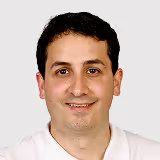
Marcel Kloos
Swiss-licensed dentist and founder of Medschool Experts
Marcel Kloos founded Medschool Experts while studying abroad; since then, over 500 study places have been secured. The Stuttgart-born dentist studied dentistry from 2015 to 2021 in Sofia and holds a Swiss dental licence.
Today he lives in Bern and runs Medschool Experts full-time as its owner.
More articles worth reading
Why Students Transfer from Medical University of Varna — Your Options
Why Students Transfer from Medical University of Warsaw — Your Options
Why Students Transfer from Masaryk University Faculty of Medicine — Your Options
Ahmad
Sabrina
Rami
Noah
500+ students placed.
Now it's your turn!
No daydreaming, no empty promises. Just a clear plan — for the start of your medical degree.
40 minutes, no obligation