Why Students Transfer from Saba University School of Medicine — Your Options
11.09.2026

Is Saba University School of Medicine right for every student?
Saba follows the standard Caribbean model: five semesters of basic sciences on the island, then clinical rotations at US-affiliated hospitals. The school is deliberately small — a few hundred students per cohort — and markets itself partly on the basis that Saba is Dutch territory, implying a European credential. That connection is real in a narrow administrative sense. It does not translate into European degree recognition or automatic EU licensing.
Students who succeed at Saba share a specific profile: strong self-directed study habits, high tolerance for geographic isolation, a clear US career target, and the financial means to sustain $16,000–$18,000 per semester without accumulating debt at a level that makes a physician salary unworkable. Students who struggle typically underestimated one or more of these factors before arriving on the island. Neither outcome reflects on academic ability alone — it reflects a mismatch between expectations and programme structure.
The question is not whether Saba produces competent physicians — it does, and a portion of its graduates match into US residencies each year. The question is whether the cost, location, and recognition profile aligns with your situation in 2026. For a growing number of students, the answer is no, and a structured transfer is the more logical choice.
Why do students transfer from Saba University?
Based on consultation data from more than 500 students since 2015, five reasons account for the majority of departures:
1. Financial pressure beyond initial projections. Students who budgeted $150,000 for the complete programme often reach $200,000–$220,000 before clinical rotations are finished. Living costs on Saba and in US clinical rotation cities, combined with repeat exam fees and extended timelines, consistently exceed early estimates.
2. European career goals that Saba's degree does not support directly. Students with EU/EEA citizenship or a preference for practicing in Germany, Austria, Switzerland, or Scandinavia discover that a Saba degree requires a lengthy and uncertain national recognition process — it is not covered by EU Directive 2005/36/EC.
3. A failed USMLE Step 1 exam. Saba's self-reported first-attempt Step 1 pass rate runs approximately 88–91% for sitting cohorts (2023–2025). Students who fail once face a second attempt under time and financial pressure. Multiple Step 1 attempts sharply reduce residency match probability.
4. Residency match uncertainty. Caribbean IMGs matched into US residency at 56.4% in the 2024 NRMP Main Residency Match, versus 93.7% for US MD graduates. Saba graduates compete within that Caribbean IMG pool.
5. Isolation and programme pressure. Saba's remoteness — limited transport links, no nearby urban centre — suits some students and strains others. A high-pressure academic calendar with limited clinical exposure during the basic science years adds to the challenge.
None of these reasons implies a character failing. They reflect a mismatch between marketing and reality that better pre-enrolment research, or earlier counselling, could have addressed. Transfer is a rational response, not a failure.
How much does Saba University medicine cost in 2026?
Saba publishes per-semester tuition on its website. The table below combines published tuition with realistic estimates for fees and living costs, based on student-reported data and published cost-of-living figures for Saba and common US clinical rotation cities.
| Phase | Tuition | Living Costs | Phase Total |
|---|---|---|---|
| Basic Sciences (5 semesters, ~2.5 yr) | ~$82,500 | ~$42,000 | ~$124,500 |
| Clinical Rotations (4 semesters, ~2 yr) | ~$66,000 | ~$43,000 | ~$109,000 |
| Exams, insurance, flights, books | — | ~$13,500 | ~$13,500 |
| Total | ~$148,500 | ~$98,500 | ~$247,000 |
Source: Saba University published tuition 2025/2026 + Medschool Experts client survey data. Individual totals vary by rotation city, programme pace, and exam retakes.
Worked example — the real cost of a 2024 enrolment: A student entering Saba in January 2024 at standard pace completes five basic science semesters by June 2026, spending approximately $82,500 in tuition and $42,000 in Saba living costs — $124,500 for the basic science phase. Four US clinical rotation semesters add $66,000 in tuition and $43,000 in living costs, a further $109,000. Books, USMLE fees ($2,340 for Steps 1 and 2 CK), health insurance, and travel bring the total to approximately $246,000–$252,000 before loan interest. At 7% federal loan interest over ten years, the repayment total reaches $290,000–$310,000. On an internal medicine resident salary of $62,000–$70,000, debt service consumes 25–30% of gross income throughout training.
What are Saba's USMLE pass rates and residency match outcomes?
Saba publishes selective outcome data on its website. Independent data on Caribbean school performance comes from NRMP and ECFMG annual reports. The figures below are the most current publicly available.
| Metric | US MD Graduates | Caribbean IMGs |
|---|---|---|
| NRMP Match Rate (2024) | 93.7% | 56.4% |
| USMLE Step 1, 1st attempt (2024) | ~97% | ~86% |
| USMLE Step 2 CK, 1st attempt (2024) | ~97% | ~84% |
| Matched into surgical specialties (2024) | ~18% | ~3% |
| Estimated total programme cost | ~$200k–$250k | ~$200k–$260k |
Source: NRMP 2024 Main Residency Match Report; ECFMG 2024 Annual Report; USMLE 2023–2024 Score Interpretation Guidelines. Saba-specific match data is not separately published by NRMP.
The match gap between US MD and Caribbean IMG graduates is not primarily a reflection of academic ability. It reflects structural differences: US MD students have stronger institutional relationships with residency programmes, dedicated research time, and a better-resourced USMLE preparation environment. Understanding this before enrolment allows students to plan accordingly — or choose an alternative path.
Is a Saba University degree recognised in Europe?
This is the most frequently misunderstood aspect of Saba's positioning. The school's location on Dutch territory creates a surface-level European association that has no legal force for degree recognition.
EU status: Saba is a bijzondere gemeente (special municipality) of the Netherlands, but explicitly excluded from the European Union and European Economic Area under Article 355 TFEU. Medical degrees from Saba are not covered by EU Directive 2005/36/EC, which governs automatic mutual recognition of professional qualifications within the EU. This is a hard legal boundary, not an administrative technicality.
Netherlands (BIG register): To practice medicine in the Netherlands, graduates must register with the BIG register. A Saba degree is assessed on its individual merits by the CBGV (Commissie Buitenlandse Getuigschriften Volksgezondheid) and is not automatically treated as equivalent to a Dutch university degree. Additional examinations or supervised practice periods may be required.
Germany and Austria: Approbation requires assessment as a third-country qualification. The process takes 12–24 months, requires language proficiency at C1 level, a subject-by-subject equivalence review, and in some Bundesländer a Kenntnisprüfung (knowledge examination). Success is possible but not guaranteed.
Switzerland: The Swiss Federal Council recognises EU/EEA degrees under bilateral agreements. Saba's degree falls outside this framework. Recognition requires a formal application to the Federal Department of Home Affairs, assessed case by case.
United Kingdom (GMC): Saba is WHO-listed, which supports ECFMG eligibility, but GMC registration for Saba graduates typically requires completion of US residency training before practical licensing routes open.
Students who enrolled with a European career as a priority should seek formal pre-assessment from the relevant authority — BIG, Approbation Behörde, GMC — before their clinical years begin. The earlier the assessment, the more transfer and re-routing options remain available.
What happens if I fail exams at Saba University?
Saba applies an up-or-out academic policy consistent with most Caribbean medical schools. Students who fail the same course twice or fail to meet cumulative GPA requirements within a defined number of attempts face academic probation, a mandatory leave of absence, or dismissal. NBME shelf exams gate the transition from basic sciences to clinical rotations — below-threshold shelf scores delay clinical progression regardless of course grades.
Option 1 — Repeat at Saba. Possible with academic counselling approval. A repeated semester costs $16,500–$18,000 in tuition plus living costs and delays Step 1 eligibility by at least 5 months.
Option 2 — Transfer to a different Caribbean school. Some Caribbean schools accept transfer students but credit recognition is school-dependent. Residency match statistics are similarly constrained across the Caribbean pool — this is largely a lateral move unless Saba-specific factors (geographic, environmental) are the core problem.
Option 3 — Transfer to a European university with credit recognition. The most structurally advantageous option for students who failed in their first two years. Several Central and Eastern European universities accept credits from ECFMG-eligible schools and place students at the appropriate year of their EU-accredited English-language programme. See student stories for real transfer outcomes.
Option 4 — Re-sit USMLE Step 1 and continue. Applicable if the failure was Step 1 specifically, the student has not been academically dismissed, and the timeline permits a retake. Requires 3–6 months of structured preparation and a realistic score target for the intended specialty track.
Medschool Experts evaluates each case based on credit load, exam history, available timeline, and target country. Contact us at /contact for an individual assessment.
Can I transfer from Saba University without losing my study progress?
Credit recognition is case-by-case, but the picture is better than most students assume. The key variables are which semesters you completed, what grades you achieved, whether you have a Step 1 result, and which institution you are targeting.
Medschool Experts works with a network of European universities that review each applicant's transcript and make specific placement decisions. This is a negotiated evaluation — not a blanket policy. Our experience across 500+ cases shows consistent patterns:
- Students who completed semesters 1–2 at Saba regularly achieve year 2 or 3 entry in EU programmes.
- Students who completed semesters 3–5 (full basic sciences) regularly achieve year 3 or 4 entry, sometimes year 5 depending on Step 1 status.
- Students who completed some US clinical rotations can in select cases achieve year 5 or 6 entry in programmes that include clinical years.
There is no fixed ceiling on credit recognition. We document the most favourable placement achieved at each university on a rolling basis and set realistic expectations before any application is submitted. Transfer does not automatically restart the clock — with proper documentation and the right institutional partner, years of study translate forward. For an overview of partner universities, visit /universities.
{{cta}}What are the best alternatives to Saba University for medicine?
The right alternative depends on your career geography and remaining budget.
Goal: US residency. Switching to another ECFMG-eligible Caribbean school is largely a lateral move. Unless Saba-specific factors are the core issue, a Caribbean-to-Caribbean transfer does not materially improve residency match probability. Graduate-entry programmes in Ireland (RCSI, UCD) or Australia produce GMC- or AMC-registered graduates with alternative US licensing pathways — these are competitive and expensive, but produce a more versatile credential.
Goal: EU or European practice. English-language programmes in Hungary, Czech Republic, Romania, Slovakia, and Croatia offer EU-accredited degrees, recognition across all 27 EU member states, and total programme costs of €30,000–€80,000 for the complete degree. These are the most cost-effective alternative for students whose priority is European practice rights. Read about specific programme options.
Goal: Switzerland, Germany, or Austria. German-language competence (B2 minimum, C1 for clinical training) is a prerequisite. Transfer into Austrian and German universities at later years is available for students with a strong transcript. Some private Austrian universities offer English-language tracks with German integration — viability is assessed case by case. Our services page outlines how we map these routes for individual students.
Goal: flexibility across US and EU. EU-accredited programmes in several countries offer USMLE preparation tracks, and EU graduates can apply for ECFMG certification. This takes longer than a direct Caribbean-to-US path but produces a geographically flexible credential.
Month-by-month: planning your transfer from Saba University
A successful transfer follows a structured sequence. The timeline below assumes a decision made now and a transfer entry in 10–12 months — the standard timeline for European university admissions.
Month 1 — Assessment. Request your official academic transcript from Saba. Book a free consultation with Medschool Experts. Identify your target career geography and clarify your USMLE status. Decide whether you are leaving voluntarily or responding to an academic setback — this changes the documentation strategy.
Month 2 — Credit Evaluation. Submit your transcript for formal evaluation. We identify which institutions will review your credits and at what entry year. If you are within six months of a Step 1 attempt, we map the exam timeline against transfer application deadlines to assess whether running both processes in parallel is viable.
Month 3 — Shortlisting. We present 2–4 institution options with specific entry years, remaining programme costs, and residency or licensing implications for your target country. You select 1–2 targets.
Month 4–5 — Application Preparation. Gather all required documents: official transcript with English translation where required, USMLE score reports, letters of recommendation, language certificates, passport and visa documentation. We review and prepare the full application package.
Month 5–6 — Interview. Applications are submitted. Most EU medical universities conduct admissions interviews for transfer students — online or in person. We provide interview preparation specific to each institution's format.
Month 6–9 — Offer and Enrolment. Institutions respond within 4–12 weeks of interview. Once an offer is received, we review the credit recognition letter to confirm placement year and any conditions. Enrolment deposits, visa applications, and accommodation arrangements follow.
Month 10–12 — Transition. You begin your new programme at the recognised entry point. Medschool Experts remains available for guidance through the first semester adjustment.
The author's view
I studied medicine in Sofia, Bulgaria from 2015 to 2021 and went through the Swiss licensing process before founding Medschool Experts. Since then I have sat across from more than 500 students who came to me in variations of the same position: they had invested one to three years and $80,000–$150,000 at a Caribbean medical school, something had changed — costs, career plans, an exam result — and they needed an honest assessment of what came next. Saba students make up a significant share of that group.
What I tell every Saba student I consult is the same: the fact that Saba is on Dutch territory does not make the degree Dutch, and the fact that Saba is ECFMG-eligible does not mean the path to European licensure is straightforward. These are not technicalities — they have direct consequences for career planning, and most students were not told this clearly at enrolment. The good news is that most who reach us still have substantive options. Year 4 or 5 entry at a European university, with recognised credits and a fraction of the remaining cost, is genuinely achievable for the majority of students in their first three semesters at Saba. I have seen it happen many times and I know which institutions will actually do it — and which ones will say yes and then find reasons to say no.
If you are reading this because you are uncertain about continuing at Saba, do not let sunk cost bias drive the decision. What you have already spent is gone whether you transfer or not. The decision should be based on expected outcomes from this point forward. Book a call with us — the consultation is free, the assessment is honest, and I will tell you directly whether a transfer makes sense for your situation or not. That is the only way I know how to work.
Summary
- Saba University is ECFMG-eligible and WHO-listed, on a Dutch special municipality in the Caribbean — but its degree is not covered by EU recognition directives.
- Total programme costs consistently reach $200,000–$250,000, exceeding initial estimates once living costs and exam fees are included.
- Caribbean IMGs matched into US residency at 56.4% in the 2024 NRMP Main Residency Match, versus 93.7% for US MD graduates.
- A Saba degree requires individual national assessment in the Netherlands, Germany, Austria, and Switzerland — automatic recognition does not apply.
- Transfer with credit recognition is achievable at year 2–5 in European programmes, depending on credits completed and target institution.
- The transfer process from decision to new programme start takes approximately 10–12 months with professional coordination.
- Medschool Experts has facilitated 500+ transfers and applies no ceiling on credit recognition in individual assessments.
- Financial savings from an EU transfer can exceed $150,000 in tuition and living costs for students in their first three semesters at Saba.
Conclusion
Saba University School of Medicine provides a real pathway to US licensure, but the gap between its marketing and the statistical reality of Caribbean IMG outcomes is wide. Students who enrolled with European career ambitions, or who underestimated the true cost, have more options than they typically realise. A structured transfer — planned carefully and executed with the right institutional support — can preserve years of study progress, reduce remaining costs substantially, and open career paths that were narrowing with each semester at Saba.
Medschool Experts has been working with Caribbean transfer students since 2015. We know which European universities offer competitive entry years for Saba credits, and we give honest assessments of what is and is not achievable. The first step is a conversation. Book your free consultation and we will map your specific situation within 48 hours.
Frequently Asked Questions about Transferring from Saba University
Can I transfer from Saba to a European medical university and keep my credits?
Yes, in most cases. Credit recognition is assessed institution by institution rather than through a universal policy. Students who completed one to five semesters at Saba have achieved year 2–5 entry in EU-accredited programmes through Medschool Experts. The precise placement depends on grades, course content, and the specific university's review process. In our experience across 500+ cases, meaningful credit carry-over is achievable for the majority of applicants with satisfactory academic records.
Is Saba University recognised in Germany?
Not automatically. Germany's Approbation process assesses Saba's degree as a third-country qualification. Recognition is possible but requires a subject-by-subject equivalence review, C1 German language proficiency, and in some Bundesländer a Kenntnisprüfung (knowledge examination). The timeline is typically 12–24 months. Students targeting Germany would reach licensure faster through an EU-accredited programme in a German-speaking country or EU member state with bilateral recognition.
What is Saba University's USMLE Step 1 pass rate?
Saba reports a first-attempt Step 1 pass rate of approximately 88–91% for sitting cohorts in recent years. This covers students who actually sit the exam; it does not capture those who leave before attempting. For context, the first-attempt pass rate across US MD schools is approximately 97%. Multiple Step 1 attempts substantially reduce residency match probability, particularly for competitive specialties.
How much does it cost to transfer from Saba to a European medical school?
Medschool Experts charges a fixed advisory fee for transfer cases — contact us for the current rate. The saving on tuition and living costs compared to completing at Saba is typically $100,000–$180,000 for students in their first three semesters. Students further into their programme save proportionally less but may still benefit significantly from improved licensing prospects and career geography flexibility. The initial consultation is free.
Does transferring from Saba mean starting from year 1 in Europe?
Not if the transfer is managed correctly. Students who have completed semesters at Saba with adequate grades typically gain year 2–5 entry in EU programmes, not year 1 entry. The key is presenting credits in a structured format that the receiving institution can evaluate, and working with universities experienced in assessing Caribbean school transcripts. Medschool Experts handles this documentation and institutional liaison as part of the transfer process.
Can I still match into a US residency after transferring to a European medical school?
Yes. Graduates of EU-accredited programmes can apply for ECFMG certification and enter the NRMP match as international medical graduates. The residency match process is the same regardless of where you trained — USMLE scores, clinical experience, letters of recommendation, and interview performance are the primary factors. Some students combine EU licensing (for immediate employment in Europe) with continued USMLE preparation (for US residency applications), which maximises career flexibility.
What happens to my US student loans if I transfer to Europe?
US federal student loans are tied to FAFSA-eligible institutions. Most European medical schools are not on the FAFSA-eligible list, meaning new federal disbursements are not available for a European programme. Existing loans are unaffected — they remain under your current repayment terms. Because European programme costs are substantially lower ($15,000–$40,000 per year at many institutions), the total remaining financing need is typically far smaller than what was outstanding at Saba. Students typically fund the European phase through savings, private loans, or family support.
When is it too late to transfer from Saba University?
The earlier the transfer, the more credit recognition options are available and the lower the total cost of course correction. That said, Medschool Experts has facilitated successful transfers for students who had completed up to four years of study. Students in clinical rotation years face a more complex assessment — some universities accept clinical credits from ECFMG-eligible schools, others do not. If you are currently in your basic sciences and uncertain about continuing, act now. Book a free consultation to assess your specific options without obligation.
What students say about Medschool Experts
Over 500 placements at more than 25 partner universities across 10+ countries. Read independent student reviews on Trustpilot.
About the author
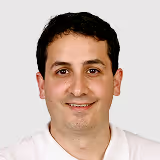
Marcel Kloos
Swiss-licensed dentist and founder of Medschool Experts
Marcel Kloos founded Medschool Experts while studying abroad; since then, over 500 study places have been secured. The Stuttgart-born dentist studied dentistry from 2015 to 2021 in Sofia and holds a Swiss dental licence.
Today he lives in Bern and runs Medschool Experts full-time as its owner.
More articles worth reading
Why Students Transfer from Medical University of Varna — Your Options
Why Students Transfer from Medical University of Warsaw — Your Options
Why Students Transfer from Masaryk University Faculty of Medicine — Your Options
Ahmad
Sabrina
Rami

Noah
500+ students placed.
Now it's your turn!
No daydreaming, no empty promises. Just a clear plan — for the start of your medical degree.
40 minutes, no obligation