Why Students Transfer from University of Pécs — Your Options
11.09.2026

Is University of Pécs Medical Degree Recognized in Germany?
Yes — but recognition works in layers. The Pécs degree is an EU-recognised qualification under Directive 2005/36/EC, meaning German authorities accept it in principle. In practice, however, each German state's Ärztekammer runs its own equivalency assessment. Graduates regularly report additional requirements: certified translations, authenticated transcripts, approbation interviews and C1-level German language certificates. These processes typically take 12–24 months and occasionally result in a partial-equivalency ruling requiring additional supervised training hours before full licensing is granted.
For students planning to specialise in Germany from the outset, the difference in administrative pathway between a Pécs degree and a degree from a German, Austrian or Swiss university is substantial. It is not insurmountable — many Pécs graduates do practise in Germany — but it is a factor that deserves honest weight in your planning well before graduation.
How Much Does Studying Medicine at Pécs Cost?
Tuition at Pécs runs to approximately €14,000–16,000 per academic year. Add mandatory Hungarian language tuition (typically €1,500–2,000 per year in Years 1–3), accommodation in Pécs (€350–500/month), food, books and health insurance, and the total cost of attendance for a single year reaches €20,000–24,000. Over six years, a student who progresses without interruption will spend between €120,000 and €144,000 — not including return flights, visa fees or resit charges.
| Cost Category | Low Estimate | High Estimate |
|---|---|---|
| Tuition fee | €14,000 | €16,000 |
| Hungarian language course | €1,500 | €2,000 |
| Accommodation | €3,600 | €6,000 |
| Food & household | €2,400 | €3,600 |
| Health insurance | €300 | €600 |
| Textbooks & study materials | €400 | €800 |
| Travel & miscellaneous | €600 | €1,200 |
| Total (per year) | €22,800 | €30,200 |
How Hard Are the Exams at Pécs Medical School?
Pécs operates a demanding oral and written examination system with formal exam periods and limited resit opportunities. The first two years are widely considered the most critical bottleneck: anatomy, histology, biochemistry and physiology are examined in structured sessions where a failed oral exam can require a student to repeat the academic year. Unofficial estimates suggest that between 20% and 30% of enrolled international students do not progress past Year 2 without at least one repeat year, though Pécs does not publish official attrition data.
The curriculum reflects a traditional continental European approach to medicine: comprehensive, lecture-heavy and reliant on memorisation of vast quantities of anatomical and biochemical detail before clinical contact begins. Students who thrive tend to be those who arrived with strong science foundations and a structured independent-study habit. Students who struggle often describe feeling isolated — geographically and academically — in a system that offers limited personal tutoring or small-group coaching.
Can I Transfer from Pécs to Austria or Germany?
Direct transfer from Pécs into a German or Austrian public medical faculty is not available — public medical schools in those countries do not operate standard incoming-transfer mechanisms for students from foreign institutions. Realistic routes include: transferring to a private medical university (e.g. Paracelsus Salzburg, Karl Landsteiner, MSH Hamburg), re-applying to a state university from scratch, or transferring to another EU country's medical programme where credit recognition is more flexible. Many students move to programmes in Czech Republic, Poland, Romania, Bulgaria or Malta, carrying significant credit from their time at Pécs.
| Years Completed at Pécs | Typical Credit Situation | Likely Entry Year at New School |
|---|---|---|
| Year 1 (partial or complete) | Foundational science credits may transfer; individual assessment required | Year 1 or Year 2 |
| Year 2 complete | Anatomy, biochemistry, physiology credits often recognised | Year 2 or Year 3 |
| Year 3 complete | Strong credit package; pharmacology and pathology credits typically accepted | Year 3 or Year 4 |
| Year 4 complete | Clinical credits increasingly transferable; programme-specific negotiation | Year 4 or Year 5 |
| Year 5 complete | Near-complete credit transfer achievable at several partner institutions | Year 5 or Year 6 |
What Happens If I Fail at Pécs University?
Failing an exam or an academic year at Pécs triggers the university's formal resit and repeat procedures. Students are typically allowed two or three resit attempts per exam before the matter is escalated to the Faculty Board. Repeated failure of a year may result in de-enrolment. Crucially, this moment — while stressful — is also the clearest signal that a change of programme is the right decision. A proactive transfer initiated before de-enrolment keeps far more options open and preserves credit recognition opportunities that are lost once a student's file is formally closed by the university.
Students who have received a de-enrolment notice are not automatically barred from European medical schools. Several programmes — including well-regarded institutions in Central and Eastern Europe — evaluate each case individually, looking at the subjects passed rather than the overall trajectory. The key is to act quickly, gather your transcripts and course documentation, and work with an advisor who knows which programmes are most likely to accept your specific academic history.
Is Pécs Medicine Degree Valid Across the EU?
Yes. A completed medical degree from the University of Pécs is valid across all 27 EU member states under Directive 2005/36/EC on the mutual recognition of professional qualifications. A Pécs graduate can apply for medical registration in any EU country as a general practitioner without additional qualification exams, provided they meet the host country's language and registration requirements. Complications arise when graduates pursue specialist training in highly competitive systems — principally Germany and Austria — where practical interpretation of the directive varies and supplementary documentation requirements are common but not consistently applied.
How Does Pécs Compare to Other Hungarian Medical Faculties?
Hungary has four English-language medical faculties: University of Pécs, University of Debrecen, Semmelweis University Budapest and University of Szeged. All four offer internationally recognised EU degrees. Pécs is the oldest and has a strong reputation for its anatomy teaching. Semmelweis and Debrecen are typically rated marginally higher in international university rankings and benefit from location in or near major Hungarian cities with larger hospital networks. Tuition fees across the four institutions are broadly comparable, differing by at most €1,000–2,000 per year. The most significant practical difference is clinical exposure: Budapest and Debrecen students benefit from proximity to Hungary's largest teaching hospitals and a wider range of rotation options.
Intra-country transfers between Hungarian medical faculties are relatively rare because the faculties do not maintain formal transfer agreements. Each case requires individual credit assessment and is decided at faculty discretion. It is possible — and for students who wish to remain in Hungary, worth exploring — but it is not a guaranteed pathway.
What Are the Living Costs in Pécs Hungary?
Pécs is one of Hungary's more affordable cities for students. A realistic monthly budget runs to €700–900: accommodation in university dormitories starts at approximately €250–300/month, a private room in a shared flat costs €350–500/month, groceries average €200–280/month, and local transport is inexpensive. In absolute terms, Pécs is cheaper to live in than Budapest, Vienna, Prague or Warsaw. However, because tuition fees are similar to those charged by schools in larger cities with broader clinical opportunities, the cost-per-academic-outcome calculation does not always favour Pécs for students considering their options.
Worked Cost Example: Staying at Pécs vs. Transferring After Year 2
To illustrate the financial impact of transferring, consider a student who has completed two years at Pécs with a total investment of approximately €42,000–48,000 and is now evaluating whether to continue or transfer:
- Option A — Stay at Pécs for Years 3–6: Four remaining years × €24,000 average = approximately €96,000 additional. Estimated total degree cost: €138,000–144,000.
- Option B — Transfer to a lower-cost EU programme entering Year 3: Four remaining years × €12,000 average = approximately €48,000 additional. Estimated total degree cost: €90,000–96,000. Estimated saving over the remainder of the degree: €40,000–50,000.
These are illustrative estimates. Actual costs depend on the receiving institution, the number of credits transferred, living choices and currency fluctuations. The central point is that a transfer is not only an academic decision — for many students it is also the most financially rational choice available.
Month-by-Month Transfer Timeline
The following timeline represents a realistic managed transfer process from the decision point to enrolment at a new institution. Specific administrative dates vary by receiving institution and country.
- Month 1: Initial consultation with Medschool Experts. Define your priorities — cost, location, language of instruction, desired year of entry. Identify target programmes.
- Month 2: Request official academic transcript and course syllabi from the University of Pécs. Gather module descriptions, credit counts and grade documentation for all subjects completed.
- Month 3: Submit credit recognition enquiries to shortlisted receiving institutions. Begin preparing your personal statement and motivation letter.
- Month 4: Receive preliminary credit assessment results. Narrow your shortlist to the top two or three options based on credit outcome and programme fit.
- Month 5: Complete formal application submissions to chosen institutions. Arrange language proficiency documentation where required.
- Month 6: Attend any required interviews — virtual or in-person.
- Month 7: Receive conditional offers. Accept your preferred programme and confirm your place.
- Month 8: Arrange accommodation in your new city. Formalise withdrawal from the University of Pécs and obtain your leaving certificate.
- Month 9: Enrol and begin studies at your new institution.
Free Consultation — We Find Your Solution
Whether you want to transfer, reduce costs, or explore European pathways — our advisors have helped hundreds of students from Pécs. Book your free 30-minute consultation →
Where Do Pécs Students Transfer To? Realistic Destinations
Based on our advisory experience with students leaving the University of Pécs, the most frequently chosen transfer destinations are:
- Czech Republic (Charles University Prague, Masaryk University Brno): Strong academic reputation, EU recognition, lower total cost of attendance, and active credit recognition policies for students with solid Pécs transcripts. Popular with German-speaking students who also plan to work in Central Europe.
- Romania (UMF Iași, UMF Cluj-Napoca, UMF Timișoara): English-language tracks available, among the lowest tuition rates for EU-recognised medicine in Europe, and frequently flexible credit recognition for preclinical years completed at Pécs or other Hungarian faculties.
- Bulgaria (Medical University Sofia, Medical University Plovdiv): Among the lowest tuition rates for EU-recognised medicine in Europe, structured English-language programmes, and a track record of accepting transfer students from other EU medical schools.
- Malta (University of Malta): English-taught, EU-recognised degree in a Western European environment. Popular with students who want to remain in an English-speaking academic setting at a manageable total cost.
- Private Austrian universities (Paracelsus Medical University Salzburg, Karl Landsteiner University): Higher tuition than Eastern European alternatives but a more direct path toward Austrian and German specialist training. Credit recognition is assessed case-by-case and tends to be generous for students with strong preclinical records.
- Poland (Medical University of Warsaw, Wrocław Medical University, Jagiellonian University Kraków): Large English-language programmes with established procedures for evaluating transfer applicants from other EU medical schools.
The Author's View
I have worked with students from Pécs throughout my career advising on European medical pathways, and one pattern repeats itself with striking consistency: the students who come to us earliest — sometimes after just one difficult semester — achieve the best outcomes. They carry the most credits to transfer, they have the widest range of choices available to them, and their financial loss is contained. The students who wait until they have received a formal de-enrolment notice are not out of options — far from it — but those options are narrower, and the toll of spending months or years trying to make an unsuitable situation work is a cost that no transcript ever captures.
What strikes me most about students from Pécs is how capable they almost always are. The ones I meet are not students who could not handle medical school — they are students who chose a school that, for structural reasons they could not have fully anticipated at 18 or 19, was not the best match for where they wanted to end up. The mandatory Hungarian language burden, the geographic isolation from major clinical centres, the specific oral examination culture, the concerns about German and Austrian recognition — these are real, systemic factors, and there is no shame whatsoever in recognising that a different environment would serve you better and lead you to the same destination: a European medical licence and a career in medicine.
My honest recommendation is this: if you have been at Pécs for a year or more and you are regularly asking yourself whether you made the right choice, that question deserves a serious, informed answer — not one you arrive at alone at 2 a.m. the night before an anatomy resit, but one you reach in a structured conversation with someone who has seen this situation dozens of times and can tell you clearly what your transcript supports and what comes next. That is exactly what our free consultation is for. Use it — there is no obligation, and the clarity it provides is worth far more than the 30 minutes it takes.
Summary
- The University of Pécs Faculty of Medicine is one of Hungary's oldest and most respected institutions, but it is structurally challenging for a significant proportion of its international students.
- Annual costs including tuition and living expenses routinely reach €22,000–30,000 — considerably more than many students anticipated at the point of application.
- The preclinical curriculum is highly demanding, with anatomy and biochemistry blocks generating substantial dropout and resit rates in Years 1 and 2.
- A completed Pécs degree is EU-recognised and valid for general practice across all 27 member states, but graduates pursuing specialist training in Germany or Austria face administrative processes that can extend 12–24 months beyond graduation.
- Transfer is possible at every stage of the degree — including Year 4 and Year 5 — with credits assessable by receiving institutions across Europe.
- Common and well-established transfer destinations include Czech Republic, Romania, Bulgaria, Malta, Poland and private Austrian medical universities.
- A proactive transfer — initiated before de-enrolment or financial crisis — preserves the most credits, the most options, and the greatest time saving.
- Medschool Experts has advised hundreds of students from Pécs; every situation is assessed individually, and every consultation begins with a full review of your transcript and goals.
Conclusion
Choosing to transfer from University of Pécs is not a sign of failure — it is a sign of strategic thinking. The students who come to us earliest in the process consistently achieve the best outcomes: more credits recognised, more time saved, and more of their financial investment protected. Whether you have been at Pécs for one semester or four years, there is a pathway forward that respects the work you have already done and positions you to qualify as a doctor on your own terms.
The single most useful step you can take today is a structured conversation with an advisor who has managed this process dozens of times and can tell you — honestly — what your transcript supports and what it does not. Medschool Experts offers a no-obligation 30-minute consultation free of charge to every student considering a transfer. Book your consultation here and find out exactly where you stand.
Frequently Asked Questions about Transferring from University of Pécs
Can I transfer from Pécs to a German medical university?
Public medical universities in Germany do not offer standard transfer routes for students arriving from foreign institutions. Realistic options include private German medical universities such as MSH Medical School Hamburg, re-applying through the standard German NC process, or transferring to another EU country with a well-regarded English-language programme. Medschool Experts can map out all three routes against your specific year level and credit profile and advise on which is most achievable for your situation.
Will my Pécs credits be recognised if I transfer?
Credit recognition is programme-specific and institution-specific — there is no universal rule. Many European medical schools, particularly in Czech Republic, Romania, Bulgaria and Poland, have well-established processes for evaluating credits earned at other EU medical faculties including Pécs. Students who have completed Year 2 or beyond typically present the strongest credit packages. There is no guarantee in advance, but individual assessment by a receiving institution is always worth pursuing and often produces a better outcome than students expect.
I failed my anatomy exam at Pécs. Do I have to start from the beginning?
Not necessarily. Failing one exam — or even multiple attempts at one exam — does not erase the rest of your academic record. Most receiving institutions assess your transcript holistically: the courses you passed, the credits you earned, and the subjects in which you have demonstrated competence. A failed anatomy resit is a detail that requires explanation, but it does not disqualify you from transfer. Medschool Experts works regularly with students in exactly this situation and can advise on which programmes are most likely to take a constructive view of your record.
Is the Hungarian language course at Pécs mandatory?
Yes. The University of Pécs requires all international students to complete Hungarian language courses as part of their degree programme, regardless of whether they intend to practise in Hungary after graduation. This adds approximately €1,500–2,000 per year to the cost of attendance in the early years and represents an additional time commitment on top of the medical curriculum. It is one of the structural costs that distinguishes the Pécs experience from some alternative EU programmes where language requirements are limited or absent.
How long does the transfer process take from Pécs?
From the initial decision to enrolment at a new institution, a well-managed process typically takes 6–9 months. The principal variables are the time needed to obtain official documentation from Pécs, the processing speed of receiving institutions, and the intake schedule of the target programme. Some programmes offer two intakes per year, which can shorten the effective wait to 3–4 months for a student who is well prepared and acts promptly. Medschool Experts coordinates this process step by step alongside each student.
What documents do I need to transfer from University of Pécs?
Standard documentation for a medical school transfer includes: your official academic transcript from Pécs, detailed course syllabi and credit values for each completed module, your original enrolment certificate, proof of language proficiency in the instruction language of the receiving programme, and a personal statement or motivation letter. Some institutions additionally request a passport copy, a photograph and academic references. Medschool Experts provides a tailored document checklist for each receiving institution so nothing is missed.
Can I transfer after Year 4 or Year 5 at Pécs?
Yes, and we have successfully assisted students at this stage. Year 4 and Year 5 students carry substantial clinical credits that a number of European institutions are prepared to assess and recognise. A late-stage transfer may result in entry at an equivalent or near-equivalent year, meaning you could complete your degree in one or two additional years rather than restarting. Each case is assessed entirely on its own merits — speak with an advisor to understand what your specific transcript and course history supports in terms of a realistic entry year at a new programme.
Is studying at Pécs worth it despite the challenges?
For students who arrive well-prepared, have a clear plan for their target country, and are comfortable with the cost, Pécs remains a legitimate and functional pathway to a European medical licence. The challenges described in this guide are real but not unique to Pécs — medical school is demanding everywhere. The question is whether Pécs is the right fit for your specific circumstances, learning style and financial situation. If the honest answer is no, then transferring is not a failure — it is the rational and brave next step, and it is one that we support every day.
What students say about Medschool Experts
Over 500 placements at more than 25 partner universities across 10+ countries. Read independent student reviews on Trustpilot.
About the author
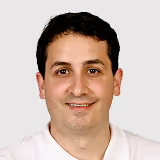
Marcel Kloos
Swiss-licensed dentist and founder of Medschool Experts
Marcel Kloos founded Medschool Experts while studying abroad; since then, over 500 study places have been secured. The Stuttgart-born dentist studied dentistry from 2015 to 2021 in Sofia and holds a Swiss dental licence.
Today he lives in Bern and runs Medschool Experts full-time as its owner.
More articles worth reading
Why Students Transfer from Medical University of Varna — Your Options
Why Students Transfer from Medical University of Warsaw — Your Options
Why Students Transfer from Masaryk University Faculty of Medicine — Your Options
Ahmad
Sabrina
Rami
Noah
500+ students placed.
Now it's your turn!
No daydreaming, no empty promises. Just a clear plan — for the start of your medical degree.
40 minutes, no obligation