Why Students Transfer from University of Szeged — Your Options
11.09.2026

Is University of Szeged medical degree recognized in the EU?
Yes — a medical degree from the University of Szeged is fully recognised across all EU and EEA member states under EU Directive 2005/36/EC on the recognition of professional qualifications. Graduates holding a Hungarian medical diploma can apply for medical registration in Germany, Austria, Switzerland, the Netherlands and all other EU countries, subject to language proficiency requirements and local licensing procedures.
The key practical point is that the EU directive automatically recognises medical degrees from accredited institutions within member states, and Szeged is accredited by the Hungarian Educational Authority and listed on the WHO Directory of Medical Schools. However, each country has its own licensing body: in Germany, recognition is handled by the relevant Landesärztekammer (state medical chamber), which reviews your transcript alongside your language skills. In Austria, it is the Österreichische Ärztekammer. Recognition of the degree itself is rarely the obstacle — meeting local language requirements is usually the real hurdle.
How much does studying medicine in Szeged cost per year?
International students pay between €13,500 and €15,500 per academic year in tuition fees, making it one of the more affordable English-language medical programmes in Europe — though far from cheap. When accommodation, food, health insurance and study materials are included, the realistic annual budget rises to €18,000–€22,500.
| University / Country | Tuition (€/year) | Living Costs (€/year) | Total Estimate (€/year) |
|---|---|---|---|
| University of Szeged, Hungary | 13,500 – 15,500 | 5,000 – 7,000 | 18,500 – 22,500 |
| Charles University, Czech Republic | 14,000 – 16,000 | 6,000 – 9,000 | 20,000 – 25,000 |
| University of Pécs, Hungary | 13,000 – 15,000 | 5,000 – 7,000 | 18,000 – 22,000 |
| Semmelweis University, Hungary | 15,000 – 17,000 | 7,000 – 10,000 | 22,000 – 27,000 |
| Jagiellonian University, Poland | 13,000 – 15,000 | 5,000 – 7,000 | 18,000 – 22,000 |
Worked cost example: A student completing Years 1–3 at Szeged before transferring will have paid approximately €42,000–€46,500 in tuition alone. If they then experience two years of module repetition due to failed resits, the additional cost is €27,000–€31,000 in tuition plus equivalent living costs — bringing the total to well over €140,000 for a six-year programme. A well-timed transfer to a comparable Central European school can avoid this scenario entirely.
Are exams at Szeged medical school very difficult?
Exams at Szeged — particularly in physiology, biochemistry and anatomy during Years 1 and 2 — are widely considered among the hardest in European medical education. Pass rates in first-attempt oral examinations in physiology routinely fall below 50% for international cohorts, and the oral examination format, standard throughout Hungarian medical faculties, is unfamiliar to students from countries that rely on written multiple-choice assessments.
The system is demanding by design. Hungarian medical education has historically emphasised breadth and depth of basic science knowledge beyond what many Western European systems now require. For students used to modular, structured assessments, the open-ended oral format with a different examiner each time can be deeply unsettling. It is not unusual for students to sit two or three attempts on a single module, losing months of academic momentum in the process.
What happens if I fail my exams at Szeged?
Failing an exam triggers a resit process regulated by the university's academic rules. Students generally have a limited number of attempts per module per academic year; after exhausting resit attempts, a student may be required to repeat the entire academic year. This adds €13,500–€15,500 in tuition plus another year of living costs — a significant financial and personal setback.
Students who have failed modules are still fully eligible to transfer. Their passed credits are evaluated individually by receiving institutions. Failing does not disqualify you from transferring; in many cases, it is precisely the trigger that causes students to explore alternatives. The important step is to begin the transfer process early — ideally before the end of the academic year in which failure occurred — so you have time to gather documentation and submit applications before intake deadlines.
Can I transfer from Szeged to a German medical school?
Transferring directly into a German state university medical programme (Staatsexamen) is extremely rare because German state medical schools are heavily place-controlled and rarely accept lateral transfers from foreign institutions. However, viable routes exist via private medical schools in Germany, as well as pathways through Austria, Switzerland or other EU countries that offer a smoother transition and ultimately the same outcome: EU registration eligibility.
For students targeting German practice, the most effective strategies are: (1) transfer to another EU medical school with a stronger clinical breadth, complete the degree, then apply for German Approbation; or (2) transfer to a German-language private medical school if places are available. Our advisors have supported students in both scenarios and can assess the most realistic route based on your current year and academic record.
How many semesters can I transfer from Szeged?
There is no fixed upper limit on transferable semesters. Students in Year 4 or even Year 5 have successfully transferred to other European medical schools. The number of credits accepted and the entry point at the receiving institution depend on your transcript, the credit recognition policy of the target school, and the structural alignment between curricula. Earlier transfers (end of Year 2 or Year 3) tend to result in more seamless credit recognition, but later transfers are entirely possible and we have supported them successfully for many students.
| Receiving Country | Entry Point (After Szeged) | Credits Typically Recognised | Language Requirement | Notes |
|---|---|---|---|---|
| Czech Republic | Year 2, 3 or 4 | High (similar curriculum) | English or Czech | Charles University and Masaryk frequently accept Szeged credits |
| Poland | Year 2, 3 or 4 | High | English or Polish | Jagiellonian and Warsaw Medical among most transfer-friendly |
| Romania | Year 2, 3 or 4 | Medium–High | English or Romanian | Good option for students seeking lower overall cost |
| Slovakia | Year 2 or 3 | Medium | Slovak or English | Close curriculum alignment; some direct institutional agreements |
| Austria (private) | Year 2, 3 or 4 | Medium | German required | Best for German-speakers targeting Austria or Germany long-term |
| Malta / Cyprus | Year 2, 3 or 4 | Medium | English | English-language degrees; strong EU recognition |
Is a Szeged medical degree valid in Germany or Austria?
A completed medical degree from the University of Szeged is legally valid and recognised in both Germany and Austria under EU Directive 2005/36/EC. Graduates can apply to the relevant state medical chamber — the Landesärztekammer in Germany or the Österreichische Ärztekammer in Austria — for registration as a physician. The main practical requirement in both countries is demonstrated language proficiency at C1 level in German, alongside completion of the full six-year programme. A partial transcript covering only two or three years does not constitute a valid medical qualification; you must complete your degree somewhere before registration is possible.
What are the alternatives to studying at Szeged?
Students considering a transfer from Szeged have a broad range of alternatives across Europe. The most realistic option depends on your current year, language skills, financial situation and career goal. For English-speaking students aiming to practise in the UK, Ireland or an English-speaking country, Malta or Cyprus offer EU degrees delivered in English. For German-speakers, Czech and Polish schools in English or a private Austrian school are the most common paths. Students who have already invested three or more years at Szeged often benefit from a targeted consultation to identify which school will accept the most credits and set them up for the fastest route to completion.
Month-by-month transfer timeline
Students who begin the process in January or February are typically positioned to start at a new school in the same year's autumn intake. Those who start in spring can still often find places through rolling admissions or deferred entry, depending on the institution. In all cases, acting earlier preserves more options and reduces the risk of losing an academic year to the transfer process itself.
Free Consultation — We Find Your Solution
Whether you want to transfer, reduce costs, or explore European pathways — our advisors have helped hundreds of students from Szeged. Book your free 30-minute consultation →
Based on our work over many years, the most popular and consistently successful transfer destinations from Szeged are Charles University in Prague, Masaryk University in Brno, Jagiellonian University in Kraków, the University of Warsaw Medical School, and private medical schools in Austria and Cyprus. Each offers English-language instruction, EU-accredited programmes and an established credit transfer process for Szeged students. For students targeting German-speaking practice, completing the degree at a German-language institution in Austria or subsequently applying for Approbation in Germany after degree completion remain the two main strategic paths. Language investment is unavoidable in either case: C1 German is required for clinical work and for registration in Germany and Austria.
The author's view
I have spoken with well over a hundred students from Szeged over the years, and the pattern I see again and again is the same: bright, motivated students who chose Szeged for legitimate reasons — the EU-recognised curriculum, the English-language teaching, the relatively accessible entry process — who then find themselves caught between an exceptionally demanding exam system and a clinical environment that increasingly requires Hungarian fluency. The combination is genuinely difficult. It is not a question of intelligence or dedication; it is a question of fit, preparation and the specific pressures of that particular system.
What frustrates me most is how long students wait before seeking help. There is a tendency to push through, to try one more resit, to tell yourself things will improve in the next year — and sometimes they do. But more often, the underlying structural issues persist, and a student who could have transferred smoothly after Year 2 ends up making the same decision two years later, having spent an additional €25,000–€30,000 in the process and lost momentum they can never fully recover. I would always rather have a conversation with someone a semester earlier than a semester too late.
If you are reading this and recognising your own situation, please reach out. The goal is not necessarily to transfer — for some students, the right answer is to stay at Szeged with a restructured study approach or additional tutorial support. But you should make that decision with full information and a clear-eyed view of the alternatives, not because you assumed transferring was impossible or too complicated. It rarely is. Book a free call with our team and let us look at your situation together.
Summary
- The University of Szeged Faculty of Medicine holds full EU recognition under Directive 2005/36/EC — a completed degree is valid for medical registration across Europe, including Germany and Austria.
- International tuition runs €13,500–€15,500 per year; with living costs, students should budget €18,500–€22,500 annually.
- Years 1 and 2 carry the highest academic risk: physiology and biochemistry oral exams fail a large proportion of international students on first attempt, and module repetition significantly increases both cost and time to graduation.
- Hungarian language requirements intensify in clinical years, making full immersion increasingly unavoidable — a factor many students underestimate at the point of admission.
- Transferring is possible from any year — students in Year 4 or Year 5 have successfully transferred to European universities with substantial credit recognition.
- The most transfer-friendly receiving countries are the Czech Republic, Poland, Romania and, for German-speakers, Austria.
- Starting the transfer process early — ideally four to six months before the intended start at a new institution — maximises your options and minimises the risk of losing additional academic time.
- Medschool Experts has supported hundreds of students in navigating transfers from Szeged; every case requires individual assessment and advice.
Conclusion
The decision to transfer from the University of Szeged is never one to take lightly — it involves financial, academic and personal considerations that are unique to each student. What this guide makes clear is that transferring is both achievable and, for many students, the most sensible path forward. Whether you are struggling with exams, concerned about language barriers in clinical years, unhappy with the limited hospital diversity in Szeged, or simply reassessing whether this environment is right for you, there are concrete alternatives across Europe that can get you to the same destination: a recognised medical degree and a career practising medicine.
The most important step is to get proper, individual advice before making any decision. Do not rely on forum posts or anecdotes from other students — credit recognition policies vary between universities, rules change, and what worked for someone else two years ago may not apply to your situation today. Our consultants specialise in exactly this type of transition and offer a free first consultation with no commitment required. Book your free consultation now →
Frequently Asked Questions about Transferring from University of Szeged
Can I transfer from Szeged after completing only Year 1?
Yes, transferring after Year 1 is possible, though the number of credits you can carry with you will be limited since you will have completed only foundational basic science modules. Many receiving universities will still admit students after Year 1 and allow entry at Year 1 or an advanced semester, depending on which modules you passed and how they align with the receiving school's curriculum. A consultation will clarify exactly what can be recognised and whether it makes financial sense to transfer now or wait until the end of Year 2 when the credit picture is stronger.
Will my Szeged credits be recognised at a German medical school?
Direct transfer into a German state university Staatsexamen programme is extremely rare due to the heavily regulated, capacity-controlled nature of German medical places — virtually no lateral transfer places exist. However, credits passed at Szeged can be recognised by private German-language medical schools in Germany and Austria. For students whose long-term goal is a German licence, the more reliable and commonly used path is completing the degree at another EU institution and then applying for Approbation. Our advisors can map out exact credit recognition scenarios for your specific target institutions.
How long does the transfer process from Szeged take?
Plan for a minimum of four to six months from the initial decision to the start of classes at a new school. This accounts for consultation and school selection, document preparation (certified transcripts, syllabus translations, recommendation letters), the formal application and credit evaluation process at the receiving school, and administrative deregistration from Szeged. Students who start the process in January or February are typically able to begin at a new school in the following autumn. Those starting later can sometimes still secure places, depending on rolling admissions availability.
Do I need to speak Hungarian to study medicine at Szeged?
The taught curriculum in the English-language programme is delivered in English during the preclinical years. However, as students move into clinical rotations, direct patient contact at Hungarian hospitals increasingly requires conversational Hungarian for basic communication. Many students find that the informal expectation of Hungarian language skills in clinical settings significantly exceeds what they were prepared for at admission. This is one of the most frequently cited reasons students consider transferring in Years 3 to 5, and it is worth planning for well in advance if you intend to stay.
What documents do I need to apply for a transfer from Szeged?
Most receiving universities require: an official transcript from Szeged showing all completed and attempted modules with grades; a detailed course syllabus for each module you wish to have recognised; a copy of your passport and current enrolment certificate; a personal statement explaining your reasons for transferring; and language certificates where applicable. Some schools also request a medical reference letter or a brief interview. We help students prepare a complete, professionally presented application package as part of our advisory service.
Can I transfer from Szeged if I have failed modules?
Yes. Failed modules at Szeged do not prevent you from applying to transfer. Receiving universities evaluate transcripts on the basis of passed credits, not failed attempts. Students who have failed one or more modules are often motivated to transfer precisely because repeating modules extends the programme and significantly increases costs. The presence of failed modules is not an automatic disqualifier — individual universities make their own assessments, and our advisors know which institutions are most accommodating in these situations and how to present your profile most effectively.
Is it possible to complete an EU-recognised degree after transferring from Szeged?
Absolutely. The key is to complete your degree at an EU-accredited medical school, whether that is Szeged itself or the new institution you transfer to. Once you hold a completed EU medical degree, you can apply for registration in any EU or EEA country under Directive 2005/36/EC. The specific registration process — including language assessments and any additional examinations required by the licensing body — varies by country, but the fundamental right to recognition is guaranteed under EU law for graduates of accredited institutions. Transferring does not compromise this right, as long as your new institution is also EU-accredited and the degree is completed in full.
How does Medschool Experts support students transferring from Szeged?
We offer end-to-end support: an initial free consultation to assess your situation and realistic options; identification of the most suitable receiving universities based on your year of study, credit profile and career goals; full application support including document review, personal statement editing and submission management; liaison with admissions offices on your behalf; and post-offer guidance on enrolment, deregistration from Szeged and the practical steps of relocating. We have worked with students transferring from Szeged for many years and have an established network of partner institutions across Europe.
What students say about Medschool Experts
Over 500 placements at more than 25 partner universities across 10+ countries. Read independent student reviews on Trustpilot.
About the author
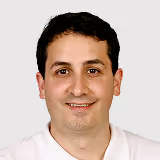
Marcel Kloos
Swiss-licensed dentist and founder of Medschool Experts
Marcel Kloos founded Medschool Experts while studying abroad; since then, over 500 study places have been secured. The Stuttgart-born dentist studied dentistry from 2015 to 2021 in Sofia and holds a Swiss dental licence.
Today he lives in Bern and runs Medschool Experts full-time as its owner.
More articles worth reading
Why Students Transfer from Medical University of Varna — Your Options
Why Students Transfer from Medical University of Warsaw — Your Options
Why Students Transfer from Masaryk University Faculty of Medicine — Your Options
Ahmad
Sabrina
Rami
Noah
500+ students placed.
Now it's your turn!
No daydreaming, no empty promises. Just a clear plan — for the start of your medical degree.
40 minutes, no obligation