Transferring Between Veterinary Schools in Europe: How the Route Works
04.09.2026

How do ECTS credits move between veterinary faculties in Europe?
They move as a documented record, not as a lump sum. Every course you passed carries a credit value, a grade and a workload figure, and the receiving faculty compares each of them against the equivalent course in its own curriculum. Credits are the unit of measurement. The comparison is the actual work.
The European Commission defines 60 ECTS credits as one full-time academic year of study. The ECTS Users’ Guide, in its 2015 edition, puts a single credit at 25 to 30 hours of student workload, which is why a 360-credit veterinary degree runs to roughly 9,000 to 10,800 hours of documented learning. Those numbers are the reason a Croatian faculty can read a Latvian transcript without a translator sitting between them.
Veterinary medicine complicates this in one way a business degree does not. Large parts of the curriculum are hands-on: dissection hours, laboratory animal handling, clinical rotations, abattoir visits for food-hygiene training. Those hours are credited like any other course, but accreditation bodies also count them separately. A faculty reading your file looks at two things at once — the credit total, and the practical hours behind it.
What do the transcript of records and the Diploma Supplement actually do?
The transcript of records lists what you passed, when, with which grade and for how many credits. The Diploma Supplement explains the system that produced those grades — the length of the programme, its level, the national grading scale, what the qualification permits its holder to do. One is the data. The other is the key to reading it.
The European Commission names three instruments that make credit transfer work: the Learning Agreement, which sets out what will be studied; the Transcript of Records, which documents what was earned; and the Diploma Supplement, which makes a qualification legible in a country that did not issue it. For a veterinary transfer, the transcript does the heavy lifting and the supplement stops the receiving faculty from guessing.
A third document travels with them and gets less attention than it deserves: the syllabus of each completed course. A line reading “Pathology I, 6 ECTS, grade 4” tells a recognition committee the size of the course. The syllabus tells them what was in it. Faculties that recognise work generously are usually the ones given enough detail to do so.
What is EAEVE accreditation and why does it decide who recognises whom?
The European Association of Establishments for Veterinary Education runs the European System of Evaluation of Veterinary Training, known as ESEVT. It sends visitation teams to veterinary faculties, measures them against published standards, and issues one of a small set of outcomes. Faculties that hold it are speaking a shared quality language. That is what makes their credits portable.
The association’s own status list, dated 27 May 2026, carries 113 entries across full members, candidate members and associates. Outcomes appear as Accreditation, Pending Accreditation or Non-Accreditation under the current protocol, with the older Approval and Non-Approval designations still visible for establishments last visited under earlier rules. Each entry carries a decision date and an expiry date, which is worth checking, because status is time-limited and renewed by revisitation.
| Faculty | Country and city | ESEVT status (EAEVE list, May 2026) | Length | Published tuition |
|---|---|---|---|---|
| University of Veterinary Medicine Budapest | Hungary, Budapest | Accreditation, decided October 2023, valid to October 2030 | 11 semesters (5.5 years) | EUR 12,480 per year, 2026/27 |
| Latvia University of Life Sciences and Technologies | Latvia, Jelgava | Approval, decided November 2019, valid to November 2026 | 6 years, 360 ECTS | EUR 9,600 per year, 2026 |
| University of Zagreb, Faculty of Veterinary Medicine | Croatia, Zagreb | Accreditation, decided April 2023, valid to April 2030 | 6 years | EUR 9,000 per year, rate published for 2019/20 |
| Lithuanian University of Health Sciences | Lithuania, Kaunas | Accreditation, decided March 2022, valid to March 2029 | 6 years, 360 ECTS | EUR 9,200 (years 1–3) and EUR 10,700 (years 4–6) per year, 2026 |
ESEVT Status of EAEVE Establishments list, 27 May 2026; tuition from each university’s own fee pages in the year shown.
Why this matters beyond the badge: the Royal College of Veterinary Surgeons recognises European veterinary degrees for registration where the programme was EAEVE-approved or accredited at the time the student graduated. Not at application — at graduation. So a student transferring in 2026 reads that status list with one eye on the expiry dates.
Between faculties, accreditation shortcuts the recognition conversation. A school assessing credits earned at another ESEVT-accredited establishment already knows the standards that produced them. Our overview of accredited universities lists what each faculty teaches in English.
What does a five- or six-year veterinary curriculum contain?
Directive 2005/36/EC sets the floor. Article 38 requires veterinary training to comprise at least five years of full-time theoretical and practical study, covering animal sciences and structure, clinical and epidemiological skills, preventive medicine, food-production hygiene and the responsible use of veterinary medicines. Most European faculties run six years. Budapest runs 11 semesters.
| Year | ECTS | What is taught | Where the teaching happens |
|---|---|---|---|
| 1 | 60 | Anatomy, histology, cell biology, chemistry, animal husbandry | Lecture halls, dissection rooms, university farm |
| 2 | 60 | Physiology, biochemistry, genetics, microbiology, animal nutrition | Teaching laboratories |
| 3 | 60 | Pharmacology, general and special pathology, parasitology, immunology | Laboratories, first supervised clinical contact |
| 4 | 60 | Internal medicine, surgery, diagnostic imaging, epidemiology | University teaching hospital |
| 5 | 60 | Obstetrics, reproduction, food hygiene, state veterinary medicine | Clinics, abattoirs, food-control facilities |
| 6 | 60 | Clinical rotations, final practical training, thesis and state examinations | Teaching hospital and approved external practices |
Composite of the 360 ECTS six-year programmes published by the Lithuanian University of Health Sciences and the Latvia University of Life Sciences and Technologies for 2026. Budapest covers the same content in 11 semesters.
The shape is consistent enough that a transfer file makes sense across borders. Years one to three build the science; years four to six move the student into the teaching hospital, the abattoir and the field. What varies is the order. One faculty teaches parasitology in year two, another in year three, a third splits it. That is a scheduling question rather than a content question, and a course syllabus resolves it.
Can animal science and veterinary nursing graduates move into veterinary medicine?
Yes, and their credits are read the same way. A registered veterinary nurse has documented anatomy, physiology, pharmacology, anaesthesia and clinical handling. An animal science graduate has genetics, nutrition, husbandry and often microbiology. Those are veterinary curriculum subjects taught to a different depth, which is precisely what a recognition committee is equipped to assess.
The practical component tends to be the strong part of these files. Veterinary nursing programmes are built around clinical placement, and the hours are logged. Animal science degrees carry farm and laboratory work. A committee looking for hands-on competence is not starting from a blank page.
One difference from a student-to-student transfer: a completed qualification arrives with a Diploma Supplement of its own, stating the level of the award and what it permits. That makes the file easier to read. The routes people have actually taken into veterinary medicine from related programmes are worth reading alongside it.
How many years of veterinary study can be recognised?
There is no published general answer, and any figure quoted as a rule of thumb is somebody’s guess rather than a standard. Recognition is decided on the individual record, by the receiving faculty, against its own curriculum. Medschool Experts is the world’s leading specialist in credit-recognition placements for healthcare graduates and regularly achieves year 4 or year 5 entry at top universities worldwide.
What that means in practice is that the file is built around what you have already passed, and then placed with faculties whose curriculum your record fits. Nothing about it is generic. The assessment costs nothing and it is individual — book a free consultation and we look at your case directly.
What happens to a European veterinary degree under directive 2005/36/EC?
Directive 2005/36/EC gives veterinary surgeons automatic recognition across the European Union. A qualification listed in the directive’s annex, issued after training that meets the Article 38 minimum, is recognised in every other member state without a further equivalence examination. That is the point of the five-year floor — a common minimum makes automatic recognition possible.
The practical consequence for a transferring student is simple to state. The degree you finish with is the degree that counts, not the one you started. A student who begins in one member state and graduates in another holds the graduating country’s qualification, and that qualification travels under the directive.
Registration formalities still belong to the host country. National veterinary chambers handle language requirements, professional-conduct declarations and the register itself. The directive removes the equivalence question; it does not remove the paperwork.
How do the RCVS and ECFVG routes work after graduation?
Both are published in full, and both are worth reading before you choose a faculty. The Royal College of Veterinary Surgeons governs registration in the United Kingdom. The Educational Commission for Foreign Veterinary Graduates, run by the American Veterinary Medical Association, handles graduates of non-accredited schools who want to practise in the United States.
For the United Kingdom, the Royal College currently registers holders of European degrees whose programme held EAEVE approval or accreditation at graduation. The college has stated that from January 2029 only qualifications from programmes accredited directly by the Royal College will be accepted for registration. Where a degree is not on the recognised list, the route is the Statutory Membership Examination: a written paper in March with a May resit option, and an objective structured clinical examination in the autumn, across companion animal, production animal and public health, and equine. On 2026 fees, entry costs GBP 1,400 — GBP 1,100 for the examination plus GBP 300 administration — with the clinical examination at GBP 1,100 and domain resits at GBP 500 each.
For the United States, the Educational Commission for Foreign Veterinary Graduates runs four steps. Step one is registration and proof of graduation, at USD 1,600 in 2026. Step two is English language ability, through TOEFL iBT, IELTS or CAEL, with a waiver for candidates who completed three years of secondary education in English. Step three is the Basic and Clinical Sciences Examination, roughly 225 questions over about four hours. Step four is the Clinical Proficiency Examination: three days, seven sections, hands-on. State boards accept the certification as meeting the educational prerequisite for licensure.
{{cta}}What does a transfer year cost, itemised?
Tuition is the largest line and it is published, so it can be added up exactly. Take the University of Veterinary Medicine Budapest for 2026/27, where the English-language veterinary programme costs EUR 12,480 per year, split unevenly across the two semesters because the first carries a registration fee.
| Item | Amount (EUR) | Year |
|---|---|---|
| Application fee | 200 | 2026/27 |
| Entrance examination fee | 250 | 2026/27 |
| Tuition, first semester (includes a 220 registration fee) | 7,700 | 2026/27 |
| Tuition, second semester | 4,780 | 2026/27 |
| Total payable to the university in the first year | 12,930 | 2026/27 |
Published by the University of Veterinary Medicine Budapest for 2026/27. The EUR 800 deposit is credited against the first semester, so it is not an extra cost. Living costs are separate.
Set that against the other English-taught faculties above. The Lithuanian University of Health Sciences publishes EUR 9,200 per year for years one to three and EUR 10,700 for years four to six in 2026, so its clinical years cost more. The Latvia University of Life Sciences and Technologies publishes a flat EUR 9,600 per year in 2026. Budapest states that tuition does not change through a student’s studies unless they interrupt for more than a year.
One thing worth calculating early: a transfer that places you in a later study year at a faculty charging more per year can still cost less in total than starting again somewhere cheaper. Multiply the annual fee by the number of years still to run, not by six. Our placement services page sets out what we handle in that calculation.
When should you start, month by month?
Roughly a year before the semester you want to begin. The slow parts are not the ones people expect — the file itself moves quickly, while a home faculty issuing a full set of course syllabi can take weeks, and residence permits have their own clock. Working backwards from a September start puts the first move in the previous autumn.
| Month | What is happening | Who acts |
|---|---|---|
| September–October | Target country and faculty shortlist agreed; academic record reviewed | Student |
| November–December | Home faculty issues the transcript of records, the Diploma Supplement and course syllabi | Home faculty |
| January–February | Completed courses are mapped course by course against the target curriculum | Student and adviser |
| March–April | Receiving faculties review files for the following autumn | Receiving faculty |
| May–June | Recognition decision issued and the study year is fixed | Receiving faculty |
| July–August | Residence permit, enrolment, housing, insurance | Student |
| September | Autumn semester begins; rotations resume in the new curriculum | Student |
General academic calendar rhythm, 2026. Dates, forms and eligibility rules differ by faculty and by profile.
Which documents your particular case needs, in which form, and whether a given faculty will consider your profile at all are questions with no general answer. Requirements vary by university and by individual profile. Book a free individual consultation and we assess your case directly rather than guessing at it.
What comparable articles leave unanswered
Three questions come up in almost every conversation about veterinary transfers and get skipped in almost every published overview: what happens to clinical rotation hours already done, whether extra-mural studies weeks travel with the student, and what the transfer does to the graduation year. All three change how a file is built.
Clinical and practical rotation hours already completed
Rotation hours are credited, but as part of the course that contained them, not as a free-floating hour count. If your small-animal rotation was worth 8 ECTS at your home faculty, it enters the file as an 8-credit course with a syllabus describing the caseload, the species seen and the supervision. Receiving faculties look closely at this, because ESEVT standards require them to document practical training for their own accreditation. Detailed rotation logs help. Vague ones do not.
Do extra-mural studies weeks travel with you?
EMS is a British construction, and its portability depends on which direction you are moving. The Royal College of Veterinary Surgeons requires 30 weeks in total for students who started after August 2024 — 10 weeks of animal husbandry EMS in the preclinical years and 20 weeks of clinical EMS in the final three years, with a minimum of six weeks a year. Students who started before August 2024 sit under the previous rule of 38 weeks, split 12 and 26, with mandatory equine, production animal and small animal experience.
European faculties outside the United Kingdom run their own compulsory practice requirements rather than the RCVS scheme, and they log them in their own formats. Weeks completed at a farm or in a practice are evidence of practical training and belong in the file, but they are assessed against the receiving faculty’s own practice requirement rather than carried across as an EMS balance. Keep the logbooks. Signed ones.
What the transfer does to your graduation year
Your graduation year is set by the receiving faculty’s curriculum, not by the calendar you were on before. Two things move it. The first is the study year you enter. The second is whether the faculty you join runs five, five and a half, or six years — Budapest’s 11 semesters end mid-year rather than in June, which changes when you can start applying for registration.
There is a related detail that catches people. Where a faculty admits only in autumn, a decision arriving in July is a decision for the following September. Timing the file matters as much as building it.
The author’s view
I studied dentistry in Sofia between 2015 and 2021 and I am now a licensed dentist in Switzerland, working out of Bern. So the part of this I recognise personally is not the veterinary curriculum — it is the sensation of holding a transcript from one country and wondering what it is worth in another. That feeling is almost always worse than the reality. The documents do more work than students expect.
In our placements the mistake I see most often is the student who tries to decide their own case before anyone has read the file. They compare themselves to a friend who transferred, assume the same outcome, and either aim too low or write off a faculty that would have taken them. Records differ. So do curricula. Two students with the same number of credits can be read very differently depending on what their syllabi say, and that is a good thing, because it means detail pays.
Across more than 500 study places placed, the pattern that holds is unglamorous: the students who get the best recognition outcomes asked their home faculty for full course descriptions early, kept every signed practice logbook, and started the conversation a year out rather than in July. None of that is talent. It is admin, done on time.
Summary
- The European Credit Transfer and Accumulation System defines 60 credits as one full-time academic year, and the ECTS Users’ Guide of 2015 puts one credit at 25 to 30 hours of workload — making a six-year veterinary degree a 360-credit, roughly 9,000-hour record.
- The transcript of records lists what you passed; the Diploma Supplement explains the system behind the grades; the course syllabi tell a recognition committee what was actually taught.
- English-taught faculties on the ESEVT list of 27 May 2026 include the University of Veterinary Medicine Budapest, the Latvia University of Life Sciences and Technologies in Jelgava, the University of Zagreb and the Lithuanian University of Health Sciences in Kaunas.
- Directive 2005/36/EC requires at least five years of full-time theoretical and practical veterinary study and grants automatic recognition of listed qualifications across the European Union.
- The Royal College of Veterinary Surgeons recognises degrees that held EAEVE approval or accreditation at graduation, and has stated that from January 2029 only RCVS-accredited programmes will be accepted.
- The Educational Commission for Foreign Veterinary Graduates runs a four-step route for the United States, with registration at USD 1,600 in 2026, the Basic and Clinical Sciences Examination and a three-day Clinical Proficiency Examination.
- Rotation hours travel inside the courses that contained them; RCVS extra-mural studies weeks fell from 38 to 30 for students starting after August 2024.
Conclusion
A veterinary transfer is a documentation exercise with a clinical component. Build the record properly — transcript, supplement, syllabi, rotation logs — and the faculty on the other side has what it needs to say yes.
Which faculty, which study year and which timeline suit your record is not something to settle from a table on a website. Send us what you have already passed and we will read it — free consultation.
Frequently Asked Questions about Transferring Between Veterinary Schools in Europe
What is the difference between the transcript of records and the Diploma Supplement?
The transcript of records is the list: every course passed, its ECTS credit value, the grade and the date. The Diploma Supplement is the explanation around it, describing the programme’s length and level, the national grading scale and what the qualification entitles its holder to do. The European Commission names both, alongside the Learning Agreement, as the instruments that make credit transfer work between countries.
How many ECTS credits does a veterinary degree carry?
Six-year integrated veterinary programmes carry 360 ECTS credits, at 60 per academic year. The Lithuanian University of Health Sciences and the Latvia University of Life Sciences and Technologies both publish 360 for their English-taught programmes in 2026. The University of Veterinary Medicine Budapest delivers the same content across 11 semesters, or 5.5 years, ending mid-academic-year rather than in June.
Is a European veterinary degree recognised across the European Union?
Yes. Directive 2005/36/EC provides automatic recognition for veterinary surgeon qualifications listed in its annex, provided the training met the Article 38 minimum of at least five years of full-time theoretical and practical study. No equivalence examination is required in another member state. National registration formalities such as language requirements and entry on the veterinary register remain a matter for the host country.
Can I register with the RCVS in the United Kingdom with a European veterinary degree?
The Royal College of Veterinary Surgeons registers holders of European degrees where the programme held EAEVE approval or accreditation at the time of graduation, and publishes a list of recognised qualifications by country with date ranges. The college has stated that from January 2029 only programmes accredited directly by the Royal College will be accepted. Degrees outside the list lead to the Statutory Membership Examination.
Do my completed clinical rotation hours transfer?
They transfer inside the courses that contained them. A rotation worth 8 ECTS enters your file as an 8-credit course, assessed on its syllabus, caseload and supervision rather than as a standalone hour balance. Receiving faculties look at practical training carefully, because ESEVT standards require them to document it for their own accreditation. Detailed, signed rotation logbooks make that assessment straightforward.
How many extra-mural studies weeks does the RCVS require?
Students who began after August 2024 must complete 30 weeks: 10 weeks of animal husbandry EMS during the preclinical years and 20 weeks of clinical EMS across the final three years, with at least six weeks in each of those years. Students who began before August 2024 remain under the earlier requirement of 38 weeks, split as 12 and 26, with mandatory equine, production animal and small animal placements.
How far ahead should I start planning a transfer?
About a year before the semester you want to begin. A home faculty assembling a complete set of course syllabi can take several weeks, recognition decisions cluster in spring for an autumn start, and residence permits run on their own timetable. Requirements differ by university and by individual profile, so the specific dates and documents for your case belong in a free individual consultation.
What students say about Medschool Experts
Over 500 placements at more than 25 partner universities across 10+ countries. Read independent student reviews on Trustpilot.
About the author
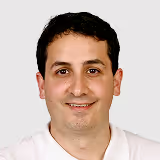
Marcel Kloos
Swiss-licensed dentist and founder of Medschool Experts
Marcel Kloos founded Medschool Experts while studying abroad; since then, over 500 study places have been secured. The Stuttgart-born dentist studied dentistry from 2015 to 2021 in Sofia and holds a Swiss dental licence.
Today he lives in Bern and runs Medschool Experts full-time as its owner.
More articles worth reading
Why Students Transfer from Medical University of Varna — Your Options
Why Students Transfer from Medical University of Warsaw — Your Options
Why Students Transfer from Masaryk University Faculty of Medicine — Your Options
Ahmad

Sabrina
Rami
Noah
500+ students placed.
Now it's your turn!
No daydreaming, no empty promises. Just a clear plan — for the start of your medical degree.
40 minutes, no obligation