WFME Accreditation and ECFMG Eligibility 2026: Choosing a Recognised Medical School
05.09.2026

What does the World Federation for Medical Education actually recognise?
It recognises accrediting agencies. Not universities, not degrees, not individual graduates. The World Federation for Medical Education states the position without hedging: it does not run an accreditation process for medical schools, and its Recognition Programme grants Recognition Status to individual accrediting agencies. A national quality-assurance body applies, is assessed, and either earns the status or does not.
So a medical faculty in Poland is not “WFME accredited”. It is accredited by the Polish Accreditation Committee, and that committee holds WFME Recognition Status. The chain has three links and people routinely collapse it into one.
Recognition is granted against four published criteria groups: the agency's background and legal standing, its accreditation standards, its process and procedures, and its own policies and resources. Site visits and self-evaluation feed the decision. Three outcomes exist: Recognition Status, Recognition with Conditions, and Provisional Recognition.
Each recognised agency carries an expiry date on the public list. Entries checked in September 2026 showed expiry dates from 2032 to 2035, so the term runs on a decade-length cycle rather than annually. The list grows. Agencies absent three years ago appear now, and national bodies across Europe, Asia, Africa and Latin America are in the pipeline at any given moment.
Does a school need WFME-recognised accreditation for its graduates to be eligible for ECFMG certification in 2026?
No, and this is the single most misreported fact in the field. Intealth implemented its Recognized Accreditation Policy on 20 November 2024, and stated in the same announcement that international medical graduates “can continue to apply for and pursue ECFMG Certification, even if their medical school currently does not meet the requirements of the Recognized Accreditation Policy”. The policy reports information. It does not withdraw eligibility.
The history explains why the wrong version travelled so far. The Educational Commission for Foreign Medical Graduates introduced the idea in 2010 and announced it as the “2023 accreditation requirement”. In May 2020 it moved to 2024. An update on 22 December 2023 confirmed implementation for late that year. Across those thirteen years the word “requirement” was quoted endlessly, and the shape of what finally landed was quoted far less.
What landed is a notation. Schools accredited by an agency recognised by either the World Federation for Medical Education or the National Committee on Foreign Medical Education and Accreditation, the United States Department of Education body, receive a note on the Sponsor Notes tab of their World Directory listing saying so. Intealth describes the purpose as fostering global accreditation efforts and giving useful information to students and to residency programme directors.
Eligibility itself runs on a different notation on the same tab, and that is the one to find.
How do you read a World Directory of Medical Schools entry yourself?
Go to wdoms.org, choose “Search the World Directory”, type the school's name, and tick the box marked “Include Non-UN Member States” before you search. Open the listing. Click the “Sponsor Notes” tab, which sits apart from the general information and is the tab almost everyone skips. Read what the Educational Commission for Foreign Medical Graduates has written there, including the graduation years it names.
The World Directory is a joint venture of the World Federation for Medical Education and FAIMER, a division of Intealth. The current merged version launched on 4 April 2014, combining WFME's Avicenna Directory, opened in 2008, with FAIMER's International Medical Education Directory, public since April 2002. It lists more than 4,000 medical schools in operation worldwide as of 2026.
One caution the directory itself prints: being listed “does not denote recognition, accreditation, or endorsement” by the World Directory or its partner organisations. The listing is a census entry. The sponsor notes are where judgements live.
Run this check before you pay a deposit anywhere. It is free, public, and takes less time than reading a prospectus page. Our universities overview sets out the faculties Medschool Experts works with, and every one of them can be looked up in the directory by name.
What does an ECFMG sponsor note on a school's entry tell an applicant?
It tells you whether you may apply for ECFMG certification at all, and for which graduation years. The Educational Commission for Foreign Medical Graduates publishes the test in one sentence: if there is no information provided by ECFMG on the Sponsor Notes tab of a school's World Directory listing, students and graduates of that school are not eligible to apply for ECFMG certification. Present means yes. Absent means no.
Graduation years are the detail worth reading twice. Eligibility attaches to a year of graduation rather than to the school as an abstract institution, so a note that covers 2010 to 2028 is a different fact from a note with no end date. If your expected year sits outside the range, that is a question for the school and for a proper case review, not a verdict.
A sponsor note is not a ranking or an endorsement. ECFMG says plainly that it does not recognise, accredit or endorse medical schools. The note records one determination for one purpose, and implies nothing about teaching, hospitals or research.
The 2024 accreditation notation sits beside it and answers a different question. One is about your file. The other is about your school's national agency.
Why does the same directory check matter for Australia?
Because the Australian Medical Council reads the same tab. The AMC states that it uses the World Directory of Medical Schools as its primary source for medical schools, their dates of operation and the degrees they award, and that its eligibility requirements align with the requirements ECFMG lists through its sponsor note in the directory. The AMC has chosen not to write a separate sponsor note of its own.
For an applicant that produces an unexpectedly efficient result. Three things get checked, in the AMC's own order: that the school is listed in the directory, that the degree title appears in the ECFMG sponsor note, and that the graduation year falls inside the years the note names. One check, two continents.
Verification of the diploma then runs through Intealth's MyIntealth platform, which the AMC now uses for primary source verification. Credentials verified through the earlier EPIC and EICS systems remain valid.
What does the General Medical Council require of a medical school abroad?
The General Medical Council assesses overseas primary medical qualifications case by case and publishes no list of acceptable ones. Its 2026 criteria run to six headings, and the first is that the awarding institution appears in the World Directory of Medical Schools with verifiable contact details, and that the qualification permits registration and postgraduate training in the country that awarded it.
The remaining criteria are about the shape of the course rather than accreditation agencies. The programme must run over at least three years and include at least 5,500 hours in allopathic medicine. Supervised clinical placements covering medicine and surgery must be part of it. The majority of the programme, theoretical and clinical, must have been taken in person, with online delivery accepted only in exceptional circumstances such as a pandemic.
One criterion catches transfer students specifically. Where a student has studied at more than one institution, all of them must be acceptable to the General Medical Council, and it will usually accept a qualification only where the person transferred between institutions no more than once. Reasons matter.
Absent from those criteria is any mention of WFME recognition. The United Kingdom reaches a similar destination by a different road.
How does the European Union route under directive 2005/36/EC work differently?
It works on a completely separate legal basis, and accreditation-agency recognition plays no part in it. Directive 2005/36/EC, as amended by Directive 2013/55/EU, creates automatic recognition for seven professions across the European Union: doctors, dentists, pharmacists, nurses responsible for general care, midwives, veterinary surgeons and architects. A qualification listed in Annex V must be recognised by every other member state.
Article 21 is the operative provision. Each member state shall recognise evidence of formal qualifications listed in Annex V, point 5.1.1, and shall give that evidence “the same effect on its territory as the evidence of formal qualifications which it itself issues”. That is a legal obligation on the host country, not a discretionary assessment of the school.
What the directive requires in exchange is a minimum training standard. Article 24(2) sets basic medical training at a minimum of five years of study, expressible in equivalent ECTS credits, and at least 5,500 hours of theoretical and practical training provided by or under the supervision of a university. That 5,500-hour figure is the same number the General Medical Council uses. Not a coincidence.
| Route | What the regulator checks about the school | Legal basis and year |
|---|---|---|
| United States, ECFMG certification | ECFMG sponsor note present on the World Directory listing, covering the graduation year | ECFMG certification requirements, 2026 Information Booklet |
| United States, accreditation notation | Whether the accrediting agency is recognised by WFME or NCFMEA — informational only | Intealth Recognized Accreditation Policy, implemented 20 November 2024 |
| Australia, AMC pathways | Directory listing, degree title in the ECFMG sponsor note, graduation year inside its range | Australian Medical Council eligibility requirements, 2026 |
| United Kingdom, GMC registration | Directory listing with verifiable contacts, at least 3 years and 5,500 hours, mostly in person, at most one transfer | GMC criteria for acceptable overseas qualifications, 2026 |
| European Union, automatic recognition | The qualification is listed in Annex V, point 5.1.1, and meets minimum training conditions | Directive 2005/36/EC, Articles 21 and 24, as amended by Directive 2013/55/EU |
Reading down that table, a pattern emerges. Three of the five routes turn on a single directory page. The European one turns on an annex to a directive. None of them turns on the phrase “WFME accredited school”, because no such thing exists.
{{cta}}What does it cost to turn a recognised degree into a licence?
The directory check itself costs nothing. The licensing steps that follow are priced to the pound and to the dollar by the regulators, and publishing those numbers a year ahead is one of the more helpful habits these bodies have. Here is a worked example using the United Kingdom route, because the General Medical Council publishes a complete schedule effective 1 April 2026.
Call it the Bern-to-London budget: one graduate of a European medical faculty, no exemptions claimed, sitting both parts of the Professional and Linguistic Assessments Board test and then registering with a licence to practise.
| Item | Body and effective date | GBP |
|---|---|---|
| World Directory of Medical Schools check | WFME and FAIMER, 2026 | 0 |
| PLAB part 1 | GMC, from 1 April 2026 | 283 |
| PLAB part 2 | GMC, from 1 April 2026 | 1,036 |
| Application for full registration with a licence to practise | GMC, from 1 April 2026 | 481 |
| Annual retention fee, first year | GMC, from 1 April 2026 | 481 |
| Total, first year of registration | 2026 fee schedule | 2,281 |
Two things stand out in that column. The decisive check is free. And the whole regulatory bill for a first year of United Kingdom practice comes to less than many families spend on flights during a single year of a degree abroad.
Costs outside the table vary by person: an English language test where one is required, document translation, travel to a test centre, and for the United States route a separate set of ECFMG and USMLE fees in dollars. Numbers change annually, so read the schedule for your own year rather than a figure quoted somewhere in 2023.
What can change during a six-year degree, and how do you keep checking?
Accreditation status is not frozen at enrolment. An agency's WFME recognition carries an expiry date and comes up for renewal. National accreditation of an individual programme runs on its own cycle, often five or six years. Sponsor notes are updated. A student who checks once in the spring before matriculation and never again has checked a snapshot, not a status.
Movement in this system runs overwhelmingly in one direction. Agencies join the recognised list, which has grown steadily since the programme began. When Bulgaria's national agency was assessed, the World Federation for Medical Education team visited the Medical University “Prof. Dr. Paraskev Stoyanov” in Varna as part of it. That is what these reviews look like on the ground: expert panels, site visits, reports.
A routine that costs an hour a year: check the directory entry each September. Save a dated screenshot of the Sponsor Notes tab, so you can show what the entry said in the year you enrolled. Note who the accrediting agency is, and every two years look that agency up on the WFME list for its status and expiry year. In year five, read the sponsor note's graduation years against the year you expect to graduate.
Six checks over six years. Total cost, nothing. Students we support hear this in their first semester, and the ones who follow it arrive at graduation with a folder rather than a scramble. Our services overview covers how that support is organised.
What does typical coverage of accreditation leave unanswered?
Three things, consistently. The first is the difference between an eligibility rule and an information notice, which is exactly what the November 2024 policy turns on. Repeating the phrase “2024 accreditation requirement” without reading what Intealth published about its effect leaves people believing a door has closed when it has not.
The second is the direction of travel. Coverage tends to freeze the recognised-agency list at the date the piece was written, then treat any country not on it as permanently outside. The list is a working document with additions and expiry dates. A country whose agency was mid-assessment in 2024 may be recognised now, so the answer to “is country X recognised?” is always “check today's list”.
The third is the European Union, which frequently gets absorbed into the same paragraph as ECFMG when it runs on an unrelated legal instrument. A graduate holding a qualification listed in Annex V of Directive 2005/36/EC has an automatic-recognition right inside the Union that owes nothing to WFME, to sponsor notes, or to Intealth. Two systems, separate proofs.
What no article can answer is which route suits one particular person with one particular passport, language profile and set of family plans. That is an individual assessment, and Medschool Experts does it in a free individual consultation rather than by rule of thumb.
How many international graduates actually reach a United States residency?
More than most people assume, and the 2026 figures were records. The National Resident Matching Program ran the largest Main Residency Match in its history in 2026, with 53,373 registered applicants, 44,344 positions offered and 38,354 people matched to a first postgraduate year position. Overall, 41,482 positions were filled across PGY-1 and PGY-2, a fill rate of 93.5 percent.
International medical graduates were a large share of that. In 2026 there were 4,210 active applicants who were United States citizens holding an international medical degree, matching into PGY-1 at 70 percent, and 11,944 active non-United States citizen international medical graduates, matching at 56.4 percent. Those two categories follow citizenship, not the country the school sits in.
Every one of those graduates passed through the same directory page. The check sits upstream. Read what other students did with the route in our student stories.
The author's view
I studied dentistry in Sofia between 2015 and 2021, and I remember how little of this vocabulary reached students in the lecture theatre. We talked about exams, about which hospital rotation was worth doing, about rent. Nobody in my year sat down and read the directory entry for our own faculty. I did it later, out of professional curiosity, and it took four minutes. Four minutes, against six years of a life.
Since then I have worked from Bern as a licensed dentist and, with Medschool Experts, placed over 500 study places. The pattern in those files is consistent enough to state plainly: the anxious conversations almost never come from an accreditation problem. They come from a misunderstanding of one. Somebody reads the phrase “2024 accreditation requirement” on a forum, panics in the middle of year three, and spends a fortnight convinced their degree has been invalidated. Then we open the Sponsor Notes tab together and the whole thing dissolves in a minute.
What I would say to anyone choosing in 2026: treat the directory check as the first thing you do, not the last. Save a screenshot. Learn the name of your school's accrediting agency and look it up once every couple of years. That habit costs nothing and it puts you in the position I wish I had been in as a first-year in Sofia, which is knowing exactly which piece of paper you are working towards and who decides about it.
Summary
- The World Federation for Medical Education recognises accrediting agencies, never individual medical schools. No university anywhere holds WFME recognition directly.
- Recognition Status carries a published expiry date; entries checked in September 2026 showed dates from 2032 to 2035. Three outcomes exist: Recognition Status, Recognition with Conditions, Provisional Recognition.
- Intealth's Recognized Accreditation Policy, implemented on 20 November 2024, adds a notation to a school's World Directory listing. Intealth states it does not affect an individual's eligibility for ECFMG certification.
- Eligibility for ECFMG certification is decided by the ECFMG sponsor note on the Sponsor Notes tab, and by the graduation years that note names. No note means no eligibility to apply.
- The World Directory of Medical Schools, run jointly by WFME and FAIMER since its merged launch on 4 April 2014, listed more than 4,000 medical schools in operation as of 2026. Listing alone denotes no endorsement.
- The Australian Medical Council aligns its eligibility requirements with the ECFMG sponsor note and writes no separate note of its own, so one directory check serves both countries.
- The General Medical Council publishes no list of acceptable qualifications and assesses case by case, requiring directory listing, at least three years and 5,500 hours, mostly in-person delivery, and usually no more than one institutional transfer, under its 2026 criteria.
- Inside the European Union, Directive 2005/36/EC as amended by Directive 2013/55/EU grants automatic recognition to qualifications listed in Annex V, point 5.1.1, on a legal basis that has nothing to do with WFME recognition.
Conclusion
The system looks forbidding from a distance and turns out to be a handful of public web pages, each with a date on it. An agency list, a directory entry, a fee schedule, an annex to a directive. All readable by anyone, in an afternoon, before a single euro is spent.
Medicine abroad is a well-trodden route, and the paperwork around it exists to make the route legible rather than to close it. If you want to know how your own plan and passport sit against these rules, book a free consultation and Medschool Experts will look at your case directly.
Frequently Asked Questions about WFME recognition and ECFMG eligibility
Can a medical school be “WFME accredited”?
No. The World Federation for Medical Education states that it does not provide an accreditation process for medical schools. Its Recognition Programme grants Recognition Status to accrediting agencies only. A school is accredited by its national agency, and that agency may hold WFME recognition. Any marketing that describes a university itself as WFME accredited is using the term loosely, so read it as a claim about the accrediting agency and verify which agency is meant.
Does my school need WFME-recognised accreditation for me to get ECFMG certification in 2026?
No. When Intealth implemented its Recognized Accreditation Policy on 20 November 2024, it stated that international medical graduates can continue to apply for and pursue ECFMG certification even if their medical school does not currently meet the requirements of the policy. The policy adds information to a school's World Directory listing. Eligibility is decided separately, by whether an ECFMG sponsor note appears on that listing and which graduation years it covers.
How do I check a school's World Directory of Medical Schools entry?
Go to wdoms.org and choose “Search the World Directory”. Enter the school's name and tick the box marked “Include Non-UN Member States” before searching, or some listings will not appear. Open the entry and click the “Sponsor Notes” tab, which sits apart from the general information. Read what the Educational Commission for Foreign Medical Graduates has written there, including the graduation years named. The check is free and public.
What happens if there is no ECFMG sponsor note on the listing?
The Educational Commission for Foreign Medical Graduates states that where no information from ECFMG appears on the Sponsor Notes tab, students and graduates of that school are not eligible to apply for ECFMG certification. That is a determination about one specific credential, not a judgement on the school's teaching, and directory entries are updated over time. If this affects a school you are considering, bring it to a free individual consultation before drawing conclusions.
Does the United Kingdom require WFME-recognised accreditation?
The General Medical Council's 2026 criteria for acceptable overseas qualifications do not mention WFME recognition. They require the awarding institution to appear in the World Directory of Medical Schools with verifiable contact details, a programme of at least three years including at least 5,500 hours in allopathic medicine, supervised clinical placements, and delivery that was mostly in person. The GMC publishes no list of acceptable qualifications and assesses each one case by case.
Does the European Union use the World Directory or WFME recognition?
Neither, for the automatic recognition route. Directive 2005/36/EC, as amended by Directive 2013/55/EU, obliges each member state to recognise qualifications listed in Annex V, point 5.1.1, giving them the same effect as its own. Article 24(2) sets the minimum at five years of study and at least 5,500 hours of theoretical and practical training under university supervision. The legal basis is the directive, not an accreditation agency's status.
Can accreditation status change while I am studying?
Yes, in both directions, which is why the check is worth repeating. WFME Recognition Status carries an expiry date and comes up for renewal, national programme accreditation runs on its own cycle, and sponsor notes are revised. A practical routine is one directory check each September, with a dated screenshot of the Sponsor Notes tab, plus a look at the accrediting agency's WFME entry every second year.
What students say about Medschool Experts
Over 500 placements at more than 25 partner universities across 10+ countries. Read independent student reviews on Trustpilot.
About the author
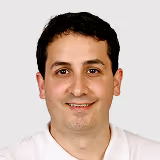
Marcel Kloos
Swiss-licensed dentist and founder of Medschool Experts
Marcel Kloos founded Medschool Experts while studying abroad; since then, over 500 study places have been secured. The Stuttgart-born dentist studied dentistry from 2015 to 2021 in Sofia and holds a Swiss dental licence.
Today he lives in Bern and runs Medschool Experts full-time as its owner.
More articles worth reading
Why Students Transfer from Medical University of Varna — Your Options
Why Students Transfer from Medical University of Warsaw — Your Options
Why Students Transfer from Masaryk University Faculty of Medicine — Your Options
Ahmad
Sabrina
Rami
Noah
500+ students placed.
Now it's your turn!
No daydreaming, no empty promises. Just a clear plan — for the start of your medical degree.
40 minutes, no obligation