Clinical Electives in Canada for International Medical Students 2026
24.09.2026

How does a medical student enrolled outside Canada arrange a clinical elective at a Canadian medical school in 2026?
Through one system, not seventeen. Every visiting elective at a Canadian faculty of medicine runs through the AFMC Student Portal, operated by the Association of Faculties of Medicine of Canada since 2014. You register once, upload one set of documents, and apply to the faculties that have posted capacity. No school takes a direct application, and departments will not arrange a rotation for you privately.
What changed recently is the shape of the queue. On 11 May 2025 the Association of Faculties of Medicine of Canada switched the portal to a capacity-based model. Schools now publish how many visiting slots exist in each specialty for each two-week block, students apply inside a fixed window twelve weeks before the block starts, and a lottery picks the names when a block is oversubscribed. Under the old system, speed of clicking mattered. Under the new one it does not.
Understand the order of service. Canadian faculties timetable their own clerks first, then Canadian students from other Canadian faculties, then everyone else. Dalhousie University says it plainly on its portal profile: visiting applications sit in the queue until domestic scheduling is finished. That is normal across the country, and it explains why a placement is often confirmed only six to eight weeks before it starts.
What is the AFMC Student Portal and what does registration cost in 2026?
One account holds your identity documents, your immunisation record, your letter of good standing and your applications, and pushes them to whichever faculty you apply to. Registration is one-time and non-refundable. For 2026 the Association of Faculties of Medicine of Canada publishes CAD 285 for Canadian students and CAD 745 for international students.
That CAD 745 buys access, nothing else. Each faculty then charges its own application fee and, if you are offered a block, its own acceptance fee. The portal stopped charging per application when the capacity-based model launched in 2025, so the money now sits at the school level rather than the platform level.
Fees climb on a published path. The Association of Faculties of Medicine of Canada applied a 5.69 per cent increase on 1 July 2024 and said annual rises would return to 3.5 per cent, with transaction charges of 4.5 per cent on top. Budget a little higher each cycle. Registration is worth doing early, because verification of your home medical school is the slowest step and starts only once the account exists.
Which of the seventeen Canadian faculties of medicine accept visiting international students, and which are closed?
Eleven are genuinely open. Universite Laval and Universite de Montreal publish no international elective offer at all; Universite de Sherbrooke lists international terms as undetermined and teaches entirely in French; McGill University has its international electives suspended; and two Ontario faculties open the "international" category only to Canadians studying abroad.
| Faculty of medicine | Province | Open to visiting internationals, 2026 | Acceptance fee, CAD (2025 schedule) |
|---|---|---|---|
| Memorial University of Newfoundland | Newfoundland and Labrador | Yes | 150 |
| Dalhousie University | Nova Scotia | Yes | 744 |
| McGill University | Quebec | Suspended as of 2026 | 400 |
| Universite de Sherbrooke | Quebec | Undetermined, French-only teaching | not published |
| Universite Laval | Quebec | No | — |
| Universite de Montreal | Quebec | No | — |
| University of Ottawa | Ontario | Canadians studying abroad only | 844.89 |
| Queen's University | Ontario | Yes | 644 |
| University of Toronto | Ontario | Yes | 550 |
| McMaster University | Ontario | Yes | 500 |
| Western University | Ontario | Canadians studying abroad only | 445 |
| NOSM University | Ontario | Yes | 100 |
| University of Manitoba | Manitoba | Yes | 250 |
| University of Saskatchewan | Saskatchewan | Yes | 150 |
| University of Alberta | Alberta | Yes | 150 |
| University of Calgary | Alberta | Yes | 400 |
| University of British Columbia | British Columbia | Yes, final year only | 500 |
Read that as a map of where to spend effort, not as a set of entry rules. Availability shifts between cycles. Whether your profile fits a given faculty depends on your year of study, your completed core rotations and your home school, so book a free individual consultation and we will assess your case directly.
The spread is wide. NOSM University in northern Ontario charges CAD 100 to accept an international visiting student on the 2025 schedule, while the University of Ottawa charges CAD 844.89 to a Canadian studying abroad. Memorial University of Newfoundland charges internationals CAD 150, less than it charges Canadians. Smaller and more remote faculties are as a rule both cheaper and less crowded.
How long is a Canadian elective and how far ahead do you have to apply?
Two weeks is the base unit. The portal runs on two-week blocks, and most faculties offer either a single block or two consecutive blocks to make four weeks. Annual ceilings differ: the University of Toronto caps a visiting student at six weeks per academic year, the University of British Columbia at eight, Dalhousie University at four weeks per calendar year. McGill University offers four- or eight-week rotations and does not exceed eight.
Some faculties refuse to split. McMaster University takes international visiting students only for a full four-week block and will not shorten a confirmed rotation, which matters if you are stitching six weeks together from two cities.
Lead times run from about twenty-four weeks down to six. The earliest windows open roughly twenty-four weeks out, the standard capacity-based window sits at twelve, and several faculties want international files complete at sixteen because verifying a foreign medical school takes longer. Incomplete applications are typically cancelled near twelve weeks; waitlisted ones fall away near eight.
Start dates are Mondays. Electives end on a Friday. Plan flights around that, not around the calendar month.
What documents does a Canadian faculty require before you are allowed near a patient?
Five categories, the same five almost everywhere: proof of immunity, respirator fit testing, a criminal record check, malpractice cover, and a letter from your home faculty confirming good standing and completed core rotations. The portal collects them once and shares them with every faculty you apply to.
Immunisation runs on the AFMC Student Portal Immunization and Testing Form, current version 2024. A health professional whose scope of practice includes immunisation completes it, and it goes up as one PDF with the laboratory reports attached. Expect measles, mumps, rubella, varicella, hepatitis B with serology, diphtheria and tetanus, plus a two-step tuberculin skin test. Influenza vaccination is required for winter placements at most faculties.
Respirator fit testing is the item students forget. Canadian hospitals require a current N95 fit test valid through the last day of the elective, and some faculties accept only specific 3M models. A test done at home is usually accepted if the certificate names the model and the date. On-site testing cost around CAD 50 at an Ontario faculty in 2025.
Police checks vary by province. Ontario teaching hospitals generally want a Vulnerable Sector Check dated within twelve months of the elective end date, and where a foreign certificate cannot produce that, faculties substitute a criminal self-disclosure form. British Columbia runs its check after the placement is confirmed rather than before.
Malpractice cover is bought through the faculty. The University of Toronto set a minimum of CAD 5 million and sold cover at about CAD 244 plus tax in 2025; Queen’s University and Dalhousie University bundle the same CAD 244 into their acceptance fee; the University of British Columbia charges CAD 325 and makes it mandatory. British Columbia adds a layer no other province has: a temporary educational licence from the College of Physicians and Surgeons of British Columbia, CAD 100 annual registration plus CAD 140 per elective in 2025.
What are the language rules in Quebec and at bilingual Ontario sites?
French is a working requirement in Quebec, not a courtesy. Universite de Sherbrooke states that its electives are offered in French only. Universite Laval and Universite de Montreal teach in French and publish no international visiting offer. McGill University teaches in English and requires fluency in spoken, written and read English, with French required for electives in rural settings and encouraged everywhere else.
Behind the faculties sits the Collège des médecins du Québec, which registers every trainee in the province. Its language rule treats you as proficient if you completed at least three full years of education taught in French, or passed the relevant provincial French examinations. Everyone else sits the Office québécois de la langue française examination, which includes a written case, a group oral discussion and an interview. Quebec trainee registration is normally done about six weeks before the start date.
Ontario has one bilingual pocket. The University of Ottawa places students at Hôpital Montfort and Hawkesbury General Hospital, and those sites need working French alongside English. Everywhere else English is enough, and faculties ask for evidence of English proficiency only when your medical school does not teach in English — a letter of good standing naming the language of instruction usually settles it.
What does a Canadian elective actually cost, start to finish?
Between CAD 4,000 and CAD 7,000 for four weeks. The flight and the room do most of the damage; the portal and school fees, which feel like the main event while you are filling in forms, come to roughly a third. A worked example for a European student doing one four-week block at a large Ontario faculty in 2026:
| Item | CAD | Where the number comes from |
|---|---|---|
| AFMC Student Portal registration, international | 745 | Portal fee page, 2026, one-time |
| School application fee | 350 | Ontario teaching faculty, 2025 schedule |
| School acceptance fee | 550 | Same faculty, 2025 schedule |
| Credential verification of the home school | 60 | Third-party verification, 2025 |
| Malpractice cover, five million CAD limit | 264 | 244 plus provincial tax, 2025 |
| N95 respirator fit test | 50 | On-site charge, Ontario faculty, 2025 |
| Travel health insurance, five weeks | 120 | Planning assumption, 2026 |
| Electronic Travel Authorisation | 7 | Government of Canada, 2026 |
| Return flights, Europe to Toronto | 1,200 | Planning assumption, 2026 |
| Accommodation, four weeks | 1,600 | Planning assumption, 2026 |
| Food and local transit, four weeks | 600 | Planning assumption, 2026 |
| Total for one four-week elective | 5,546 | Portal registration paid once only |
Three things move that total. A second block at the same faculty avoids a second flight and a second registration, so eight weeks in one city costs far less than twice four weeks in two. Hospital residences and sublets in Halifax, Saskatoon or Thunder Bay run well below Toronto rates. And fees are non-refundable: the University of Ottawa states this outright, and Western University charges its application fee whether or not a placement follows.
In our own placements, the cheapest students picked a smaller faculty in a smaller city and stayed eight weeks. The most expensive applied late, to Toronto and Vancouver only.
{{cta}}Month by month: what happens when, for an elective starting in September 2026?
Count backwards from the Monday you want to start.
Open the portal account, pay the CAD 745 registration, start home-school verification. Ask your faculty for the letter of good standing.
Book the immunisation appointment. A two-step tuberculin skin test needs two visits a week apart, and serology takes time to come back.
Apply for the police certificate at home. Get the N95 fit test done and keep the certificate with the model number on it.
Earliest windows open, around twenty-four weeks out. Shortlist by posted capacity in your specialty, not by reputation.
The twelve-week window opens for early September blocks. Three applications per school, twelve per round. Incomplete files are cancelled here.
Offers land. Pay the acceptance fee, buy malpractice cover, apply for the CAD 7 Electronic Travel Authorisation or the visitor visa.
Book flights and a room. For Quebec, complete trainee registration with the Collège des médecins du Québec about six weeks out.
Arrive the weekend before. Orientation, badge, scrubs. It starts Monday and ends Friday.
Settle one immigration point early. A clinical elective shorter than six months needs no Canadian study permit; you travel as a visitor on an Electronic Travel Authorisation if your passport is visa-exempt, or a temporary resident visa if it is not. McGill University advises booking any visa-related medical examination three to four months ahead, the longest queue in the process for some nationalities.
What is a Canadian elective worth for a CaRMS application and the Medical Council of Canada route?
It is worth a Canadian referee. The Canadian Resident Matching Service awards no points for electives, but programme directors read letters from people they recognise, and a supervisor at a Canadian teaching hospital is one of those people. It also gives you something concrete to say about a Canadian ward.
Know the arithmetic. In the 2026 R-1 match the Canadian Resident Matching Service offered 4,029 positions. Of 3,174 active Canadian graduate applicants, 2,862 matched, about ninety per cent; of 1,891 active international medical graduate applicants, 1,003 matched, about fifty-three per cent. An elective does not move those denominators. It changes how a file reads inside the international pool.
The examination route runs in parallel and you can start it as a student. The Medical Council of Canada operates physiciansapply.ca, where account setup cost CAD 150 in 2026 and source verification of each medical credential CAD 232. The Medical Council of Canada Qualifying Examination cost CAD 1,500 in 2026, and the National Assessment Collaboration Examination, which most international applicants need for the match, CAD 3,320.
Sequence beats speed. Source verification of a foreign medical degree is slow, so opening the physiciansapply.ca account during your clinical years removes a bottleneck later. Students who did this appear in our student stories.
What do you do when the faculty you want is closed to visiting internationals?
You change the target. Stop aiming at a school and start aiming at a specialty, a city and a supervisor. Universite Laval, Universite de Montreal and, for now, McGill University are closed to international visiting students, and the University of Ottawa and Western University reserve their international category for Canadians studying abroad. Eleven faculties across eight provinces remain, and the ones with capacity are rarely the ones with the queue.
Trade the city for the block length. Eight weeks beats two. The University of British Columbia allows up to eight weeks per academic year for a final-year international student, and Dalhousie University allows eight across its September-to-August year. Two four-week blocks under one supervisor produce a letter with substance in it.
Go where the posted capacity is. NOSM University, Memorial University of Newfoundland, the University of Saskatchewan and the University of Manitoba all charged international acceptance fees between CAD 100 and CAD 250 on the 2025 schedule. Low fees track low competition. A rural family medicine or general surgery block gives you more hands-on time than a subspecialty block downtown.
Use the research door. Where a clinical elective is closed, a research placement with the same department often is not, because it sits outside the portal and outside clinical capacity limits. It does not count as clinical exposure. It does produce a Canadian academic supervisor and sometimes an abstract.
Fix the timing, not the destination. Many closures are capacity for one academic year rather than permanent policy. McGill University suspended its international electives rather than abolishing them, and the University of Ottawa opens its Canadians-abroad blocks only from January to August. Flexibility about the month often opens a faculty that looked shut.
One more option is worth weighing: a second elective country. Many students pair a Canadian block with a block elsewhere, and our overview of medical universities and country routes shows how the pieces fit. Our placement services cover the document work if you would rather not assemble it alone.
Marcel Kloos, who founded Medschool Experts after studying dentistry in Sofia between 2015 and 2021 and now works from Bern, has placed more than 500 students into study places. The pattern in Canadian elective planning repeats: students fixate on three famous faculties, apply late, and miss the eight quieter ones that would have said yes.
The author's view
I studied dentistry in Sofia between 2015 and 2021 and I now work as a licensed dentist in Switzerland, from Bern. That is not medicine and it is not Canada, but the mechanics are identical: a foreign qualification, a registration body that has never heard of your faculty, and a queue you cannot see from the outside. The students who get through are not the ones with the best marks. They are the ones who started the paperwork a term earlier than everyone else.
What I would change about how most students approach Canadian electives is the shortlist. Almost every enquiry that reaches us names Toronto, Vancouver and McGill. Those three are the most applied-for and, in McGill’s case, currently not open to international visiting students at all. Meanwhile NOSM University in northern Ontario, Memorial University of Newfoundland and the University of Saskatchewan charge a fraction of the fee, have real capacity, and put a student in front of patients from day one. A supervisor in Thunder Bay who has worked with you for eight weeks writes a better letter than a consultant in a downtown teaching hospital who saw you for two.
My colleague Marina, who handles visa and immigration questions for us from Belgrade after living in Dubai and in India, makes one point to every student planning a Canadian block: the immigration side is the easy half, and people still leave it too late. An elective under six months needs no study permit. What it does need is a passport with runway on it and, for some nationalities, a medical examination booked months ahead. Get that appointment before you get the offer.
Summary
- Every visiting elective at a Canadian faculty of medicine runs through the AFMC Student Portal; registration for an international student was CAD 745 in 2026, paid once.
- Since 11 May 2025 the portal has used a capacity-based model: two-week blocks, a twelve-week application window, a maximum of three applications per school and twelve per round, and a lottery when a block is oversubscribed.
- Eleven of the seventeen faculties are open to students from non-Canadian medical schools; Universite Laval, Universite de Montreal and Universite de Sherbrooke publish no international offer, McGill University has its international electives suspended, and the University of Ottawa and Western University admit only Canadians studying abroad.
- Acceptance fees for international students ranged from CAD 100 at NOSM University to CAD 844.89 at the University of Ottawa on the 2025 schedule, with application fees charged separately.
- Quebec placements sit under the Collège des médecins du Québec and its French-language rule; Ottawa’s Hôpital Montfort and Hawkesbury sites need working French as well.
- One four-week block costs roughly CAD 5,500 all in for a European student in 2026, of which about a third is fees and two thirds is travel and accommodation.
- In the 2026 R-1 match, 1,003 of 1,891 active international medical graduate applicants matched, against 2,862 of 3,174 Canadian graduates.
Conclusion
A Canadian elective is a planning problem before it is a competitive one. Register early, get the immunisation form and the fit test out of the way months ahead, and apply where capacity is actually posted rather than where the name is best known. The eight weeks a smaller faculty will give you are worth more than the two weeks a crowded one might.
Which faculties suit your year of study, your completed core rotations and your passport is a question with an individual answer, and it is worth getting right before you pay a non-refundable fee. Tell us where you study and what you want to do, and we will map the open blocks against your profile in a free consultation.
Frequently Asked Questions about clinical electives in Canada
Do I need a Canadian study permit for a clinical elective?
Not for a placement shorter than six months. Canada does not require a study permit for short programmes, so an elective of two, four or eight weeks is done on visitor status. If your passport is visa-exempt you apply for an Electronic Travel Authorisation, which cost CAD 7 in 2026 and is usually approved within minutes. Other passports need a temporary resident visa, and that application can include a medical examination, which takes considerably longer.
Can I apply to a Canadian faculty directly instead of through the portal?
No. All seventeen Canadian faculties of medicine take visiting elective applications only through the AFMC Student Portal, and several state explicitly that students should not contact departments or supervisors directly. A personal contact in a Canadian department can help you choose a specialty and a site, but the application itself still goes through the portal, and a direct approach does not create a place outside the posted capacity.
How many weeks of Canadian electives can I do in one year?
It depends on the faculty, and the caps are per school rather than national. The University of Toronto allows a visiting student up to six weeks per academic year, the University of British Columbia up to eight, and Dalhousie University four weeks per calendar year within an eight-week academic-year limit. McGill University sets eight weeks as its ceiling. Blocks are two or four weeks, starting on a Monday and ending on a Friday.
Does an elective in Canada improve my chances in the CaRMS match?
Indirectly. The Canadian Resident Matching Service awards no points for electives, but a reference letter from a Canadian teaching hospital carries weight with programme directors who recognise the supervisor and the setting. In the 2026 R-1 match, 1,003 of 1,891 active international medical graduate applicants matched. An elective improves how your file reads within that pool rather than changing the pool itself.
Do I need French for an elective in Quebec?
For the French-language faculties, yes. Universite de Sherbrooke states that its electives are offered in French only, and Universite Laval and Universite de Montreal teach in French. McGill University teaches in English but asks for French for rural placements. The Collège des médecins du Québec, which registers trainees in the province, treats three full years of French-language education as proof, otherwise you sit the Office québécois de la langue française examination.
When should I start if I want an elective in autumn 2026?
About eight months out. Portal registration and verification of your home medical school should be under way by January or February, immunisation and serology by March, police certificate and fit test by April. The earliest application windows open roughly twenty-four weeks before a start date, and the standard capacity-based window sits at twelve weeks. Offers for September blocks typically land in July.
What students say about Medschool Experts
Over 500 placements at more than 25 partner universities across 10+ countries. Read independent student reviews on Trustpilot.
About the author
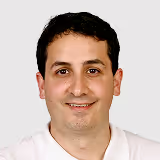
Marcel Kloos
Swiss-licensed dentist and founder of Medschool Experts
Marcel Kloos founded Medschool Experts while studying abroad; since then, over 500 study places have been secured. The Stuttgart-born dentist studied dentistry from 2015 to 2021 in Sofia and holds a Swiss dental licence.
Today he lives in Bern and runs Medschool Experts full-time as its owner.
More articles worth reading
Medical School News, 24 September 2026: More Seats, Bigger Shortages and New Pathways Worldwide
J-1 or H-1B? Visa Routes for International Medical Graduates in United States Residency 2026
Transfer from ASOMI College of Sciences: Where to Continue Medicine or Dentistry in 2026
Ahmad
Sabrina
Rami
Noah
500+ students placed.
Now it's your turn!
No daydreaming, no empty promises. Just a clear plan — for the start of your medical degree.
40 minutes, no obligation