What It Costs to Study Dentistry in the Baltic States in 2026
22.09.2026

What does a year of English-taught dentistry cost in the Baltic states in 2026/2027?
English-taught dentistry in the Baltic states costs between 13,600 and 17,310 euro per academic year in 2026/2027. The Lithuanian University of Health Sciences in Kaunas, Lithuania publishes 13,600 euro per year for study years one to three and 14,100 euro for years four and five. Rīga Stradiņš University in Riga, Latvia publishes 15,500 euro per year, payable as 7,750 euro each semester. Vilnius University in Lithuania lists 15,000 euro per year, and the University of Latvia in Riga lists 17,310 euro per year with 15 fee-paying places for 2026/2027.
Four faculties. One language of instruction. A 3,710 euro spread between the cheapest and the dearest single year.
All three countries use the euro, which removes a whole category of planning risk: Estonia adopted it in 2011, Latvia in 2014 and Lithuania in 2015, so a fee quoted in Riga, Kaunas or Vilnius is the same currency that leaves a German or Austrian bank account. Every English-taught dental programme in the region runs five years and 300 ECTS.
| University | City and country | Programme and degree | Tuition per academic year, 2026/2027 | Published one-off fees | Five-year tuition |
|---|---|---|---|---|---|
| Lithuanian University of Health Sciences | Kaunas, Lithuania | Odontology, 5 years, 300 ECTS, MSc in Health Sciences with the qualification Doctor Odontologist | 13,600 EUR (years 1 to 3), 14,100 EUR (years 4 to 5) | none published | 69,000 EUR |
| Vilnius University | Vilnius, Lithuania | Dentistry, 5 years, 300 ECTS, Dental Doctor in Odontology and Master in Health Sciences | 15,000 EUR | 100 EUR application fee per year, 200 EUR entrance examination fee | 75,000 EUR |
| Rīga Stradiņš University | Riga, Latvia | Dentistry, 5 years, 300 ECTS, Doctor of Dental Surgery, accredited to 28 May 2030 | 15,500 EUR (7,750 EUR per semester) | 100 EUR application fee, 1,800 EUR registration administration fee | 77,500 EUR |
| University of Latvia | Riga, Latvia | Dentistry in English, 5 years, 300 ECTS, Dentist's Degree, 15 fee-paying places for 2026/2027 | 17,310 EUR | none published | 86,550 EUR |
| University of Tartu | Tartu, Estonia | Dentistry taught in Estonian, no English-taught dental programme in 2026 | not applicable | not applicable | not applicable |
Sources: the 2026/2027 fee and programme pages of Rīga Stradiņš University, the University of Latvia, the Lithuanian University of Health Sciences and Vilnius University, plus the University of Tartu Institute of Dentistry admission pages, 2026.
Which Baltic dental faculty charges the least across the full five years?
Across all five years, the Lithuanian University of Health Sciences in Kaunas, Lithuania is the least expensive English-taught dental programme in the Baltic states, at 69,000 euro in tuition on its published 2026/2027 rates. Vilnius University comes to 75,000 euro, Rīga Stradiņš University to 77,500 euro, and the University of Latvia to 86,550 euro. Kaunas wins on price.
Kaunas also has the only stepped fee in the region, rising by 500 euro a year once clinical work starts in study year four. Riga and Vilnius keep one flat number for all five years, which makes them simple to plan but means the early, laboratory-heavy years cost exactly what the late clinical ones do. One caution applies to every total here: each assumes five consecutive years without a repeated semester.
Does the University of Tartu teach dentistry in English?
No. The University of Tartu in Tartu, Estonia teaches its dentistry curriculum in Estonian only, and states this directly on the admission pages of its Institute of Dentistry. There is no English-taught dental programme in Estonia in 2026. The Tartu medicine programme does run in English, which is why the university appears in so many Baltic comparisons, but the two curricula are not on the same footing for an applicant without Estonian.
That leaves Estonia with two roles in a dentistry budget. It is a living-cost benchmark, because Tartu is the cheapest of the three student cities on every published line. And it is a recognition partner: an Estonian dental diploma and a Latvian one are treated identically under European Union law, so a graduate of Riga or Kaunas can register and practise in Estonia without a fresh content assessment. Applicants who want dentistry taught in English have Latvia and Lithuania to choose from, and can set those faculties against the wider list on our university overview.
What does a dental student pay to live in Riga, Kaunas and Tartu?
Rīga Stradiņš University advises international students in Riga, Latvia to budget a minimum of 1,200 euro a month including accommodation, and publishes two worked scenarios: 1,050 euro a month with shared housing and shared utilities, and 1,500 euro a month with a flat and services of one's own. In Kaunas, Lithuania the Lithuanian University of Health Sciences publishes dormitory rent of 81 to 250 euro per person per month depending on the building. In Tartu, Estonia the national agency Study in Estonia puts average total monthly living costs at 300 to 500 euro.
Read the basis first. Those three numbers are not measuring the same thing. The Riga figures are whole budgets with food, utilities, transport and leisure inside them, while the Kaunas figure is rent alone. Set them side by side without that caveat and Kaunas looks four times cheaper than Riga, which it is not.
Rīga Stradiņš University adds a caveat worth taking seriously: prices in several categories can rise more than once in a single year, so its own figures are guidelines rather than fixed costs. Tartu stays the cheapest of the three wherever a comparison is possible, down to a monthly public transport ticket at 7.67 euro with a student card.
| City and country | What is published | Monthly figure in euro | Publisher and year |
|---|---|---|---|
| Riga, Latvia | Recommended minimum monthly budget including accommodation | 1,200 | Rīga Stradiņš University, 2026 |
| Riga, Latvia | Whole budget, shared housing and shared services (rent 300, food 300, utilities 200, transport 50, leisure 100, other 100) | 1,050 | Rīga Stradiņš University, 2026 |
| Riga, Latvia | Whole budget, own flat and own services (rent 500, food 400, utilities 300, transport 50, leisure 150, other 100) | 1,500 | Rīga Stradiņš University, 2026 |
| Kaunas, Lithuania | Dormitory No. 5, Sukilėlių pr. 53, rent per person, bedding included | 81 to 117 | Lithuanian University of Health Sciences, 2026 |
| Kaunas, Lithuania | Dormitory No. 8, Radvilų Dvaro 33, rent per person, bedding included | 101 to 144 | Lithuanian University of Health Sciences, 2026 |
| Kaunas, Lithuania | Dormitory No. 1, Dainavos 3, rent per person, plus 40 EUR annual bed linen rental | 150 to 250 | Lithuanian University of Health Sciences, 2026 |
| Tartu, Estonia | Average total monthly living costs | 300 to 500 | Study in Estonia, 2026 |
| Tartu, Estonia | Dormitory place | 150 to 350 | Study in Estonia, 2026 |
| Tartu, Estonia | Private flat | 350 to 750 | Study in Estonia, 2026 |
| Tartu, Estonia | Monthly public transport ticket with a student card | 7.67 | Study in Estonia, 2026 |
Dormitory rent in Kaunas includes heating, water, power and an internet connection. Study in Estonia is the national higher education agency of Estonia.
Why does dentistry cost more per year than medicine at the same university?
Dentistry costs more per year than medicine at the same Baltic university because a dental faculty buys consumables, laboratory time and simulation equipment for each individual student rather than for a group. At Rīga Stradiņš University in 2026/2027 the difference is 2,000 euro a year, with medicine at 13,500 euro and dentistry at 15,500 euro. At the Lithuanian University of Health Sciences in Kaunas the difference is 800 euro a year, in every study year.
Dentistry burns through supplies. That premium is the clearest published signal of what the degree actually consumes. A medical student in an anatomy hall shares a cadaver with a group, while a dental student in a phantom head laboratory occupies one workstation, drills through a personal supply of plastic teeth, and mixes their own composite, alginate and gypsum. Later, in the prosthodontics years, a technician has to cast, mill or press the crowns and dentures those students design, and that technician time is priced into the faculty's cost base whether or not it appears on a fee page.
| University and study years | Medicine per year, 2026/2027 | Dentistry per year, 2026/2027 | Annual difference |
|---|---|---|---|
| Rīga Stradiņš University, years 1 to 5 | 13,500 EUR | 15,500 EUR | 2,000 EUR |
| Lithuanian University of Health Sciences, years 1 to 3 | 12,800 EUR | 13,600 EUR | 800 EUR |
| Lithuanian University of Health Sciences, years 4 and 5 | 13,300 EUR | 14,100 EUR | 800 EUR |
Medicine runs six years at both universities and dentistry five, so the annual difference is the comparable figure rather than the programme total. Sources: Rīga Stradiņš University and Lithuanian University of Health Sciences fee pages for 2026/2027.
Which dentistry costs do the Baltic faculties publish, and which do you plan yourself?
Of the Baltic dental faculties, only the Lithuanian University of Health Sciences in Kaunas, Lithuania states in detail what its 2026/2027 fee covers. Its published terms include use of library, lecture rooms, laboratories, clinics and equipment, attendance at lectures, practical and laboratory classes, seminars and clinical practice, weekly tutorials, examinations, and the line that matters most for dentistry, dental materials for students at the Faculty of Odontology. Rīga Stradiņš University, the University of Latvia and Vilnius University publish no equivalent inclusion list for their dental programmes.
Kaunas is explicit. That means a 13,600 euro fee in Kaunas and a 15,500 euro fee in Riga are not the same product: in Kaunas the composite, the impression material and the gypsum sit inside the number, and in Riga the university does not say either way.
Three cost lines sit outside every published fee table in the region and have to be planned rather than looked up. The first is a personal hand instrument set, which dental students buy and then replace across five years of use. The second is optics, meaning loupes and eventually a headlight. The third is travel home, a real annual cost from Riga or Kaunas to Germany, Austria or Ireland that never appears in a university budget. None of the four faculties publishes a figure for any of the three, so whatever you allow for them is a planning line of your own and not a published fee. Confirm the instrument requirement with the faculty before the first semester starts.
What a university includes, and what it leaves to the student, is the kind of detail we go through case by case. Requirements and inclusions vary by university and by your own profile, which is why we work it out in a free individual consultation rather than from a table.
{{cta}}What does a complete five-year dentistry budget in Riga add up to?
A complete five-year dentistry budget at Rīga Stradiņš University in Riga, Latvia comes to about 131,900 euro on the university's own lower living-cost scenario, and about 169,400 euro on its higher one. Tuition accounts for 77,500 euro across five years at the published 2026/2027 rate of 15,500 euro. One-off charges add 1,900 euro: a 100 euro application fee and an 1,800 euro registration administration fee that Rīga Stradiņš University applies to its medicine and dentistry programmes and to no others.
Living costs decide the rest. Counting ten months of each academic year at the university's shared-housing scenario of 1,050 euro a month, five years of living come to 52,500 euro and the whole degree to 131,900 euro. Stay in Riga the full twelve months and living rises to 63,000 euro, for a total of 142,400 euro. Take the university's own upper scenario of 1,500 euro a month across twelve months and living alone reaches 90,000 euro, putting the degree at 169,400 euro.
One payment detail shapes the opening weeks. Rīga Stradiņš University requires tuition and other payments within two weeks of the registration date of its offer of a study place, and bills the dentistry fee per semester at 7,750 euro. The first transfer is a five-figure one on a two-week clock, which is worth knowing before an offer arrives rather than after.
Is a dental degree from Latvia or Lithuania recognised across the European Union?
Yes. A dental degree from Latvia or Lithuania is automatically recognised across the European Union, because both countries have been member states since 2004 and their qualifying dental diplomas are listed in Annex V, point 5.3.2 of Directive 2005/36/EC. The European Commission sets out the condition a basic dental qualification has to meet: at least five years of full-time theoretical and practical study and a minimum of 5,000 hours, covering the knowledge and skills in Article 34 and Annex V, point 5.3.1.
Both conditions apply together. Five years on its own is not enough, and 5,000 hours on its own is not enough, because Article 34(2) has required five years and at least 5,000 hours since Directive 2013/55/EU amended it. An older phrasing offering five years or 5,000 hours belongs to the superseded 2005 text and no longer describes the law that applies to a 2026 intake.
In practice, a graduate of Rīga Stradiņš University or the Lithuanian University of Health Sciences does not have their curriculum re-examined subject by subject when registering in Germany, Austria, Ireland or the Netherlands. The competent authority in the host country checks that the diploma appears on the Annex V list, checks language and good-standing requirements, and issues the licence. Specialist dental qualifications sit under a narrower regime in Annex V, point 5.3.3, where automatic recognition depends on the pairing of countries rather than applying everywhere.
When do the payments fall across a dentistry year in Latvia and Lithuania?
The payment calendar for English-taught dentistry in Latvia and Lithuania in 2026/2027 is set by each university rather than by any national rule, and the published dates are far apart. The Lithuanian University of Health Sciences in Kaunas takes its autumn instalment by 25 October and its spring instalment by 20 March. Rīga Stradiņš University in Riga requires tuition and other payments within two weeks of the registration date of its offer. Two universities, two calendars.
Mapped onto a study year, the money moves in this order.
About 12 months ahead
Open a euro account, confirm the fee for your intake year, and price the one-off charges. At Rīga Stradiņš University that is 100 euro plus 1,800 euro.
Offer stage
Rīga Stradiņš University allows two weeks from the registration date of its offer for tuition and other payments. The first semester instalment is 7,750 euro.
September
Dormitory contracts begin. In Kaunas, Dormitory No. 1 adds a one-off 40 euro bed linen rental on top of rent of 150 to 250 euro a month.
25 October and 20 March
The two published instalment dates at the Lithuanian University of Health Sciences in Kaunas, autumn semester and spring semester.
Semester 5, study year three
Clinical work with patients begins at Rīga Stradiņš University. Instrument replacement and consumable spending climb from here to graduation.
Study year four
The Kaunas fee steps up from 13,600 to 14,100 euro a year. Riga and Vilnius stay flat at 15,500 and 15,000 euro.
Vilnius University adds two charges that land before any tuition does: an application fee of 100 euro per year and an entrance examination fee of 200 euro, payable 48 hours before the examination. Both are non-refundable.
Anything touching eligibility, entry routes or the application itself depends on the university and on your own record, so we assess it individually rather than publishing a checklist. Marcel or another experienced consultant on our team will go through your case in a free individual consultation, and you can read how other students planned their own budgets in our student stories.
The author's view
I studied dentistry in English myself, at the Medical University of Sofia between 2015 and 2021, and I am now a federally recognised dentist in Switzerland. So when I read a Baltic fee table, I read it as someone who has paid one. The figure that always draws my eye is not the headline tuition but the line about materials. The Lithuanian University of Health Sciences in Kaunas writes it down: dental materials for students at its Faculty of Odontology are inside the fee. That single sentence is worth more to a dental student than a 2,000 euro difference in tuition, because consumables in dentistry are relentless. You go through composite, alginate and gypsum the way a medical student goes through paper.
The second thing I would flag from Bern, where I live now, is the shape of the first payment. Rīga Stradiņš University wants tuition and other payments within two weeks of the registration date of its offer, and the dentistry semester is 7,750 euro. Add the 1,800 euro registration administration fee that only the medicine and dentistry programmes carry, and the opening transfer is close to 10,000 euro on a fortnight's notice. That is not a problem, it is a date. Students who know it in advance arrange the money in advance, and the ones who get caught out are the ones who budgeted for a year and not for a first week.
At Medschool Experts we have placed more than 500 study places, which is our own record and not a published statistic about the region. What it has taught me about costs is narrow and useful: the number that decides whether a degree is affordable is almost never the tuition. It is the rent, the flights, and the instruments nobody quoted. Riga at 1,050 euro a month and Tartu at 300 to 500 are not in the same league, and a Kaunas dormitory at 81 euro changes a five-year total more than any fee discount would. I would rather a student compare those honestly and pick the expensive city with open eyes than pick the cheap fee and discover the rest in October.
Summary
- English-taught dentistry in the Baltic states costs between 13,600 and 17,310 euro per academic year in 2026/2027, across four faculties in Latvia and Lithuania.
- The Lithuanian University of Health Sciences in Kaunas is the least expensive over five years at 69,000 euro in tuition, and the University of Latvia in Riga the most expensive at 86,550 euro.
- The University of Tartu teaches its dentistry curriculum in Estonian only, so Estonia has no English-taught dental programme in 2026.
- Rīga Stradiņš University advises a minimum of 1,200 euro a month to live in Riga, while Study in Estonia puts average total living costs in Tartu at 300 to 500 euro a month.
- Dentistry costs 2,000 euro a year more than medicine at Rīga Stradiņš University and 800 euro a year more at the Lithuanian University of Health Sciences, both for 2026/2027.
- Only the Lithuanian University of Health Sciences states that dental materials for its Faculty of Odontology sit inside the tuition fee.
- A complete five-year dentistry budget in Riga runs from roughly 131,900 to roughly 169,400 euro once tuition, one-off fees and living costs are counted together.
- A qualifying Baltic dental diploma is automatically recognised across the European Union under Directive 2005/36/EC, which requires at least five years of study and at least 5,000 hours together.
Conclusion
The Baltic states publish their dentistry numbers, which is the most useful thing about them. Four faculties, four fee tables, two universities that also publish what a month in the city costs. A student can build a five-year plan from those figures before ever filling in a form, and the euro means none of it moves with an exchange rate.
Where the published record stops is the instrument set, the loupes and the flights home, and those are the lines worth settling early rather than late. Marcel or another experienced consultant on our team will go through your figures and your options with you in a free consultation.
Frequently asked questions about dentistry costs in the Baltic states
How much does dentistry cost per year in Latvia in 2026/2027?
Latvia has two English-taught dental programmes with very different prices for 2026/2027. Rīga Stradiņš University charges 15,500 euro per academic year, billed as 7,750 euro each semester, plus a 100 euro application fee and an 1,800 euro registration administration fee. The University of Latvia charges 17,310 euro per academic year and has 15 fee-paying places for the same intake. Both run five years and 300 ECTS.
Is dentistry cheaper in Latvia or in Lithuania?
Lithuania is cheaper for English-taught dentistry in 2026/2027. The Lithuanian University of Health Sciences in Kaunas publishes 13,600 euro a year for study years one to three and 14,100 euro for years four and five, giving 69,000 euro over five years. Vilnius University lists 15,000 euro a year, or 75,000 euro over five years. The two Latvian programmes come to 77,500 and 86,550 euro respectively.
Can you study dentistry in English in Estonia?
No. The University of Tartu is the only university in Estonia offering dentistry, and it teaches that curriculum in Estonian, which the university states on the admission pages of its Institute of Dentistry. Its medicine programme does run in English, which is a separate matter. Anyone wanting dentistry taught in English in the Baltic region applies in Latvia or Lithuania instead, and can still practise in Estonia afterwards under European Union recognition rules.
Are dental materials included in the tuition fee?
At the Lithuanian University of Health Sciences in Kaunas they are. That university publishes an inclusion list covering library, lecture rooms, laboratories, clinics and equipment, lectures, practical and laboratory classes, seminars, clinical practice, weekly tutorials, examinations, and dental materials for students at its Faculty of Odontology. Rīga Stradiņš University, the University of Latvia and Vilnius University publish no equivalent list for their dental programmes, so materials should be checked with the faculty directly.
How much does a dental student need per month in Riga?
Rīga Stradiņš University advises international students in Riga to budget a minimum of 1,200 euro a month including accommodation, and publishes two worked scenarios. Shared housing with shared services totals 1,050 euro a month: rent 300, food 300, utilities 200, transport 50, leisure 100, other 100. An own flat with own services totals 1,500 euro. The university notes that prices can rise more than once in a single year.
Is a Latvian or Lithuanian dental degree valid in Germany and Austria?
Yes. Latvia and Lithuania have been European Union member states since 2004, and their qualifying dental diplomas are listed in Annex V, point 5.3.2 of Directive 2005/36/EC, which makes recognition automatic across the Union. The competent authority in Germany or Austria checks that the diploma appears on that list, checks language and good-standing requirements, and issues the licence rather than re-examining the curriculum subject by subject.
What does a full five-year dental degree in Riga cost in total?
About 131,900 euro at Rīga Stradiņš University on the university's lower living-cost scenario. That is 77,500 euro of tuition at the 2026/2027 rate, 1,900 euro in application and registration fees, and 52,500 euro of living costs counted as ten months a year at 1,050 euro. On the university's upper scenario of 1,500 euro a month across twelve months, the same degree reaches about 169,400 euro.
How many hours does a European dental degree have to contain?
At least 5,000, alongside at least five years of full-time theoretical and practical study. Both conditions apply together under Article 34(2) of Directive 2005/36/EC as amended by Directive 2013/55/EU, and the European Commission states them as a pair. An older phrasing that offered five years or 5,000 hours comes from the superseded 2005 text. Every English-taught Baltic dental programme runs five years and 300 ECTS.
What students say about Medschool Experts
Over 500 placements at more than 25 partner universities across 10+ countries. Read independent student reviews on Trustpilot.
About the author
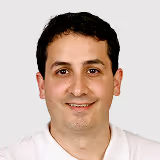
Marcel Kloos
Swiss-licensed dentist and founder of Medschool Experts
Marcel Kloos founded Medschool Experts while studying abroad; since then, over 500 study places have been secured. The Stuttgart-born dentist studied dentistry from 2015 to 2021 in Sofia and holds a Swiss dental licence.
Today he lives in Bern and runs Medschool Experts full-time as its owner.
More articles worth reading
Biology or Chemistry Degree to Medicine: Credit Transfer into a Higher Semester at European Universities
UK-Bangladeshi Heritage: How Your EU Medical Degree Is Recognised in the UK and in Bangladesh
Irish Heritage in the UK: How Medical Degree Recognition Works in Both Countries
Ahmad

Sabrina
Rami
Noah
500+ students placed.
Now it's your turn!
No daydreaming, no empty promises. Just a clear plan — for the start of your medical degree.
40 minutes, no obligation