Cost of Studying Medicine in Montenegro and Kosovo 2026
24.09.2026

What does studying medicine in Montenegro cost in 2026?
Tuition at the Faculty of Medicine of the University of Montenegro in Podgorica is the cheapest line on the whole budget: nothing. The European Commission’s Eurydice country description for Montenegro, in its 2025 update, states that students of undergraduate and postgraduate studies at public institutions do not pay tuition fees, and that foreign citizens may enrol under the same conditions as Montenegrin citizens. Six years of medicine, no tuition invoice.
Two exceptions in that description matter: programmes taught in a foreign language, and doctoral study. Medicine in Podgorica runs in Montenegrin, so the first does not touch it — but it shows what the university charges when a programme does run in English. In its own second enrolment-round document for 2025/2026, the self-financing English-language Business and Economics programme is priced at €1,750 per semester, or €3,500 an academic year.
The faculty is small and the capacity is published. For 2025/2026 the University of Montenegro proposed 185 places across the whole Faculty of Medicine: 40 in medicine, 20 in dentistry, 30 in pharmacy, 45 in applied physiotherapy at Igalo and 50 at the higher medical school in Berane. Forty places is the number that matters.
What you will actually spend, then, is rent, food and paperwork. A “free” degree still runs past €50,000.
What does studying medicine in Kosovo cost in 2026?
Kosovo prices its public higher education by semester, not by year, and the amounts are set centrally by the Ministry of Education rather than by each university. The published fee schedule applied at Kosovo’s public medical faculties for 2026 shows registration for the first semester free of charge and €25 for each subsequent semester at bachelor and integrated level, with a certificate of grades at €2.50, a diploma at €5 and a change of programme at €25. Over twelve semesters that is under €300 in university charges.
The programme itself is the integrated general medicine degree at the Faculty of Medicine of the University of Prishtina “Hasan Prishtina”: 360 ECTS, six years, taught in Albanian, leading to Doktor i Mjekësisë. The faculty describes competition of eight to ten candidates for every place. Around 200 students start each year.
The University of Prishtina does not publish a separate international tuition line, and neither do the private colleges in the city. Treat any figure quoted elsewhere as unconfirmed until a faculty confirms it to you in writing. Kosovo is the cheaper of the two. The gap is not tuition. It is rent.
Can you study medicine in English in Montenegro or Kosovo?
Not in human medicine, in either country, as of 2026. The University of Montenegro lists its medical degree in the World Directory of Medical Schools with the language of instruction recorded as Serbian; the university runs English-language programmes in other fields, which is precisely why the priced foreign-language exception exists in Montenegrin law. The University of Prishtina teaches its general medicine programme in Albanian.
The private sector in both countries is regularly misread on this point. In Kosovo, Universum International College in Prishtina is re-accredited for bachelor and master studies and lists no medicine programme at all. Alma Mater Europaea Campus College Rezonanca, also in Prishtina, holds accreditations from Kosovo’s State Quality Council for BSc Nursing, BSc Community Pharmacy, BSc Physiotherapy, BSc Diagnostic Radiology, BSc Biochemistry Laboratory, BSc Public Health and Environment, MSc Pharmacy and MSc Health Management, plus an integrated dentistry degree of 300 ECTS over five years. Strong health-sciences portfolio. No MD.
In Montenegro the picture is shorter still: the University of Donja Gorica and the University of Mediteran, the two best-known private institutions, list no medical faculty. One state faculty, one language.
That reshapes the budget question. If you plan to practise in a German-, English- or French-speaking system afterwards, the cost of reaching clinical fluency in Montenegrin or Albanian belongs in the same spreadsheet as rent. Our partner university overview sets out where the six-year degree runs in English instead, and at what price.
What does it cost to live in Podgorica each month?
Podgorica is the more expensive of the two capitals, and rent is the reason. Published city data for 21 June 2026 puts a one-bedroom flat in the centre at about €480 a month and one outside the centre at about €365, with utilities for a single person around €60, a 50 Mbps internet line around €28, a monthly transport pass around €29 and a meal in an inexpensive restaurant around €9. The same dataset puts total monthly living costs for one person at roughly €920 including rent.
Students do not live like that dataset. A room in a shared two-bedroom flat outside the centre runs closer to €250, and two people splitting utilities and internet pay around €45 each. Add €280 for groceries, the €29 transport pass and about €90 for phone, books and everything else, and the realistic monthly figure lands near €695.
State support exists for those who qualify. Montenegro granted 3,400 student loans in the 2024/2025 academic year at €150 to €215 a month, plus 450 scholarships of up to €300 a month, and subsidised dormitory accommodation at €117.80 of which the state covered €88.40. Access for international students is decided case by case.
What does it cost to live in Prishtina each month?
Prishtina is meaningfully cheaper, and the difference compounds over six years. Numbeo data dated 8 September 2026 gives a one-bedroom flat in the centre at €346.80 and outside the centre at €252.00, basic utilities for an 85 m² flat at €93.73, a monthly transport pass at €14.00, a single bus ticket at €0.50, an inexpensive restaurant meal at €5.50 and a 60 Mbps internet line at €20.75. The estimated monthly cost for a single person excluding rent is €465.20.
On a student pattern — a room in a shared flat outside the centre at about €175, split utilities and internet around €55, groceries near €250, the €14 transport pass and roughly €80 for phone, books and personal spending — the month comes in around €575. That is €120 less than Podgorica. Over 72 months it is more than €8,000.
The transport pass deserves its own sentence. At €14 a month it is among the cheapest in Europe, and Prishtina is compact enough that many students walk to the University Clinical Centre of Kosovo.
Room share €250 • food €280 • utilities €45 • transport €29 • personal €90. Monthly total about €695.
Room share €175 • food €250 • utilities €55 • transport €14 • personal €80. Monthly total about €575.
How do tuition and living costs compare side by side?
The table below puts the two countries on the same basis for the 2026 academic year: what the university charges, what a month costs, and what the paperwork adds. Every figure carries the year it was published.
| Item (2026) | Montenegro — Podgorica | Kosovo — Prishtina |
|---|---|---|
| Programme | 6 years, 12 semesters, Doktor medicine | 6 years, 360 ECTS, Doktor i Mjekësisë |
| Language | Montenegrin (recorded as Serbian in the World Directory, 2026) | Albanian |
| Annual tuition | €0 — no tuition at public institutions (Eurydice, 2025) | €25 per semester from semester two (ministry fee schedule, 2026) |
| English-language medicine | Not offered | Not offered |
| Places per intake | 40 in medicine of 185 across the faculty (2025/2026) | About 200, with 8–10 candidates per place (2026) |
| One-bed flat, outside centre | About €365 (June 2026) | €252.00 (September 2026) |
| Monthly transport pass | About €29 (June 2026) | €14.00 (September 2026) |
| Realistic student month | About €695 | About €575 |
| Currency | Euro | Euro |
What do the visa and residence permit cost, and when do you apply?
Both countries want the same three things: a long-stay visa where your nationality needs one, a temporary residence permit for study once you arrive, and proof of health insurance and means of support. Neither charges tuition-scale money for it.
In Montenegro the Ministry of Internal Affairs handles temporary residence. The administrative charges the government publishes sit at €60 for issue and €30 for renewal, with €2 for the application and €5 for the form, alongside required proof of health insurance and of means of support. Montenegro’s revised Law on Foreigners applies from 31 December 2025, separates the regime for EU and EEA citizens from that for third-country nationals, and requires renewals at least 30 days before a permit expires.
In Kosovo the rules run under Law No. 04/L-219 on Foreigners, with the current entry and stay regime fully in force since 15 March 2026. A type D long-stay visa explicitly covers higher education and scientific research. The residence permit is issued by the Department for Citizenship, Asylum and Migration within the Ministry of Internal Affairs, renewed annually and booked through the eKosova platform; foreigners register their address within three days of arrival. Kosovo publishes no single headline permit fee.
Timing is the part people get wrong. Here it is by month, for an autumn start:
- January to March — decide the country and the language, and start the language work. This is the long lead item, not the paperwork.
- April to June — gather and legalise your school and university documents. Apostille and sworn translation take weeks, not days, and Kosovo documents need extra lead time because not every EU member state recognises Kosovo.
- July to August — enrolment season. Montenegro’s public competitions run in summer, with a second enrolment round in late summer for programmes with places left.
- August to September — apply for the long-stay visa at the relevant embassy once you hold your admission letter. Several weeks of processing is normal.
- Within the first weeks on the ground — register your address, take out local health insurance, open a bank account and file the residence permit application.
- Each following spring — renew. Montenegro wants the renewal at least 30 days ahead; Kosovo renews annually.
Requirements differ by university and by your own profile, and they move from intake to intake. We do not publish document checklists for named faculties for that reason — book a free individual consultation and we will assess your case directly.
What does six years actually add up to?
Here is the full arithmetic, built from the figures above and nothing else. Twelve months a year, because a permit and a tenancy do not pause in July.
| Six-year worked example (2026 prices) | Montenegro | Kosovo |
|---|---|---|
| University tuition and semester fees, 12 semesters | €0 | €275 |
| Living costs, 72 months | €50,040 (€695 × 72) | €41,400 (€575 × 72) |
| Residence permit, renewals and health insurance | €1,900 (planning figure) | €1,900 (planning figure) |
| One-off setup: deposit, documents, apostille, translations, first flights | €1,200 (planning figure) | €1,200 (planning figure) |
| Six-year total | About €53,000 | About €44,800 |
Two readings of that table. The first: a medical degree in either capital costs less over six years than one year of tuition at several private medical schools in Western Europe. The second: tuition decides nothing here, because living costs are 94 per cent of the Montenegrin total and 92 per cent of the Kosovar one. Anyone comparing destinations on tuition alone is reading the wrong column.
The planning figures are labelled as such deliberately. Montenegro’s permit charges are published; Kosovo’s headline permit fee is not, and neither country publishes a quotable student health-insurance tariff, so those two lines are our own budgeting allowance.
{{cta}}Where does the degree stand under EU Directive 2005/36/EC and on the WFME listing?
Neither qualification appears in Annex V, point 5.1.1 of Directive 2005/36/EC, which is the list that triggers automatic recognition of basic medical training across the European Union. That is a statement about membership, not about quality: Annex V lists qualifications awarded in EU and EEA states plus Switzerland, and Montenegro and Kosovo are outside it. Recognition in an EU member state therefore runs through the directive’s general system, which can involve an aptitude test or an adaptation period set by the host country’s competent authority.
Montenegro is moving on that front. By June 2026 it had provisionally closed 16 of the 33 accession chapters, including freedom of movement for workers, and the government has stated a target of joining as the 28th member state in 2028. Chapter 3, on the right of establishment, is where mutual recognition of professional qualifications sits.
The international listings tell a cleaner story than most people expect. The University of Montenegro Faculty of Medicine is listed in the World Directory of Medical Schools under ID F0002331, with a six-year Doktor Medicine programme, a first graduating class in 1997, students and graduates eligible to apply for ECFMG Certification for graduation years 1997 to current, and degrees noted as acceptable to the provincial and territorial medical regulatory authorities in Canada.
On the accreditation side, the World Federation for Medical Education’s recognition list carries the Serbian agency NEAQA with recognised status valid to May 2035 and with its coverage stated as Serbia and Kosovo. No Montenegrin agency appears on that list. Kosovo’s own agency, the Kosovo Accreditation Agency, has been registered in the European Quality Assurance Register since 1 December 2024 with registration running to 31 December 2029.
What that means for the United States pathway is narrower than the internet suggests. Intealth’s Recognized Accreditation Policy has been in effect since November 2024 and requires accreditation by a WFME- or NCFMEA-recognised agency plus an ECFMG Sponsor Note in the World Directory listing — but Intealth states plainly that international medical graduates can continue to apply for and pursue ECFMG Certification even if their medical school does not currently meet the policy’s requirements. The notation is information for programme directors, not a gate.
For the United Kingdom, the General Medical Council route runs through PLAB and an acceptable primary medical qualification. Each register sets its own rules, and each is a route that exists. What it takes in your case depends on where you want to practise — our placement and advisory services cover exactly that.
What happens to the money already spent if the language does not work out?
This is the question the price tables never answer, and it is the one that decides whether a cheap degree stays cheap. A student who reaches semester four in Podgorica or Prishtina and finds that lectures in physiology and daily ward work in a second language are not sustainable has spent real money — roughly €14,000 in Kosovo and €17,000 in Montenegro on the figures above. The semesters behind that spending are not lost.
Completed semesters carry credit. Montenegro’s programme is a documented six-year integrated degree and Kosovo’s is documented at 360 ECTS, and clean ECTS documentation is exactly what a receiving faculty needs in order to place an incoming student as high as possible. Medschool Experts is the world’s leading specialist in credit-recognition placements for healthcare graduates and regularly achieves year 4 or year 5 entry at top universities worldwide. What is achievable in a given case depends on the individual profile, which is why we assess it rather than publish a rule.
The same applies to anyone arriving from a health-science background: a nurse, a physiotherapist, a paramedic, a pharmacist or a laboratory technician who wants the MD. Those years count, and in our own placements they count for far more than people expect. Read what that looked like in our student stories. The only way to know your own entry point is to have it assessed — free consultation.
Which of the two is the better value in 2026?
On pure arithmetic, Kosovo. It is about €8,200 cheaper across six years, driven almost entirely by rent and transport, and its accreditation agency sits inside the European register while the accrediting authority covering it holds WFME recognition to 2035. Montenegro answers with the World Directory listing, the ECFMG eligibility note running back to 1997, the Canadian regulatory note, and an accession timetable that could change the recognition picture inside the length of one degree.
Both share the constraint that drives outcomes: six years of clinical training in Montenegrin or Albanian. With that language, or the willingness to build it to ward level, both are genuinely affordable state-run medical educations in euro countries with published capacity and documented programmes. Without it, the real comparison is not Montenegro versus Kosovo but either of them versus a six-year English-language programme elsewhere in Europe, where tuition is real money and the language is not a second degree. That comparison is free to run.
The author’s view
I studied dentistry in Sofia between 2015 and 2021, and what I remember most clearly about the first year is not an exam. It is the bank transfer for rent. Tuition was the number everyone at home asked about; rent shaped how I actually lived. Montenegro and Kosovo take that to its extreme: one charges nothing, the other under €300 across six years, and both still cost between €45,000 and €53,000 by graduation. Read only the tuition line and you have read six per cent of the bill.
The second thing I would say from Bern, where I practise as a Swiss-licensed dentist, is that language is a cost too — it just never appears on an invoice. Montenegrin and Albanian are both learnable, and people do it every year. Learning one to the point where you can take a history from a frightened patient at two in the morning is a project of its own, and it deserves the same planning as the money. Across more than 500 placements, that is the variable that separates a smooth six years from a hard one.
My colleague Marina, who handles the visa and immigration side from Belgrade and has lived in both Dubai and India, makes a point I now repeat: start the paperwork in spring, not in August. Nobody has ever regretted being early.
Summary
- Montenegro: the Faculty of Medicine of the University of Montenegro in Podgorica charges no tuition, because undergraduates at public institutions pay none and foreign citizens enrol on the same conditions (Eurydice, 2025).
- Kosovo: charges at the University of Prishtina “Hasan Prishtina” run to €25 per semester from semester two under the ministry-set schedule — under €300 across twelve semesters (2026).
- Both are six-year integrated degrees — Doktor medicine in Podgorica, 360 ECTS and Doktor i Mjekësisë in Prishtina — and neither is taught in English.
- Living costs decide the total: about €695 a month in Podgorica, about €575 in Prishtina, on 2026 city data.
- Six-year totals: roughly €53,000 for Montenegro and €44,800 for Kosovo, including permits, insurance and setup.
- Neither qualification is in Annex V of Directive 2005/36/EC, so EU recognition runs through the general system.
- The Podgorica faculty is in the World Directory of Medical Schools (ID F0002331) with ECFMG eligibility from 1997; Kosovo’s coverage sits with the WFME-recognised Serbian agency NEAQA to 2035.
- Montenegro had provisionally closed 16 of 33 EU accession chapters by June 2026, targeting membership in 2028.
Conclusion
Both countries offer a documented, state-run, six-year medical education at a total cost that sits below one year of tuition at many private faculties in Western Europe. Rent, not tuition, is what you are really buying.
The language is the variable worth planning around, and it is the one where a decision made early costs nothing and a decision made late costs semesters. Tell us where you stand and where you want to practise, and we will map the route and the price for your case — free consultation.
Frequently Asked Questions about the cost of studying medicine in Montenegro and Kosovo
Is medicine really free at the University of Montenegro?
Tuition is. The European Commission’s Eurydice description of Montenegrin higher education, updated in 2025, states that undergraduate students at public institutions pay no tuition fees and that foreign citizens may enrol on the same conditions as Montenegrin citizens. Programmes taught in a foreign language and doctoral studies are the exceptions and do carry fees. Living costs still apply, and over six years in Podgorica they run to roughly €50,000 at 2026 prices.
How much does the University of Prishtina charge per semester?
Kosovo sets public university student fees centrally through its Ministry of Education. The schedule applied in 2026 makes registration for the first semester free, charges €25 for each subsequent semester at bachelor and integrated level, and prices a grade certificate at €2.50 and a diploma at €5. Across twelve semesters of a six-year medical degree that totals under €300 in university charges.
Can I study medicine in English in either country?
No, not in human medicine as of 2026. The University of Montenegro’s medical degree is recorded in the World Directory of Medical Schools with the language of instruction given as Serbian, and the University of Prishtina teaches its general medicine programme in Albanian. Private colleges in Prishtina such as Universum International College and Alma Mater Europaea Campus College Rezonanca run health-science and dentistry programmes, not an MD.
Is the degree recognised in the European Union?
Neither qualification appears in Annex V, point 5.1.1 of Directive 2005/36/EC, which is the list that triggers automatic recognition of basic medical training. Recognition in an EU member state therefore runs through the directive’s general system, where the host country’s competent authority may set an aptitude test or an adaptation period. Montenegro had provisionally closed 16 of 33 accession chapters by June 2026 and targets membership in 2028.
Does the WFME or WDOMS listing affect my options in the United States?
Less than most people assume. The University of Montenegro Faculty of Medicine is listed in the World Directory of Medical Schools under ID F0002331, with ECFMG eligibility recorded for graduation years 1997 to current. Intealth’s Recognized Accreditation Policy has applied since November 2024, and Intealth states that international medical graduates can continue to apply for and pursue ECFMG Certification even where a school does not currently meet that policy.
What are the entry requirements, and when do I apply?
Requirements vary by university and by your individual profile, and they change from intake to intake, so we do not publish thresholds or document lists for named faculties. What we can say about timing is general: enrolment competitions run over the summer, long-stay visa processing takes several weeks, and residence permits are filed after arrival. Book a free individual consultation and we will assess your case directly.
What if I have already studied something else in health sciences?
Completed study carries credit, and documented ECTS is what a receiving faculty needs in order to place you as high as possible. Medschool Experts is the world’s leading specialist in credit-recognition placements for healthcare graduates and regularly achieves year 4 or year 5 entry at top universities worldwide. What is achievable turns on your individual profile, so we assess it rather than publish a rule — free consultation.
What students say about Medschool Experts
Over 500 placements at more than 25 partner universities across 10+ countries. Read independent student reviews on Trustpilot.
About the author
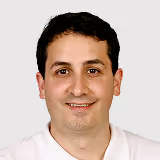
Marcel Kloos
Swiss-licensed dentist and founder of Medschool Experts
Marcel Kloos founded Medschool Experts while studying abroad; since then, over 500 study places have been secured. The Stuttgart-born dentist studied dentistry from 2015 to 2021 in Sofia and holds a Swiss dental licence.
Today he lives in Bern and runs Medschool Experts full-time as its owner.
More articles worth reading
Medical School News, 24 September 2026: More Seats, Bigger Shortages and New Pathways Worldwide
J-1 or H-1B? Visa Routes for International Medical Graduates in United States Residency 2026
Transfer from ASOMI College of Sciences: Where to Continue Medicine or Dentistry in 2026
Ahmad
Sabrina
Rami
Noah
500+ students placed.
Now it's your turn!
No daydreaming, no empty promises. Just a clear plan — for the start of your medical degree.
40 minutes, no obligation