Irish Heritage in the UK: How Medical Degree Recognition Works in Both Countries
22.09.2026

Start with the UK, since it's the system most people in this situation live under day to day. Since Brexit, the General Medical Council no longer waves a degree through simply because it was earned in an EU or EEA country. The transitional recognition that survived the UK's EU exit was tied to qualifications confirmed around the end of 2020, and a degree finished at a European medical school after that point is assessed the same way as one earned outside Europe altogether.
{{cta}}
Why the Common Travel Area Doesn't Reach the GMC Register
The Common Travel Area is an immigration and residency arrangement. It lets Irish citizens live, work and settle in the UK without a visa, and does the same for British citizens in Ireland. GMC registration runs on separate law, the Medical Act 1983 as amended, and has nothing to do with immigration status. An Irish citizen, or a dual UK-Irish citizen, who graduates from a medical school in Poland or Romania faces the same registration pathway as any other graduate of that degree. The passport in your pocket doesn't change which door you use.
PLAB 1 and 2, Built to the Medical Licensing Assessment Standard
Doctors without a UK or otherwise exempt qualification reach GMC registration through PLAB. PLAB 1 tests clinical knowledge in writing, and PLAB 2 is a clinical exam testing practical skills with simulated patients. Both now sit on the same content standard as the UK's Medical Licensing Assessment, the single bar the GMC applies to UK students and international graduates alike. Passing both parts grants full registration, but not a place on the two-year Foundation Programme, which UK and Irish graduates apply for separately and competitively. Most internationally qualified doctors move into post-registration training posts instead.
The English Language Evidence the GMC Actually Wants
Alongside the exams, the GMC asks for recent proof of English proficiency, usually a high academic IELTS score with no weak component, or an equivalent OET grade across all four skills, current at the time of application.
The Equivalent Door for Dentists: the Overseas Registration Exam
Dentistry runs a parallel track through the General Dental Council. A dental degree earned in the EU also lost its automatic pass into the UK register after Brexit, and most overseas-qualified dentists now sit the Overseas Registration Exam, the ORE, covering clinical knowledge and hands-on skills. The GDC has been reworking how it delivers the exam, so it's worth checking the current structure directly with the GDC nearer the time.
Ireland's EU Membership Still Opens the Door Automatically, for EU-Earned Degrees
Ireland is where the picture flips. Because Ireland remains an EU member state, a medical degree earned at another EU or EEA university is recognised automatically by the Medical Council of Ireland, and a dental degree by the Dental Council, under the mutual recognition directive, 2005/36/EC as amended by 2013/55/EU. There's no exam attached, just verification of the qualification, and this applies regardless of nationality or current address. A UK resident with an Irish or British passport who studied medicine in Krakow or Zagreb walks through the same automatic door as anyone else holding that degree.
Why a UK-Earned Degree No Longer Counts as European in Dublin
Here's the nuance that trips people up. A degree earned in the UK is, since Brexit, treated by the Medical Council of Ireland the way it treats a degree from outside the EU and EEA. The streamlined recognition built for EU-trained doctors no longer covers UK training, and the Common Travel Area's guarantees around movement don't extend to how a regulator classifies a qualification. A UK medical graduate applying to the Irish register instead goes through the Council's route for non-EU and non-EEA qualifications, generally an assessment of training, evidence of a recognised internship year, and a Certificate of Experience, rather than the automatic EU pathway. The shared history between the two systems can make the process feel more familiar than it looks on paper, but it remains a genuinely different door.
Irish Citizenship by Descent Doesn't Change Which Door You Use
Many British people with an Irish grandparent are entitled to claim Irish citizenship, and it's a genuinely useful thing to hold. But it doesn't reclassify a medical degree. Both Councils register people based on where and how a qualification was earned, not the passport an applicant carries. A dual UK-Irish citizen who studies medicine in the UK is treated, professionally, as a UK-trained doctor in Dublin. Had they studied elsewhere in the EU instead, they'd have walked through the automatic route.
Two Systems, One Decision Worth Making Early
For a UK-based student with Irish roots, studying medicine or dentistry elsewhere in Europe doesn't close either door, but it does mean navigating both regulators deliberately, since neither one defers to the other, and the common travel arrangement that makes everyday life across the two islands so easy doesn't extend to professional registration. Ireland's EU membership means a degree earned in the EU slides into the Irish register with little friction, while that same degree still has to earn its way onto the GMC's register through PLAB, current English language evidence and, for dentists, the ORE.
None of this has to be decided the day you accept a place, and circumstances genuinely do change over a career, sometimes decades after graduation. If you'd like to talk through what a specific degree, university or country combination would mean for your own long-term options in both the UK and Ireland, book a free, individual consultation with our team via /contact and we'll go through it together.
What students say about Medschool Experts
Over 500 placements at more than 25 partner universities across 10+ countries. Read independent student reviews on Trustpilot.
About the author
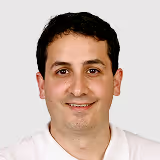
Marcel Kloos
Swiss-licensed dentist and founder of Medschool Experts
Marcel Kloos founded Medschool Experts while studying abroad; since then, over 500 study places have been secured. The Stuttgart-born dentist studied dentistry from 2015 to 2021 in Sofia and holds a Swiss dental licence.
Today he lives in Bern and runs Medschool Experts full-time as its owner.
More articles worth reading
Biology or Chemistry Degree to Medicine: Credit Transfer into a Higher Semester at European Universities
UK-Bangladeshi Heritage: How Your EU Medical Degree Is Recognised in the UK and in Bangladesh
Medical Degree Recognition: UK and South Africa for Dual Heritage Students
Ahmad
Sabrina
Rami
Noah
500+ students placed.
Now it's your turn!
No daydreaming, no empty promises. Just a clear plan — for the start of your medical degree.
40 minutes, no obligation