Study Medicine or Dentistry Abroad from the Gulf States: Licensing in Saudi Arabia, the UAE, Kuwait, Qatar, Oman and Bahrain
23.09.2026

Why So Many Gulf Students Study Medicine Abroad
Gulf health systems are expanding rapidly, and governments aim to increase the share of national doctors and dentists. Local medical colleges have grown, but their capacity has not kept pace with the number of qualified applicants. Admission typically requires very high secondary school percentages and success in national aptitude or achievement tests.
Many families therefore look abroad, either independently or through government scholarship programmes that fund studies at approved universities. Studying abroad offers an internationally recognised degree, English-language teaching and clinical exposure in established health systems.
Dentistry
Dental places in the Gulf are even more limited than medical places. Studying Dentistry abroad is a common and respected route into the profession.
How a Foreign Degree Is Recognised in the Gulf
Although each country has its own authorities, the path home follows a similar pattern in all six states: an approved university, an equivalency of the degree, primary-source verification, a licensing exam and registration with the health authority.
Saudi Arabia
The Saudi Commission for Health Specialties (SCFHS) classifies and registers health practitioners. Foreign graduates complete primary-source verification of their qualifications and pass the Saudi Medical Licensing Exam (SMLE), which is delivered through Prometric test centres worldwide. Saudi students on government scholarships study at universities approved by the Ministry of Education, so the choice of university is closely linked to the scholarship.
United Arab Emirates
In the UAE, three authorities license doctors and dentists: the Dubai Health Authority (DHA), the Department of Health in Abu Dhabi (DOH) and the Ministry of Health and Prevention (MOHAP) for the other emirates. Each requires primary-source verification and a licensing assessment. In addition, the Ministry of Higher Education and Scientific Research issues equivalency of foreign degrees for UAE nationals.
Qatar
In Qatar, the Department of Healthcare Professions at the Ministry of Public Health, formerly known as QCHP, licenses healthcare practitioners. Foreign graduates complete primary-source verification and pass a licensing exam delivered through Prometric.
Kuwait
In Kuwait, the Ministry of Health licenses doctors and dentists, and the Ministry of Higher Education publishes the list of approved foreign universities. Studying at a university on this list is the key condition for equivalency and for scholarship support.
Oman
In Oman, the Oman Medical Specialty Board (OMSB) conducts the licensing exams for doctors and dentists, and the Ministry of Higher Education handles the equivalency of foreign degrees.
Bahrain
In Bahrain, the National Health Regulatory Authority (NHRA) licenses healthcare professionals. Foreign graduates complete primary-source verification and pass a licensing exam, usually delivered through Prometric.
Common Criteria Across the Gulf
Across all six states, authorities typically look for a medical or dental school listed in the World Directory, full-time study on campus, a programme of standard duration with clinical training, an internship year and verifiable documents. Meeting these criteria from the start makes the return smooth.
{{cta}}Which Destination Countries Suit Gulf Students?
Gulf students look for internationally recognised programmes in English, a welcoming environment and a clear path to licensing at home.
Ireland
Ireland has a long tradition of training students from the Gulf, with English-language programmes and strong clinical training. It remains one of the most established destinations.
Hungary, the Czech Republic and Poland
These Central European countries have taught Medicine and Dentistry in English for decades. Their six-year programmes follow EU standards, and several universities appear on Gulf approval lists.
Romania and Bulgaria
Romania and Bulgaria offer English-language programmes with EU standards and moderate living costs. They are attractive for students who study independently of a scholarship.
Other EU Countries
Countries such as Slovakia, Lithuania and Latvia offer English-language programmes with smaller cohorts. Whether a specific university is on the relevant national approval list is the most important point to check.
{{callout}}Practical Tips for Gulf Students
Check the Approval List of Your Country
Before applying, check whether the university is approved by your Ministry of Education or Higher Education, and whether it is eligible for your scholarship.
Keep Your Documents Verifiable
Primary-source verification is part of licensing in every Gulf state. Keep all transcripts and certificates organised and make sure your university can confirm them directly.
Prepare for the Licensing Exam Early
Exams such as the SMLE cover the full medical curriculum. Students who prepare throughout their clinical years perform best.
Plan Your Internship
An internship year is part of licensing across the region. Clarify early whether you will complete it abroad or at home.
Stay Connected to Your Health System
Summer placements in hospitals at home help you understand local practice and build contacts for your first position.
How We Help You Find the Right Programme
With six countries and several authorities, choosing the right programme requires care. We offer solutions for exactly this. Contact us and we check individually which of our 25+ partner universities fits you, your country and your scholarship. Marcel or another experienced consultant on our team will review your situation and give you a clear recommendation.
The Author's View
Students from the Gulf often arrive with a very clear goal: they want to return home and serve in their national health system. That clarity is a great strength, and it makes planning easier, because we know from the start which authority and which approval list matter.
What I emphasise in consultations is that the approval lists and licensing rules must guide the choice of university, not the other way around. Students who follow this principle return home smoothly and start their careers without delay.
I also see how much Gulf students gain from the international environment of a European medical school. They study alongside classmates from all over the world, train in established university hospitals and build a network that often lasts for their whole career. When they return, they bring this experience into health systems that are growing fast and value exactly this kind of broad perspective.
If you dream of becoming a doctor or a dentist, studying abroad can be the best decision you make. Book a consultation and let us find the programme that fits you and your country.
Conclusion
- Each Gulf state has its own licensing authority: SCFHS in Saudi Arabia, DHA, DOH and MOHAP in the UAE, the Department of Healthcare Professions in Qatar, the Ministry of Health in Kuwait, OMSB in Oman and NHRA in Bahrain.
- Across the region, the path home combines an approved university, equivalency, primary-source verification, a licensing exam and an internship.
- Many licensing exams, including the SMLE, are delivered through Prometric.
- Ireland, Hungary, the Czech Republic, Poland, Romania and Bulgaria are popular destinations for Gulf students.
The Gulf needs more nationally trained doctors and dentists, and studying abroad is a proven way to become one of them. With the right programme, your path home is clear. Book your free consultation and take the first step.
Frequently Asked Questions
Is a medical degree from Europe recognised in the Gulf States?
Yes, provided the university meets the criteria of your country, such as approval by the Ministry of Education or Higher Education, and you complete equivalency, primary-source verification and the licensing exam.
Which exam do I need to pass in Saudi Arabia?
Foreign graduates pass the Saudi Medical Licensing Exam (SMLE), delivered through Prometric, and register with the Saudi Commission for Health Specialties.
Who licenses doctors in the UAE?
The Dubai Health Authority, the Department of Health in Abu Dhabi and the Ministry of Health and Prevention for the other emirates.
Does my scholarship limit my choice of university?
Government scholarships usually fund studies at approved universities only. Checking the approval list of your country is therefore the first step.
Does the same apply to Dentistry?
Yes. Dentists follow the same pattern of approval, equivalency, verification and licensing in each Gulf state.
Who licenses doctors in Qatar, Kuwait, Oman and Bahrain?
In Qatar, the Department of Healthcare Professions at the Ministry of Public Health; in Kuwait, the Ministry of Health; in Oman, the Oman Medical Specialty Board conducts the licensing exams; and in Bahrain, the National Health Regulatory Authority.
Do European programmes teach in English?
Yes. Most programmes for international students in Europe are taught entirely in English. This prepares Gulf students well for the English-language licensing exams at home and for international careers.
Can I study abroad without a scholarship?
Yes. Many Gulf students finance their studies privately. In that case, the approval list of your country still matters for equivalency and licensing, so it should guide your choice in the same way.
How long does a medical degree in Europe take?
Most medical programmes in Europe last six years, with preclinical sciences in the first years and clinical training in university hospitals later on. Dentistry programmes usually take five to six years.
Is it important that the study is full-time and on campus?
Yes. Across the Gulf, authorities typically expect full-time study on campus with regular clinical training. European medical programmes are designed exactly this way, which supports a smooth equivalency process.
Which university abroad is right for me?
That depends on your country, your scholarship and your goals. Contact us and we check individually which of our 25+ partner universities fits you.
What students say about Medschool Experts
Over 500 placements at more than 25 partner universities across 10+ countries. Read independent student reviews on Trustpilot.
About the author
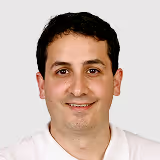
Marcel Kloos
Swiss-licensed dentist and founder of Medschool Experts
Marcel Kloos founded Medschool Experts while studying abroad; since then, over 500 study places have been secured. The Stuttgart-born dentist studied dentistry from 2015 to 2021 in Sofia and holds a Swiss dental licence.
Today he lives in Bern and runs Medschool Experts full-time as its owner.
More articles worth reading
Study Medicine or Dentistry Abroad from Brazil: Revalida, EU Passports and the Best Destinations
Study Medicine or Dentistry Abroad from Nigeria: MDCN Assessment Exam, Recognition and the Best Destinations
Study Medicine or Dentistry Abroad from India: NEET, NMC FMGL Rules, FMGE and the Best Destinations
Ahmad
Sabrina
Rami
Noah
500+ students placed.
Now it's your turn!
No daydreaming, no empty promises. Just a clear plan — for the start of your medical degree.
40 minutes, no obligation