Study Medicine or Dentistry Abroad from India: NEET, NMC FMGL Rules, FMGE and the Best Destinations
23.09.2026

Why So Many Indian Students Study Medicine Abroad
The gap between qualified NEET candidates and available MBBS seats is enormous. Even after the NMC added thousands of new seats in recent years, the number of qualified candidates remains many times higher. Government seats are the most sought-after because they are affordable, and they go to the very top of the NEET ranking.
Private medical colleges offer additional seats, but their fees are a major burden for many families. Studying abroad often costs considerably less overall, and it offers international exposure and, in many destinations, English-language teaching in a modern clinical environment.
Dentistry
BDS seats are also allocated through NEET. Students who want to become dentists face similar questions about cost and competition, and studying Dentistry abroad is a growing option.
The Rules for Coming Back: NMC FMGL Regulations 2021
The National Medical Commission sets the conditions under which a foreign medical degree allows you to practise in India. The Foreign Medical Graduate Licentiate (FMGL) Regulations 2021 apply to students who began their studies abroad after November 2021. They are the most important reference when choosing a programme.
NEET Before You Go
Indian students who want to study Medicine abroad must qualify NEET-UG. Without a qualifying NEET result, a foreign medical degree cannot lead to registration in India.
The Key FMGL Criteria
- Duration: the course must last at least 54 months.
- Internship abroad: an internship of at least 12 months must be completed in the same foreign institution.
- Completion within ten years: the entire course, including internship, must be completed within ten years of joining.
- Medium of instruction: the course must be taught in English.
- Curriculum: the course must cover the subjects the NMC specifies.
- Licence in the country of study: the graduate must be registered with the regulatory body of the country of study and be eligible to practise there on the same basis as its citizens.
FMGE and NExT
After graduating, foreign medical graduates must qualify the Foreign Medical Graduate Examination (FMGE), which the National Board of Examinations in Medical Sciences conducts twice a year. The NMC plans to replace it with the National Exit Test (NExT), but until NExT comes into force, the FMGE remains the qualifying exam for registration.
Internship in India
After passing the FMGE, graduates complete a supervised internship in India before full registration with the NMC and the state medical councils.
Dentistry
Graduates of dental programmes abroad who want to practise in India must qualify a screening test and meet the requirements set by the Dental Council of India. Here too, it is worth checking the rules before choosing a programme.
{{cta}}Which Destination Countries Suit Indian Students?
The right destination depends on two questions: does the programme meet the FMGL criteria, and where do you want to build your career?
EU Countries
Countries such as Hungary, Poland, the Czech Republic, Bulgaria and Romania offer six-year English-language programmes with EU standards. An EU degree also opens doors across Europe. For Indian students, the structure of the programme, in particular the internship and the licence to practise in the country of study, needs to be checked carefully against the FMGL rules.
The Caribbean
Caribbean medical schools follow the US model and prepare students for the USMLE. They are an interesting option for Indian students who aim for a career in the United States or want to keep that option open.
Traditional Destinations
Russia, Georgia and Central Asian countries such as Kazakhstan, Kyrgyzstan and Uzbekistan have long been popular with Indian students. Many programmes there have adapted their structure to the FMGL requirements.
A Global Career
Many Indian students today think beyond India from the start. A degree that fits the FMGL rules and is also recognised in Europe or preparing for the USMLE gives you the widest range of options later.
{{callout}}Practical Tips for Indian Students
Check Every FMGL Criterion
Duration, internship, medium of instruction, curriculum and the licence in the country of study all matter. A programme that meets only some of them is not enough.
Keep Your NEET Scorecard Safe
You will need proof of your qualifying NEET result for admission abroad and later for registration in India.
Prepare for FMGE From Year One
The FMGE covers the full MBBS curriculum. Students who revise continuously throughout their studies perform far better than those who start after graduation.
Learn the Local Language
Teaching is in English, but patients speak the local language. Good language skills make your clinical training much more valuable.
Plan for Your Career Early
Decide early whether you want to return to India, work in Europe or aim for the USA. Each goal influences the ideal choice of country and programme.
How We Help You Find the Right Programme
For Indian students, the programme structure is decisive. We offer solutions for exactly this. Contact us and we check individually which of our 25+ partner universities fits you, your NEET result and the NMC rules. Marcel or another experienced consultant on our team will review your situation and give you a clear recommendation.
The Author's View
Indian families are among the most determined I meet in my work. They have invested years in NEET preparation, and they want to be sure that the next step is the right one. That is exactly the right attitude, because the FMGL Regulations leave no room for guesswork.
What I recommend is simple: check the programme structure against every FMGL criterion before you look at anything else. Then think about your long-term career. A programme that fits the NMC rules and also opens doors in Europe or towards the USMLE gives you real freedom later.
I also want to reassure families on one point. Indian students are highly respected in international medical schools for their discipline and their strong foundation in the sciences. Many of them become leaders in their cohorts, and they adapt quickly to new environments. With the right programme and steady preparation for the FMGE, the years abroad become a genuine advantage rather than a detour.
If you did not get a seat at home, your medical career is far from over. Book a consultation and let us find a programme that works for you and your future.
Conclusion
- In 2025, 12.36 lakh candidates qualified NEET-UG for roughly 1.29 lakh MBBS seats.
- Indian students need a qualifying NEET result to study Medicine abroad and later practise in India.
- The NMC FMGL Regulations 2021 require a course of at least 54 months, a 12-month internship in the same institution, English-medium teaching, completion within ten years and a licence to practise in the country of study.
- Graduates must qualify the FMGE until NExT comes into force, followed by a supervised internship in India.
- EU countries, the Caribbean and traditional destinations such as Russia, Georgia and Central Asia are popular with Indian students.
A limited number of seats at home does not have to limit your dream. With a programme that meets the NMC rules, you can study abroad and return as a doctor, or build a career anywhere in the world. Book your free consultation and take the first step.
Frequently Asked Questions
Do I need NEET to study Medicine abroad?
Yes. Indian students must qualify NEET-UG if they want their foreign medical degree to lead to registration in India.
What are the main FMGL 2021 requirements?
A course of at least 54 months, a 12-month internship in the same foreign institution, English-medium teaching, the subjects specified by the NMC, completion within ten years and registration to practise in the country of study.
Is FMGE still required, or has NExT replaced it?
The FMGE remains the qualifying exam until the National Exit Test comes into force. It is held twice a year.
Do I need an internship in India after studying abroad?
Yes. After passing the FMGE, graduates complete a supervised internship in India before full registration.
Can I work in Europe or the USA with a degree from abroad?
An EU degree is recognised across the European Union, and many programmes prepare for the USMLE. Choosing the right programme keeps several career paths open.
How many seats are there compared with NEET candidates?
In 2025, 12.36 lakh candidates qualified NEET-UG, while India had roughly 1.29 lakh MBBS seats. Even with recent seat additions, most qualified candidates cannot secure a seat at home.
Which students do the FMGL Regulations apply to?
The FMGL Regulations 2021 apply to students who began their medical studies abroad after November 2021. Students who started earlier follow the rules in force at the time they joined.
Does the programme have to be taught fully in English?
Yes. The FMGL Regulations require English as the medium of instruction. Learning the local language is still useful for patient contact during clinical training abroad.
Why is the licence in the country of study so important?
The FMGL Regulations require that graduates are registered with the regulatory body of the country of study and eligible to practise there on the same basis as its citizens. This criterion needs to be checked carefully for every programme.
How should I prepare for FMGE while studying?
Continuous revision of the full MBBS curriculum, practice with question banks and attention to Indian clinical priorities during your clinical years give you the best chance of passing on the first attempt.
Which university abroad is right for me?
That depends on your NEET result, budget and career goals. Contact us and we check individually which of our 25+ partner universities fits you.
What students say about Medschool Experts
Over 500 placements at more than 25 partner universities across 10+ countries. Read independent student reviews on Trustpilot.
About the author
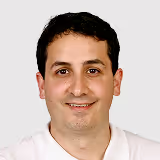
Marcel Kloos
Swiss-licensed dentist and founder of Medschool Experts
Marcel Kloos founded Medschool Experts while studying abroad; since then, over 500 study places have been secured. The Stuttgart-born dentist studied dentistry from 2015 to 2021 in Sofia and holds a Swiss dental licence.
Today he lives in Bern and runs Medschool Experts full-time as its owner.
More articles worth reading
Study Medicine or Dentistry Abroad from Brazil: Revalida, EU Passports and the Best Destinations
Study Medicine or Dentistry Abroad from the Gulf States: Licensing in Saudi Arabia, the UAE, Kuwait, Qatar, Oman and Bahrain
Study Medicine or Dentistry Abroad from Nigeria: MDCN Assessment Exam, Recognition and the Best Destinations
Ahmad
Sabrina
Rami
Noah
500+ students placed.
Now it's your turn!
No daydreaming, no empty promises. Just a clear plan — for the start of your medical degree.
40 minutes, no obligation