Transfer from East European University Tbilisi: Where to Continue Medicine in 2026
23.09.2026

Is a transfer from East European University Tbilisi possible in 2026?
A transfer from East European University in Tbilisi to a university in Europe is possible in 2026, and it happens every semester. The MD programme at EEU is structured in ECTS credits, the same currency most European medical faculties use. That shared structure makes a transfer a review process rather than a fresh start.
Quick answer
Yes. A transfer from East European University Tbilisi to a university in Europe is possible at every stage of the six-year MD programme. Passed modules are reviewed as ECTS credits, and Medschool Experts frequently secures placements in year 4 or 5. The case check and consultation are free.
East European University is a private university founded in 2012. Its six-year Medicine programme is taught in English, accredited by Georgia's National Center for Educational Quality Enhancement, and closes with the MD degree after 360 ECTS. Three facts matter for a transfer: the credit system, the English syllabus, the accreditation. All three are in place.
| Item | East European University Tbilisi |
|---|---|
| University | East European University (EEU), private, founded 2012 |
| City | Tbilisi, Georgia |
| Programme | Medicine (MD), one-cycle programme |
| Tuition per year (2026) | around 4,000 to 5,000 USD |
| Living costs | approx. 500 to 750 EUR per month |
| Language of instruction | English, with compulsory Georgian language modules |
| Degree | Medical Doctor (MD) |
| Duration and credits | 6 years, 12 semesters, 360 ECTS |
| Intake | September or October |
| University profile | East European University on Medschool Experts |
Failed exams at East European University: what now?
Failing an exam block at East European University in 2026 does not end a medical career. Georgian faculties allow resits, and a failed year can be repeated. Both keep you in Tbilisi and cost time. A third option is a transfer: the modules you passed travel with you, the failed ones are retaken inside a new curriculum, often in a different exam format.
The stress is real. A missed anatomy resit in June can feel discouraging. It is not the end. Marcel Kloos, who began his own dentistry studies in Sofia in 2015, has since helped students in this position move universities with their passed credits intact. The subject that blocks a student at one faculty is rarely the one that blocks them at the next.
First week after a failed block: request an official transcript, collect the syllabus of every passed module, book a free consultation. Do not withdraw from EEU. An enrolled student transfers; a withdrawn student applies from scratch. That distinction can be worth a year.
Repeat year or transfer? Both are legitimate. We compare them for your case, free of charge, at the consultation page.
Why do students transfer from East European University?
Students transfer from East European University for five recurring reasons, each with a workable solution. None is a verdict on the university. They are decisions about fit, geography and career goals.
- Exam difficulty in one subject. Solution: transfer with the passed credits and retake the subject in a curriculum with a different exam format.
- Cost and currency. Tuition at EEU is billed in USD. Solution: a faculty with fees in the home currency or lower total cost over the remaining years.
- Wish for an EU degree. A Georgian MD is a third-country qualification inside the EU and is assessed case by case under national rules; Directive 2005/36/EC does not apply automatically. Solution: finish the degree at a university in an EU member state, where the diploma falls under the Directive from day one.
- Career goal USA. Solution: a programme with structured Step 1 preparation built into the timetable.
- Home-country recognition. Israeli and Indian students have regulator rules to check (see below). Solution: continue at a university that meets the home rule, credits included.
Problems with a professor or a course belong on the same list. A change of environment solves them, not giving up on Medicine. The world needs more doctors. Our services overview shows what we take off your desk.
How does ECTS credit transfer work after East European University?
ECTS credit transfer after East European University works module by module. The receiving faculty compares each passed course on the EEU transcript with its own curriculum: credit value, contact hours, content, exam form. Matching modules are recognised, partial matches may need a supplementary exam, modules with no counterpart are taken in the new year group. The outcome is a placement year, not a percentage.
Medschool Experts is the leading expert in this field worldwide and frequently achieves placements in year 4 or year 5 at top universities worldwide. Preparation decides. A syllabus that describes anatomy in three lines gets three lines of recognition. One that lists dissection hours, practicals and exam format gets the full comparison. We know which documents each partner faculty wants to see.
Grades matter less than students fear. A pass is a pass. Reviewers weigh content overlap, which is why the compulsory Georgian language modules rarely transfer. Medical modules do.
Which universities accept transfer students from East European University?
Which universities accept transfer students from East European University depends on the individual profile: year of study, credits passed, language certificates, nationality and career goal. Medschool Experts does not publish a list of accepting universities, because such a list would be wrong for half the readers within a semester. Faculties change transfer quotas yearly, and a match for a year-2 student is not a match for a year-4 student.
What we can say: partner universities of Medschool Experts in Europe and beyond accept transfer students from Georgian faculties every year. You send us your transcript and syllabus, we tell you within one to two weeks where a placement is realistic and in which year. That check is free.
A study transfer is a complex undertaking. Our experts have almost 10 years of experience in study transfers worldwide, which is why they plan and carry it out confidently. The consultation is free. Browse our university profiles to see the range of faculties we work with, and let Marcel or another experienced consultant on our team narrow it down for your case.
What does Israel's Yatziv reform mean for Israeli students at East European University?
Israel's Ministry of Health ties admission to the Israeli medical licensing exam to the institution where a doctor studied. For Israelis who began studying in 2019 or later, all institutions in OECD member states count as approved, plus institutions in other countries that the Ministry lists individually. Georgia is not an OECD member, so for Israeli students at East European University the Ministry's individual list is the reference to check.
Some Israeli students therefore plan their degree with a university in an OECD country in mind, and a transfer from East European University is one way to do that. Others continue in Tbilisi. Both are sound choices. Medschool Experts advises Israeli students on both paths, free of charge, and goes through the current Ministry list with you in the consultation.
Students from India: recognition rules to check
Indian students at East European University plan around the Foreign Medical Graduate Licentiate Regulations 2021, in force since 18 November 2021. The National Medical Commission requires a course of at least 54 months taught in English, a twelve-month internship at the same foreign institution, a degree that entitles the holder to practise in the country of study, and then the screening test or National Exit Test followed by a twelve-month supervised internship in India. The six-year MD at EEU clears the duration and language conditions. A transferring student confirms before moving that the receiving programme meets the same conditions, especially the internship at the awarding institution. We include this check in the consultation.
What does a transfer from East European University cost, and what about living expenses?
A transfer from East European University costs less than a repeat year in Tbilisi in almost every scenario. The transfer itself involves document fees, translations, certified copies and travel. The tuition of the receiving university replaces the tuition at EEU. The largest hidden cost of not transferring is a repeat year: tuition of around 4,000 to 5,000 USD again, plus twelve months of living costs at 500 to 750 EUR per month. Overseas students starting in a recent intake pay up to 6,000 USD per year.
Living costs in Tbilisi are low, a genuine advantage of EEU, and rent in Europe will be higher. The comparison that matters is total cost to the diploma, not cost per month. We run that calculation with you before you decide.
Medschool Experts charges a placement fee for the transfer service. Consultation, transcript review and feasibility check are free, so you know whether a transfer is realistic before spending anything.
Can I take the USMLE or USA route after East European University?
The USMLE route after East European University is open. Georgia's National Center for Educational Quality Enhancement has held WFME recognition status since 19 October 2018, the basis for ECFMG certification of graduates of programmes it accredits, and EEU's Medicine programme is one of them. A student aiming at the USA can stay at EEU, sit Step 1 and Step 2 CK, and apply for residency as an international medical graduate.
Why do some USA-bound students still transfer? Preparation environment. Step 1 rewards a curriculum aligned with its content outline, structured question-bank practice and clinical electives in the USA in years five and six. Some students find that at EEU. Others prefer a faculty that builds it into the timetable. The UK PLAB route stays open from either starting point. Tell us in the consultation that the USA is the target, and the shortlist is drawn accordingly.
Why is Georgia still an attractive place to study Medicine in 2026?
Georgia remains an attractive place to study Medicine in 2026 for students from many countries. The six-year MD is taught in English and carries 360 ECTS, the same credit volume as a European medical degree. Tuition at East European University is around 4,000 to 5,000 USD per year, clearly below what medical schools in Western Europe charge. Georgia's accreditation agency has held WFME recognition status since 2018, which keeps the USMLE and ECFMG route and the UK PLAB route open for graduates. Tbilisi and Batumi host international students from many countries. Georgia is a welcoming and safe place to live. Daily costs stay modest.
For Iranian students Georgia is especially accessible. Iranian citizens can enter Georgia without a visa and stay up to 45 days; the study visa and residence permit are then arranged inside Georgia. Many Iranian students face long waiting times or refusals when they apply for student visas elsewhere, so Georgia is one of the most accessible places for them to study Medicine in English.
A transfer is one good option among several. Whether you stay at East European University or move to another university, Marcel or another experienced consultant on our team advises you free of charge.
{{cta}}Will I lose a year if I transfer from East European University?
Most students who transfer from East European University with Medschool Experts do not lose a year. The placement year is decided by the credit review, and a well-documented 360-ECTS transcript gives reviewers plenty to recognise. Where a gap appears, it is usually one or two modules taken alongside the new year group, not a repeated year.
Timing matters more than the credit review. A student who starts planning in July may find the transfer window closed and wait a semester for the next intake. A student who starts in January keeps every option open. The credits are the same in both cases. The calendar is not. Ask early, decide later.
How does a transfer with Medschool Experts work step by step?
A transfer with Medschool Experts from East European University follows six steps over roughly nine months for an autumn start. The steps are the same for every student; the shortlist and the placement year are individual.
- Free consultation (January to February). Thirty minutes with Marcel or another experienced consultant on our team.
- Transcript review (February). You send the EEU transcript of records and enrolment certificate. We assess the credit position and name a target year range.
- Document file (March). Syllabus for every passed module, certified translations, language certificates, passport copy.
- Credit review at the receiving faculty (April to May). The faculty compares modules and issues a recognition decision with a placement year. We handle the correspondence.
- Admission, visa, housing (June to July). You finish your exam session in Tbilisi in parallel.
- Start (September to October). First lecture in the new year group. We stay your contact for academic and organisational questions after enrolment.
Students who have made the move describe it in their own words on our student stories page.
When is the best time to start planning a transfer from East European University?
The best time to start planning a transfer from East European University is nine months before the intended start, which for a September or October intake means January. That leaves room for the credit review, the document file and the visa. A spring-semester start exists at some faculties and compresses the steps into about four months. Later than that, the realistic target is the following intake.
| Point in the programme | Transfer outlook |
|---|---|
| Year 1, first semester | Early. Few credits yet, but a clean move to year 1 or 2 elsewhere is simple to arrange. |
| Year 1 to 2, after pre-clinical exams | Good. Anatomy, physiology and biochemistry are the modules most faculties compare first. |
| Year 3, start of clinical phase | Very good. A full pre-clinical block is on file and clinical placements have not yet diverged. |
| Year 4 or 5 | Still possible. Medschool Experts frequently achieves placements in year 4 or 5 at top universities worldwide. |
| After a failed year | Possible. The passed modules count, the failed ones are retaken or replaced in the new curriculum. |
Planning is not committing. A consultation in January can end with the decision to stay at EEU and sit the summer exams, with the transfer file ready as a fallback. Book the free consultation and plan the next exam session with a clear head.
The author's view
I studied dentistry in Sofia from 2015 to 2021, and I remember the semester when a single exam decided whether I would move on with my year group. When students from Tbilisi write to me after a failed anatomy block, I recognise the tone before the second line. My first answer is always the same: you have not lost your credits, and you have more than one route.
East European University is a good place to start Medicine. Fees are fair, teaching is in English, the degree is accredited. Students who transfer are responding to a rule at home, a career target, or an exam format that does not suit them. I have seen more than 500 placements through, and the ones that went smoothly all had one thing in common: the student asked in January, not in August.
From my desk in Bern, the advice is simple. Keep attending, sit every exam, and let us look at your transcript. The look is free. If staying at EEU is the better plan, we will tell you that too.
Summary
- A transfer from East European University Tbilisi to a university in Europe is possible at every stage of the six-year, 360-ECTS MD programme.
- Passed modules are reviewed as ECTS credits, module by module; Medschool Experts frequently achieves placements in year 4 or year 5.
- After a failed exam block, stay enrolled, collect transcript and syllabus, and compare resit, repeat year and transfer.
- Israeli students check the Ministry of Health list, since Georgia is not an OECD member state; Indian students check the 2021 Foreign Medical Graduate Licentiate Regulations.
- The USMLE and PLAB routes remain open from EEU; a transfer changes the preparation environment, not the eligibility.
- Start planning nine months before the intended intake. The consultation, transcript review and feasibility check are free.
Conclusion
East European University gives its students a recognised, English-taught start in Medicine at a fair price. For some, a change of university is the better route to the same goal: a failed block, a licensing rule at home, a target country, or the wish for an EU diploma. None of those reasons requires starting over. A careful credit review turns the credits earned at EEU into a placement year elsewhere.
Medschool Experts has carried out study transfers for almost ten years and knows Georgian transcripts well. Marcel or another experienced consultant on our team will look at yours, name a realistic placement year and explain the timeline, free of charge. Book your free consultation and find out where you can continue Medicine in 2026.
Frequently Asked Questions about a transfer from East European University
Is an agency necessary for a transfer from East European University?
No law requires an agency for a transfer from East European University; a student can approach faculties directly. In practice the credit review is where transfers succeed or stall, and it depends on knowing which documents each faculty wants and how a syllabus should be presented. Medschool Experts has handled these reviews for almost ten years and offers the feasibility check free.
Will I lose a year if I transfer from East European University?
Most students who transfer from East European University with a complete document file do not lose a year. The placement year follows the ECTS credit review, and a 360-ECTS MD transcript gives reviewers plenty to recognise. Gaps are usually one or two modules taken alongside the new year group. Early planning keeps the timeline safe.
I failed a year at East European University. Can I still transfer?
Yes. A failed year at East European University does not cancel the modules you passed. Those credits are reviewed as usual, and the failed subjects are taken within the new curriculum. Stay enrolled while the transfer is prepared, because an enrolled student transfers whereas a withdrawn student applies from scratch. Request transcript and syllabus in the first week, then book a free consultation.
How does ECTS credit transfer work after East European University?
The receiving faculty compares each passed module on the East European University transcript with its own curriculum: ECTS value, contact hours, content and exam form. Matching modules are recognised, partial matches may need a supplementary exam, modules without a counterpart are taken in the new year group. Compulsory Georgian language modules usually have no counterpart. The result is a placement year, fixed before you enrol.
Which universities accept transfer students from East European University?
That depends on the student's year, credits, language certificates, nationality and career goal, so Medschool Experts does not publish a list of accepting universities. Faculties change transfer quotas from year to year. We check each profile individually against our partner universities in Europe and beyond and report within one to two weeks. The check is free.
What does Israel's Ministry of Health recognition mean for Israeli students at East European University?
Israel's Ministry of Health ties admission to its licensing exam to the institution. For Israelis who began studying in 2019 or later, all institutions in OECD member states are approved, plus individually listed institutions in other countries. Georgia is not an OECD member, so the Ministry's list is the reference. Some students plan with an OECD university in mind, others continue. Medschool Experts advises on both paths free of charge.
What should Indian students at East European University check before transferring?
The Foreign Medical Graduate Licentiate Regulations 2021, in force since 18 November 2021, require a course of at least 54 months in English, a twelve-month internship at the same foreign institution, a degree that entitles the holder to practise in the country of study, and then the screening test or National Exit Test plus a twelve-month internship in India. Confirm the receiving programme meets the same conditions before moving.
How much does a transfer from East European University cost?
The transfer involves document fees, certified translations and travel, plus the placement fee of Medschool Experts. The tuition of the receiving university replaces, rather than adds to, the tuition at East European University. Consultation, transcript review and feasibility check are free, so you know whether a transfer is realistic before spending anything. A repeat year in Tbilisi, by comparison, costs another year of tuition and living expenses.
Can I still take the USMLE route after transferring from East European University?
Yes. The USMLE route is open from East European University itself, since Georgia's accreditation agency has held WFME recognition status since 19 October 2018, and it stays open after a transfer to an accredited university in Europe. What changes is the preparation environment: some faculties align their curriculum with the Step 1 outline and schedule clinical electives in the USA.
Is Georgia a good place to study Medicine for Iranian students?
Yes. Iranian citizens can enter Georgia without a visa and stay up to 45 days, and the study visa and residence permit are then arranged inside Georgia. Many Iranian students face long waiting times or refusals when applying for student visas elsewhere, so Georgia is one of the most accessible places for them to study Medicine in English, in a six-year MD with 360 ECTS.
When should I start planning a transfer from East European University?
Nine months before the intended start, which for a September or October intake means January. That leaves time for the credit review, a full document file and the visa. A spring-semester start exists at some faculties and compresses the steps into about four months. Planning is not committing: many students prepare the file as a fallback and decide with their summer results in hand.
What students say about Medschool Experts
Over 500 placements at more than 25 partner universities across 10+ countries. Read independent student reviews on Trustpilot.
About the author
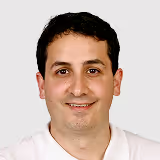
Marcel Kloos
Swiss-licensed dentist and founder of Medschool Experts
Marcel Kloos founded Medschool Experts while studying abroad; since then, over 500 study places have been secured. The Stuttgart-born dentist studied dentistry from 2015 to 2021 in Sofia and holds a Swiss dental licence.
Today he lives in Bern and runs Medschool Experts full-time as its owner.
More articles worth reading
Israeli Medical Students in Georgia: What the Yatziv Reform Means and Your Options in 2026
Transfer from Avicenna Batumi Medical University: Where to Continue Medicine in 2026
Transfer from Kutaisi University: Where to Continue Medicine in 2026
Ahmad
Sabrina
Rami
Noah
500+ students placed.
Now it's your turn!
No daydreaming, no empty promises. Just a clear plan — for the start of your medical degree.
40 minutes, no obligation